
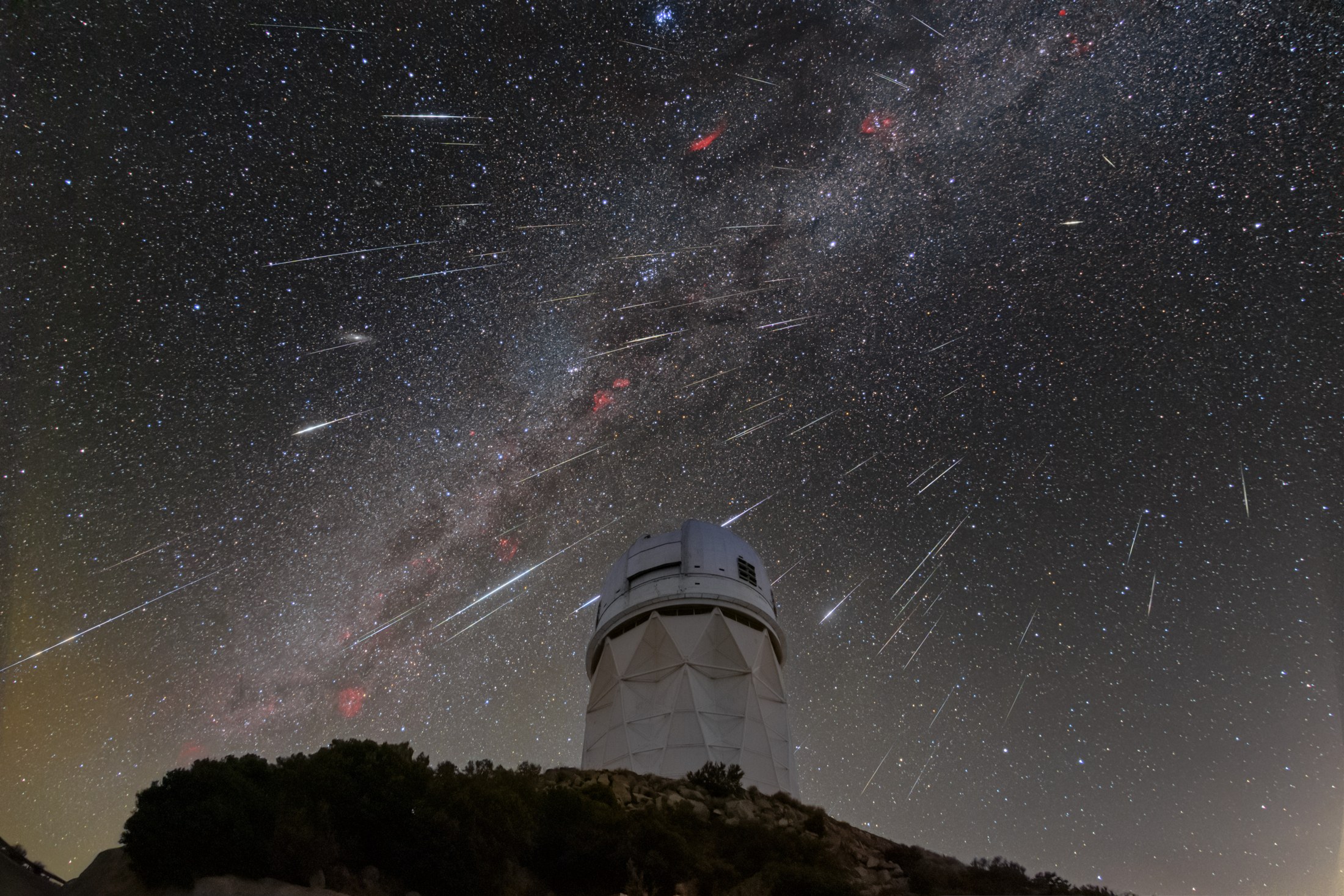
Two-hour composite. Not an instantaneous naked-eye view.
KPNO/NOIRLab/NSF/AURA/R. Sparks (NSF’s NOIRLab) · CC BY 4.0 / image details
December’s
meteor shower.
How to watch.
The 2026 Geminids peak around 14 December, with a thin crescent Moon and several nights worth checking.
Choose a dark observing spot with a wide view, check the local weather and allow at least an hour outside. The best time depends on where you are: the shower’s radiant rises earlier in northern skies than in southern ones.
Check the dates and times ↗IMO predicts a broad maximum around 14:00 UTC on 14 December. Moon figure: AMS for 13–14 December. Choose your local night below.
The meteoroid
A grain in
the dark.
Long before there is anything to see from Earth, a rocky grain is already orbiting the Sun.
The Geminid stream
One of
many.
This grain belongs to a stream associated with asteroid 3200 Phaethon. Nearby grains follow similar paths through space.
The December crossing
Earth enters
the stream.
Each December, Earth sweeps through this moving material. Only the grains that meet our atmosphere can make a meteor here.
Atmospheric entry · ≈35 km/s
A streak
of light.
The grain meets air at about 35 kilometres per second. Excited gas and vaporized material glow along its path. That flash is the meteor.

The meteoroid
A grain in
the dark.
Long before there is anything to see from Earth, a rocky grain is already orbiting the Sun.

The Geminid stream
One of
many.
This grain belongs to a stream associated with asteroid 3200 Phaethon. Nearby grains follow similar paths through space.

The December crossing
Earth enters
the stream.
Each December, Earth sweeps through this moving material. Only the grains that meet our atmosphere can make a meteor here.

Atmospheric entry · ≈35 km/s
A streak
of light.
The grain meets air at about 35 kilometres per second. Excited gas and vaporized material glow along its path. That flash is the meteor.
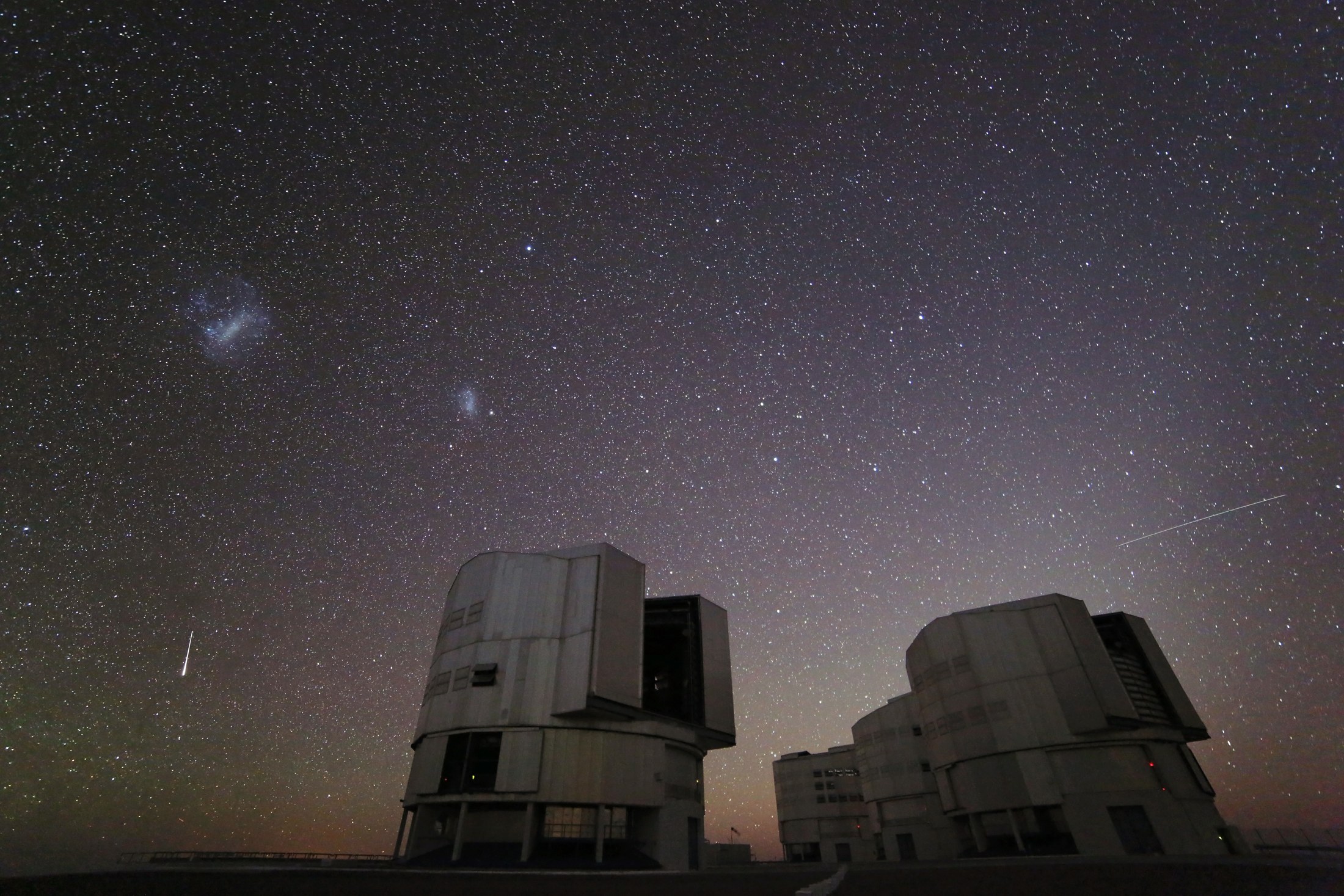
ESO/G. Lombardi (glphoto.it) · Source · CC BY 4.0
Responsive crop; image otherwise unchanged.
01 / Choose your night
When to watch
in December.
≈15% ILLUMINATED
Illustrative phase graphic
NASA lists activity from 4–17 December. The International Meteor Organization’s 2026 calendar uses 4–20 December, with a broad maximum around 14:00 UTC on 14 December. The peak matters more for planning than the difference between those seasonal boundaries.[1][2]
Check the forecast for more than one night around the peak. If 13 December is cloudy and 14 December is clear, use the clear night. Choose your observing spot and check access before setting out.
At northern latitudes, you can start in the evening once the radiant has risen. In the Southern Hemisphere, it generally becomes useful around midnight or later. Buildings, hills and trees can delay your first clear view.
The American Meteor Society lists the night of 13–14 December. IMO’s UTC timing also puts the night of 14–15 December in contention for East Asia and Australia. That follows from converting the forecast to local time; it is not a separate predicted peak.
The Moon is a waxing crescent, about 15% illuminated for the AMS peak night. Check its setting time locally. Once it has set, clouds, haze and artificial lighting may still obscure faint meteors.
02 / Take in the sky
Where to look.
Watch a broad area
of dark sky.
Geminid trails, traced backwards, appear to meet in the constellation Gemini. This point is the radiant. The alignment is an effect of perspective, not a connection to the stars in Gemini.[1]
Recline and watch a wide area of sky rather than staring at the radiant. Trails near it tend to look short; farther away, they can appear longer. Face away from nearby lamps and avoid looking at bright screens.
Use your eyes, not a telescope or binoculars: meteors can appear across too much sky for a narrow field of view. Northern observers have the advantage of a higher radiant. The shower is also visible from southern locations, but the lower radiant limits how many meteors are visible.[1]
Recorded at Paranal
Geminids
on camera.
Geminids at Paranal, 14–16 December 2012.
Time-lapse footage, not real-time meteor frequency.
ESO/Gianluca Lombardi (glphoto.it) · Original time-lapse · CC BY 4.0 · Playback starts on request.
03 / Read the numbers
How many
will you see?
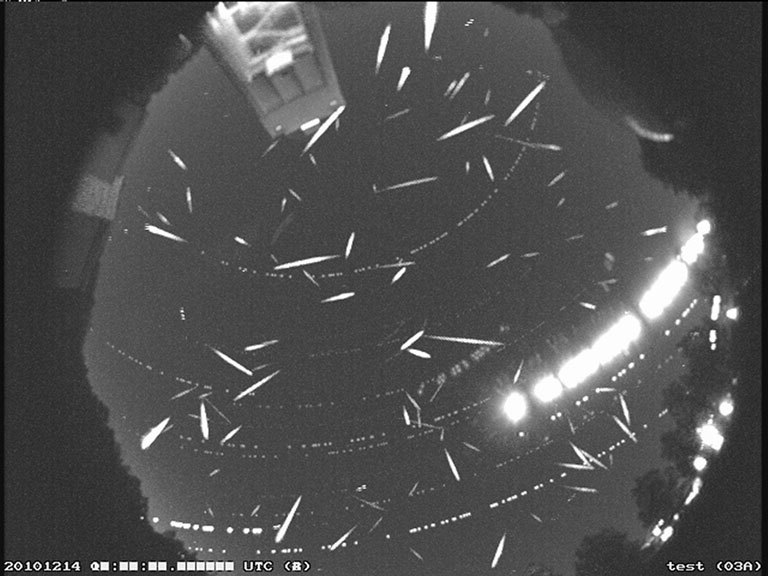
NASA/MSFC/Danielle Moser, NASA’s Meteoroid Environment Office. Source ↗
IMO lists a rate of 150 for the 2026 Geminids. This is the zenithal hourly rate, or ZHR, standardized to a dark sky with the radiant overhead. It lets observers compare shower activity under different conditions; it is not a forecast of your personal count.[2]
IMO’s listed ZHR for 2026, corrected to ideal observing conditions.
Meteors per hour in NASA’s dark-sky observing guidance, not a site-specific forecast.
You may see far fewer. Light pollution hides faint meteors; clouds, trees and buildings reduce the visible sky. A low radiant also reduces the count. Even in good conditions, meteors arrive irregularly, with quiet intervals between them.
Allow at least an hour if you can. Repeated short checks give your eyes little time to adjust and make it easy to miss a more active interval.
04 / The source
The parent:
Phaethon.
The Geminids are associated with 3200 Phaethon, an asteroid. Most meteor showers are associated with comets, making the Geminids unusual. Phaethon itself does not need to be near Earth for us to encounter particles in the stream.[1]
The terminology describes three different things: a meteoroid is the incoming solid object, a meteor is the luminous atmospheric event, and a meteorite is material that reaches the ground.
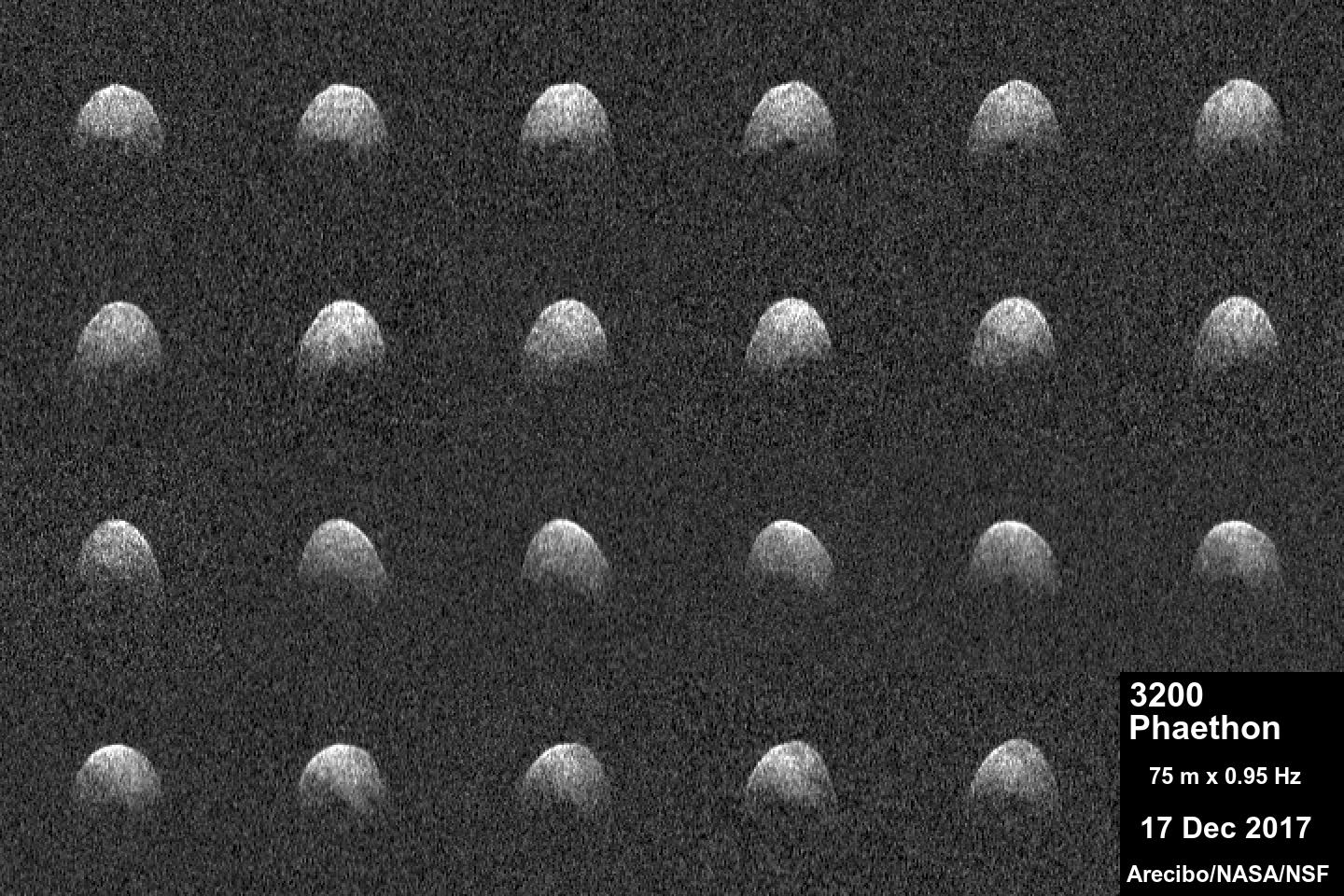
Arecibo, 17 December 2017.Radar imagery · 17 December 2017
Arecibo Observatory/NASA/NSF · Source and credit
Delay-Doppler views, not optical photographs.
05 / Before you leave
Before
you go.
TO ADAPT
- Check access. Choose a safe observing spot you can legally use. Avoid road shoulders and private land without permission.
- Check the local sky. Check cloud cover, moonset and when the radiant rises above your local horizon.
- Bring warm layers. A reclining chair or ground mat helps. Bring a blanket and enough clothing for an hour of sitting still.
- Let your eyes adapt. Allow roughly 30 minutes away from bright light. Keep your phone put away and any necessary light dim.
- Allow enough time. Plan an hour of observing if the weather and your comfort allow. Leave sooner if conditions become unsafe.
Geminids 2026 FAQ
What is the best night for the Geminids in 2026?
Check both nights around the 14 December maximum. The most useful one depends on your time zone, the height of the radiant and the weather. See the timing section above for regional guidance.
Will the Moon spoil the shower?
Moonlight should be limited compared with a full-Moon year. The waxing crescent is about 15% illuminated on the AMS peak night; check when it sets at your location.
Do I need to find Gemini first?
No. Find a comfortable view of a broad, dark part of the sky. Knowing Gemini’s position helps identify Geminid trails, but is not necessary to see them.
Can I watch from a city?
Yes, though city lighting hides fainter meteors. A darker location with an open view will usually let you see more.
Do I need a telescope?
No. A telescope covers too little sky. Watch with unaided eyes.
Sources & image credit
- NASA Science: Geminids. Parent body, meteor speed, general activity dates, observing advice and practical dark-sky rates.
- International Meteor Organization: 2026 Meteor Shower Calendar. Pages 20–21: activity window, broad maximum, hemisphere guidance and listed ZHR. Calendar values are not a local observing forecast.
- American Meteor Society: Meteor Shower Calendar. 2026 peak night and Moon illumination. This calendar is updated over time.
Hero photograph: KPNO/NOIRLab/NSF/AURA/R. Sparks (NSF’s NOIRLab), Geminids over Kitt Peak National Observatory, 14 December 2023. CC BY 4.0. A two-hour photographic stack, not an instantaneous naked-eye view. Displayed with a dark overlay and responsive crop.
Photography & motion
Paranal photograph and time-lapse: ESO/G. Lombardi and ESO/Gianluca Lombardi (glphoto.it), respectively. ESO reuse policy; CC BY 4.0. The photograph is responsively cropped. The footage is unchanged and is not a real-time prediction.
Phaethon radar image: Arecibo Observatory/NASA/NSF, PIA22185; used for this educational article under JPL’s image-use policy. NASA all-sky composite: NASA/MSFC/Danielle Moser, NASA’s Meteoroid Environment Office.
The scroll sequence uses cropped Phaethon radar frames, NASA/Goddard Space Flight Center Scientific Visualization Studio’s Blue Marble (Reto Stöckli, NASA/GSFC) and an ISS photograph of airglow. The stream particles and the bright meteor over the Pacific are illustrations. No image is presented as a 2026 observation. All captions distinguish recorded imagery from composites and conceptual graphics.
2023 Kitt Peak composite · KPNO/NOIRLab/NSF/AURA/R. Sparks (NSF’s NOIRLab) · CC BY 4.0 · Responsive crop