


November 2026 supermoon
Why does the Moon
look so big?
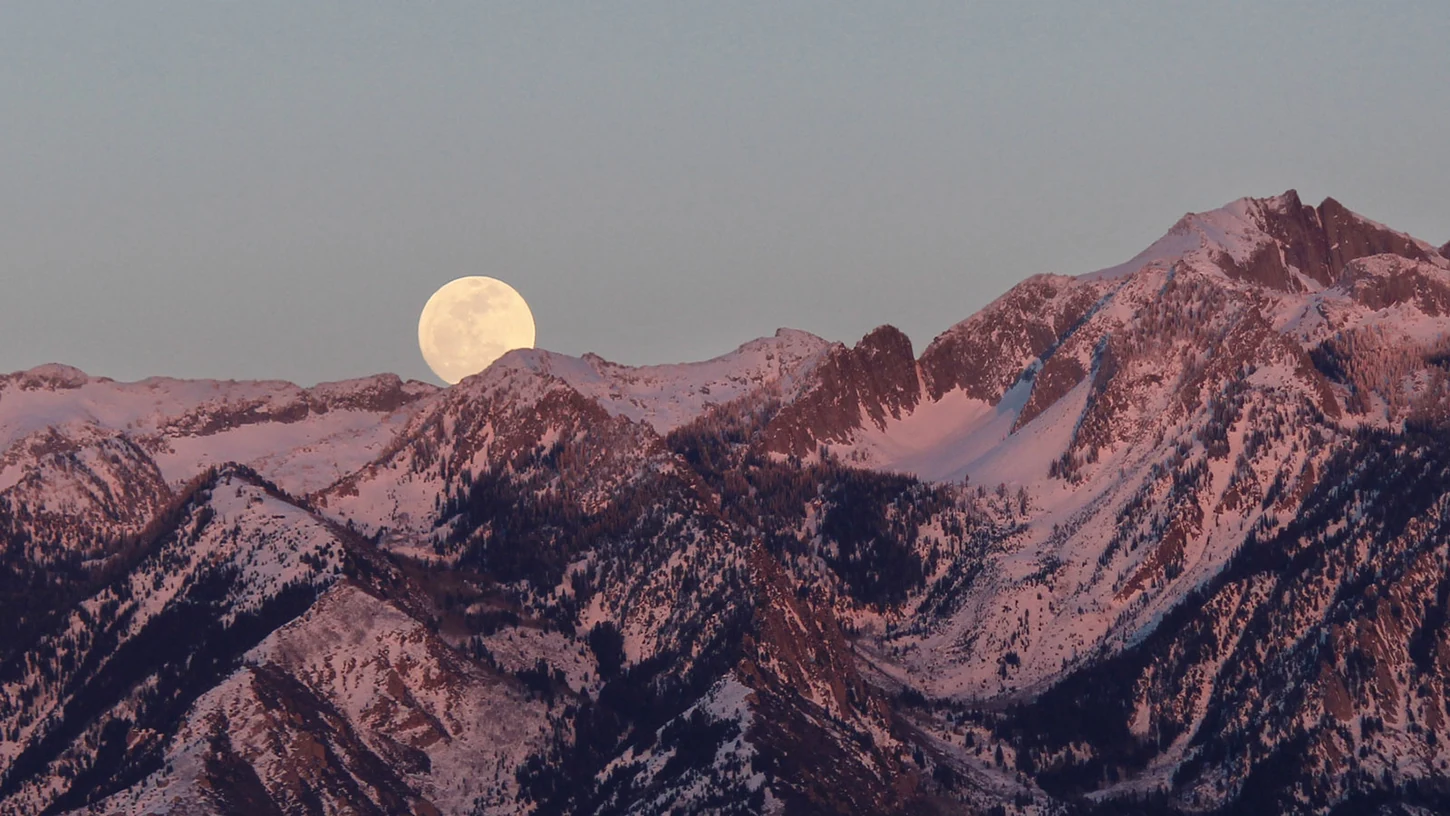
At moonrise on November 24, you can test the Moon illusion with two photographs.
The full Moon can look huge beside a rooftop and smaller a few hours later in open sky. Yet in two photos taken at the same zoom, its width barely changes. That’s the Moon illusion.
November 24 is also a supermoon. Its disk will appear wider than May’s full Moon because it will be closer to Earth.
Does the Moon shrink as it rises?
Does the Moon shrink as it rises?


A supermoon is a different comparison. A closer full Moon spans more sky than a farther one on another night.
Illustrated comparison at a fixed focal length. Lunar surface NASA/JPL/USGS. Mountain photographs adapted from NASA/Bill Dunford.
The camera test
Try it with
your camera
Photograph the Moon as it clears a tree or rooftop. Return to the same spot a few hours later and take a second picture. Keep the lens, zoom and image resolution the same, including on a phone.
Open both originals at 100% and measure the disk across its widest row of pixels. The widths should be close. Measure horizontally because air near the horizon can flatten the disk slightly from top to bottom.
Why does the low Moon look larger? A familiar roof or tree gives you a sense of distance. NASA astronauts have seen the effect from orbit, without any trees or buildings in view. Researchers still disagree about what causes it. [1]
The orbital effect
How much bigger
is November’s Moon?
The November 24 full Moon will appear 12.6% wider than the May 31 full Moon. The Moon follows an elliptical orbit around Earth. Its closest point is called perigee. A full Moon near perigee is often called a supermoon, though astronomers have no formal cutoff for the term.
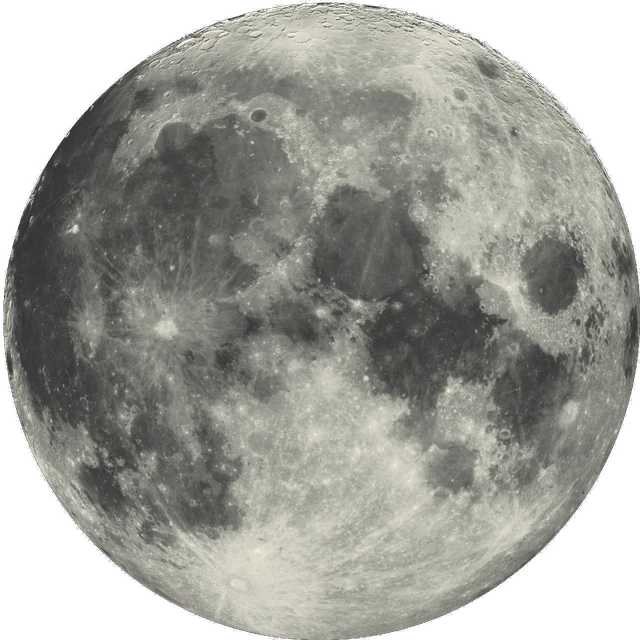
Both disks span roughly half a degree, or 30 arcminutes (′). NASA’s figure of up to 14% compares full Moons near the closest and farthest points of the orbit. The difference from an average full Moon is smaller. [2]
NASA / Bill Ingalls
Behind the photograph
Same evening,
different lenses
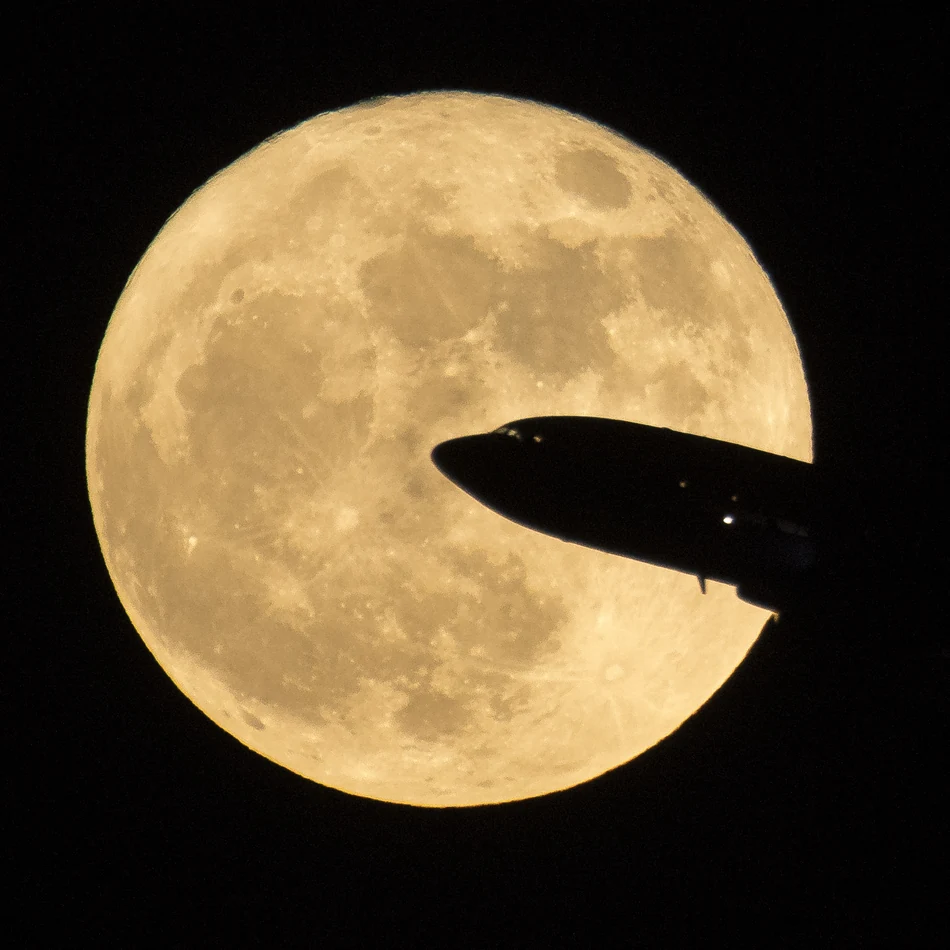
On December 3, 2017, NASA photographer Bill Ingalls photographed the Moon behind a crane in Washington, D.C., at 500 mm. About 44 minutes later, he caught a jet departing Reagan National Airport as it crossed the face of the Moon. For that shot he used 700 mm.
The longer focal length makes the lunar image larger on the sensor even before cropping. That’s why the two pictures can’t tell us whether the Moon changed size that evening. [4]
November 24, 2026
When to see
the moonrise
The Moon reaches full phase around 14:54 UTC on November 24. In New York that’s 9:54 a.m., hours before moonrise. In Sydney it’s 1:54 a.m. on November 25, hours after the Moon has risen. To catch it at the horizon, use the local times below.
| Location | Moonrise |
|---|---|
| New York City | 4:16 p.m. EST |
| London | 3:18 p.m. GMT |
| Sydney | 7:34 p.m. AEDT |
U.S. Naval Observatory predictions for city-center coordinates and a level horizon. A hill or building can delay your first sighting.
Look up another locationAt the horizon
Why does it
look orange?
At moonrise, light travels through more air on its way to your eyes. More blue light scatters out of that path, so the Moon can look yellow, orange or red. Through thick haze it may disappear altogether. [1]
If November 24 is cloudy, the next supermoon reaches full phase on December 24 at 01:28 UTC. Across most of the Americas, that’s the evening of December 23. [2]
Sources & image notes
- NASA Science · The Moon illusion
Same-zoom camera test, horizon color and the limits of current explanations. Mountain photograph by Bill Dunford.
- NASA Science · Supermoons
Definition, extreme-size comparison and full-phase times. The USNO calendar gives 14:53 UT for November, one minute earlier than NASA’s listing.
- NASA JPL Horizons · November calculation
Lunar target 301, geocentric observer, apparent angular diameter. Compared with May 31 at 08:45 UT. The figure uses unrounded widths for the ratio. Galileo surface image credited to NASA/JPL/USGS.
- NASA · December supermoon over Washington
Cover and jet photograph by Bill Ingalls, December 3, 2017. Focal lengths from the original image files. Photographs have been resized and cropped for this layout.
- U.S. Naval Observatory · Moonrise and moonset
November 24, 2026, at 40.71°N 74.01°W, 51.51°N 0.13°W and 33.87°S 151.21°E. Local civil times include Sydney daylight saving.