

Download on the App Store
SPACIAN // ARTEMIS ARCHIVEEARTH 000° → MOON 384,400 KMSIGNAL LOCKED
NASA Moon program // interactive timeline

Artemis mission timeline: Humans are going back.

Five missions. Eight named crew members. One escalating sequence from an empty capsule to boots, habitats, and a sustained human presence on the Moon.

Launch simulator armed. Press Launch SLS.

New: open four illustrated engineering guides ↓
Artemis I completeArtemis II returnedArtemis III crew trainingArtemis IV Moon landing target: early 2028Eight people. One timeline.Artemis I completeArtemis II returnedArtemis III crew trainingArtemis IV Moon landing target: early 2028Eight people. One timeline.
Engineering lab // four hard problems

Going to the Moon is a chain of controlled violence.

Choose a system to see the physics underneath the mission: changing orbital energy, sustaining a crew, surviving lunar-return re-entry, and operating where sunlight barely clears the horizon.

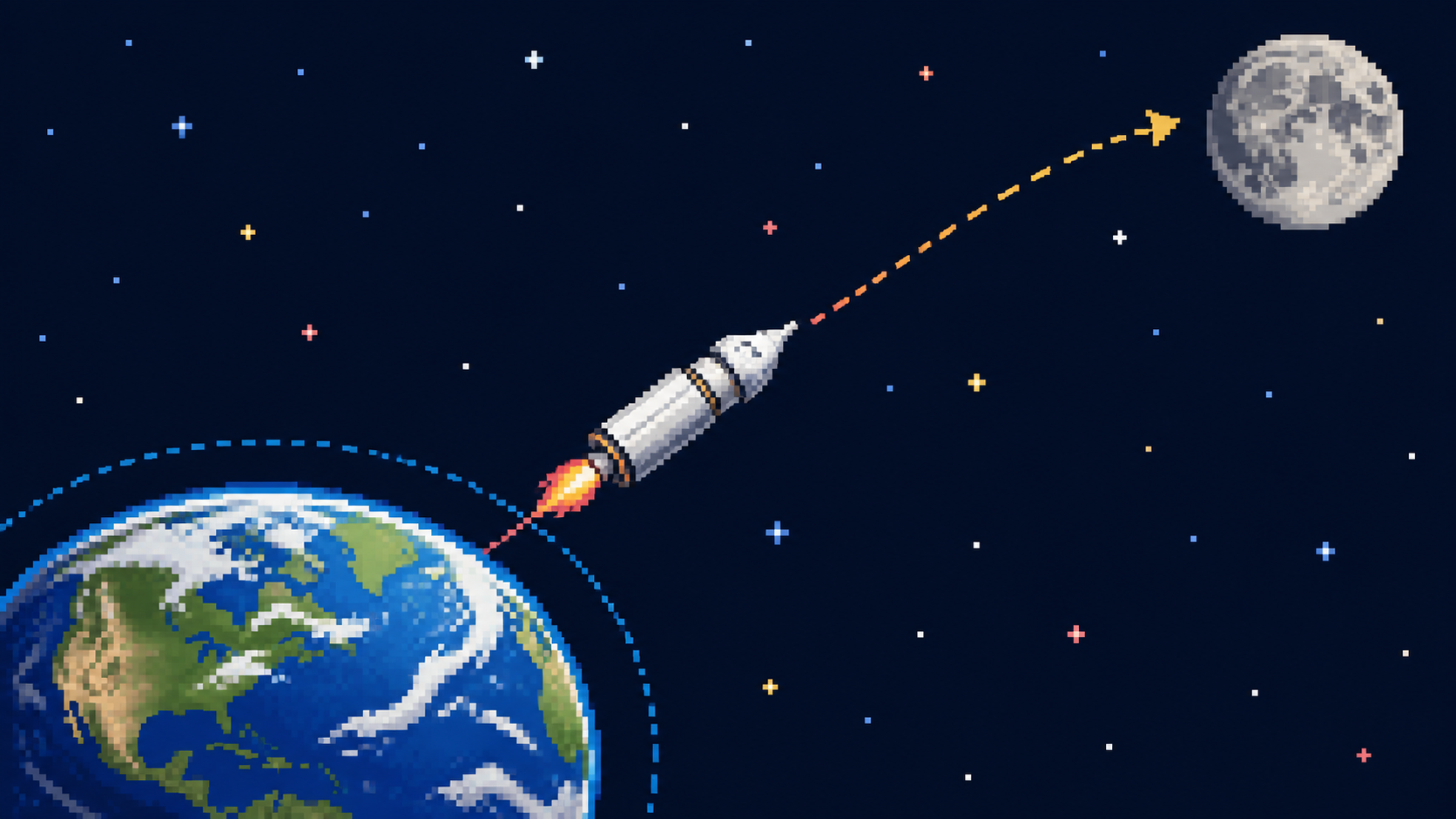
Pixel art of Orion leaving Earth orbit on a curved path toward the Moon
8-BIT FIELD GUIDEOrbital mechanics

SLS first reaches a temporary Earth orbit. About 90 minutes after liftoff, the ICPS upper stage performs an approximately 18-minute translunar injection burn. The burn raises Orion’s orbital energy and commits it to a precise path that intersects the moving Moon.

  • One liquid-hydrogen RL10 engine
  • Burn begins about 90 minutes after launch
  • Orion separates after the Moon-bound burn
The crew module is the pressurized capsule and the only part that returns to Earth. The European Service Module supplies electrical power, propulsion, thermal control, water, oxygen, and nitrogen until it separates before atmospheric entry.

  • Crew module survives re-entry
  • Service module performs major in-space burns
  • Consumables support the astronauts

Orion deliberately dips into the atmosphere, generates lift to climb back out, then enters again. This skip entry divides heating and deceleration into two pulses. Avcoat on the 16.5-foot heat shield ablates—burning away in a controlled way—to carry heat from the cabin.

  • Two entry pulses at about 4 g each
  • World’s largest ablative heat shield
  • Navigation controls the splashdown range

Permanently shadowed craters can preserve water ice, while the Sun stays extremely low over nearby terrain. That creates long, black shadows, harsh glare, power constraints, temperature extremes, and communications blind spots around crater walls.

  • Confirmed water ice in permanent shadow
  • Low Sun angle complicates landing and EVA
  • Relays can connect terrain hidden from Earth
The timeline changed

Plot twist: Artemis III is now a 2027 crewed docking demonstration in low Earth orbit. The first planned surface landing moves to Artemis IV in early 2028.

Campaign state
02 complete
03 missions queued
08 people named
Illustrated flight plan

Earth to Moon, one unlock at a time.

Read how launch, docking, cislunar flight, and landing fit together on the illustrated route. Every stage links to the matching mission inside Spacian.

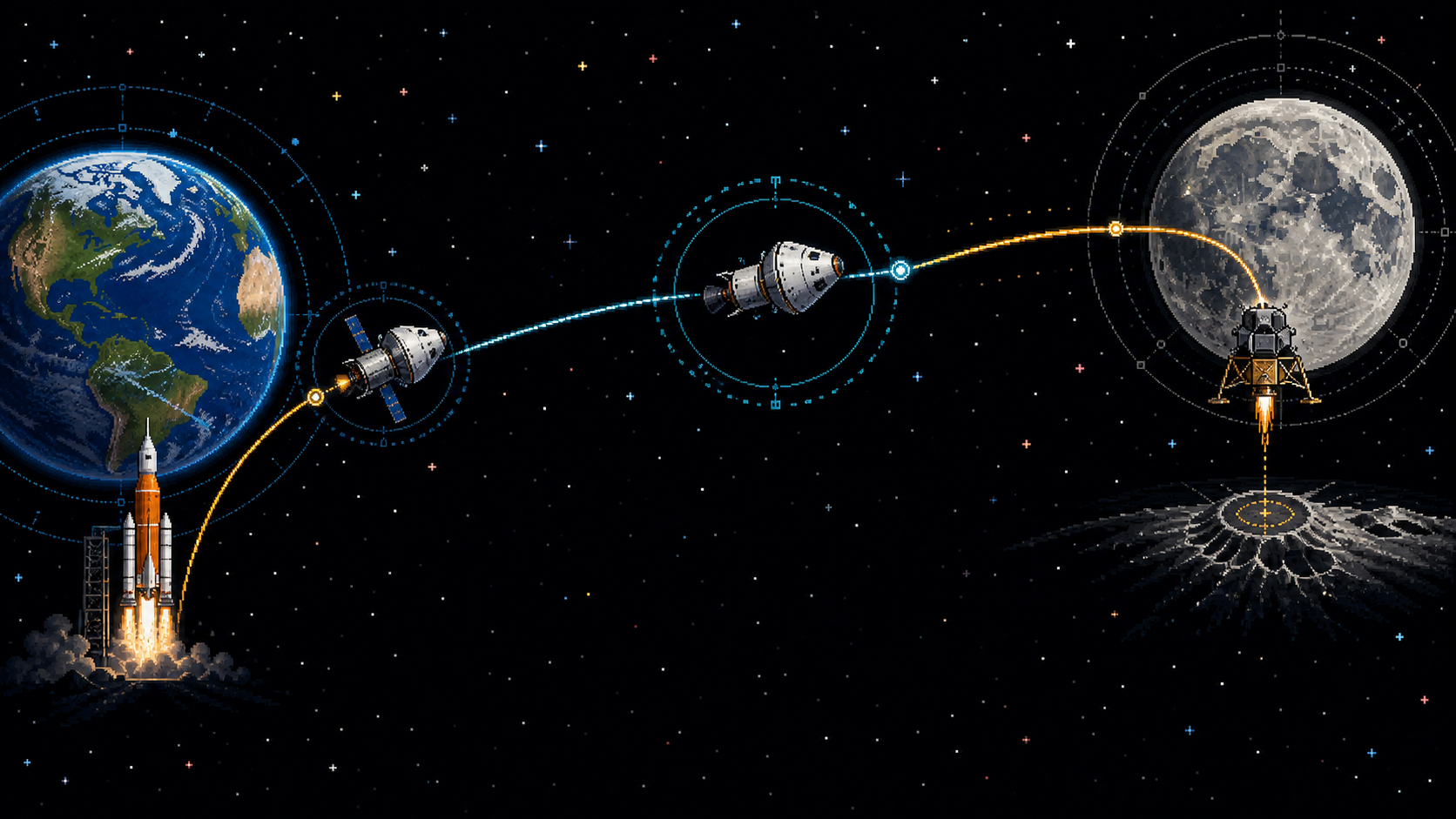
Pixel-art mission map showing SLS launching from Earth, Orion crossing cislunar space, and a lander descending toward the Moon
8-BIT FLIGHT MAPEarth → Moon
01Break gravityLC-39B · Earth

SLS produces up to 8.8 million pounds of thrust to send Orion and its crew beyond low Earth orbit.

Open Artemis I →
02Dock the stackLow Earth orbit

Artemis III is planned to rehearse rendezvous, docking, life support, communications, propulsion, and xEVA operations.

Open Artemis III →
03Cross cislunar spaceEarth ↔ Moon

Orion carries and sustains four astronauts in deep space, then shields them during the high-speed trip home.

Open Artemis II →
04Put boots on the MoonLunar South Pole

For Artemis IV, two crew members are planned to transfer from Orion to a commercial lander and spend about a week on the Moon.

Open Artemis IV →
Campaign select

Five missions. Increasing difficulty.

Past dates are actual. Future dates are NASA targets and can move as vehicles, landers, crews, and mission plans mature.

  1. Completed

    Artemis I

    SLS and Orion flew together for the first time. Orion traveled around the Moon and returned through a high-energy re-entry before splashing down in the Pacific.

    Duration25d 10h 53mDistance1.4M miRe-entryMach 32
    MissionUncrewed lunar flight test
    DestinationDistant retrograde lunar orbit
    Technical gate

    Prove the integrated SLS-Orion flight system, deep-space navigation, lunar-return heat shield, and ocean recovery without crew.

    What it unlocks

    A crewed Orion flight around the Moon with the same launch, navigation, entry, and recovery chain.

  2. Completed

    Artemis II

    Reid Wiseman, Victor Glover, Christina Koch, and Jeremy Hansen became the first crew to fly around the Moon in more than half a century, returning after a 10-day Orion mission.

    Crew4 peopleDuration10 daysRecord248,655 mi
    MissionFirst crewed lunar flyby
    DestinationAround the Moon and back
    Technical gate

    Prove life support, crew operations, navigation, communications, entry, and recovery on a real lunar flight.

    What it unlocks

    Crewed rendezvous, docking, transfer, and suit demonstrations with commercial lunar lander systems.

  3. Planned

    Artemis III

    Four astronauts are planned to test rendezvous and docking operations between Orion and commercial lunar lander systems—a critical rehearsal for the first surface mission.

    Crew4 peopleTest zoneLow Earth orbitLanders1 or 2
    MissionCrewed demonstration
    DestinationLow Earth orbit
    Technical gate

    Prove Orion-to-lander rendezvous, docking, crew transfer, lander systems, communications, and xEVA interfaces in low Earth orbit.

    What it unlocks

    Commit those vehicles and crew procedures to lunar orbit, where an abort or repair is far harder.

  4. Targeted

    Artemis IV

    NASA is targeting humanity’s return to the lunar surface. Two crew members would descend from lunar orbit, spend about a week near the South Pole, and return to Orion.

    Crew4 peopleSurface crew2 peopleSurface stayAbout 1 week
    MissionFirst crewed surface landing
    DestinationLunar South Pole region
    Technical gate

    Prove lunar-orbit transfer, precision landing, surface life support, EVA, ascent, redocking, and safe Earth return as one chain.

    What it unlocks

    Repeatable South Pole expeditions that can add science, mobility, power, and surface infrastructure.

  5. Anticipated

    Artemis V

    NASA anticipates another lunar surface mission using the standardized SLS configuration, beginning the intended cadence of sustained missions on and around the Moon.

    WindowLate 2028MissionCrewedGoalSurface cadence
    MissionCrewed surface mission
    DestinationMoon
    Technical gate

    Show the landing architecture can be repeated as an operational campaign instead of a single demonstration.

    What it unlocks

    A sustained mission cadence with progressively more capable payloads and surface work.

The humans

Meet the crews.

Artemis is not a stack of hardware milestones. These are the people who flew the Moon and the people training for the next test.

Live archive // by the numbers

The Moon program has serious stats.

Actual flight records and vehicle numbers from NASA, turned into a mission-control readout.

Artemis I flight path1.4M MI

Total distance traveled by Orion during the first integrated SLS and Orion flight test.

NASA Artemis I facts ↗
Lunar re-entry24,581 MPH

Orion hit Earth’s atmosphere around Mach 32 before its Pacific splashdown.

NASA Artemis I facts ↗
CubeSats deployed10

Small spacecraft rode with Artemis I to investigate the Moon, radiation, and deep-space technologies.

NASA mission timeline ↗
SLS max thrust8.8M LB

Four RS-25 engines and two solid rocket boosters power the Block 1 stack away from Earth.

NASA SLS facts ↗
Artemis II crew record248,655 MI

The crew became the farthest-traveling humans in history on April 6, 2026.

NASA flight record ↗
Surface cadence goal1 / YEAR

NASA’s updated architecture targets at least one lunar surface landing every year after Artemis IV.

NASA architecture update ↗
Mission loadout

The machines that make it possible.

SLS gets the stack moving. Orion keeps people alive. Landers and suits close the final distance to the lunar surface.

Heavy-lift launch vehicle

SLS Block 1

The launch stack combines a core stage, four RS-25 engines, and two five-segment solid rocket boosters.

  • 322.4 ft tall
  • 8.8M lb thrust
  • 59,000+ lb TLI
NASA SLS reference ↗
Crew spacecraft

Orion

Orion carries and sustains the crew in deep space and protects them through the high-energy return to Earth.

  • 4 crew
  • Up to 21 days
  • 67 ft full stack
NASA Orion overview ↗
Orbit-to-surface transport

Human landers

Commercial lunar landers from SpaceX and Blue Origin are part of the architecture NASA plans to test before surface missions.

  • 2 providers
  • Docking required
  • LEO demo first
NASA architecture update ↗
Extravehicular system

xEVA suits

The updated Artemis III plan includes testing the new suits alongside docked vehicles and their life-support systems.

  • Crew-worn system
  • 2027 test
  • Surface critical
NASA architecture update ↗
Mission intelligence

Artemis timeline answers.

Fast answers based on NASA’s current mission architecture and completed flight record.

01 // Next mission

What is the next Artemis mission?

Artemis III is planned for 2027. Its crew will test Orion rendezvous and docking with one or both commercial lunar lander systems in low Earth orbit.

02 // Moon landing

When will Artemis land astronauts on the Moon?

NASA is targeting Artemis IV for the first crewed landing of the campaign in early 2028, near the lunar South Pole.

03 // Flight record

Did Artemis II fly around the Moon?

Yes. Artemis II launched April 1, 2026, carried four astronauts around the Moon, and splashed down April 10 after a nearly 10-day flight.

04 // Date changes

Why can Artemis launch dates move?

Each mission depends on crew safety reviews, SLS and Orion readiness, commercial landers, spacesuits, launch infrastructure, and the objectives proven by the flight before it.

05 // Re-entry

Why does Orion skip through the atmosphere?

A lifting skip entry divides deceleration and heating into two pulses, gives guidance more control over the splashdown range, and reduces the peak load on the crew. The Avcoat heat shield sacrifices its outer material to carry heat away.

06 // South Pole

Why land near the lunar South Pole?

Permanently shadowed craters preserve scientifically valuable water ice. Nearby low-angle sunlight may support power, but it also produces extreme glare, deep shadow, temperature swings, and difficult terrain for crews and autonomous landing systems.

Continue tracking

The schedule will move. Stay locked on.

Spacian’s live Moon mission hub follows dated Artemis launches alongside lunar landers and science missions, with calendar updates and mission details.