

Field guide / November skies
The Leonids
after the peak
Can you still see the 2026 Leonid meteor shower? Yes. On the night of November 18–19, try the last dark hour before morning twilight. In London, 3 a.m. GMT on Thursday, November 19 is one workable hour: Leo’s radiant is about 42° up and the Moon is below the horizon. Check cloud before you set an alarm.
Find my local hour ↓Spacian editorial · Updated November 18, 2026
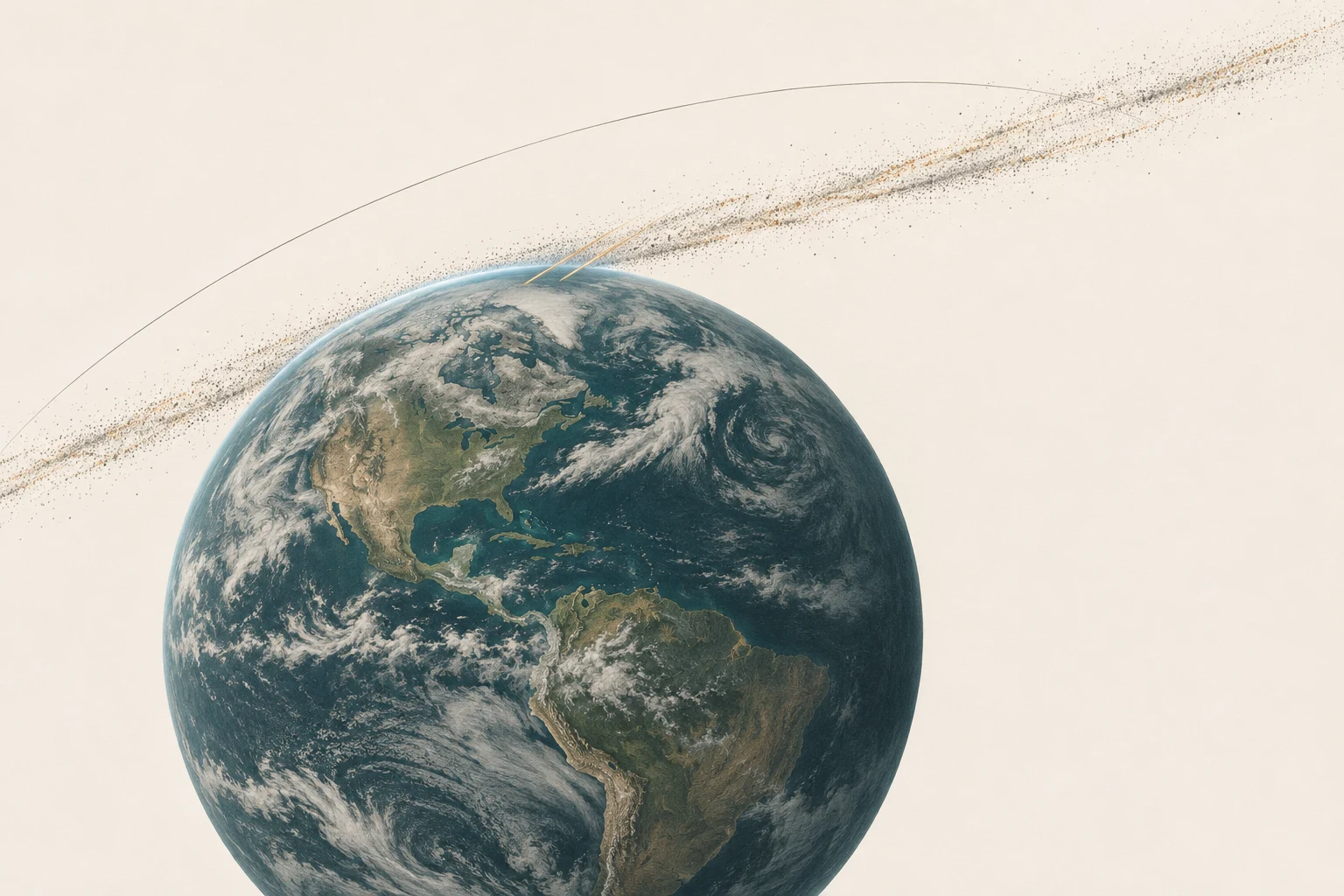
One point in Leo
The meteoroids travel on nearly parallel paths. From Earth, their trails appear to fan from one point: the radiant.
01 / Timing
Why November 17 and 18 are both on the calendar
The International Meteor Organization puts Earth’s crossing of the main stream at 23:45 UT on November 17. That was 11:45 p.m. Tuesday in Britain and 6:45 p.m. in New York, but already 10:45 a.m. Wednesday in Sydney. The New York and Sydney clock readings were poor reasons to go outside: Leo was low in New York, and Sydney was in daylight.
Earth takes more than a moment to cross the stream. The American Meteor Society’s weekly outlook names November 18 and recommends the last dark hour before twilight. For an observer, the useful question is when that darkness overlaps with a high radiant, the point in Leo from which the trails seem to spread.
YOUR SKY · 17–30 NOVEMBER
Find your local dark window
Choose the calendar date of the morning you intend to watch. The graph runs from midnight to midnight in that city, not UTC. Aim for darkness, a raised radiant and the Moon below the horizon.
━ Radiant━ Sun┄ Moon Shading: Sun below −18°
- Radiant altitude
- Sun altitude
- Moon altitude
Calculated examples for 19 November
At 03:00 local time in London (03:00 UTC), the radiant is 41.9° up, the Sun is 40.1° below the horizon and the Moon is 20.2° below it. In Sydney at 03:00 AEDT (16:00 UTC on 18 November), the radiant is only 8.0° up, the Sun is 26.8° down and the Moon is 11.4° down. These are geometry examples, not meteor-count forecasts.
Calculated with Astronomy Engine. The IMO peak radiant (RA 152°, declination +22°) is held fixed, so radiant positions become approximate away from the maximum. Sun and Moon are recalculated for every date. Refraction uses a standard atmosphere; terrain, clouds and light pollution are not modelled. No location is sent to a server.
02 / The forecast
Is a second peak coming on November 19?
There is a prediction worth watching, but not a storm warning. Dust shed by comet 55P/Tempel–Tuttle on different trips around the Sun can occupy narrow trails within the broader stream. Models in the IMO calendar place Earth near material from 1800 at 21:55 UT on November 18, and near material from 1699 at 03:31 and 03:52 UT on November 19. Those trails are expected to be thin.
These are calculated encounter times, not observed increases. Don’t give up a clear dark hour to chase an exact minute. Later in November an occasional Leonid is still possible, but the peak rate is not a forecast for the rest of the month.
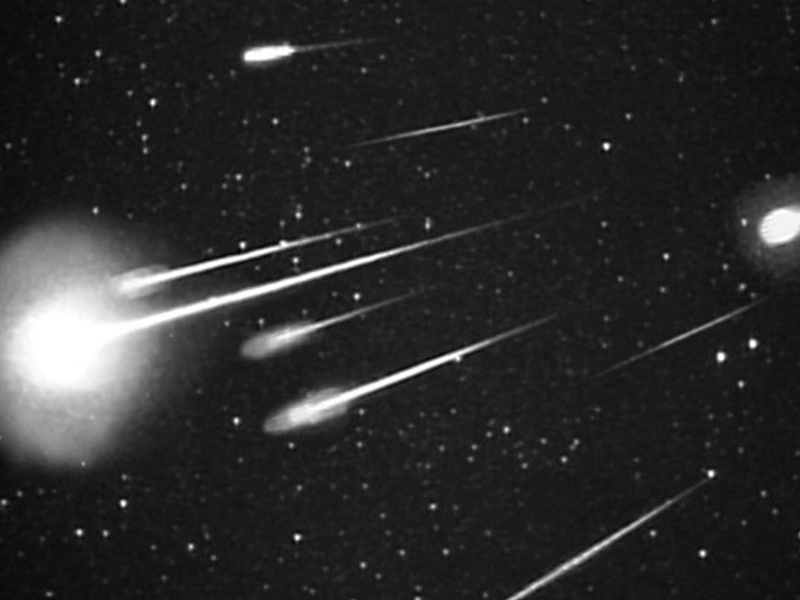
A different November
An aircraft on the 1999 Leonid MAC campaign recorded these tracks. The image preserves their directions, not the number you should expect in your own patch of sky in 2026.
NASA/Ames Research Center/ISAS/Shinsuke Abe and Hajime Yano ↗03 / In the field
What can you actually see in an hour?
The annual calendar lists a peak rate of about 15 under a very dark sky with the radiant overhead. The weekly AMS outlook gives a more modest expectation: roughly three Leonids an hour in the Northern Hemisphere and two in the Southern Hemisphere. Neither number is a personal quota. A streetlamp can erase faint trails; a quiet ten minutes tells you little.
Pick an open patch of sky rather than staring at Leo. Leonids enter the atmosphere at about 71 km/s; seen side-on, the bright streaks can be long. If you see one, trace its path backward in your mind. A line pointing toward Leo is a clue; a bright flash alone is not.
Leave the binoculars at home. Recline, shield your eyes from lights, and give them about half an hour to adapt. If you want a record you can compare with another night, note the start and end times, cloud cover and breaks as well as the count.
Sources & credits
IMO · 2026 Meteor Shower Calendar, p. 18
AMS · Meteor Activity Outlook, November 14–20
NASA · Leonids and the 1999 campaign photograph
IMO · Visual observing
Astronomy Engine · Sun and Moon calculations
Opening illustration: Spacian, generated with OpenAI ImageGen. The radiant study is an original conceptual illustration, not a real-time shower simulation.
More Spacian guides ↗Related reading and objects
Northern lights tonight: what makes a forecast worth acting on?
An aurora forecast can put an oval near you and still leave you under a blank sky. Read the map’s time, the darkness and your actual horizon together. Then use a simple Earth-curvature experiment to see why the glow need not be overhead.
What does 3I/ATLAS reveal about comets from other stars?
3I/ATLAS passed closest to Earth on 19 December 2025; its solar-system visit is now an observing record to interpret. The ATLAS survey’s discovery on 1 July 2025 revealed an unbound comet, while gas and ice grains let telescopes investigate material formed around another star.
Why does the Moon have two different months?
Artemis IV’s planned stay near the lunar South Pole needs lighting predictions for a particular place and time. Start with the change visible from Earth: the Moon’s phases show different portions of a sunlit globe, even as nearly the same face remains turned towards us.