

Reading Earth’s magnetic field from orbit
ESA launched three Swarm satellites to measure a field made mostly thousands of kilometres beneath our feet. Their instruments also detect magnetised rocks, currents in space and even moving seawater. To understand Earth’s magnetic field, they must separate those signals.
The main generator is a moving liquid
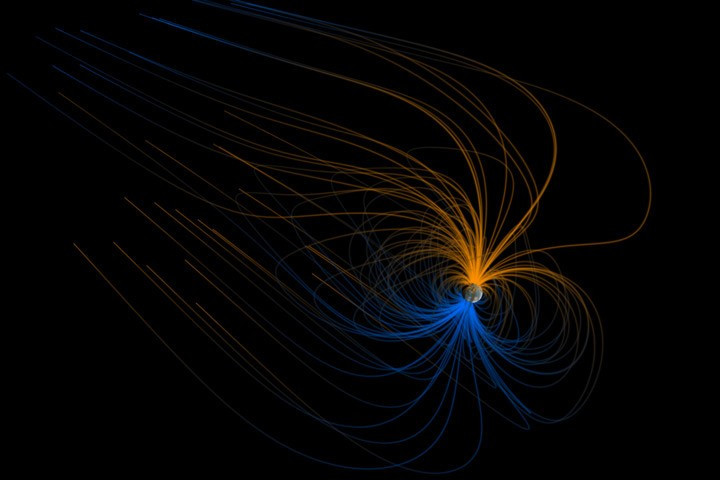
Earth’s outer core contains electrically conducting liquid metal. Its motion sustains electric currents, and those currents generate the main magnetic field. This self-sustaining process is a dynamo. The field emerges through the mantle and crust and extends far into space; Earth does not contain a giant permanent bar magnet. [1] [2] [3]
Because the liquid moves, the field changes. Magnetic north need not coincide with the geographic pole defined by Earth’s rotation, and its position drifts. The changing field provides an indirect way to study the core: scientists cannot visit the liquid metal, but they can measure the magnetic effects of its motion. [1] [2] [3]
Other material adds smaller contributions. Iron-bearing minerals in the crust can retain a record of the field present when they formed. Newly created oceanic crust preserves magnetic patterns on either side of spreading ridges. These patterns record reversals in the past and help reconstruct the movement of tectonic plates. [1] [2] [3]
Three satellites help separate space from time
A magnetometer in orbit measures the combined field at its position. A change in its reading could mean that the satellite has crossed a magnetised crustal feature. It could also mean that electrical currents above Earth have changed while the satellite was moving. One measurement cannot distinguish those explanations. [2] [4]
Swarm’s three satellites provide comparisons between locations. Repeated passes add the time dimension, while ground observatories and airborne surveys contribute measurements at other heights. Researchers combine them in models that separate the relatively persistent crustal patterns, the slowly changing core field and the faster variations associated with space weather. [2] [4]
Altitude changes what can be resolved. Smaller spatial features become harder to distinguish farther from their source. Global satellite coverage and detailed local surveys therefore complement one another. The aim is not to choose a single “best” magnetometer reading, but to explain a network of observations with a consistent set of sources. [2] [4]
The tide leaves a magnetic trace
Salty seawater conducts electricity. As tides move it through Earth’s existing magnetic field, electrical currents generate a further, very weak magnetic signal. Its regular timing helps distinguish it from the much stronger core field and from less predictable disturbances in space. [4]
In a study reported by ESA in January 2025, researchers used Swarm data to investigate these tidal signatures. Data gathered around the quieter solar conditions of 2017 were particularly useful because interference from space weather was reduced. The study connected the signals with the electrical properties of the ocean and material beneath the seabed. [4]
This gives a magnetic observation an unexpected application: constraining conductivity below the sea. Interpreting it requires models of tidal flow, seawater and the solid Earth. A magnetometer is not an ocean thermometer, but the small signal can supply information that complements instruments designed to observe the oceans directly. [4]
The field meets a wind from the Sun
Beyond the atmosphere, the solar wind pushes against Earth’s magnetic environment. It compresses the sunward side and stretches the opposite side into a long magnetotail. The resulting magnetosphere changes with the wind; it is neither a fixed sphere nor an impermeable shell. [1] [3]
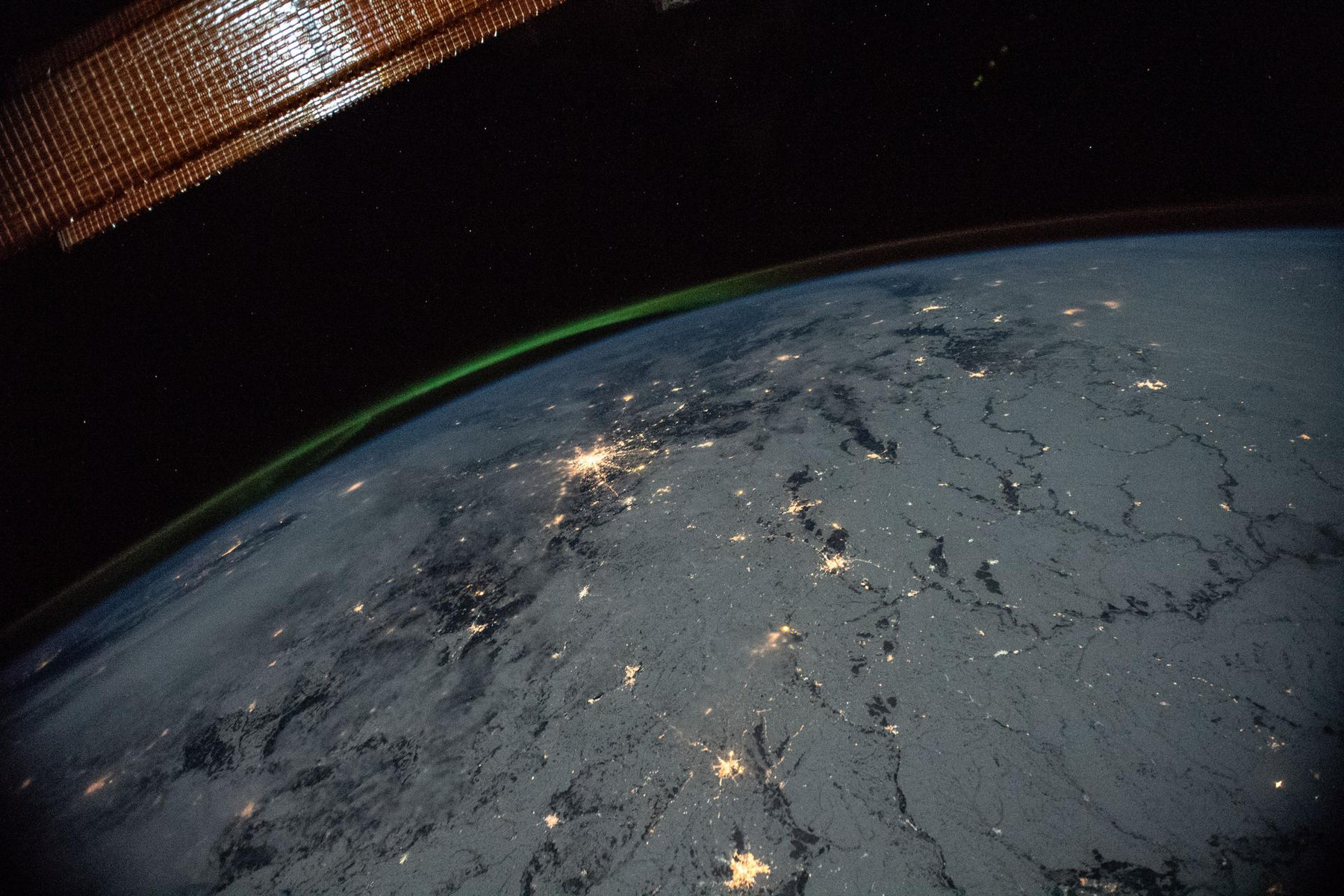
Charged particles can be trapped, guided along field lines or energised as the field rearranges. When energetic particles collide with gases in the upper atmosphere, those gases emit the light we see as auroras. A glowing arc is therefore one visible consequence of a much larger electrical system connecting Earth with space. [1] [3]
The field offers substantial protection from the solar wind, while the atmosphere supplies additional protection at the ground. Spacecraft experience a different environment, including trapped radiation and rapidly changing currents. Understanding those conditions matters for satellite operations and communication as well as for understanding the planet. [1] [3]
Start with the compass and follow its cause inward: moving liquid metal generates the main field. Follow the same field outward and it becomes a changing region shaped by the Sun. Swarm’s task is to disentangle that connected system, using small differences between measurements to distinguish events in the core, ocean, crust and space. [1] [3]
Sources & image credits
Related reading and objects
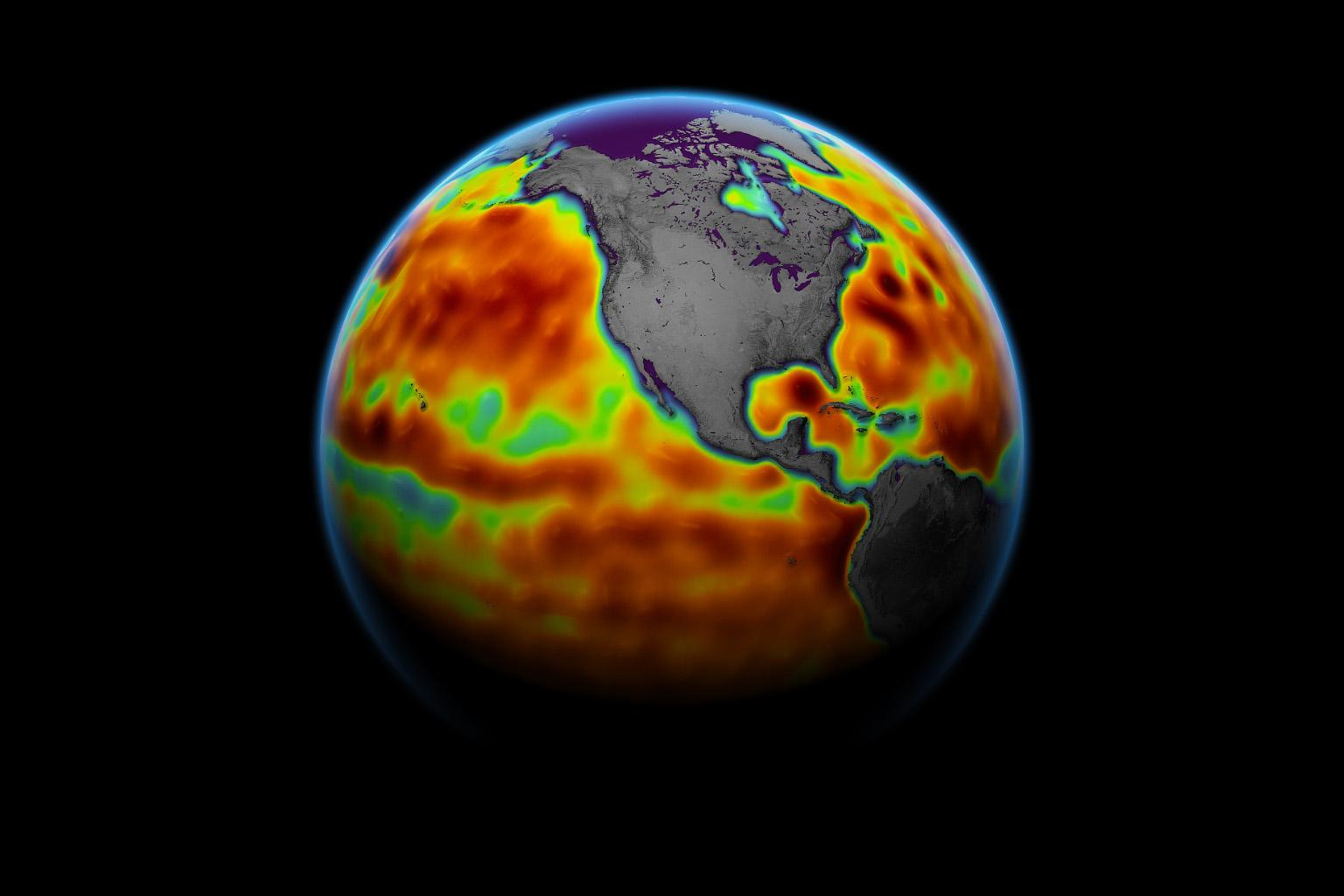
How a satellite measures the height of the ocean
Sentinel-6 Michael Freilich carries a radar altimeter that times echoes from the ocean. The mission’s launch record leads to a deceptively simple question: how can a spacecraft moving hundreds of kilometres above Earth measure changes in sea level?
How a Blue Marble is built
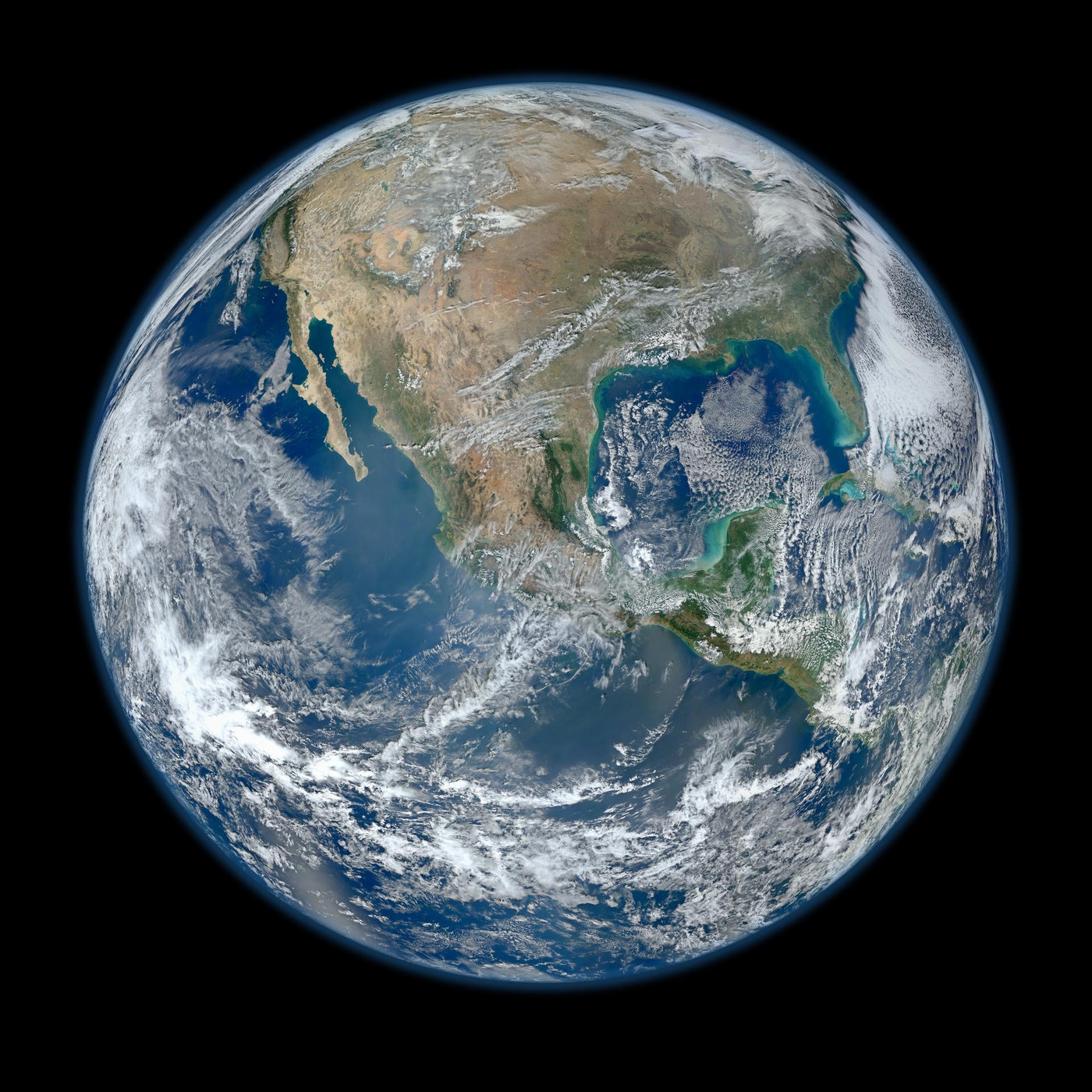
Suomi NPP’s VIIRS instrument supplied the observations used for the 2012 Blue Marble shown here. The globe is a composite assembled from orbital swaths. Understanding that construction makes it more useful as evidence—and explains why it is different from one distant snapshot.