


Read the path, not just the destination name
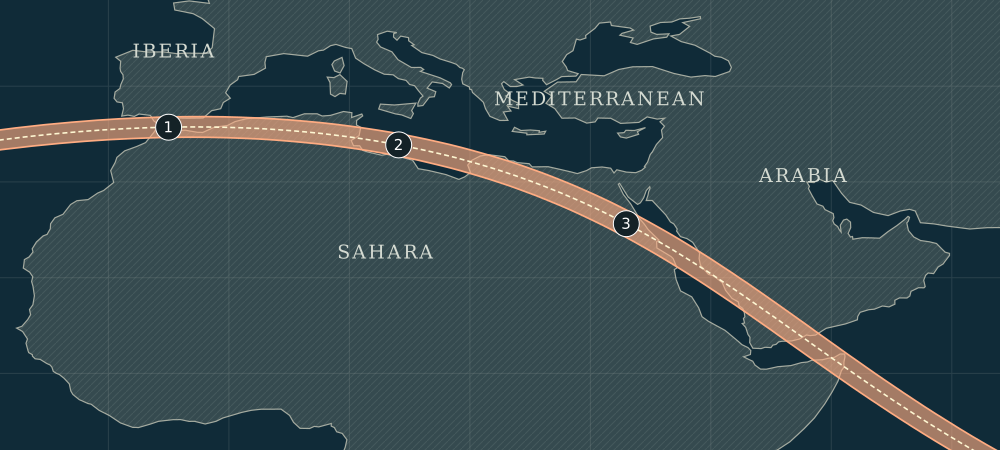
NASA lists southern Spain, Morocco, Algeria, Tunisia, Libya, Egypt, Saudi Arabia and Yemen along the total-eclipse route. That does not mean the entire territory of any of those countries experiences totality. The broader partial eclipse reaches many places outside the central corridor. NASA’s future eclipses In Tbilisi, Georgia, the same eclipse is partial throughout.
On Fred Espenak’s NASA eclipse map, two blue boundaries enclose totality and a red line marks the center. Click the actual observing location, not just the nearest city label. The map supplies local eclipse circumstances in Universal Time, including the Sun’s altitude and direction. A hotel outside the path is not rescued by being in a region advertised for eclipse travel.
For a first shortlist, note the observing coordinates, whether the eclipse is total there, and the predicted duration. Then investigate access. The place where you sleep and the place where you watch need not be identical, but travel between them is a real part of the plan. Do not leave that distinction hidden inside a booking description.
Two cities show why local circumstances matter
For Cádiz, Spain, timeanddate’s city calculation lists totality lasting approximately 2 minutes 56 seconds. Maximum eclipse is around 10:46 a.m. CEST. The entire sequence of partial and total phases lasts much longer than those three minutes. Cádiz eclipse circumstances
For Luxor, Egypt, its calculation gives approximately 6 minutes 22 seconds of totality, with maximum around 1:05 p.m. EEST. These are representative city-point predictions, not identical circumstances for every building or viewing area. Luxor eclipse circumstances
These rounded clock times are for orientation, not instructions for removing eye protection. Recheck the exact site and the time-zone rules closer to the event. Keep an explicitly labeled UTC reference alongside local time in your notes. “Maximum” is also not the beginning of totality: confusing the two can mean arriving after the part you travelled to see.
Six minutes is a location-dependent interval
Totality begins when the Moon finishes covering the Sun’s bright face and ends when that face starts reappearing. Your position across the moving shadow changes how long you remain inside it. The partial phases before and after are different portions of the event, not extra minutes of totality. The American Astronomical Society explains the distinction in its eclipse safety guidance.

NASA’s legacy calculation gives a greatest duration of about 6 minutes 23 seconds somewhere along the path. It is not a promise for every destination. That model omits mountains and valleys along the lunar edge, which can shift predicted contacts by seconds. Its map is valuable for planning, but should not be treated as a precision boundary-survey tool. NASA eclipse map and calculation notes
A practical comparison should therefore record more than duration. Is the observing area accessible? Is there a clear view in the Sun’s predicted direction? Can you reach an alternative site without an unrealistic last-minute journey? The longest nominal duration is of little use behind an obstruction or cloud.
What changes when the last edge vanishes
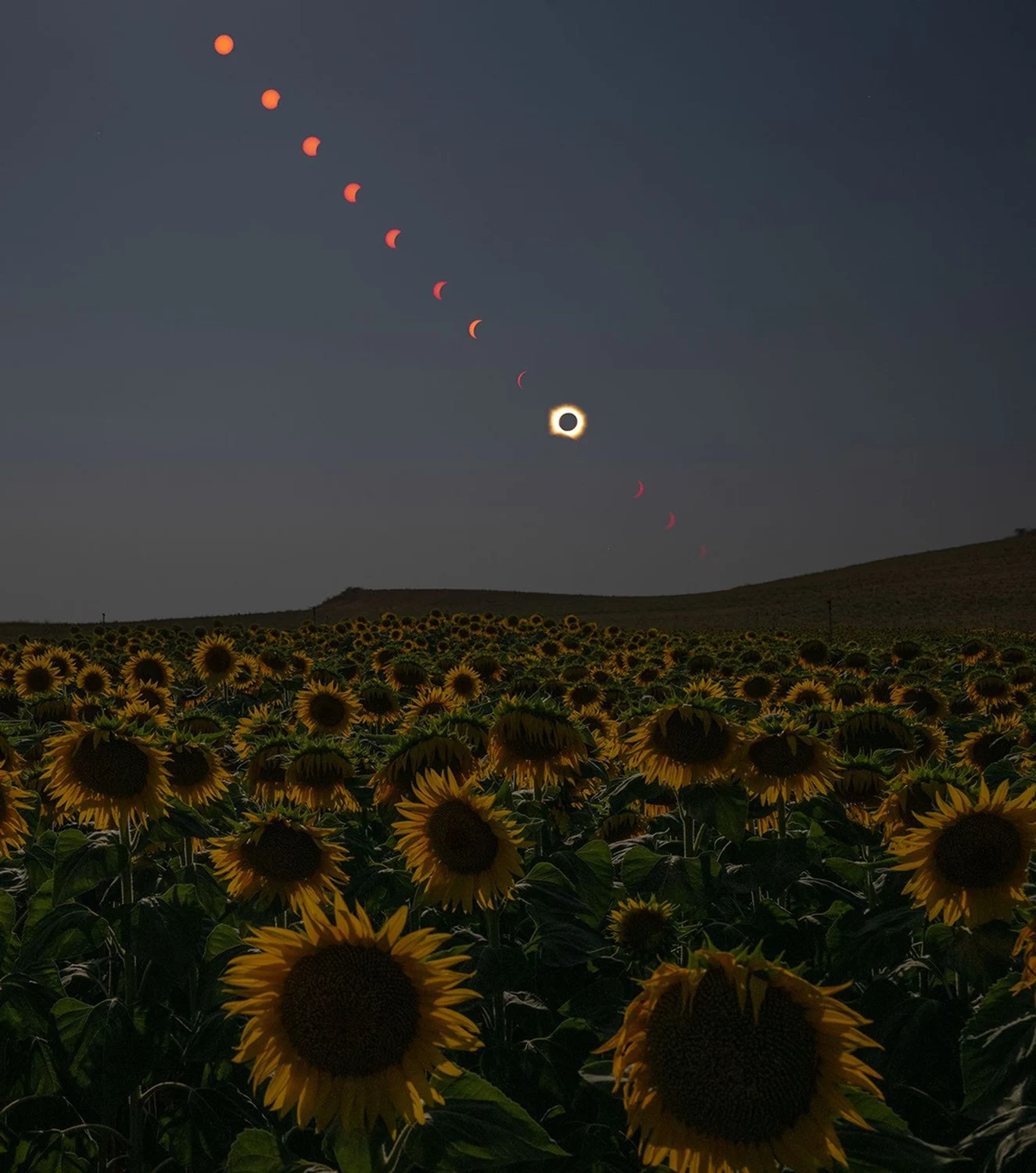
A partial eclipse can be deep without turning into totality. The thin unblocked strip is still part of the Sun’s bright surface. When the Moon covers it completely, the much fainter corona becomes visible around the dark disk. That is the practical difference between the two illustrated viewpoints here. It is also why a percentage on an eclipse app cannot tell you when it’s safe to take your viewers off.
On the NASA map, the colour bands show location, not a countdown. Read the start and end of totality as separate events, and check the local Sun altitude as well as the clock. A clear view of the right part of the sky matters more than being a few kilometres nearer the theoretical longest eclipse. Treat the numbers in this guide as planning estimates, not an instruction to remove eye protection at a particular second.
When the bright edge goes out
At the same observing site, the bright crescent narrows, disappears, then returns on the opposite side. Only the middle frame hides the entire photosphere. Within the path of totality, put eclipse glasses back on before totality ends. Outside the path of totality, keep them on whenever looking at the Sun.
Apparent disks are schematic. Orientation and timings vary by site. NASA viewing guidanceMake eye protection part of the plan
Use eclipse glasses or a handheld solar viewer that complies with ISO 12312-2 whenever any of the Sun’s bright face is visible. Ordinary sunglasses are not a substitute. Inspect viewers before use and discard damaged ones. Children need supervision. Outside totality’s path, eye protection is required throughout direct viewing of the eclipse. In Tbilisi, Georgia, the August 2 eclipse is partial. NASA eclipse safety
Within the path, unaided viewing without a solar viewer is appropriate only during complete totality. Put protection back on before the bright Sun returns; if any bright edge is visible, use your solar viewer. Never look through an unfiltered telescope, binoculars or camera while wearing eclipse glasses: concentrated sunlight can damage the viewer and injure your eyes. Optical equipment needs appropriate securely mounted front filters and expert guidance. American Astronomical Society
An indirect option is a pinhole projector. Stand with your back to the Sun and watch its projected image on a surface; do not look toward the Sun through the opening. It provides a way to follow the changing partial phase without staring at the Sun. NASA’s indirect-viewing instructions
What to confirm before committing to a site
Save the precise map location and a backup inside the path. Check property access, transport, shade and water arrangements separately from the astronomical prediction. Treat long-range climate information as background rather than a weather forecast for August 2. Revisit the local forecast near the event and decide in advance what conditions would make you move.
Finally, rehearse your equipment before eclipse day. If photography is new to you, a complicated setup can consume the brief interval you came to experience. Make the observation itself the priority: know where totality occurs, know how to watch safely, and leave the camera plan simple enough that you can look up.