


In London, try 3:30–4:30 a.m. GMT on Monday, January 4. Around New York, try 1–2 a.m. EST that morning, later than the predicted peak. Around Los Angeles, try 2–3 a.m. PST if you’re going out at all: the sky will be dark and the radiant higher, but you’ll be well past the expected maximum. These are starting points for an open, dark site near each city, not predictions of what you’ll see. In Tbilisi, try 6:00–6:45 a.m. GET on January 4, before the approach of dawn makes the nominal peak a poorer bet.

A peak is not an appointment
The International Meteor Organization’s 2027 calendar puts the nominal maximum at 03:25 UTC on January 4. It estimates the uncertainty in that timing at about 2½ hours because past observations leave gaps around the peak. If you use that uncertainty to plan, think roughly 00:55–05:55 UTC. The ends of that span aren’t the hours the shower switches on and off. There are two different unknowns: when the strongest part arrives, and how long it lasts.
The Quadrantids are active from December 28 to January 12, but the dense part of the stream is narrow. As Earth passes through it, rates can rise and fall over a single night. Four hours is a commonly quoted width for the maximum, but the calendar notes that some radio observations found a broader peak and some video observations put it earlier. Models also suggest the 2027 encounter could favour stronger activity; that has yet to be observed. Find an hour with a good sky rather than assuming you know exactly when the richest ten minutes will be.
Move the clock.
Watch the radiant rise.
The same stream passes every city at once. The sky above each city has other plans.

One crossing, four skies
The radiant is the direction the meteors seem to come from, near Boötes. The dust stream and the predicted maximum are the same everywhere; what changes is the angle at which each observer faces the incoming stream. Read the heights below from a level horizon: 0° is the horizon, 90° is straight up.
London, 3:25 a.m. GMT. The radiant is about 44° up and the Sun is about 42° below the horizon. The waning crescent doesn’t rise until 5:44 a.m. This is the one example here with a high radiant, a dark sky and the Moon down at the nominal peak. In a clear hour after 3:30, there’s no reason to wait until dawn just to put the radiant a little higher.
New York, 10:25 p.m. EST on January 3. Sunset was hours ago. The problem is the radiant, only 4° up at the nominal maximum. By midnight it’s about 12° up and rising; by 2 a.m. it’s about 26° up. Starting around 1 a.m. exchanges some proximity to the peak for a higher radiant. An evening observer with an exceptionally open horizon can still watch, but a low radiant makes for a poor comparison with someone observing at the same instant in London.
Los Angeles, 7:25 p.m. PST on January 3. The radiant is 6° below the geometric horizon. At 2:25 a.m. the next morning, it’s 26° up and the Moon hasn’t risen. That’s a better sky for seeing any remaining Quadrantids, not necessarily a better shower: seven hours have passed since the nominal maximum. If the only opening is in the evening, don’t make a long drive expecting the forecast peak to compensate for the geometry.
Tbilisi, 7:25 a.m. GET. The radiant is nearly 68° up, but the Sun is only about 11° below the horizon. Sunrise isn’t until 8:28 a.m.; it’s the spreading twilight well before sunrise that matters. At 6:30 a.m., the radiant is already about 59° up and the Sun is about 21° below the horizon. The crescent has risen by then, but earlier still gives you a darker sky than the nominal peak. Choose a view away from the Moon and nearby lights.
These are calculations for representative city coordinates, not measured sky brightness: fixed IMO peak radiant (right ascension 230°, declination +49°), USNO horizontal-coordinate method, approximate solar coordinates, and USNO rise and set data. The model doesn’t know about hills, buildings, clouds or glare. The northern radiant also means the shower is a poor target from most southern latitudes: south of about 41°S, the nominal radiant doesn’t rise above a flat horizon.
The dust source that looks like an asteroid
You don’t need a comet in the January sky to have a meteor shower. The dust is already spread along an orbit, and each year Earth crosses part of it. What flashes is the passage of dust through the atmosphere at about 41 kilometres per second. The parent body can be elsewhere.
In 2003, a Lowell Observatory survey spotted a small object now called 2003 EH₁. With more observations, its orbit turned out to be a much closer fit to the stream than previous candidates. That was Peter Jenniskens’s evidence for the link: he compared paths, not the appearance of a tail. The object moves in a comet-like orbit but doesn’t show the activity you would expect from an active comet. It could be a dormant or extinct one.
Orbital studies of the stream suggest the narrow core is only a few centuries old; the broader material may have a different history. A comet recorded in 1490 has been proposed as part of that story, but following the orbits backwards does not establish that the two objects were the same. The narrow peak is something you can try to see this January. The event that put the dust there is still an inference.
What 80 an hour actually means
The IMO’s reference peak is 80 ZHR, short for zenithal hourly rate. It’s an observing standard: the rate adjusted to what a single observer could see in a dark reference sky with the radiant at the zenith, directly overhead. It lets different observers compare results. It doesn’t say what will pass through your view in the hour you’ve set aside. The calendar’s reported peak rates also vary markedly between years.
Hold the dust stream fixed and change only the radiant height. In the simplest geometric correction, a radiant 30° up gives about half the overhead rate; at lower elevations, obstructions and haze make estimates especially unreliable. Now add a glowing horizon, a tree line or an hour missed on the falling side of the peak. An actual count might be a small fraction of the published number. There is no useful conversion from this year’s reference ZHR to a promise for someone’s back garden.
An hour you can actually count
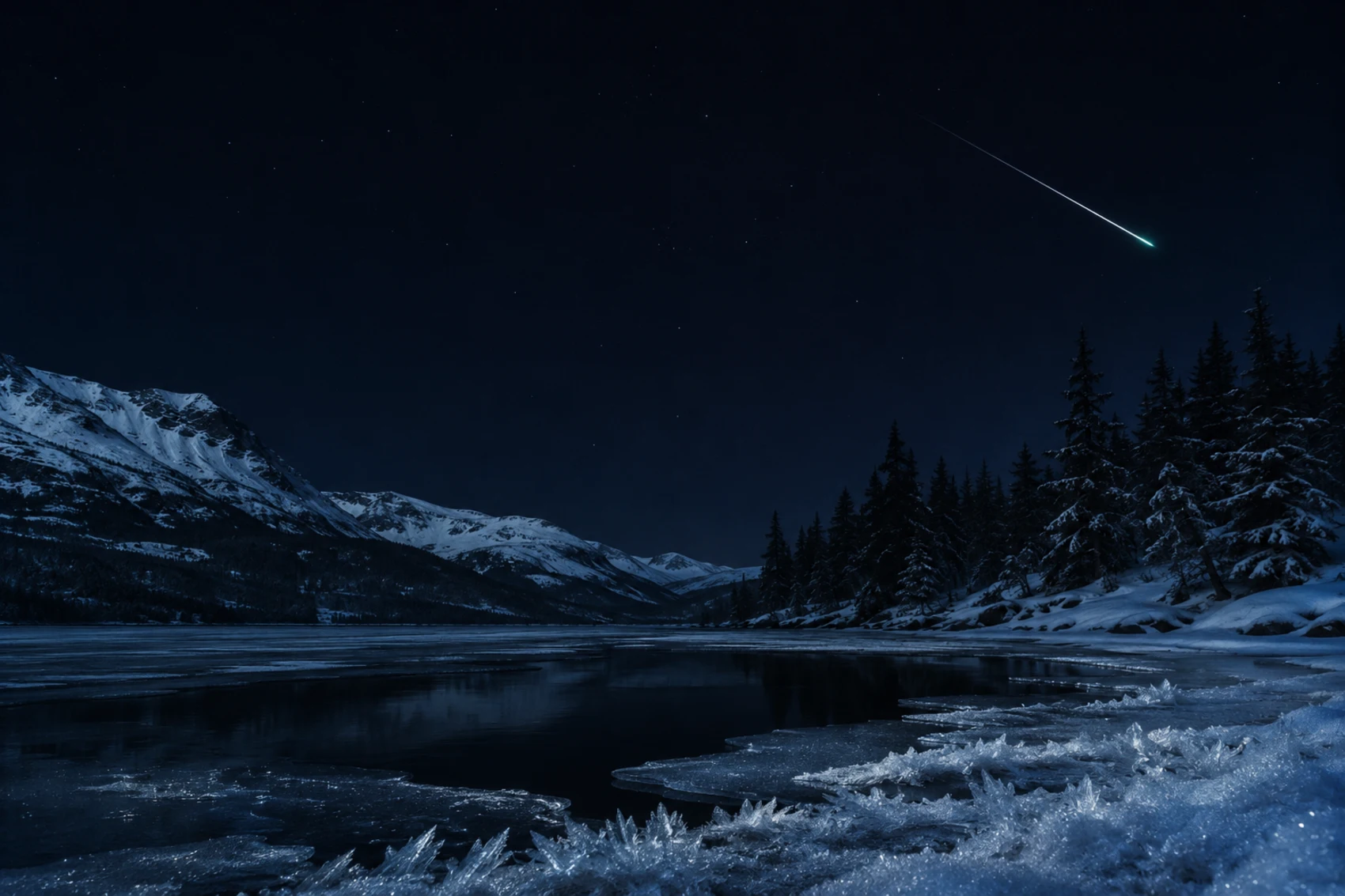
Find the Big Dipper if you can and follow its curved handle toward Arcturus in Boötes. You’re finding the neighbourhood, not something to stare at. Choose a broad, dark part of the sky off to one side of the radiant. Streaks close to the radiant can look short because the meteoroids are coming roughly toward you; farther away, their sideways motion is easier to see. Let your eyes adapt for about half an hour. Leave binoculars in the bag; you want more sky, not more magnification.
Give an uninterrupted hour if you can. Note the start and end times, cloud and any breaks, then keep two tallies: trails that point back toward the radiant and those that don’t. When a streak vanishes, trace its line backwards in your mind. If you can’t recover the direction, mark it uncertain rather than forcing it into the shower count. The IMO visual-observation guide explains how to make a more formal record. If you only have twenty minutes, record twenty minutes. A quiet interval is one observation, not a verdict on the shower.