Voyager 1 is one light-day away. Why does a reply take two?

A command sent on Monday can’t get an answer back before Wednesday. NASA’s Voyager 1 light-day mission update presented the milestone about a day after the spacecraft crossed it, when the signal could reach Earth.

A large radio dish shown at an angle, with its focal receiver suspended above the reflector.
An illustrated Deep Space Network–style dish. On November 18, 2026, Voyager 1 reached one light-day from Earth.Spacian · AI-assisted editorial illustration

Why the round trip takes two days

NASA’s trajectory model puts Voyager 1 one light-day from Earth on November 18, 2026, the first spacecraft to reach that distance. At that distance, a radio command takes 24 hours to arrive. Even if Voyager replies immediately, the reply takes another 24 hours to reach Earth.

Earth to Voyager 1
24 hours
Earliest round trip
≈48 hours
Continue reading ↓

NASA Blue Marble · Reto Stöckli · NASA Voyager

The sequence illustrates the travel time of a command and an immediate reply. It is not a recording of a transmission.

Illustrated uplink across one light-day. A reply takes another 24 hours to reach Earth.

Voyager spacecraft geometry from NASA/VTAD.

Light travel time

How far does a signal travel in a day?

299,792.458 km/s × 86,400 s≈25.9billion kilometers

Radio waves travel through a vacuum at the same speed as visible light. At about 300,000 kilometers per second, a signal travels 25.9 billion kilometers (16.1 billion miles) in one day.

Light takes about 1.3 seconds to reach the Moon. Voyager took 49 years to get as far from Earth as light travels in a day.

Two arrows of equal length point in opposite directions between an Earth symbol and a radio antenna.
A command takes about 24 hours to reach Voyager 1. With an immediate reply, the return takes another 24 hours. Symbols and distance are schematic.Earth · Voyager 1 · Command · 24 h · Reply · 24 hSpacian · explanatory illustration
Sources 2 3
Mission archive / April 2024

A repair with a two-day wait

Artist’s concept of Voyager 1 in interstellar space. A white dish and long instrument booms extend from its compact body.
Artist’s concept · NASA/JPL-Caltech ↗
Voyager flight team members gathered around a conference table at JPL as readable engineering data returns.
Voyager’s flight team receives the engineering data at JPL on April 20, 2024. NASA/JPL-Caltech ↗

On April 18, 2024, engineers sent Voyager 1 instructions to move part of its flight software out of a damaged area of memory. The team hadn’t received readable engineering data in five months.

The signal took about 22½ hours each way. On April 20, the team received readable engineering data, confirming the fix. Restoring science data took more work.

The two days cover signal travel only. Time to execute the command or wait for a scheduled contact can make the actual turnaround longer.

Sources 4 5 2
Deep Space Network

Who listens while Earth turns?

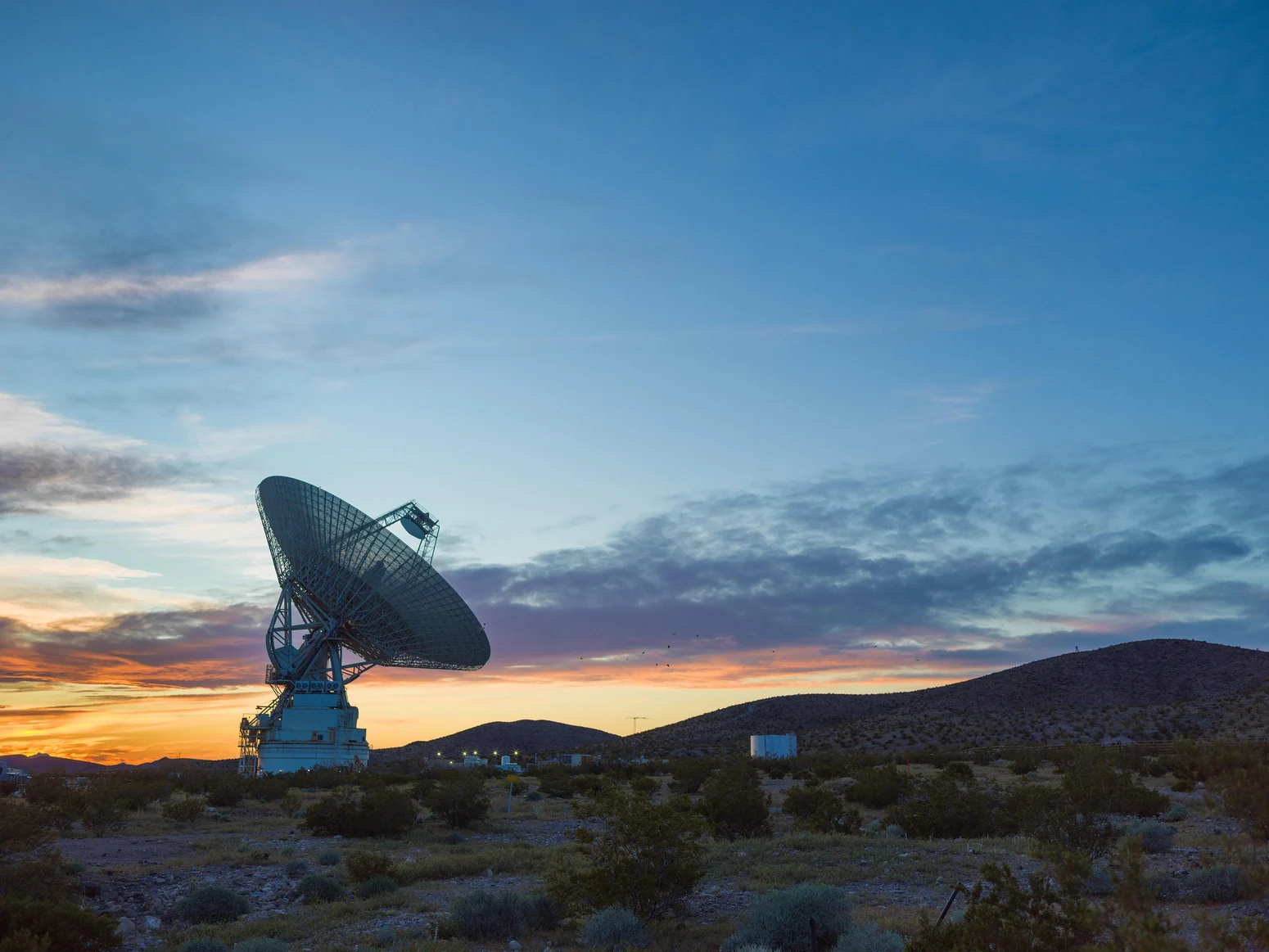
NASA’s Deep Space Network has antenna complexes at Goldstone in California, near Madrid in Spain, and near Canberra in Australia. As Earth turns, another site can take over when a spacecraft drops below the first site’s horizon. A different dish may receive Voyager’s reply.

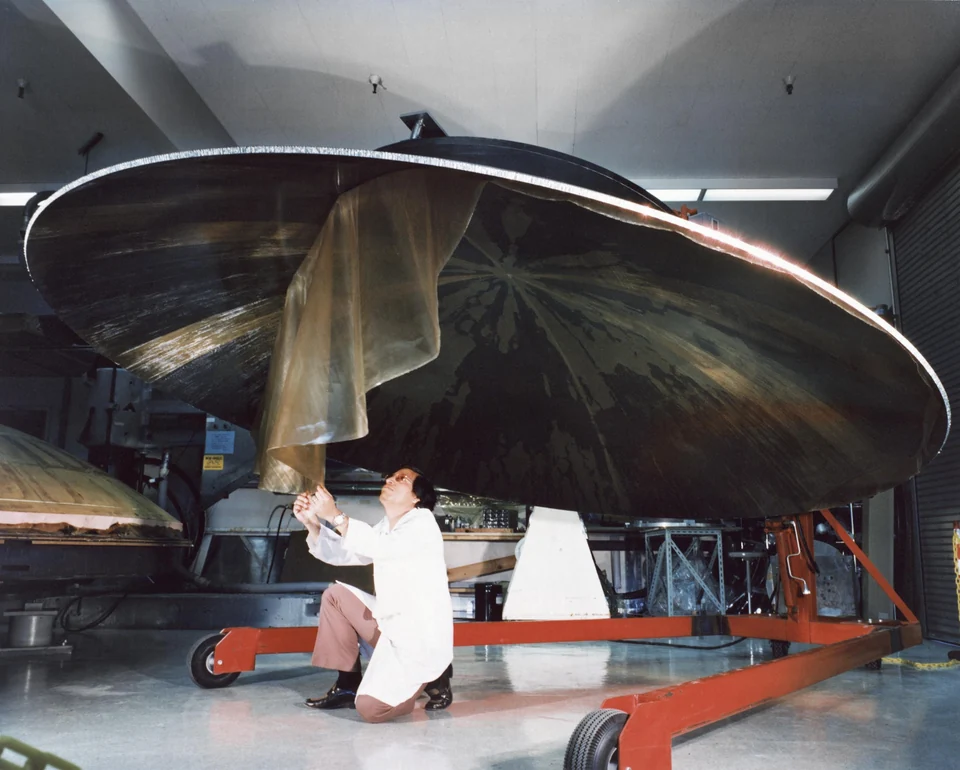
Between contacts, Voyager runs stored instructions and handles some faults on its own. Its attitude-control system keeps the main antenna pointed at Earth.
Sources 5 6
The 70-meter dish of Deep Space Station 14 stands against a blue and orange evening sky at Goldstone in California.
On Earth. Deep Space Station 14, a 70-meter antenna at Goldstone, California. NASA/JPL-Caltech ↗
An engineer works underneath a Voyager high-gain antenna during construction in 1976.
On the spacecraft. A Voyager high-gain antenna under construction, July 9, 1976. NASA/JPL-Caltech ↗
Distance from Earth

One light-day from where?

NASA’s trajectory model puts the crossing at 10:16:07 UTC on November 18, 2026, measured from Earth rather than the Sun. A signal from that point takes another 24 hours to reach Earth.

On November 14, NASA’s antenna in Canberra picked up Voyager 1’s radio carrier but received no science or engineering data. NASA is investigating the cause. The carrier is not a decoded reply.

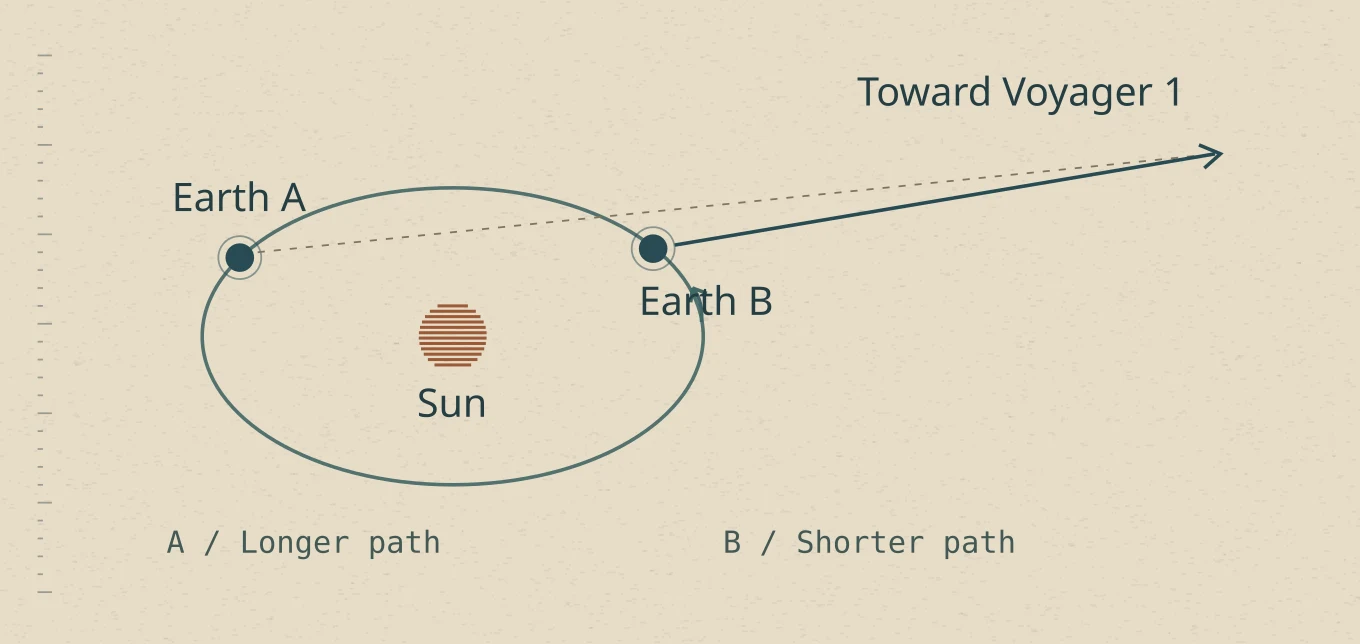
As Earth orbits the Sun, it can move toward Voyager faster than the spacecraft moves away. The gap from Earth then shrinks even as Voyager gets farther from the Sun. NASA’s tracker shows both distances and the current one-way signal time.

Sources 1 7 8
Earth appears as a tiny point in a narrow, pale band of scattered sunlight in Voyager 1’s Pale Blue Dot image.
Pale Blue Dot. Earth is the speck in the bright band just right of center. Voyager 1 took this photograph on February 14, 1990, when it was about 6 billion kilometers from the Sun. Reprocessed in 2020. NASA/JPL-Caltech ↗
Two positions on Earth's orbit. The line toward Voyager is shorter from position B, on the spacecraft's side of the Sun.
Geometric sketch / Earth’s orbitThe nearer sideCompare two positions of Earth, holding the spacecraft still for the sketch. From B the radio signal has less distance to cover.Spacian illustration. Positions are schematic, not dates; distances are not to scale.