

Inside spaceflight / 11Mars
Why a Mars rover cannot be driven in real time
The planned Rosalind Franklin rover will combine commands from Earth with onboard capabilities. Its destination imposes a constraint shared by every Mars mission: even a perfect radio link cannot deliver a command before the signal has crossed the space between the planets.
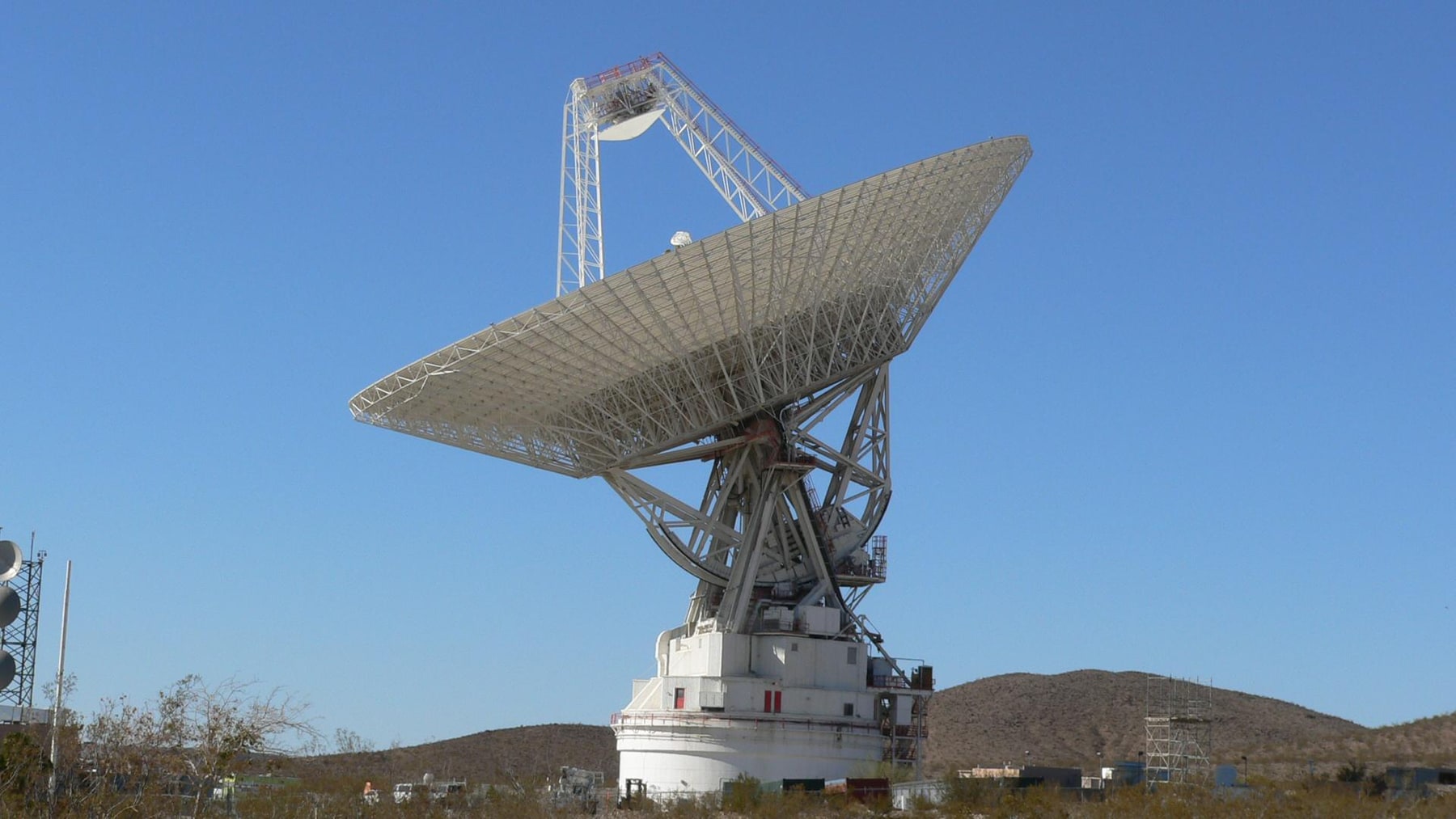
A radio command is not an instant control input
ESA’s planned Rosalind Franklin investigation includes surface mobility that can be autonomous or controlled. Both depend on the information available to the rover and its team. A plan can be prepared on Earth, but it still has to be transmitted, received, checked and executed by the spacecraft. [1]
Radio waves travel at the speed of light. NASA’s operational explanation for Perseverance gives a one-way delay of roughly three to twenty-two minutes, depending on where Earth and Mars are in their orbits. “Live” contact therefore does not mean a joystick with an immediate view of its effect. [2]
Distance is the variable in that propagation problem. For a chosen separation d, divide d by the speed of light c. The calculation gives a travel time, not a transmission speed in bits per second. A faster data rate can deliver more information during a contact; it cannot make the first bit arrive before its light time. [3]
Receiving a reply requires a second crossing
Choose an illustrative separation of 225 million kilometres. At 299,792.458 kilometres per second, the one-way propagation time is about 12.51 minutes. An immediate reply would need another 12.51 minutes to return. The combined 25.02 minutes excludes the time needed to process the command, perform the action and prepare its result. [3]
The three distances in the figure are teaching choices, not an ephemeris or a report of the planets’ current positions. Earth and Mars keep moving. For a real communication session, the geometry and the planned contacts belong to that session’s operational data. [4]
Why a Mars rover needs a plan
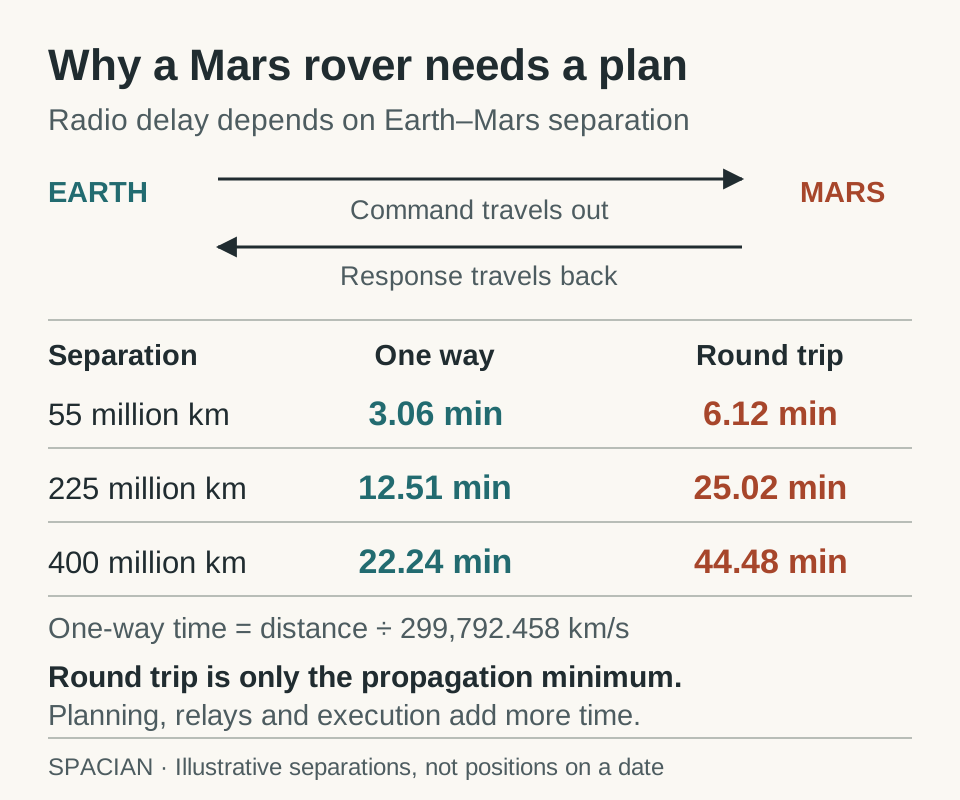
Propagation times calculated from chosen distances. Round-trip values are lower bounds before execution, communications scheduling and ground review.
- Divide an illustrative distance by the speed of light to obtain one-way propagation time; divide seconds by 60 for minutes.
- Double the unrounded one-way time to obtain the round-trip propagation minimum. Each displayed value is rounded independently to two decimal places.
- The delay supports sending a reviewed onboard plan rather than continuously steering a rover by joystick. Planning, relay opportunities, execution and downlink add time.
Original Spacian illustration · [2] Download diagram ↗
The distinction explains a familiar misunderstanding. A command could already have reached a rover while its team is still waiting for the result to begin its return journey. “No answer yet” is not by itself evidence that the command failed. [2]
Onboard navigation closes a shorter loop
A rover can use local observations to answer immediate terrain questions without waiting for a new instruction from Earth for every wheel movement. Perseverance’s AutoNav combines onboard imaging and navigation to identify terrain and select a path toward a goal. The team still chooses scientific objectives and sets the constraints for the drive. [5]
Autonomy therefore has a specific job. It can help a spacecraft act within a defined plan when the environment cannot be fully resolved from the ground. It does not mean the rover is free to invent the entire mission or that every interesting rock can be examined without human decisions. [5]
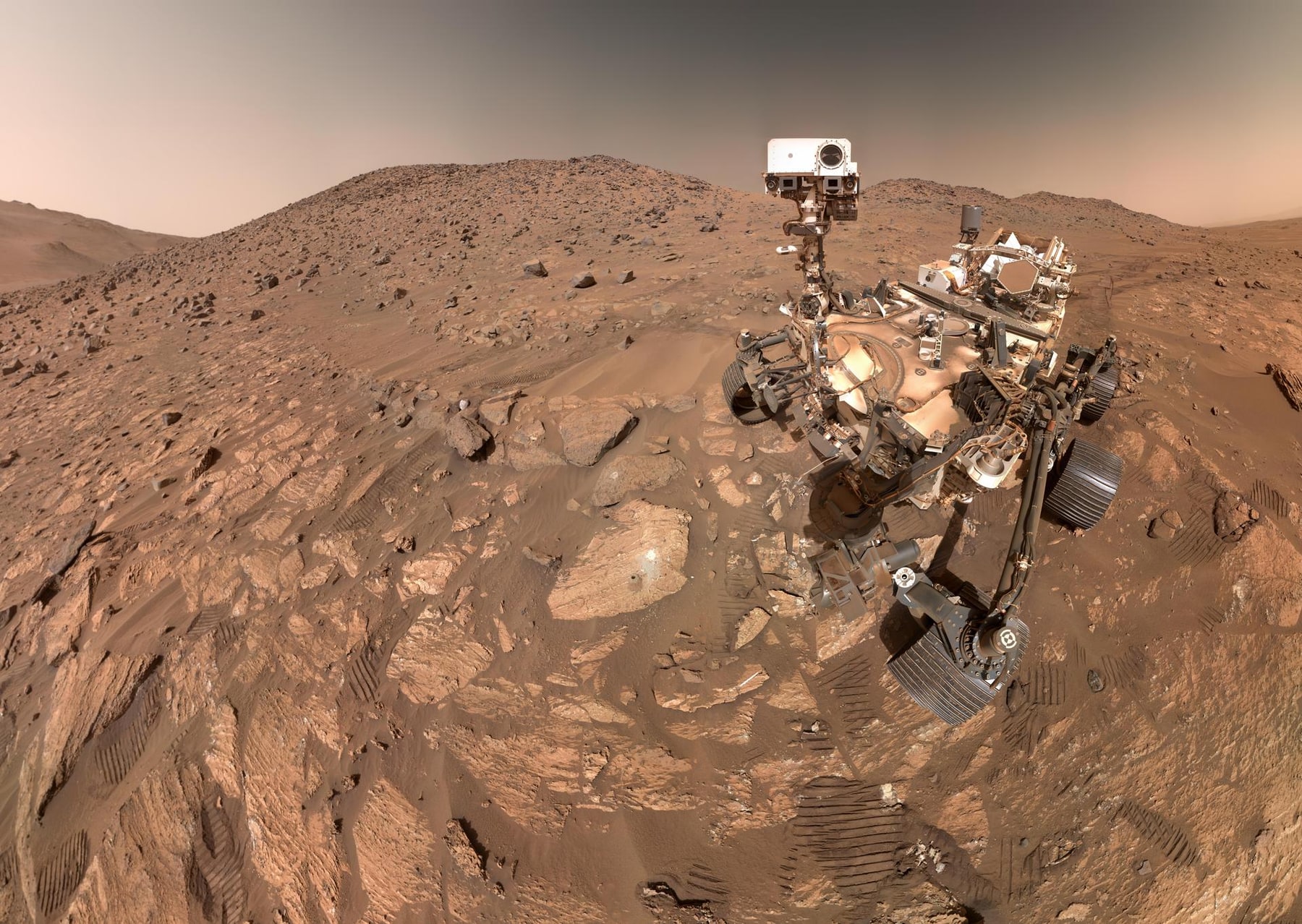
This is a useful way to read any autonomy claim: ask which decision is made onboard, what information it uses and what remains in the ground plan. Naming the decision makes the capability much clearer than calling the whole spacecraft “self-driving.” [5]
An orbiter can be a communications partner
Mars surface missions can send data through orbiting spacecraft in the Mars Relay Network. A relay receives information near the planet and forwards it toward Earth. This changes the link architecture and available communication opportunities. It does not remove the interplanetary propagation delay. [6]
A rover’s ability to see an orbiter and the orbiter’s ability to return information to Earth depend on the geometry and schedule. A result may therefore have to wait for a suitable contact. The time from an action on Mars to an image on a scientist’s screen can be longer than a simple round-trip light-time calculation. [6]
Sometimes the problem is the path, not the distance
Near solar conjunction, the Sun lies close to the Earth–Mars line of sight. Its environment can interfere with radio communication. Mission teams plan around this period, including restrictions on commanding and work that a spacecraft can perform with previously prepared instructions. [7]
A temporary communications restriction is an operational condition. It does not imply that a rover has stopped existing or that its instruments have all failed. To understand a quiet period, read the mission’s actual contact plan and status rather than treating every absence of new pictures as the same event. [7]
Return to the distance explorer on the Mars page and change the chosen separation. The one-way and return values update immediately because they are calculations. The real mission develops on another timescale: a plan, an action, a contact and a result that can change the next plan. [2]
Read the evidence
Sources & image credits
- ESA · Rosalind Franklin mission and its scientific investigation ↗
- NASA · Speaking Percy’s language: command planning and light time ↗
- NIST · Exact speed of light in vacuum ↗
- NASA · Mars facts ↗
- NASA · Mars Relay Network ↗
- NASA · Mars solar conjunction ↗
Technical explanation by Spacian, reviewed against the linked sources. Photographs retain their original dates, creators and reuse terms in their captions. Original diagrams explain mechanisms and do not reproduce engineering drawings or flight telemetry. Editorial policy and corrections.
Continue the story
Follow the mechanism
 Mars
Reading an ancient lake
Read a Martian landscape through its channels, sediments and chemistry, then separate evidence of ancient water from a claim that life existed.
Read the explanationMarsSearching for ancient life
Understand why habitability, organic chemistry and a potential biosignature are different claims, and what Rosalind Franklin’s deeper samples can add.
Read the explanation Earth orbit
A path with a purpose
Altitude, inclination and the job of a satellite.
Explore the explanation