

Solar System / 01Mars
How Curiosity reads the history of a lake
Curiosity landed in Gale Crater to investigate whether its ancient environments could have supported microbial life. The rover’s route from the crater floor up Mount Sharp connects that question to specific rocks: their layers, chemistry and relationships to the terrain around them.

Start with the crater, then separate the mountain’s history
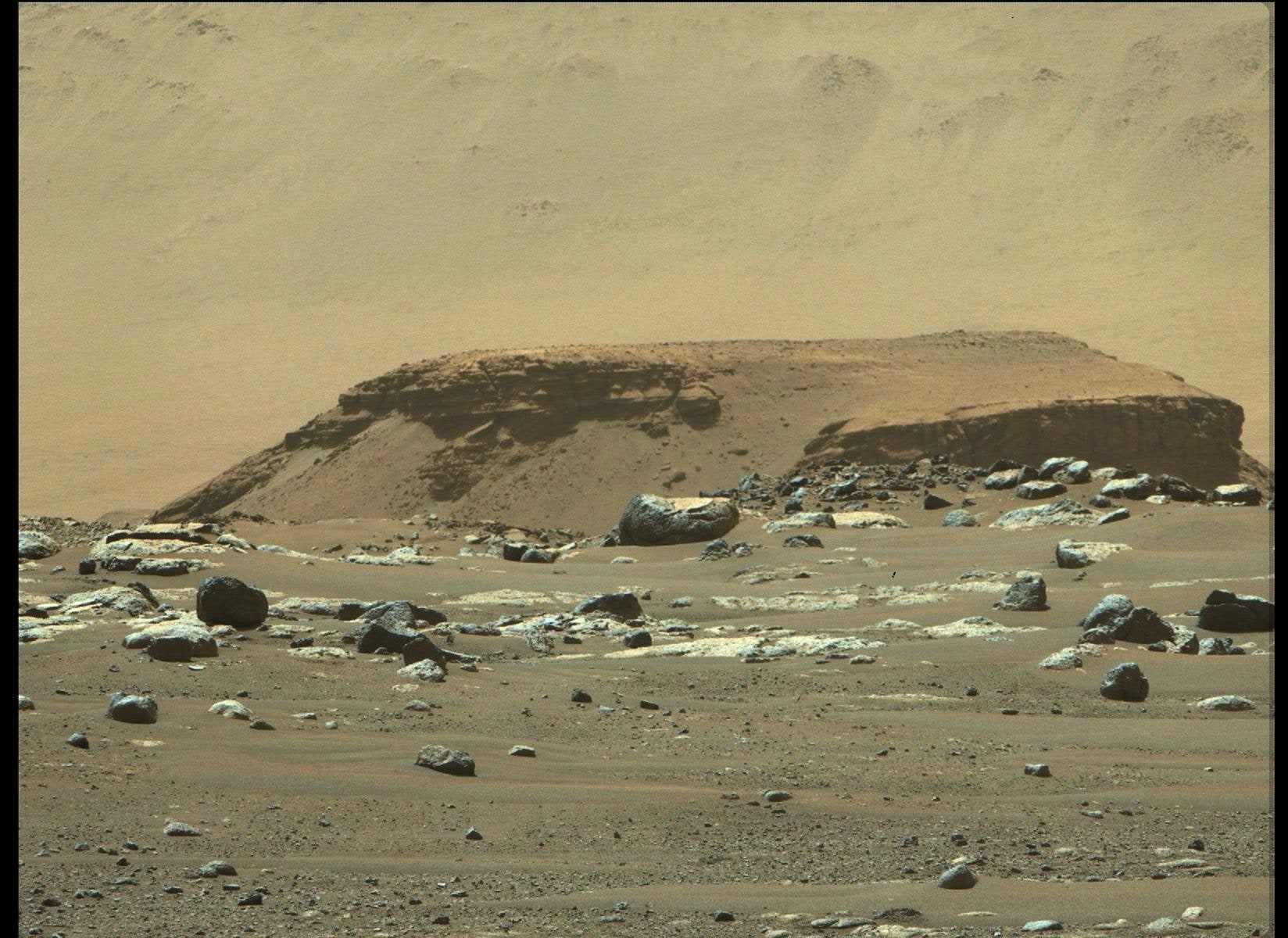
Gale is an impact crater containing a large mound of layered material called Mount Sharp. The impact made the basin; it did not instantly build every sedimentary layer the rover studies. Deposition, burial, alteration and erosion subsequently changed the landscape. Reading the whole scene as one event would erase the very history Curiosity was sent to investigate. [1]
The rover’s February 2025 panorama looks back down the mountain toward the crater rim. The view gives field measurements a location: lower terrain, the rover’s climbing route and the surrounding layered rocks. A photograph does not identify every mineral, but it shows which measurements belong together in a landscape. That context is lost if a mineral detection is treated as an isolated fact. [2]
Why fine layers can point to standing water
Sediment changes as it moves. A stream can carry material into a basin; when water slows, grains settle under different conditions from those in a fast channel or a wind-built dune. Geologists therefore examine grain size, layering, bed geometry and nearby deposits together. The presence of a layer alone is not a unique signature of a lake. [1] [3]
At Yellowknife Bay, Curiosity investigated fine-grained sedimentary rock called mudstone. The Cumberland drill sample came from this setting. Its sedimentary context and clay-rich composition supported an ancient lake environment. The interpretation was stronger than a distant resemblance to an Earth landscape because the rover could examine the rock directly and analyse material from inside it. [4]
Two laboratories ask different questions of one sample
A drill gives Curiosity access to material beneath a rock’s exposed surface. Its CheMin instrument investigates crystalline minerals using X-ray diffraction. The Sample Analysis at Mars suite, SAM, investigates gases and chemical compounds. These are complementary measurements: identifying a clay mineral is different from identifying an organic compound in material associated with that mineral. [1]
SAM measurements of the Cumberland sample reported in 2025 identified larger organic molecules than had previously been confirmed by that investigation. Heating a sample for analysis changes it, so scientists must interpret which detected compounds may have come from larger precursors. The measurement and the reconstruction of an earlier molecule are distinct steps. [4]
A climb through layers is a test of environmental change
Orbiters identified clay- and sulfate-bearing terrain on Mount Sharp before the rover reached it. Those mineral groups helped define an investigation, rather than providing a complete climate history by themselves. A rover can test how minerals occur within actual beds, veins and other structures, and whether several processes contributed to a deposit. [1] [3]
The clay-to-sulfate transition is consequently more complicated than a single line separating a wet planet from a dry one. Sediment deposition, evaporation and later groundwater can leave overlapping signals. Work on the transition combines chemical measurements with a measured vertical rock sequence. The order and setting of the observations constrain explanations that an inventory of mineral names cannot. [3]
Keep a habitable environment separate from evidence of life
Water, chemical ingredients and usable energy matter when asking whether an environment could have supported life. Curiosity’s observations make ancient Gale an important place to examine those conditions. Organic molecules are carbon-bearing chemistry, however, and can be produced without organisms. Neither “organic” nor “lake” is a synonym for a biological discovery. [1] [4]
The practical way to read a new result is to ask what was actually measured, where the sample came from and which alternatives remain possible. A photograph, a mineral identification and a chemical detection answer different parts of the same question. Curiosity’s value comes from joining those records along a real route through the crater. [1] [3]
Read the evidence
Sources & image credits
- NASA · Curiosity’s Gale Crater investigation ↗
- NASA · Curiosity’s view down Mount Sharp, 7 February 2025 ↗
- Rapin et al. · clay–sulfate transition in Gale Crater, 2026 ↗
- NASA · organic molecules measured in the Cumberland sample ↗
Technical explanation by Spacian, reviewed against the linked sources. Photographs retain their original dates, creators and reuse terms in their captions. Original diagrams explain mechanisms and do not reproduce engineering drawings or flight telemetry. Editorial policy and corrections.
Continue the story
Continue exploring
 Mars
Reading an ancient lake
Read a Martian landscape through its channels, sediments and chemistry, then separate evidence of ancient water from a claim that life existed.
Read the explanation Mars
Searching for ancient life
Understand why habitability, organic chemistry and a potential biosignature are different claims, and what Rosalind Franklin’s deeper samples can add.
Read the explanation