

Solar System / 05Small worlds
Beyond Neptune: a belt, scattered worlds and a proposed cloud
New Horizons investigated Pluto in 2015 and Arrokoth in 2019. Those encounters explored very different objects beyond Neptune. They also help separate a close-up view of one body from the larger orbital populations to which outer Solar System objects belong.
The Kuiper Belt is a population with thickness
The Kuiper Belt begins beyond Neptune and contains many icy bodies on a variety of orbits. Describing it as a thick disc is more useful than imagining a single thin ring. Different populations include objects with relatively unperturbed orbits and objects whose periods have resonant relationships with Neptune. [1]
A region’s convenient numerical boundary is not a solid edge. Surveys have selection effects, and orbital classifications depend on more than current distance. An eccentric object can move across a broad range of solar distances without changing its identity into a different kind of body at each arbitrary boundary on a diagram. [1] [2]
Pluto shows why a distant body is still a geological world
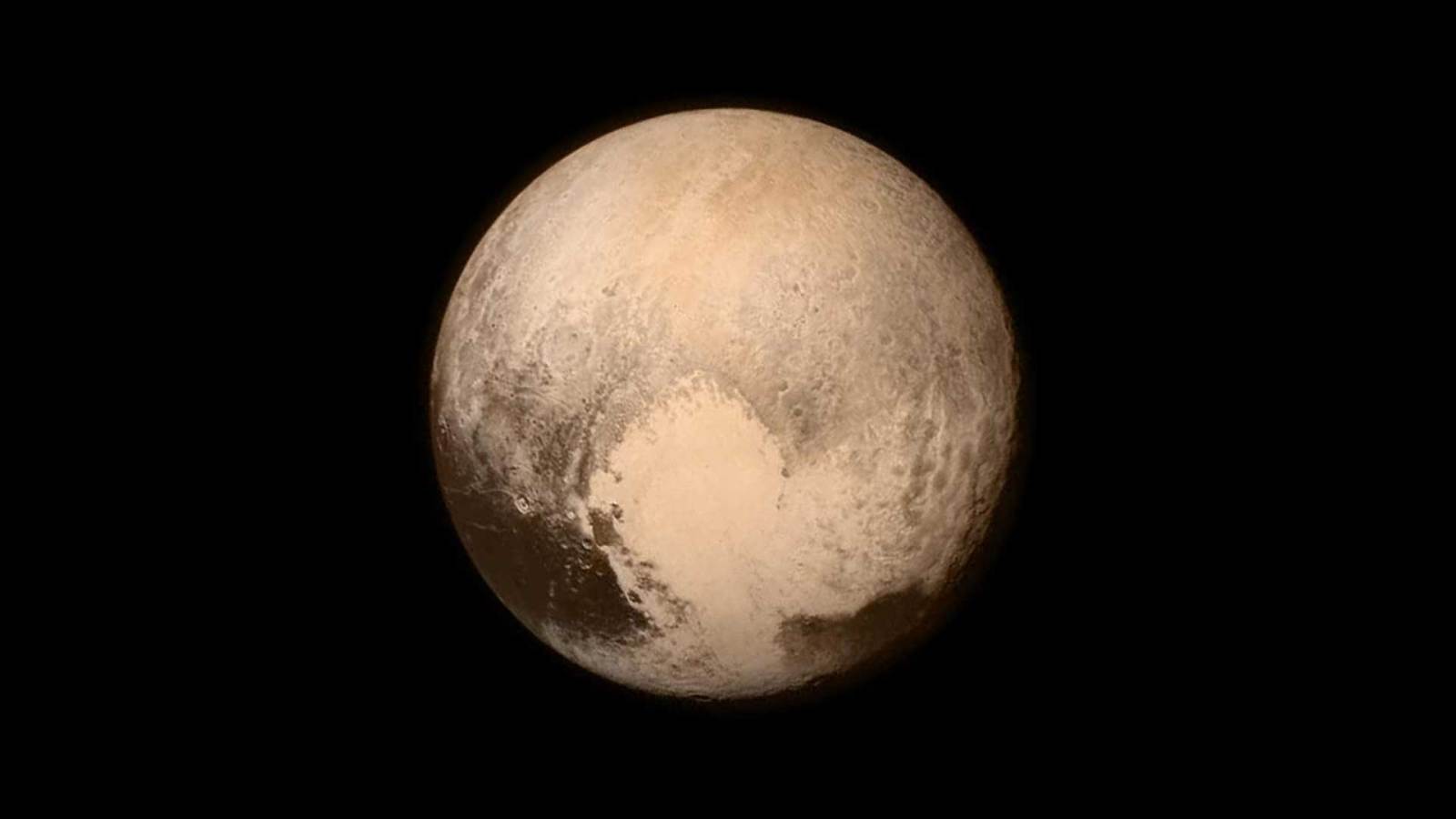
New Horizons resolved Pluto’s mountains, varied surface ices, haze layers and the large plain called Sputnik Planitia. These observations replaced a distant point or blurred disc with an actual landscape. They also showed why a body’s orbital category cannot tell the full story of its surface and internal evolution. [3] [4]
Pluto’s nitrogen-rich surface and atmospheric processes operate under conditions very different from those on Earth. The visible patterns must be interpreted using the relevant materials and temperatures, rather than assuming that every smooth plain is rock or that every bright patch is water ice. Shape and colour are the beginning of an investigation. [3]
A small contact binary asks a different question
Arrokoth is much smaller than Pluto and has two joined lobes. New Horizons’ 2019 encounter provided a close view of an object from the cold classical Kuiper Belt. Its shape and comparatively modest geological processing offer information about the assembly of small bodies, rather than another example of Pluto-like terrain. [4] [1]
A contact binary’s shape constrains formation scenarios, but it is not a film of the original collision. Researchers combine the observed geometry, surface properties and physical models to test how its components could have come together. A persuasive formation explanation must account for the actual object, including uncertainties in the reconstructed shape. [4]
Not every distant object belongs to the same orbital group
Scattered objects can follow strongly eccentric or inclined orbits extending far beyond the main Kuiper Belt. Eris illustrates why “beyond Neptune” is a broader description than “in the classical belt.” Its present distance is only one point in an elongated orbit. A semimajor axis, eccentricity and orbital inclination describe different parts of that geometry. [1] [2]
This atlas therefore keeps the recognized dwarf planets together as a useful category while retaining their different orbital information. Ceres is in the asteroid belt, Pluto is beyond Neptune and Eris has its own outer orbit. “Dwarf planet” is not a region, a composition or a guarantee that close-up surface imagery exists. [1] [5]
The Oort Cloud rests on a different kind of evidence
The Oort Cloud is a proposed, much more distant reservoir inferred largely from the orbits of long-period comets. It has not been directly photographed as a surrounding cloud of bodies. Estimates for its extent span thousands to tens of thousands of astronomical units, far outside the scale occupied by the planets and the Kuiper Belt. [6]
A planetary diagram should preserve that distinction. Placing a nearby, sharply edged Oort ring just outside Neptune would imply both the wrong geometry and the wrong scale. The useful connection is dynamical: distant reservoirs can supply comets whose changed orbits bring them inward. A close spacecraft image of a comet does not by itself reveal that comet’s entire origin story. [6] [1]
Read the evidence
Sources & image credits
- NASA · Kuiper Belt populations and structure ↗
- JPL · small-body orbits and ephemerides ↗
- NASA · Pluto’s geology and atmosphere ↗
- NASA · New Horizons at Pluto and Arrokoth ↗
- NASA · asteroid populations, composition and exploration ↗
- NASA · the proposed Oort Cloud ↗
Technical explanation by Spacian, reviewed against the linked sources. Photographs retain their original dates, creators and reuse terms in their captions. Original diagrams explain mechanisms and do not reproduce engineering drawings or flight telemetry. Editorial policy and corrections.