

Solar System / 02Small worlds
What the asteroid belt actually contains
Lucy’s route from main-belt encounters toward the Jupiter Trojans makes an important distinction visible: the asteroid belt and the Trojan populations are different orbital environments. The belt is a broad collection of bodies between Mars and Jupiter, not a dense wall of tumbling rocks.
Why spacecraft do not weave between boulders
Asteroids occupy a large volume of space. Their dimensions are tiny compared with the distances separating most bodies, even in the main belt. A scene that draws hundreds of visible dots compresses that disparity to make a population understandable. It should not be read as the view through a spacecraft window. [1]
The belt also has thickness and structure. Its members have different eccentricities and inclinations, so they do not all follow one flat, circular track. A dot’s position in a schematic diagram is therefore not an ephemeris. Navigating to an individual target requires a trajectory calculation using the relevant orbital data. [2] [1]
A surviving population from planet formation
The belt contains material left from the Solar System’s early development, subsequently changed by collisions, heating and orbital evolution. It is not well described as the pieces of one modern planet that suddenly exploded. Its total material and diverse objects preserve a more complicated history of incomplete growth and later processing. [1] [3]
Jupiter helped shape this environment. Repeated gravitational interactions can alter small-body orbits, while collisions fragment and redistribute objects. Some fragments become members of identifiable families. Present location is consequently one part of an asteroid’s story; it is not a guarantee that the body formed exactly where it is now. [1]
The gaps are orbital relationships
At an orbital resonance, an asteroid’s period has a simple relationship to Jupiter’s. In a 3:1 resonance, for example, the asteroid completes about three solar orbits during one of Jupiter’s. Repeated perturbations can then change its orbit efficiently. This helps explain why the distribution of main-belt semimajor axes contains prominent gaps. [1] [2]
A gap in this distribution is not an empty radial tunnel with a sharply defined wall. Real orbits have different shapes and orientations. The useful distinction is between a statistical pattern in orbital elements and a literal photograph of the population. The diagram’s broad band communicates the first kind of structure only approximately. [2]
Ceres and Vesta did not evolve alike
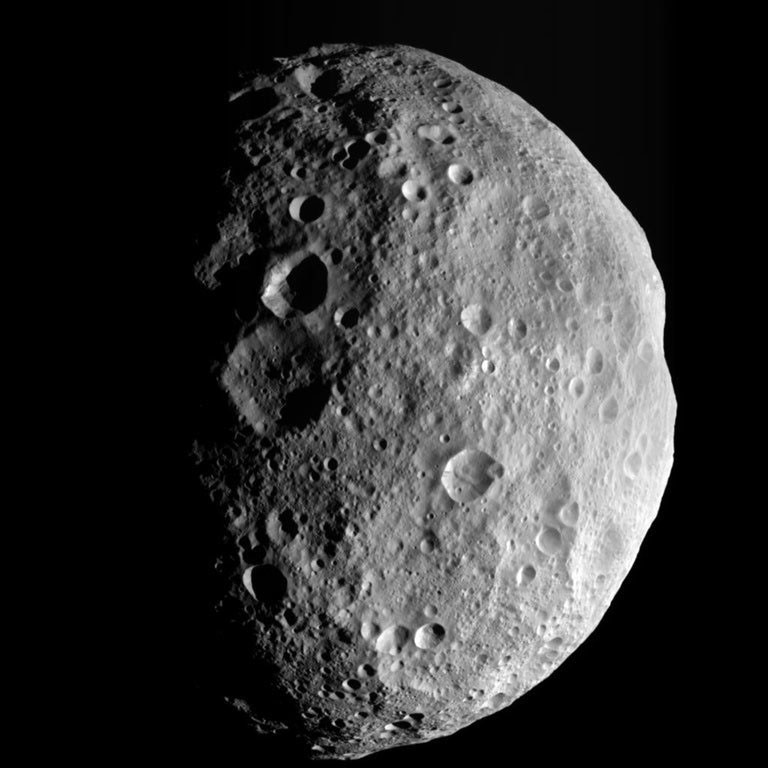
Dawn investigated both Vesta and Ceres, using the same spacecraft to compare very different bodies. Vesta preserves a differentiated rocky history and large impact basins. Its connection to a family of meteorites also lets laboratory samples on Earth contribute to the interpretation of spacecraft measurements. [3]
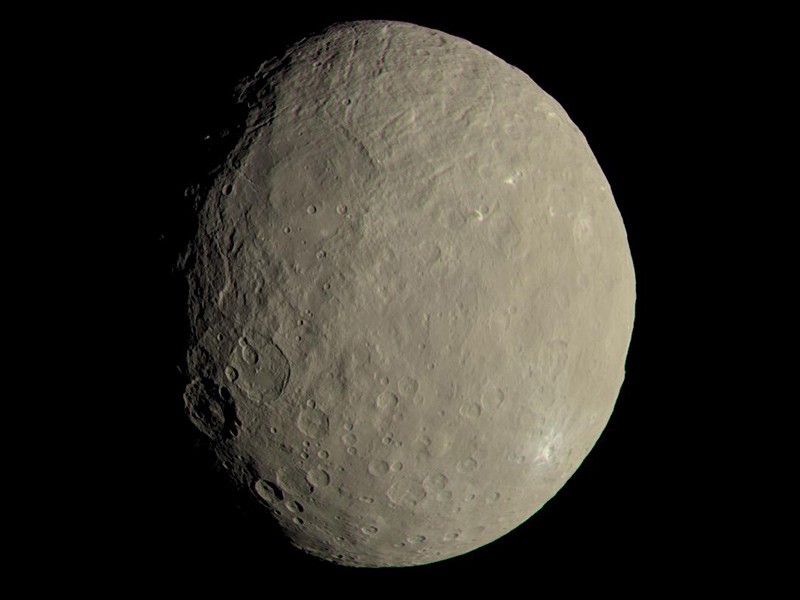
Ceres is a dwarf planet with abundant evidence for ice and salts. Its bright deposits are not simply the same material seen on Vesta under different lighting. Comparing the two demonstrates why a region label such as “main belt” cannot replace a body’s geology, composition and thermal history. [3]
How a remote asteroid becomes a scientific target
A spectrum helps constrain surface composition; a light curve constrains aspects of shape and rotation; thermal observations help estimate size. Each measurement comes with a model and uncertainties. A metallic-looking illustration or a taxonomic label is not a complete description of the interior. [1] [4]
Psyche’s spacecraft investigation is intended to test the properties of a metal-rich asteroid directly. Lucy’s observations address a different selected population around Jupiter’s orbit. Following the specific question and the actual target is more useful than treating every asteroid mission as a repeat visit to the same kind of rock. [4] [5]
Read the evidence
Sources & image credits
- NASA · asteroid populations, composition and exploration ↗
- JPL · small-body orbits and ephemerides ↗
- NASA · Dawn’s investigations of Vesta and Ceres ↗
- NASA · Psyche mission and scientific questions ↗
- NASA · Lucy’s main-belt and Trojan encounters ↗
Technical explanation by Spacian, reviewed against the linked sources. Photographs retain their original dates, creators and reuse terms in their captions. Original diagrams explain mechanisms and do not reproduce engineering drawings or flight telemetry. Editorial policy and corrections.
Continue the story
Continue exploring
 Small worlds
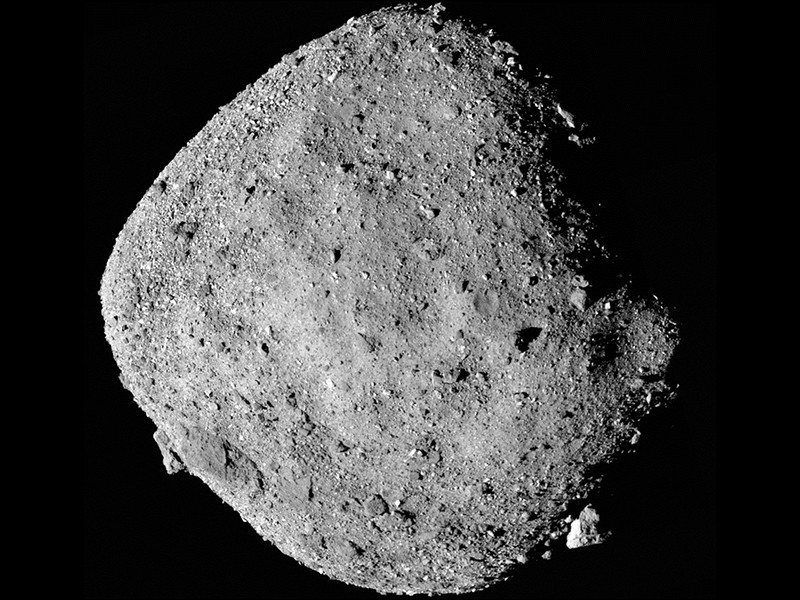
Why bring asteroid material home?
Connect an asteroid’s sampled surface to laboratory measurements of salts and organic compounds, with the limits of those interpretations.
Read the explanation