

Solar System / 03Small worlds
What the Bennu samples let scientists measure
OSIRIS-REx returned material from Bennu to Earth in 2023. The scientific advantage was access: researchers could apply several laboratory techniques to carefully documented grains instead of relying only on instruments carried by the spacecraft.
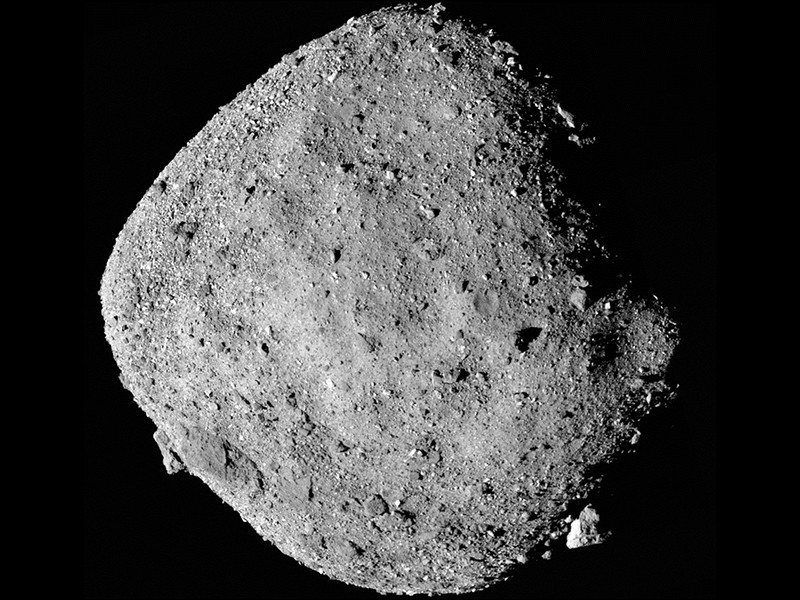
The surface observation remains part of the sample
Bennu is a rubble-pile asteroid, assembled from material with an earlier history. Its present surface contains boulders and finer particles rather than a uniform, solid shell. A returned grain must therefore be connected to the sampling site and to what the spacecraft observed there. The collection is not an average scoop from the entire asteroid. [1] [2]
OSIRIS-REx mapped Bennu before sampling it. Images and shape data helped the team understand its terrain and choose a site. Those records continue to matter in the laboratory: chemistry describes the material in a particular piece, while the remote observations describe how that piece fits into the sampled environment. [1] [2]
Why returned samples differ from ordinary meteorites
Meteorites are indispensable samples of other bodies, but passage through Earth’s atmosphere and later exposure can alter them. Water, organisms and handling on Earth can complicate the interpretation of small concentrations of compounds. A sample-return mission documents a collection and transport history designed to reduce those ambiguities. [3] [4]
That does not mean every laboratory signal is automatically extraterrestrial. Researchers still use procedural blanks, comparison materials and independent analyses. The claim must survive checks on contamination and on what the analytical method itself can produce. Sample curation and laboratory controls are part of the evidence, not just packaging around it. [3] [4]
Minerals can preserve a history of brine
Analyses reported in January 2025 identified several salt minerals in Bennu material. Together with water-rich minerals, they support a history in which liquid water interacted with rock in Bennu’s parent body. Evaporation of a solution concentrates dissolved substances and can leave different minerals as solid deposits. [5]
The interpretation concerns an earlier, larger parent body and its chemical evolution. It does not imply that liquid lakes persist on Bennu’s exposed surface today. Connecting mineral associations, textures and chemistry is what allows the earlier aqueous environment to be reconstructed. The asteroid’s current appearance alone would not reveal that sequence. [5] [4]
Useful chemistry is not the same as living chemistry
The samples contain a diverse collection of organic compounds, including amino acids and the canonical nucleobases used by terrestrial life. These molecules are scientifically important because they show that components relevant to prebiotic chemistry can form and survive outside Earth. Their presence does not identify a cell, metabolism or biological process. [4] [3]
Researchers also examine molecular distributions and handedness rather than counting familiar molecule names. Different grains can preserve different chemical environments. The result is a more detailed picture of extraterrestrial reaction networks, with uncertainty about the precise paths that produced every compound. “Ingredients for life” is a description of chemical relevance, not a life-detection verdict. [4] [3]
A collection becomes more valuable through comparison
Measurements from multiple grains help distinguish a recurring property from an unusual fragment. Comparison with meteorites and with other returned asteroid samples tests how representative Bennu is. Bodies can share broad compositional categories while preserving different histories of heating, mixing and water–rock reactions. [4]
The samples can also outlast the instrument that first studied them. Preserved material allows later laboratories to ask new questions, often using smaller quantities and more sensitive methods. The enduring value of sample return is this combination: documented material, its original field context and the ability to measure it again. [1] [3]
Read the evidence
Sources & image credits
- NASA · OSIRIS-REx sampling and return ↗
- NASA SVS · Bennu shape and surface data from OSIRIS-REx ↗
- NASA NTRS · ammonia and soluble organic matter in Bennu samples ↗
- Glavin et al. · organic compounds and aqueous alteration in Bennu samples ↗
- NASA · salts and organic compounds in Bennu samples, January 2025 ↗
Technical explanation by Spacian, reviewed against the linked sources. Photographs retain their original dates, creators and reuse terms in their captions. Original diagrams explain mechanisms and do not reproduce engineering drawings or flight telemetry. Editorial policy and corrections.
Continue the story
Continue exploring
 Small worlds
The asteroid belt is mostly space
Understand the belt’s sparse population, Jupiter’s resonances and the different histories preserved by its larger objects.
Read the explanation