

Solar System / 06Ocean moons
How do we know Europa may have an ocean?
Europa Clipper is travelling to Jupiter to investigate whether Europa has environments that could support life. Its target is largely hidden beneath ice. The ocean hypothesis comes from several measurements that constrain the interior in different ways, rather than a photograph of liquid water.
A changing magnetic field probes an unseen conductor
Europa moves through Jupiter’s magnetic environment. Because Jupiter’s magnetic field is tilted relative to its rotation axis, the field experienced by the moon changes with time. Galileo detected a magnetic response consistent with electrical currents induced inside Europa. A conductive layer can generate its own field in response to the changing external one. [1] [2]
Salty liquid water is an effective conductor, making a global subsurface ocean a strong explanation for that response. The instrument did not collect ocean water or directly measure its depth. Interpreting the signal requires models of the external field, the conductor’s properties and other magnetic effects around the moon. The inference is physical, but it is not a simple photograph through the ice. [1]
Fractures show activity, but not an open sea
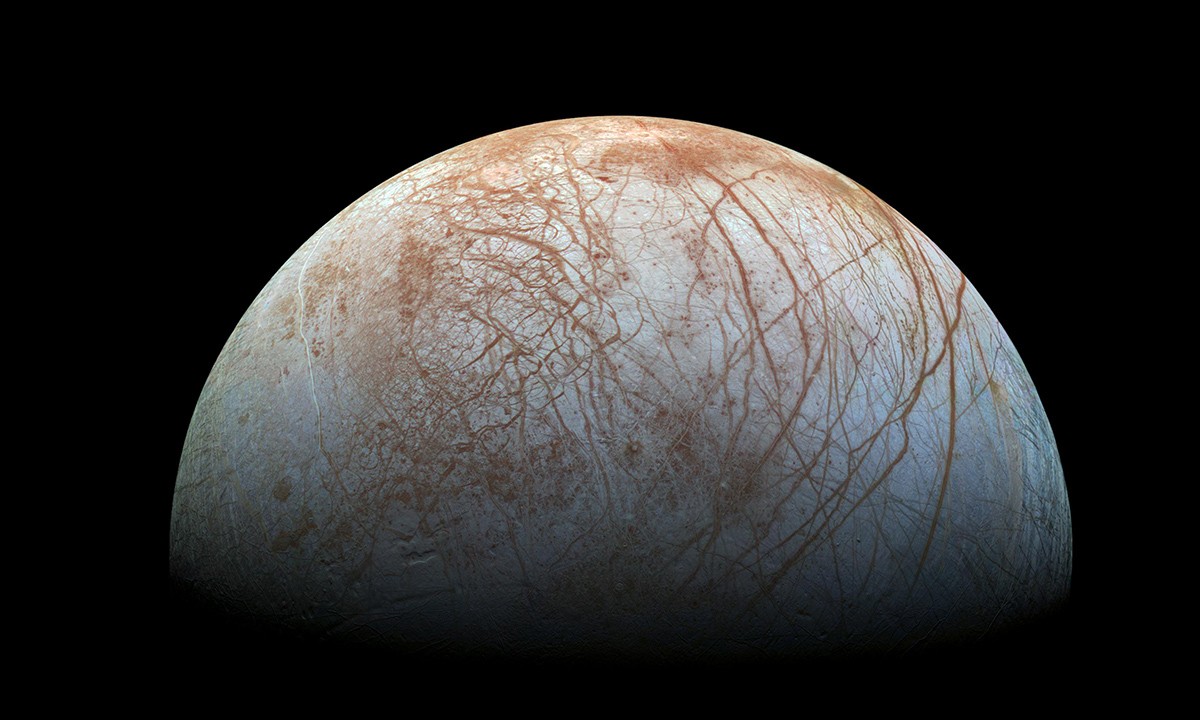
Europa’s visible surface contains long fractures, ridges and disrupted areas called chaos terrain. There are relatively few large impact craters compared with many older icy surfaces. Together, these features indicate that the surface has been modified. They provide a second line of inquiry independent of the magnetic measurements. [2]
Several processes can deform ice or move material through it. A blocky patch does not uniquely reveal how far the ocean lies underneath or whether liquid reached that exact location. The useful question is which combination of ice motion, heat and exchange can explain the observed structures. Matching photographs to composition and geophysical measurements helps distinguish those possibilities. [2] [3]
Why a moon so far from the Sun can remain active
Europa’s slightly eccentric orbit changes the gravitational pull it experiences from Jupiter. The resulting tides repeatedly deform the moon. Dissipation of that mechanical energy supplies heat, alongside other sources such as radioactive decay. The orbital relationship with neighbouring moons helps sustain the eccentricity instead of allowing the orbit simply to become circular. [2]
Tidal heating does not imply that every part of the ice has the same temperature or that every fracture opens into the ocean. Where energy is dissipated depends on the properties and structure of the interior. The ice shell, ocean and rocky material form a coupled system, with important uncertainties in how heat and chemicals move between them. [2] [3]
Why Clipper circles Jupiter instead of Europa
Jupiter’s radiation environment is severe near Europa. Clipper’s trajectory uses repeated close flybys while the spacecraft spends much of its orbit farther from that environment. Each encounter can investigate selected terrain; the collection of encounters is designed to build a broader picture rather than stare continuously from a low Europa orbit. [3]
Cameras map geology, spectrometers investigate composition, ice-penetrating radar examines subsurface structure, and magnetic and plasma measurements help constrain the ocean. None works in isolation. For example, a radar reflection needs a geological and physical interpretation; it should not automatically be labelled the bottom of the entire ice shell. [3]
Test the environment before claiming inhabitants
Habitability asks whether an environment has suitable chemistry, energy and physical conditions for life as we understand it. Europa’s ocean makes that question compelling, but water alone is insufficient. Scientists need to understand the ocean’s composition, its contact with rock and possible exchange through the overlying ice. Clipper is a habitability investigation, not a mission designed to confirm organisms. [3]
ESA’s Juice provides complementary exploration of Jupiter’s icy moons, with a particular emphasis on Ganymede. Comparing Europa, Ganymede and Callisto tests why apparently related icy worlds evolved differently. Their images, magnetic signatures and orbital settings should be compared as separate records, rather than assigning an identical hidden ocean to every bright moon. [4] [2]
Read the evidence
Sources & image credits
- NASA · induced magnetic field from Europa’s subsurface ocean ↗
- NASA · Europa and evidence for an ocean ↗
- NASA · Europa Clipper’s habitability investigation ↗
- ESA · Juice’s ocean-moon investigations ↗
Technical explanation by Spacian, reviewed against the linked sources. Photographs retain their original dates, creators and reuse terms in their captions. Original diagrams explain mechanisms and do not reproduce engineering drawings or flight telemetry. Editorial policy and corrections.
Continue the story
Continue exploring
 Ocean moons
Methane weather and organic chemistry
Follow methane through Titan’s atmosphere and surface, and understand why Dragonfly will sample different geological settings.
Read the explanation