

Solar System / 07Ocean moons
Titan has rain and rivers. What flows through them?
Dragonfly is planned to investigate Titan’s surface chemistry by visiting multiple locations with a rotorcraft. Cassini and the Huygens probe established the setting for those measurements: a dense atmosphere, drainage channels, dunes and lakes on a world cold enough for methane weather.
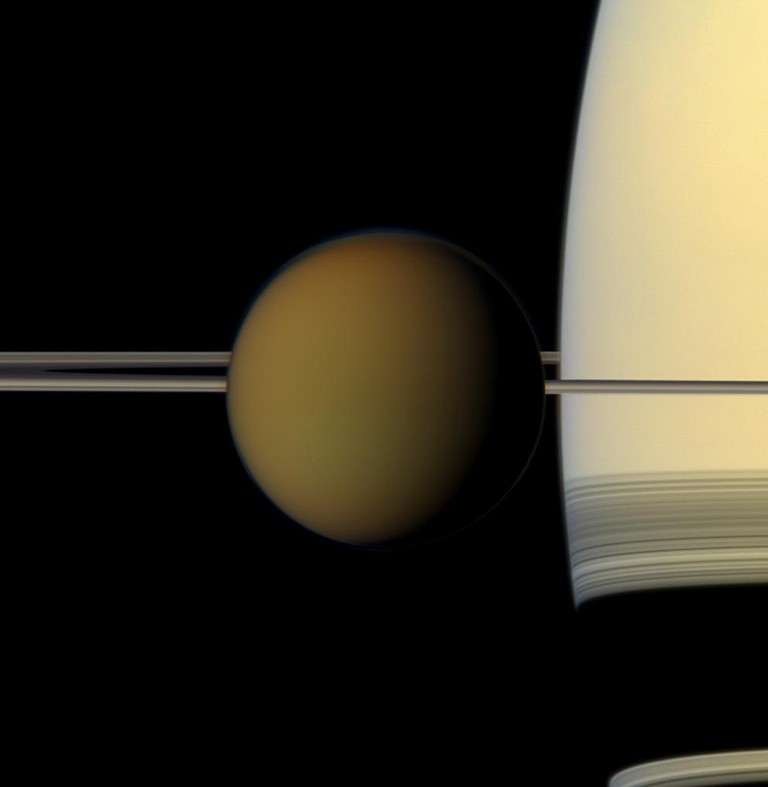
Separate the liquid weather from the icy ground
At Titan’s surface temperatures, water is frozen hard. Methane and ethane can exist as liquids. Titan therefore has familiar-looking landforms made by a different combination of materials from those we usually encounter on Earth: hydrocarbon rain can move sediment over terrain in which water ice is part of the solid foundation. [1]
Calling a dark patch a lake does not establish its composition from appearance alone. Cassini used several instruments, including radar, to investigate the surface through the atmosphere. The interpretation of lakes, seas and drainage networks rests on those measurements and their geometry, not simply on the fact that a map looks Earth-like. [1] [2]
A methane cycle connects air, rain and lakes
Methane evaporates, enters the atmosphere, forms clouds and can fall as rain. Flowing liquid cuts channels and transports material before collecting or soaking into the ground. Seasonal illumination changes where clouds and precipitation occur. A map from one encounter is consequently a record of a particular time, rather than a complete description of every season. [1] [2]
Cassini’s repeated observations made it possible to study changes as well as geography. Radar revealed large northern seas, while other observations tracked clouds and atmospheric behaviour. Combining those views helps connect a local channel or lake to circulation and weather on a much larger scale. [2]
Sunlight begins reactions high above the surface
Titan’s atmosphere is mostly nitrogen with methane. Solar ultraviolet light and energetic particles can break molecules apart, allowing new compounds to form. Chains of reactions produce a rich mixture of carbon-bearing material and contribute to the atmospheric haze. Material made aloft can eventually become part of the surface environment. [1] [2]
Webb observations reported in 2025 detected the methyl radical, a reactive fragment associated with methane chemistry. Such detections constrain actual reactions; they are more informative than describing the haze only as “organic”. Organic means carbon-bearing in this context. It does not identify an organism or establish that a reaction was biological. [3]
A landing provides context that an orbital map cannot
Huygens descended through Titan’s atmosphere and reached the surface in 2005. Its measurements and descent images tied atmospheric conditions to a specific landscape. Rounded surface objects and drainage patterns helped establish the role of flowing liquids, but one landing site could not represent every dune, plain or polar lake on the moon. [2]
A chemical measurement becomes more useful when its geological setting is known. Windblown dune material, a drainage deposit and material changed by an impact may preserve different histories. Sampling more than one setting is a way to distinguish chemistry common across Titan from chemistry produced by a particular local process. [4] [2]
Why move between sampling sites?
Titan’s dense atmosphere and low gravity make flight practical for the planned Dragonfly rotorcraft. Its scientific purpose is to compare surface materials and investigate the steps by which complex chemistry develops. Moving between sites connects laboratory-style measurements to a wider geological map instead of assuming that one collected sample describes the entire world. [4]
The mission’s measurements can test ingredients, reaction environments and preservation. They should remain separate from speculation about possible life in methane or in a deeper water ocean. Titan is valuable because it provides a chemically rich natural experiment whose conditions differ sharply from Earth’s; establishing what happened there requires measured compounds and their context. [4] [1]
Read the evidence
Sources & image credits
- NASA · Titan’s atmosphere, surface and methane cycle ↗
- NASA · Cassini’s Titan science ↗
- NASA Webb · chemistry in Titan’s atmosphere ↗
- NASA · Dragonfly’s surface-science mission ↗
Technical explanation by Spacian, reviewed against the linked sources. Photographs retain their original dates, creators and reuse terms in their captions. Original diagrams explain mechanisms and do not reproduce engineering drawings or flight telemetry. Editorial policy and corrections.
Continue the story
Continue exploring
 Ocean moons
The ocean we cannot photograph
Trace the evidence for a hidden ocean from an induced magnetic field to fractured ice, then see what Europa Clipper can test.
Read the explanation Small worlds
Why bring asteroid material home?
Connect an asteroid’s sampled surface to laboratory measurements of salts and organic compounds, with the limits of those interpretations.
Read the explanation