

Moon atlas / 05Moon
Why landing on the Moon is still hard
Artemis IV’s planned surface expedition depends on a human landing system descending from lunar orbit and returning the crew afterward. Robotic landers have demonstrated parts of that task at a smaller scale. Their results show why reaching lunar orbit, touching the ground and completing surface science are three different milestones.
There is no substantial atmosphere to do the braking
The Moon’s extremely tenuous exosphere cannot provide the aerodynamic braking used by a parachute. A lander must remove speed through propulsion. Arriving from orbit involves sideways motion as well as downward motion, so a safe descent is more than holding the vehicle above the surface and letting it fall. [1]
Lunar surface gravity is about 1.62 metres per second squared, roughly one sixth of Earth’s. That lowers the thrust needed to support a given mass near the ground. It does not eliminate the fuel needed to change velocity or the need to manage the descent precisely. The spacecraft still has limited propellant and a particular range of controllable engine thrust. [1] [2]
A safe target is smaller than a landing region
An orbital map helps select a region, but the vehicle must reach a sufficiently safe patch within it. Boulders, steep slopes and crater rims are hazards. Terrain-relative navigation compares observations with mapped features; local sensing can help estimate altitude, speed and the character of the ground below. Different missions carry different combinations of sensors. [2] [3]
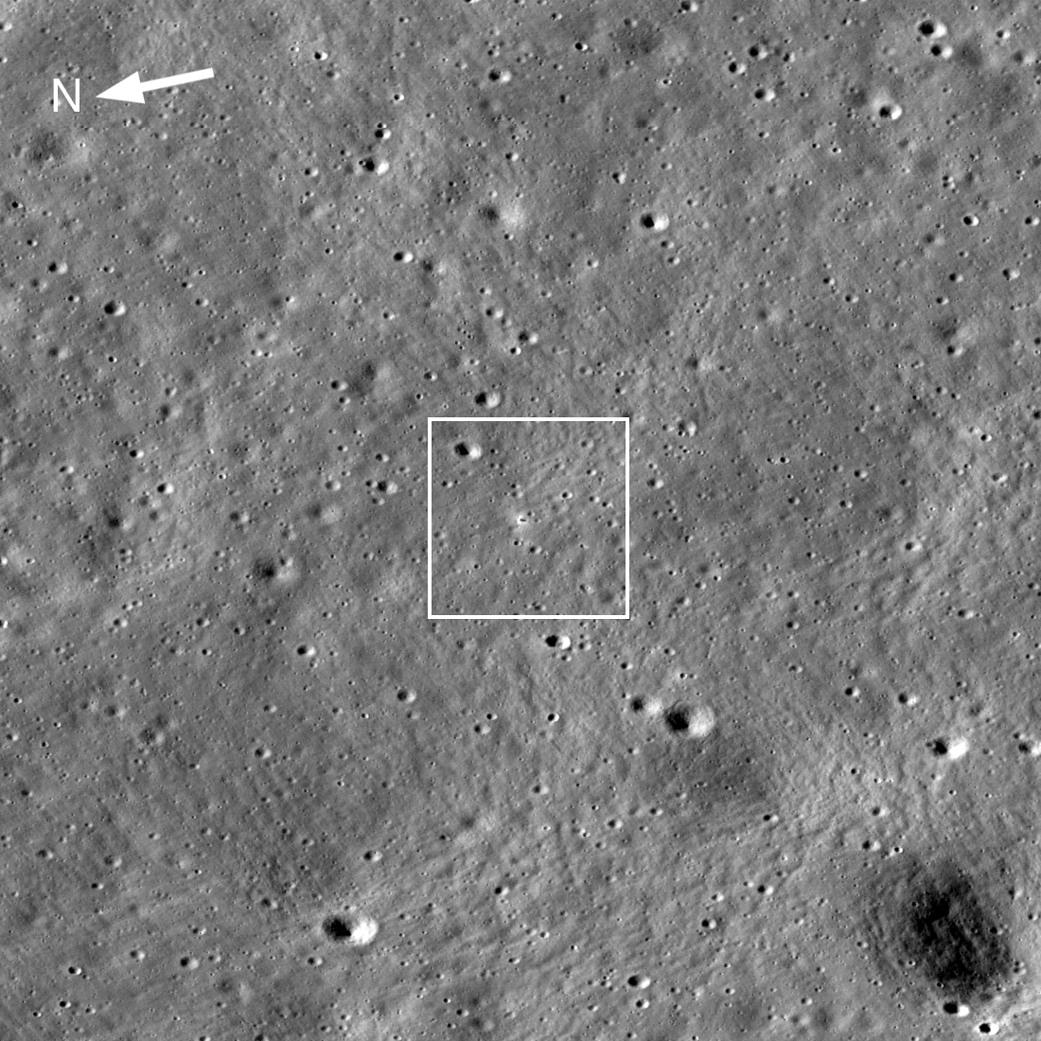
The small pin on this atlas represents a published location or a regional centre. It is not a navigational map for a lander. A 2,048-pixel global colour mosaic cannot resolve individual landing hazards. The linked high-resolution orbital photographs provide a different scale of information and should not be confused with the globe’s visual texture. [3]
The engine changes the ground it is approaching
Near touchdown, exhaust interacts with the loose regolith. Dust and other particles can be accelerated outward, changing visibility and exposing nearby hardware to a plume-driven environment. This is a local interaction between the vehicle, its engines and the surface, rather than a windstorm caused by a lunar atmosphere. [4]
NASA’s SCALPSS 1.1 cameras observed this interaction during Blue Ghost Mission 1’s landing on 2 March 2025. Several overlapping views help reconstruct the surface and its changes. These measurements are useful because larger landers may disturb the surface differently; a small lander’s image sequence is evidence, not a universal dust curve for every future engine. [4]
Contact with the ground is not the end of the landing problem
A vehicle must settle into an attitude compatible with its structure, power, thermal design, communications and instruments. A lander can reach the ground yet tip, obstruct an antenna or leave a solar panel poorly oriented. Mission results therefore need more detail than a single success label. [5]
Chandrayaan-3’s Vikram lander and Pragyan rover completed a successful 2023 surface investigation. Other recent landers have had limited operations after an off-nominal touchdown. The atlas preserves the source launch outcome separately from later landing events, so a successful rocket flight does not imply that every payload achieved its surface objectives. [5]
A crewed expedition also has to leave
Artemis IV’s published concept places two astronauts on the surface for approximately a week, then returns them to lunar orbit to rejoin the other crew members. Ascent, rendezvous and the return to Earth are part of the expedition’s required chain of operations. A beautiful touchdown sequence shows only one part of that chain. [2]
Apollo ascent records in the mission archive are kept as separate flight legs, with their original identities. They are not additional crews arriving from Earth. Use the launch title, event type and program relationship when moving through the archive: those distinctions make a long exploration history understandable without flattening it into a count of “Moon missions.” [5]
Read the evidence
Sources & image credits
- NASA NSSDC · Moon fact sheet ↗
- NASA · Artemis IV surface expedition ↗
- NASA SVS · LROC colour and LOLA elevation maps ↗
- NASA · SCALPSS observes Blue Ghost’s landing ↗
- NASA · Lunar exploration mission archive ↗
Technical explanation by Spacian, reviewed against the linked sources. Photographs retain their original dates, creators and reuse terms in their captions. Original diagrams explain mechanisms and do not reproduce engineering drawings or flight telemetry. Editorial policy and corrections.
Articles
More about the Moon
 Moon
Sunlight, shadows and polar ice
Follow grazing sunlight across polar terrain, separate evidence for water from an accessible resource, and understand why a landing region is not a landing point.
Read the explanation Moon
The distance a radio signal crosses
Compare Earth and the Moon on one physical scale, calculate radio travel time, and see why geometry matters more than a simple distance number.
Read the explanation