

Moon atlas / 06Moon
Put the Moon at its real distance
Artemis IV’s planned surface crew will work hundreds of thousands of kilometres from Earth. A radio signal can cross that distance in a little over a second, yet direct contact still depends on where the spacecraft and terrain are. Start by putting both worlds on the same physical scale.
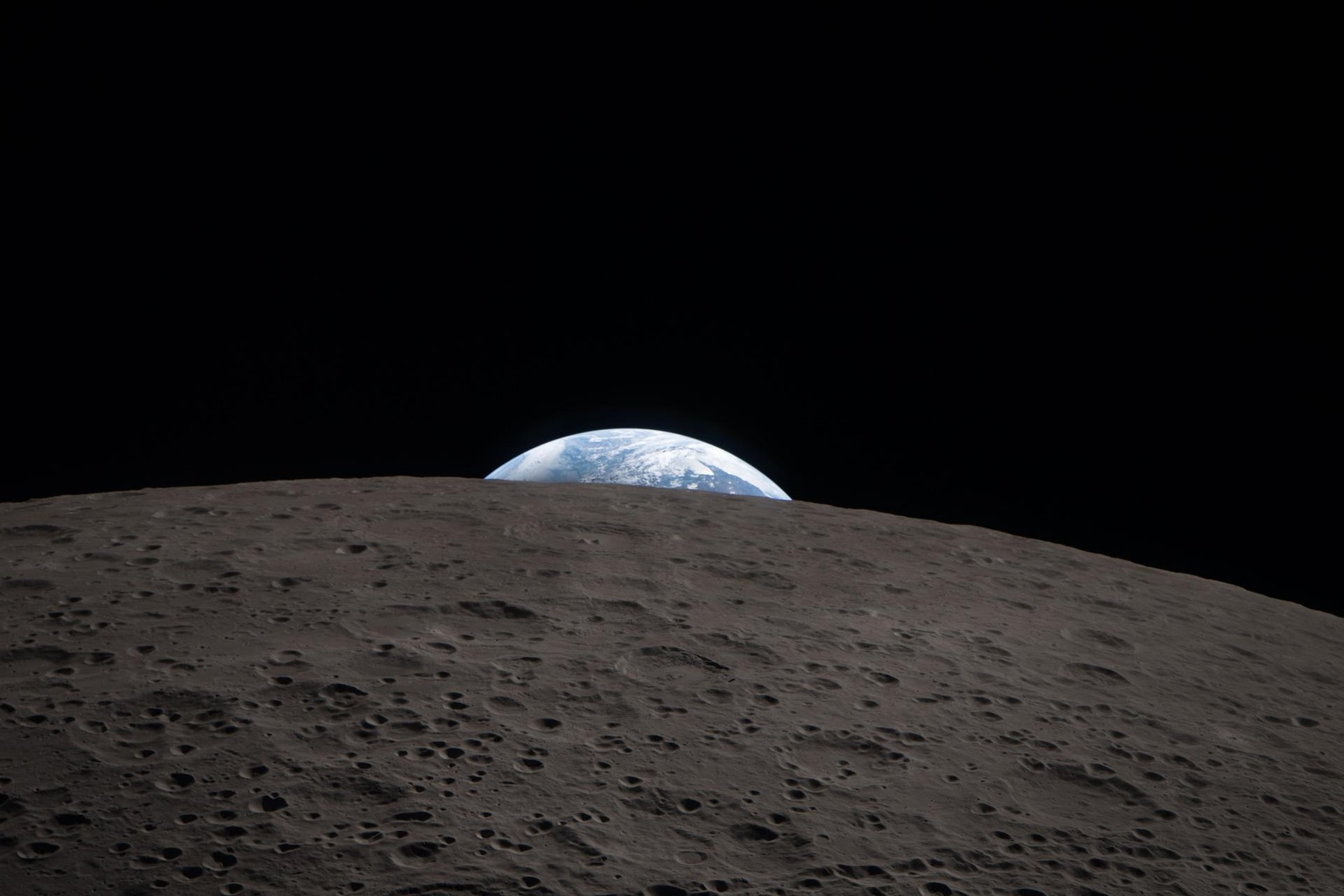
The nearby-looking Moon is about thirty Earth diameters away
Earth’s mean diameter is about 12,742 kilometres. The Moon’s is about 3,474.8 kilometres, or 27.27 percent as large. Their mean centre-to-centre separation is about 384,400 kilometres. Divide the separation by Earth’s diameter and the answer is about 30.17 Earth diameters. This is why a truthful scale drawing needs a long horizontal strip or very small worlds. [1]
The number refers to the centres. The surface-to-surface gap is smaller by one Earth radius and one Moon radius: about 376,292 kilometres at that mean separation, using the same mean radii. A diagram can use either definition, but its labels must say which. The atlas’s distance tool uses centres so its radio calculation and geometry share one explicit reference. [1]
One diameter scale
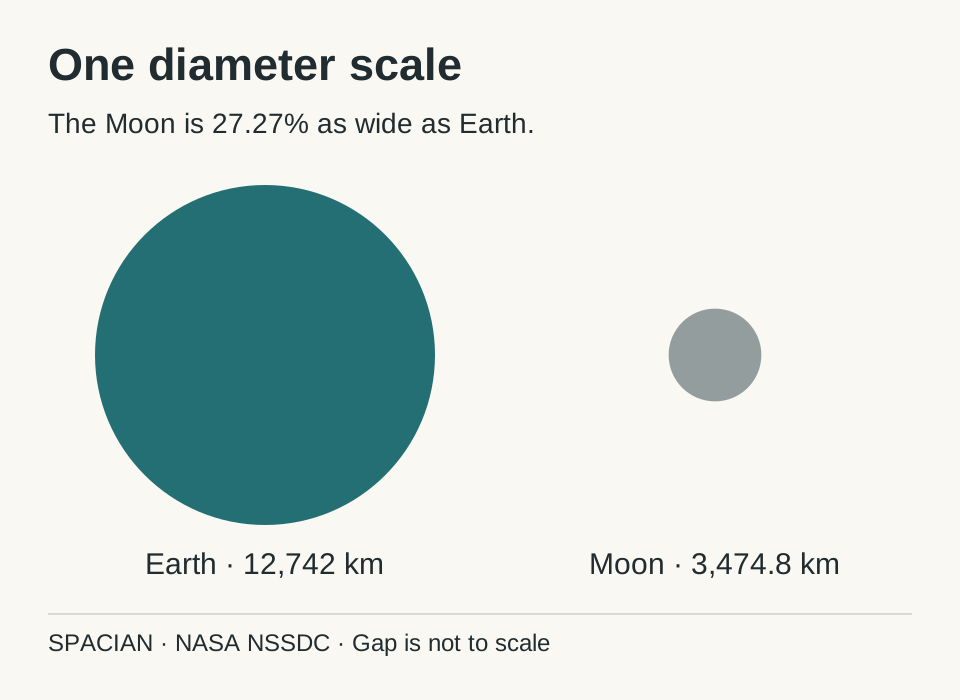
Mean diameters use one common scale. The gap is illustrative; the distance tool in the atlas separately draws the true separation.
- Divide the Moon’s mean diameter, 3,474.8 km, by Earth’s 12,742 km: 0.272704.
- The Earth circle has a radius of 170 pixels; the Moon circle uses 46.359 pixels on the same scale.
- The gap has no orbital-distance meaning. The atlas’s separate distance tool uses a common size and distance scale.
Original Spacian illustration · [1] Download diagram ↗
There is no single permanent Earth–Moon distance
The lunar orbit is elliptical. NASA’s fact sheet lists a mean perigee distance of about 363,300 kilometres and a mean apogee distance of about 405,500 kilometres. These are average orbital reference values, not the closest and farthest distances ever possible and not today’s measurements. The slider uses them as an illustrative range. [1]
The Moon’s apparent size in our sky changes as its distance changes. That does not mean its physical diameter changes. Keeping object size and orbital distance as separate quantities avoids a common error in Solar System illustrations, where planets and orbits are enlarged by unrelated amounts without explanation. The atlas’s size comparison uses one common diameter scale. [1]
Calculate the propagation time before discussing the conversation
Electromagnetic signals in vacuum travel at 299,792.458 kilometres per second. At 384,400 kilometres, dividing distance by that speed gives about 1.282 seconds one way. A signal going out and an immediate reply coming back need at least about 2.564 seconds for propagation alone. That is short compared with Mars, but it is not instantaneous. [2] [1]
A real exchange also includes signal processing, network routing, relay availability and the time taken to decide or execute a response. The distance between a particular surface antenna and a particular ground station also differs from the centre-to-centre teaching model. The displayed value is an understandable approximation, rather than a prediction of a mission’s network latency. [3]
A short delay does not guarantee a direct link
A spacecraft behind the Moon cannot maintain an ordinary direct radio path through the lunar body. Even on the near side, local terrain can hide Earth below a ridge. A relay changes the path by providing a usable route between endpoints; it does not remove propagation time. [3]
That is the connection between this scale exercise and a far-side lander. Adding a relay can enable communication where a direct link is blocked, even though the total route is longer. For an operating system, coverage and reliability can matter more than reducing a few tenths of a second from an already short delay. [3]
Use three different views for three different questions
The globe helps locate terrain. The diameter comparison helps judge the relative size of Earth and the Moon. The distance strip shows their separation at one linear scale. Combining all three in a single compact drawing would make the Moon too small to explore comfortably or make the orbital gap misleading. Each view therefore states what its geometry represents. [1] [4]
For Artemis IV, the important operational questions include the landing region, the local lighting and the return to lunar orbit. The mission record carries its current published target; this article supplies the physical context. Follow both as the plan develops, keeping a planned surface expedition distinct from an outcome already achieved. [5]
Read the evidence
Sources & image credits
- NASA NSSDC · Moon fact sheet ↗
- NIST · Exact speed of light in vacuum ↗
- ESA · Lunar Pathfinder and far-side communications ↗
- NASA SVS · LROC colour and LOLA elevation maps ↗
- NASA · Artemis IV surface expedition ↗
Technical explanation by Spacian, reviewed against the linked sources. Photographs retain their original dates, creators and reuse terms in their captions. Original diagrams explain mechanisms and do not reproduce engineering drawings or flight telemetry. Editorial policy and corrections.
Articles
More about the Moon
 Moon
What changes on the far side
Compare the two hemispheres, understand why a relay is needed, and see what far-side landing and sample missions can investigate.
Read the explanationMoonWhy the Moon has phases
Follow the sunlight to distinguish phases, synchronous rotation and eclipses. A lunar orbit and a cycle of phases measure different things.
Read the explanation