

Moon atlas / 01Moon
One face, two different lunar months
Artemis IV is planned to spend about a week near the lunar South Pole. Lighting there must be planned for a particular place and time. The familiar phases in our sky are the first step toward understanding that geometry: what changes is the part of the sunlit Moon that Earth can see.
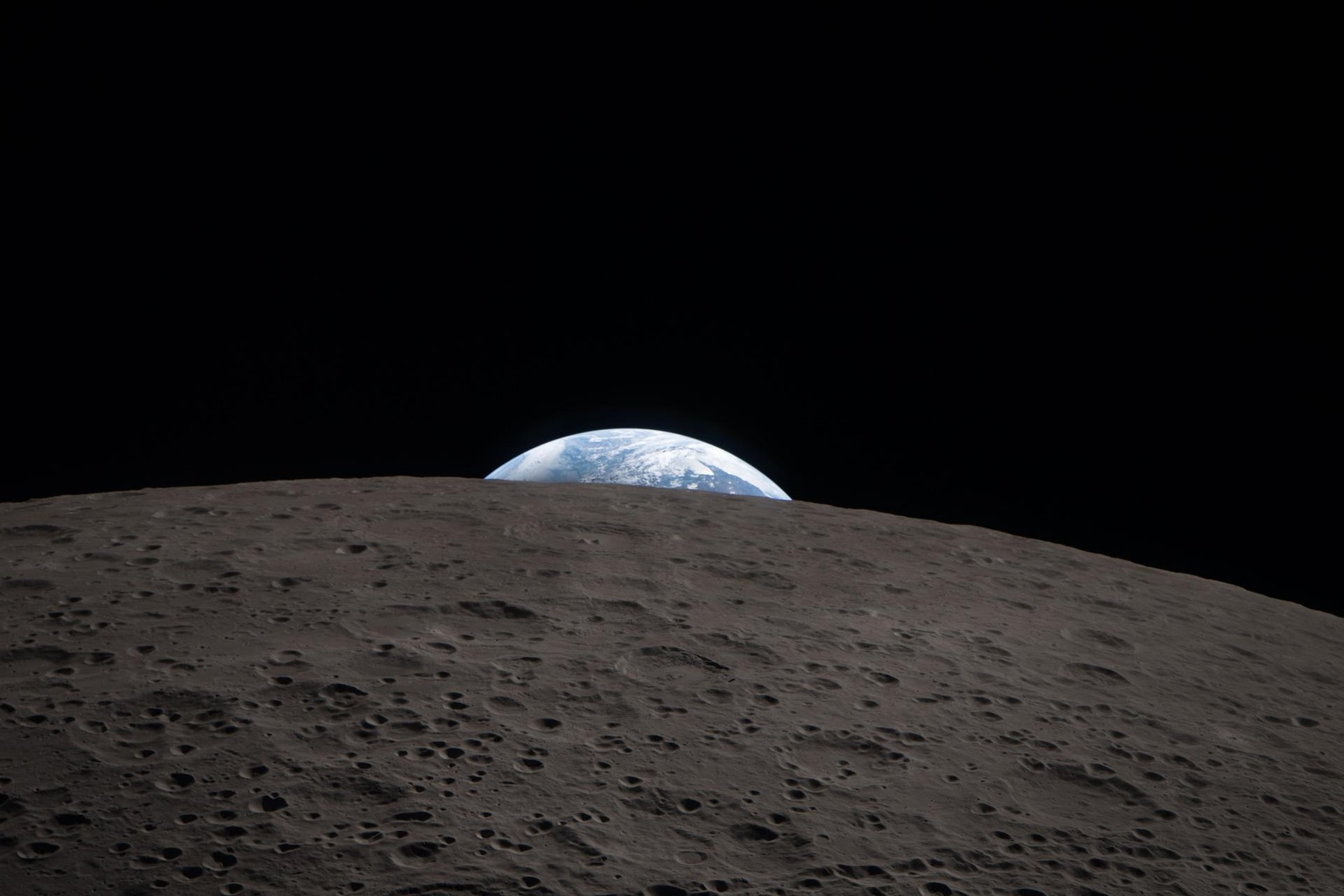
A phase is a view of sunlight
Away from an eclipse, sunlight illuminates roughly half the lunar globe. At new Moon, the Moon lies in the direction of the Sun as seen from Earth, and its illuminated hemisphere faces mostly away from us. At full Moon, it lies on the opposite side of Earth’s sky, and we see almost the whole illuminated hemisphere. Neither position normally puts the Moon inside Earth’s shadow. [1]
Between those positions, the boundary between lunar day and night—the terminator—moves across the face we see. At a quarter phase, half the visible disk is illuminated. “Quarter” refers to the progress through the phase cycle, not a quarter of the visible disk. Waxing means the illuminated fraction is increasing; waning means it is decreasing. [1]
The Moon’s two months
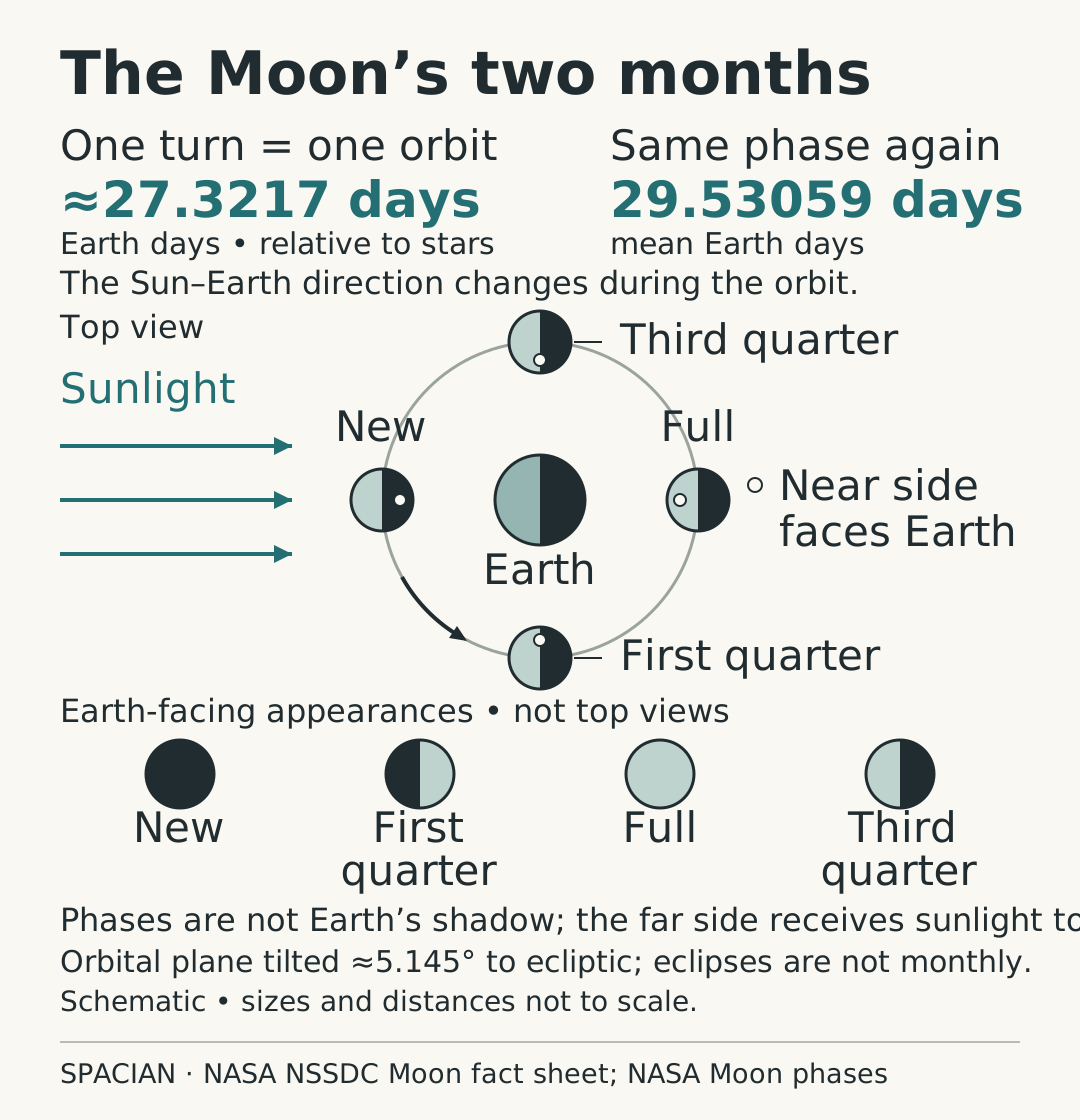
A schematic separates the orbital view from the phases seen on Earth. Sizes and distances are not to scale.
- The near side faces Earth while the Moon rotates once each orbit relative to the stars.
- Earth and the Moon move around the Sun during that orbit. Returning to the same phase takes about 29.53 days.
- The lower disks show Earth-facing appearances, while the upper diagram shows a view above the orbital plane.
Original Spacian illustration · [2] [1] Download diagram ↗
Keeping one face toward Earth requires rotation
Picture walking around a table while keeping your face toward its centre. Your direction relative to the room changes throughout the circuit. The Moon does something similar: it rotates as it orbits. One rotation relative to distant stars takes approximately 27.32 Earth days, close to the time needed for one orbit. This is synchronous rotation, commonly called tidal locking. [3] [2]
It does not mean that the Moon is stationary or that Earth always faces it with the same side. Earth rotates in about a day. Nor does it make the lunar far side permanently dark: the far side turns into sunlight during the part of the month when the near side faces away from the Sun. “Far side” describes its relation to Earth, not its lighting. [3] [1]
An orbit and a phase cycle use different reference directions
While the Moon completes an orbit, Earth and the Moon together have moved along their path around the Sun. The direction to the Sun has changed. The Moon therefore has to travel a little farther around Earth before the Sun–Earth–Moon geometry repeats. The average interval from one new Moon to the next is about 29.53 days, rather than 27.32. [2] [1]
Those are two useful clocks. The sidereal month measures the orbit relative to the stars. The synodic month measures the return of a phase relative to the Sun. The latter is also approximately the length of a solar day on much of the lunar surface: a fixed place experiences sunrise, a long daylight interval, sunset and a long night. Polar terrain makes that local cycle more complicated. [2]
Why every full Moon is not an eclipse
The lunar orbit is tilted about 5.1 degrees relative to Earth’s orbital plane. At most new and full Moons, the bodies do not line up closely enough for their shadows to produce an eclipse. A lunar eclipse occurs when the full Moon passes through Earth’s shadow. A solar eclipse occurs when the new Moon’s shadow reaches Earth. These are special alignments within the phase cycle. [2] [1]
The phase control in the atlas isolates the ordinary illumination geometry. It is a teaching model, rather than today’s lunar phase or an eclipse predictor. It keeps the geometry simple so that changing the angle has an understandable result. Accurate sky predictions also need the observation date, orbital motion and, for the view from the ground, your location. [1]
A phase does not tell you whether a particular crater is lit
An Earth-facing crescent is a description of the whole visible disk. A surface expedition needs a much more local answer: how high is the Sun above a ridge, which direction do shadows fall, and will terrain block a solar panel or a route? Near the poles, small changes in position can change those answers sharply. [4]
NASA currently describes Artemis IV as a surface expedition targeted for early 2028, with two astronauts spending approximately a week near the South Pole. Candidate regions are not a selected landing point. The next article follows the low polar Sun from the crater rim to the floor, where ordinary daylight assumptions stop working. [5]
Read the evidence
Sources & image credits
- NASA · Moon phases ↗
- NASA NSSDC · Moon fact sheet ↗
- NASA · Tidal locking ↗
- NASA · ShadowCam images of permanently shadowed terrain ↗
- NASA · Artemis IV surface expedition ↗
Technical explanation by Spacian, reviewed against the linked sources. Photographs retain their original dates, creators and reuse terms in their captions. Original diagrams explain mechanisms and do not reproduce engineering drawings or flight telemetry. Editorial policy and corrections.
Articles
More about the Moon
 Moon
Sunlight, shadows and polar ice
Follow grazing sunlight across polar terrain, separate evidence for water from an accessible resource, and understand why a landing region is not a landing point.
Read the explanationMoonThe distance a radio signal crosses
Compare Earth and the Moon on one physical scale, calculate radio travel time, and see why geometry matters more than a simple distance number.
Read the explanation