


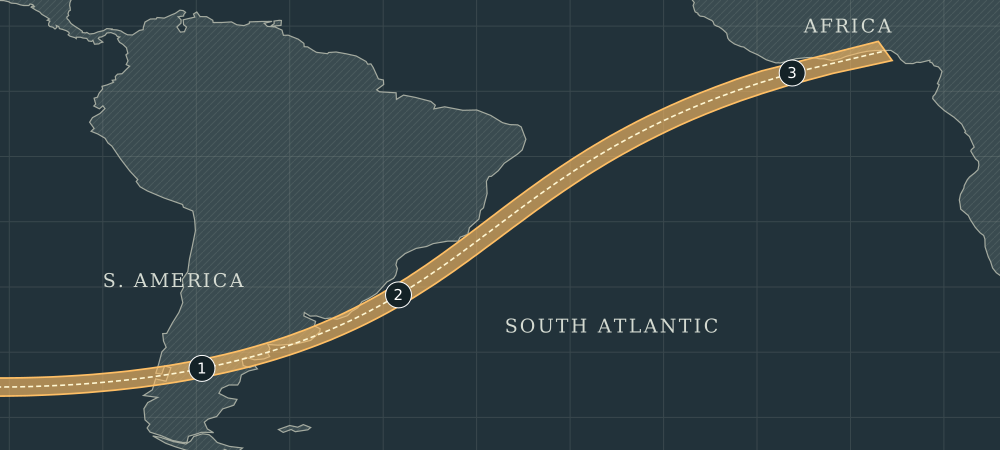
Read the two edges of the map
On NASA’s interactive map, the blue lines mark the limits of the annular path. If your viewing spot is between them, the Moon can move completely inside the Sun’s outline and leave light all the way around it. If you’re outside those lines but inside the broader visibility area, the Moon will cover only part of the Sun. Being in a country crossed by the path doesn’t tell you which view you’ll have. Choose your actual observing spot on the map.
The red line shows the centre of the path. All else being equal, moving toward it gives you more time with the ring. But it isn’t necessary to be on the line, and a clear site with an unobstructed view of the Sun matters more than squeezing out a few extra seconds. For Argentina, the National University of La Plata’s eclipse guide offers a regional reference. Along the overall path, pay attention to whether the Sun will be low: a nearby ridge or building can block a view that the map says should be possible.
Find your local start, ring and finish
The global greatest eclipse is around 16:00 UTC, over the South Atlantic. NASA’s catalog gives about 7 minutes 51 seconds of annularity there. Neither figure is your local observing schedule. The shadow travels across Earth, and its centre arrives at different places at different times. NASA Goddard’s 2027 eclipse catalog
Click your spot on the map to see the local circumstances. The first contact is when the Moon starts to cover the Sun. Inside the annular track, the next contact starts the complete ring, and another breaks it. The final contact marks the end of the partial phase. Outside the track, there’s no ring to time: check when the partial eclipse starts, reaches its local maximum and ends. NASA’s map gives times in Universal Time. Convert each time for your location, not the place where you’re reading this now, if you plan to travel.
Accra gets the ring. Montevideo doesn’t.
The eclipse calculation for Accra, Ghana gives about five and a half minutes of annularity, centred on 17:52 GMT. This is a rounded city-point prediction, not the ring’s start time. Check the contacts for your exact site. The Sun is low late in the afternoon, so check that buildings or hills don’t block the direction of the Sun at maximum. Compare that with Montevideo, Uruguay: Uruguay is crossed by the annular path, but Montevideo itself gets a partial eclipse. A map shaded by country would obscure that difference.
The duration at your spot is not the number printed for the eclipse as a whole. The NASA map distinguishes the point of greatest eclipse from the point where annularity is longest. Both lie on the global track; neither tells you how long the ring will last in a particular city. If you move toward the edge of the track, the ring can last much less time. Move just beyond the edge, and the ring is gone.
A shadow that ends in space
Follow the two rays past the Moon. Where they cross, the completely dark cone ends. An observer farther along the axis still receives light from the Sun’s rim.
Distances and diameters are compressed for clarity. NASA eclipse geometry.Why the Moon doesn’t cover the whole Sun
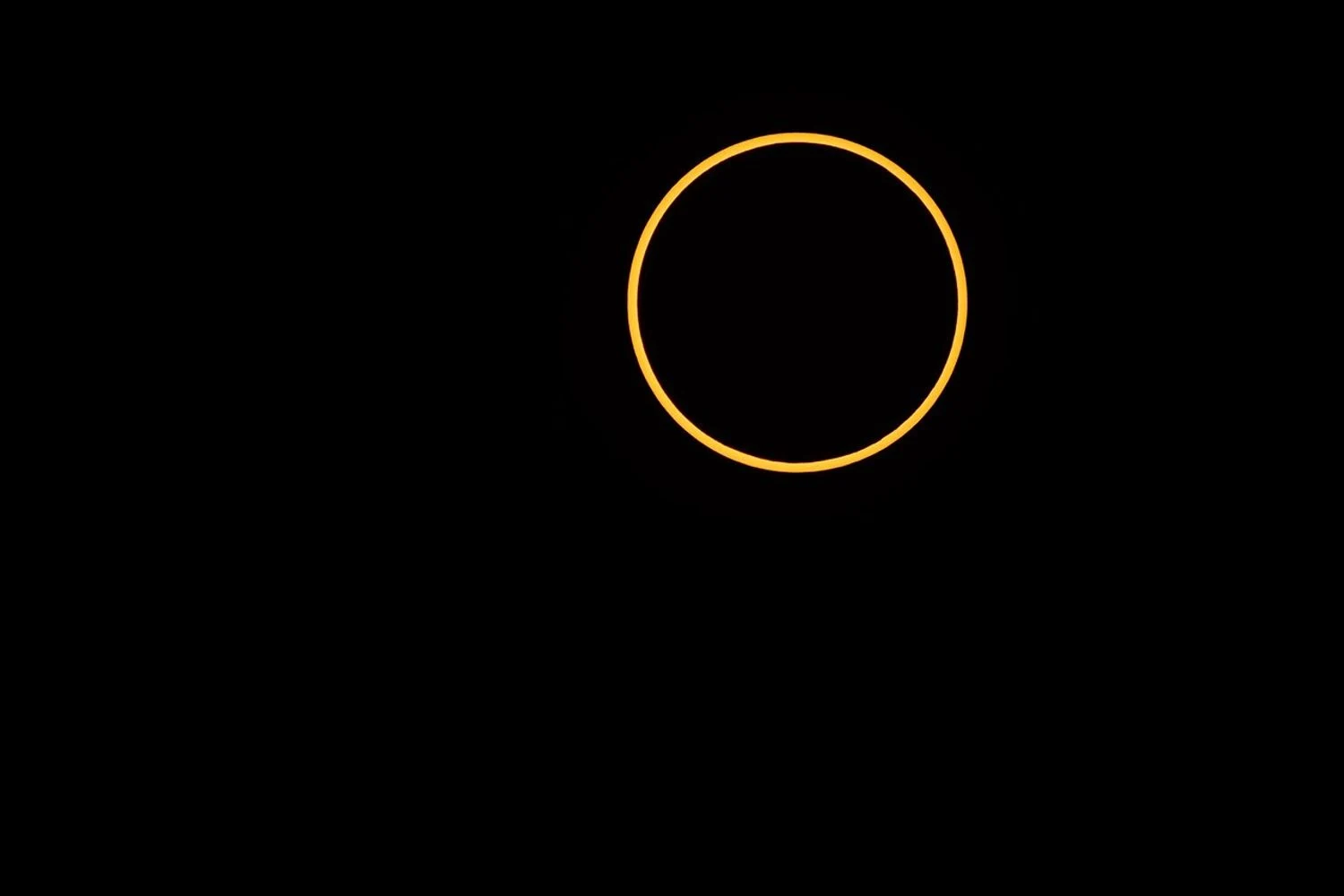
A solar eclipse happens when the new Moon lines up closely enough with the Sun as seen from Earth. What happens next depends on how wide the two disks look in the sky. The Moon’s distance changes along its orbit. On February 6 its disk appears too small to hide the whole Sun, even for an observer looking straight down the middle of the shadow. That leaves a bright rim of the Sun’s visible surface. It’s not the faint solar corona that can appear during a total eclipse.
The narrow ring-viewing region sits in the antumbra, the part of the Moon’s shadow beyond the point where the fully dark inner shadow comes to an end. From the surrounding penumbra, the two disks are offset, and observers see the crescent instead. That geometry is why one map contains both a thin track and a much wider partial-eclipse area. NASA eclipse geometry
The ring is sunlight
Even at perfect alignment, the Moon’s disk fits inside the Sun’s. The middle frame still shows the brilliant solar surface, not the corona. Eclipse glasses stay on for every direct look.
Apparent disks are schematic. Orientation and timings vary by site. NASA viewing guidanceHow to watch safely
For direct viewing, use undamaged eclipse glasses or a handheld solar viewer that meets the ISO 12312-2 standard and comes from a trusted source. Ordinary sunglasses are not safe, no matter how dark. Keep protection on through every stage, including when the ring looks complete. The American Astronomical Society’s viewer list names suppliers it has vetted.
Never look at the Sun through unfiltered binoculars, a telescope or a camera’s optical viewfinder, even while wearing eclipse glasses. Concentrated sunlight can damage the viewer and injure your eyes. Optical equipment needs an appropriate solar filter secured over the front of the lens or objective. If you don’t have a safe viewer, a pinhole projector can put the changing shape onto paper. Stand with your back to the Sun, look at the projected image, and never look through the pinhole. NASA’s viewing and projection instructions
