

What does 3I/ATLAS reveal about comets from other stars?
The ATLAS survey reported 3I/ATLAS on 1 July 2025. Its unbound trajectory identified an interstellar visitor, while its active coma gave telescopes access to gas and ice grains. Observations extending into 2026 turned that brief passage into a comparison with the ingredients of our own Solar System.
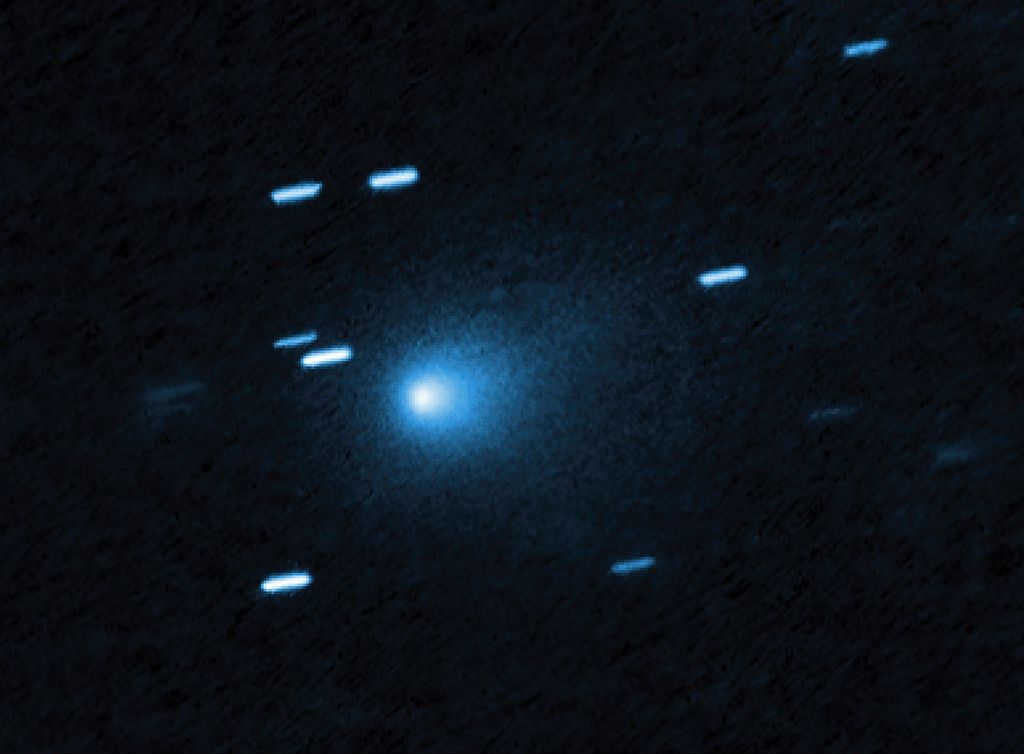
The orbit established the interstellar connection
The NASA-funded ATLAS telescope in Chile first reported the comet to the Minor Planet Center. Earlier images recovered from survey archives extended the observed path back into June 2025, improving the trajectory determination. [1]
The reconstructed orbit was strongly hyperbolic. The comet arrived with enough energy to leave the Sun again instead of returning periodically. Its name identifies the third recognised interstellar object and the survey that discovered it. [1]
The closest solar passage occurred around 30 October 2025, at roughly 1.4 astronomical units from the Sun. An astronomical unit is the mean Earth–Sun distance. The trajectory never brought the comet dangerously close to Earth. [1]
A photograph mostly shows what left the nucleus
Hubble recorded a dusty envelope around 3I/ATLAS. That extended material made the comet visible, but also complicated attempts to measure the much smaller solid nucleus hidden within it. [1]
A bright central concentration is not automatically the edge of the nucleus. Dust contributes light, and its distribution changes as material escapes. Early size estimates therefore covered a broad range and had to be revised as observations improved. [1]
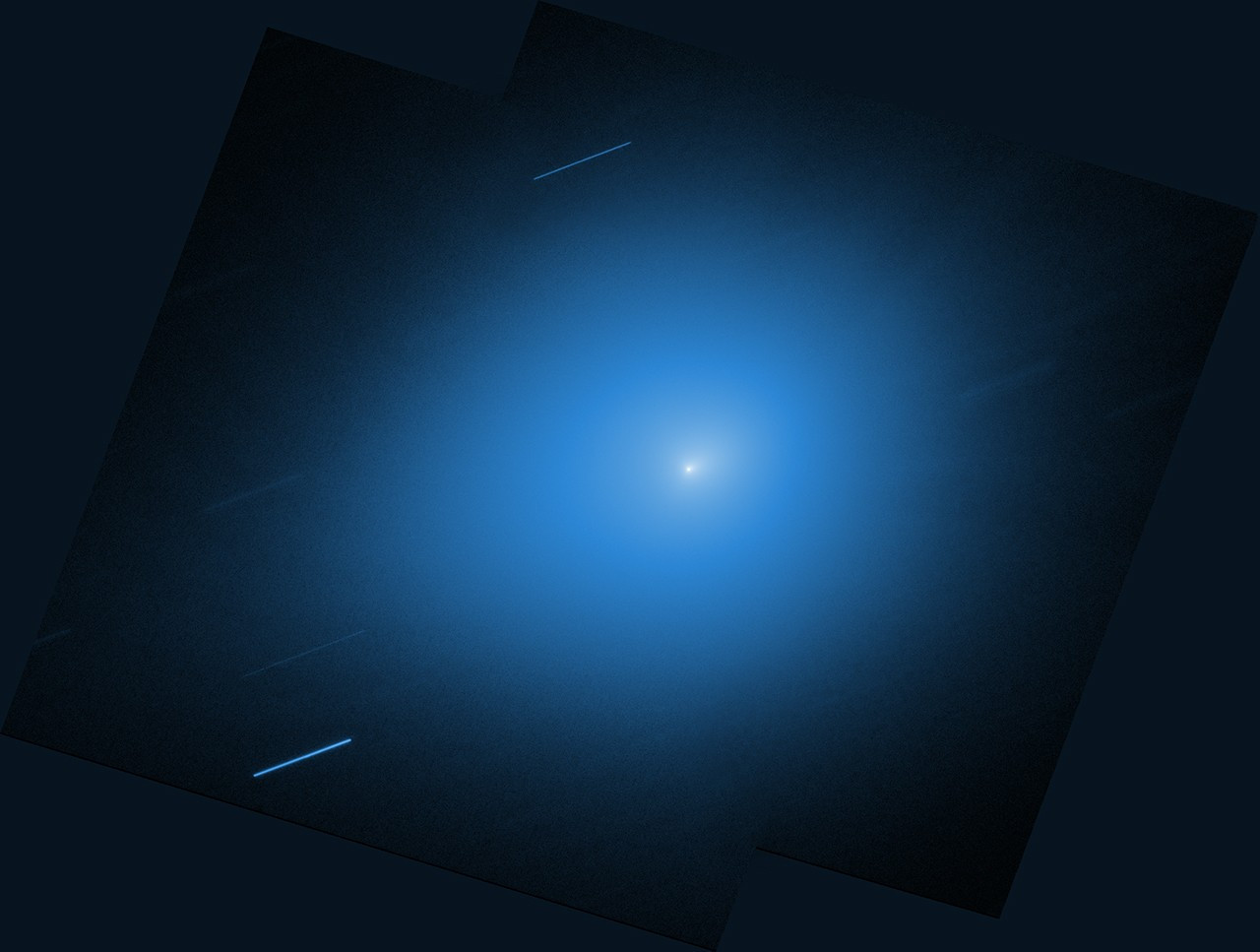
The same escaping material provided the opportunity for spectroscopy. Gas molecules and ice grains interact with different wavelengths in characteristic ways, giving instruments access to ingredients that a simple visible-light image cannot identify. [1]
Ratios constrain conditions before the journey
Webb observations reported in June 2026 measured unusual ratios involving deuterium, the heavy form of hydrogen, and carbon isotopes. Those ratios differ from the comparison measurements of Solar System comets. [2]
Researchers interpreted the high deuterium content as evidence that the material formed and remained under very cold conditions, avoiding prolonged warming that would have reprocessed the ice. Carbon-isotope measurements supplied another clue about the chemical environment and possible early formation. [2]
The study proposed a very old origin, potentially predating the Solar System by billions of years. That age is an interpretation based on chemical and galactic-evolution models, rather than a direct clock reading from the nucleus. The isotope measurements are the observations that any proposed history must explain. [2]
The shape of an absorption band tests a mixture
A separate study reported in October 2026 compared Webb spectra obtained between August 2025 and April 2026. Water ice produced a strong absorption feature near three microns, while weaker features near 1.5 and two microns were unusually faint or absent. [3] [4]
Light-scattering models favoured tiny grains, around a micron or smaller, containing water ice mixed with dust. Light travels through less pure ice in such aggregates, changing the relative strength of the absorption bands. The spectrum therefore constrained both composition and the physical form of the grains. [3] [4]
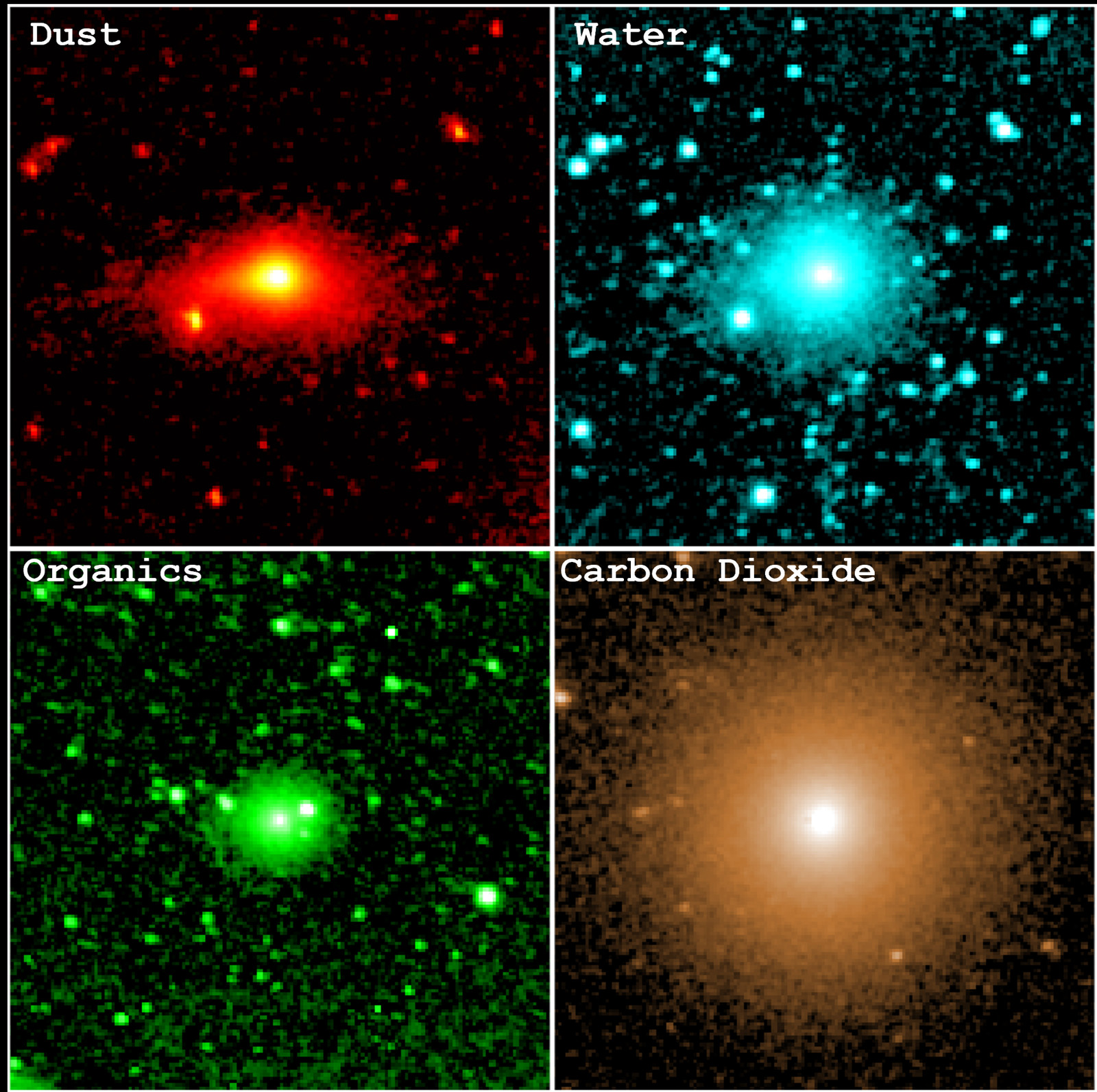
The final observation also favoured an additional population of somewhat larger, ice-rich grains. The team could not yet determine whether the changing signal mainly reflected different solar heating or newly exposed material. The changing spectrum is evidence to explain, rather than proof that one mechanism has already been selected. [3] [4]
Three visitors do not define every other system
ʻOumuamua, Borisov and 3I/ATLAS have supplied very different observing opportunities. That diversity may reflect formation conditions, later processing and how each object responded to the Sun, as well as the limits of the available data. [1] [3] [2]
3I/ATLAS shows how a visitor’s gas and grains can preserve testable information about another stellar environment. Its strongest contribution is the combination: a measured interstellar path, unusual chemical ratios and physical models checked against spectra at several times during the passage. [1] [3] [2]
Sources & image credits
Related reading and objects
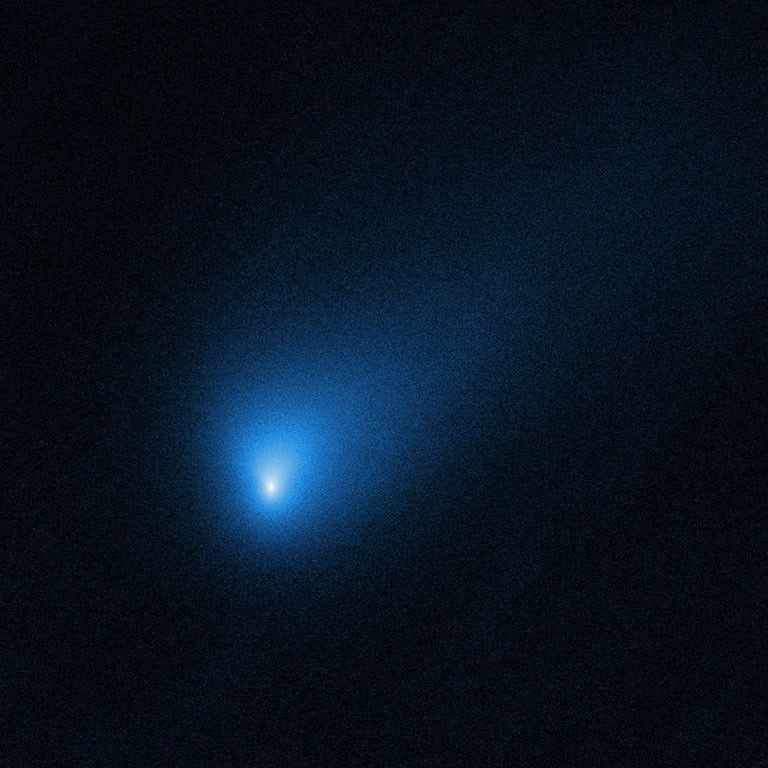
What made Borisov an interstellar comet?
Gennady Borisov discovered the object now called 2I/Borisov on 30 August 2019. Unlike ʻOumuamua, it displayed a dusty coma. Its trajectory established an interstellar journey, while the escaping gas allowed astronomers to investigate material formed around another star.
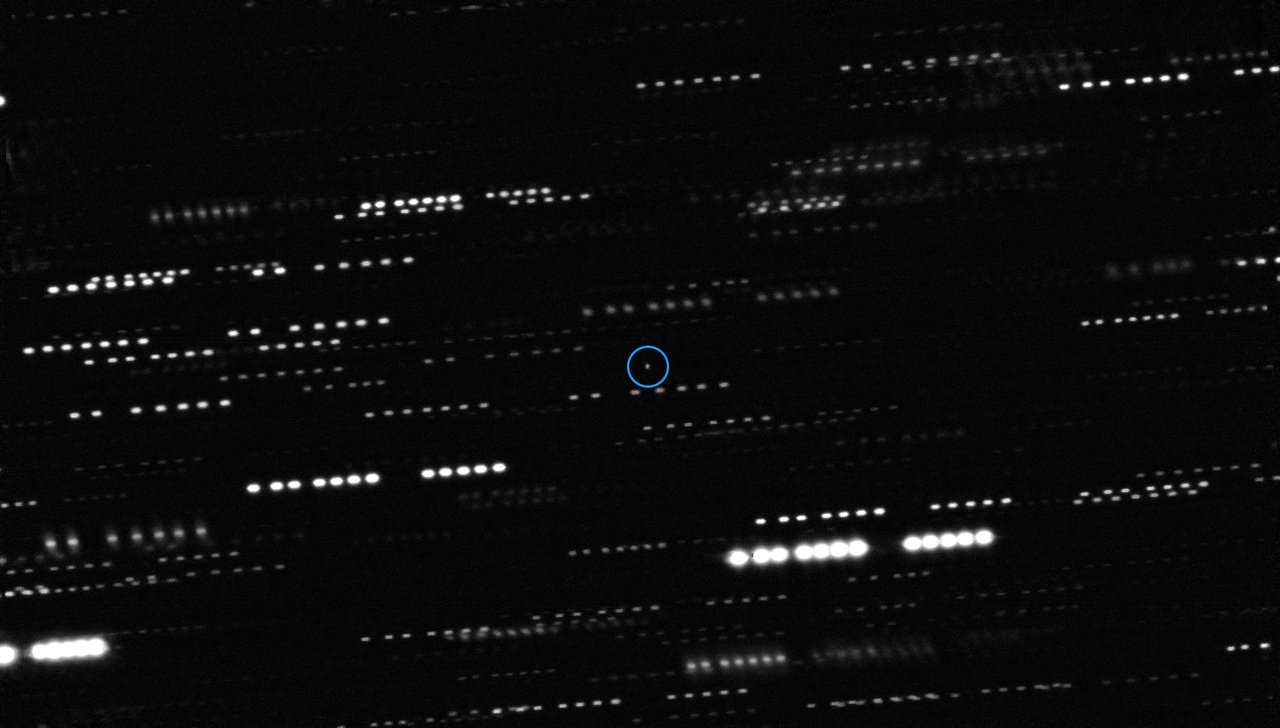
How do we know ʻOumuamua came from another star system?
Pan-STARRS1 discovered ʻOumuamua on 19 October 2017, after it had already passed the Sun. Telescopes saw only an unresolved point of light. Tracking that point nevertheless established something decisive: it had arrived from beyond the Solar System and would leave again.