

What made Borisov an interstellar comet?
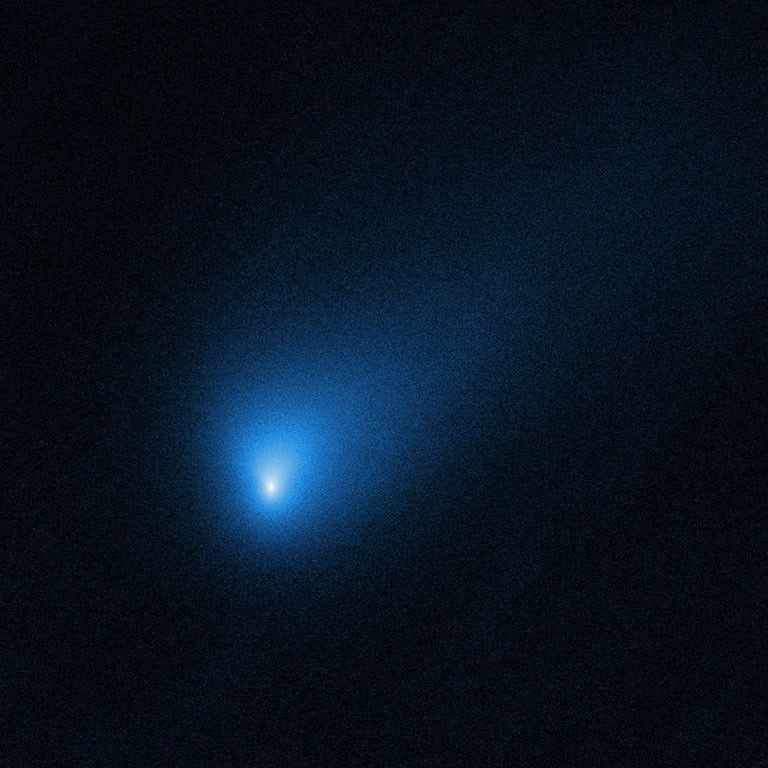
Gennady Borisov discovered the object now called 2I/Borisov on 30 August 2019. Unlike ʻOumuamua, it displayed a dusty coma. Its trajectory established an interstellar journey, while the escaping gas allowed astronomers to investigate material formed around another star.
Origin and activity answer different questions
A fuzzy coma identifies material escaping from a small body as sunlight warms it. It does not by itself make a comet interstellar: many comets formed in the Solar System also develop bright comae and tails. [1]
Borisov’s origin was established by tracking its position and reconstructing a strongly unbound trajectory. The Sun deflected its path, but could not retain it on a returning elliptical orbit. Its incoming motion required a source outside the Sun’s original family of bodies. [1]
The name records both distinctions. The I identifies an interstellar object, and the 2 marks its place after the first recognised visitor, ʻOumuamua. Borisov supplied the first clear example of an active comet from that interstellar population. [1]
Hubble imaged dust around an unseen nucleus
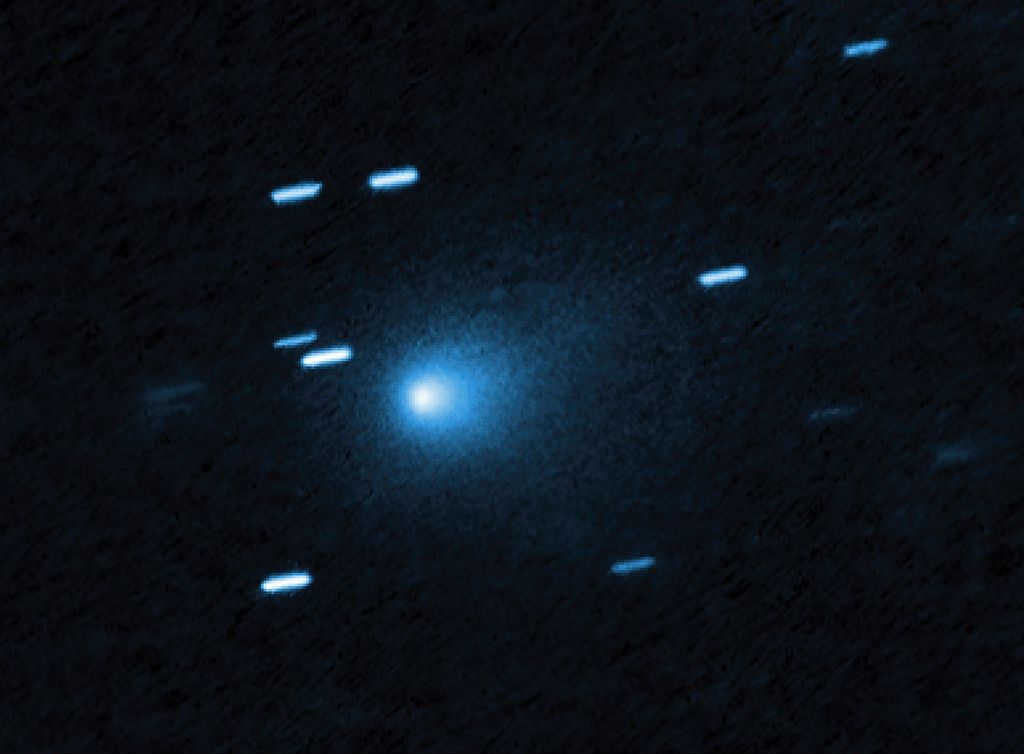
Hubble’s October 2019 images showed a concentration of dust surrounding the nucleus. The solid nucleus itself was too small to resolve. The apparent bright centre therefore cannot be measured as if it were a sharply photographed rock. [1]
Tracking the moving comet also stretched background stars into trails in some exposures. Those streaks record the observing technique, while the comet remains comparatively fixed in the image. Reading the photograph requires distinguishing released material, the unresolved source and the stationary sky. [1]
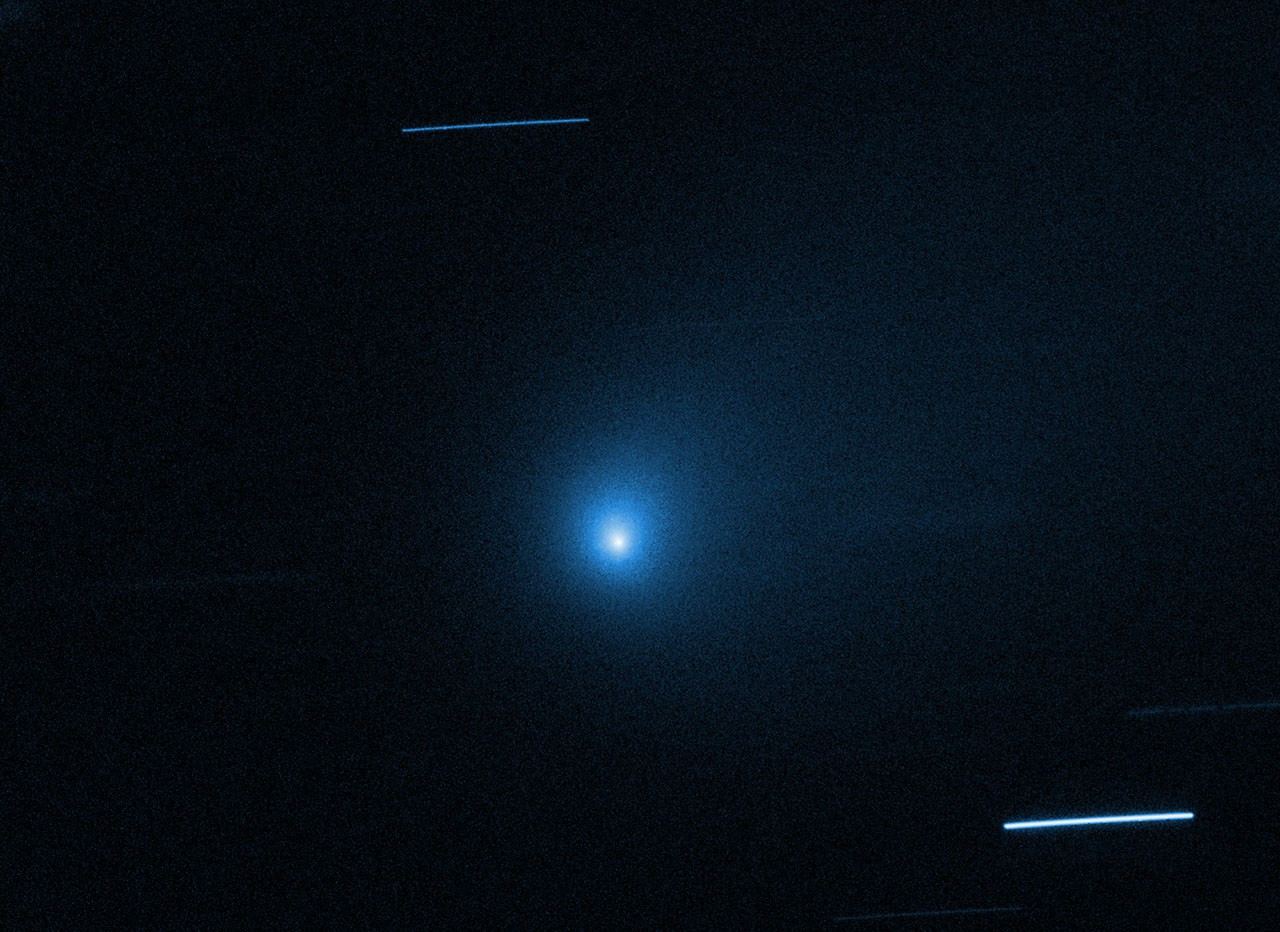
In March 2020, changes in the inner appearance suggested that a fragment had separated. Such activity showed that the visitor was responding physically to its solar encounter, rather than passing through as an unchanged frozen body. [1]
Escaping molecules supplied a chemical comparison
Hubble observed Borisov in ultraviolet light, while ALMA used millimetre wavelengths to measure molecular emission. Independent techniques found a high carbon-monoxide abundance relative to water compared with many Solar System comets observed at similar solar distances. [2] [3]
The distance comparison is essential. Different ices become active under different heating conditions. A ratio measured far from the Sun cannot simply be ranked beside one measured in a much warmer environment without considering how release rates change. [2] [3]
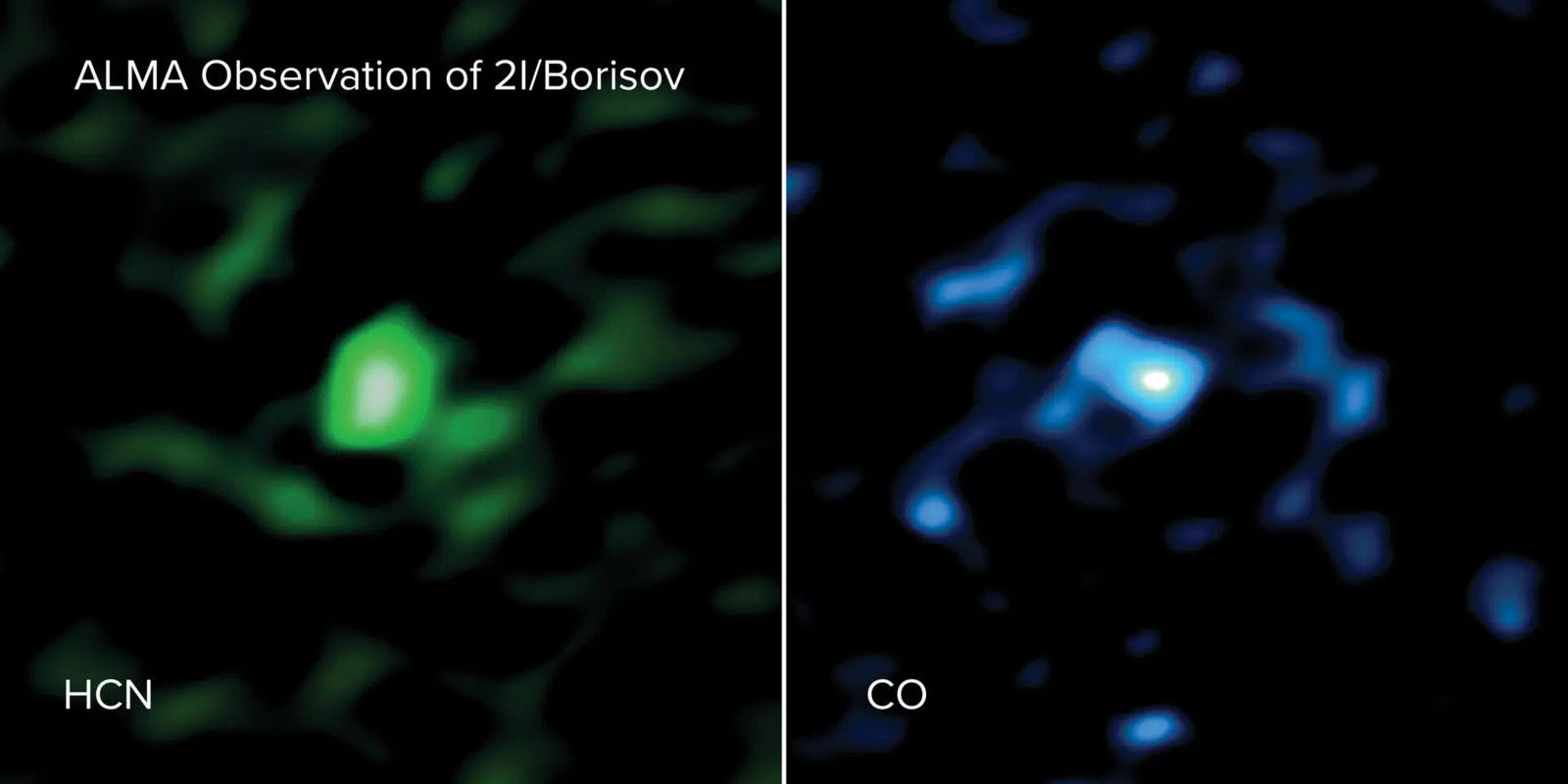
Carbon monoxide is particularly volatile, so preserving a rich supply points towards a cold history. The measurements constrained the material contributing to the coma during the observation, rather than providing an unfiltered bulk assay of every layer of the nucleus. [2] [3]
Chemistry narrows possibilities without naming a star
Researchers considered formation in a very cold region around another star, followed by ejection through gravitational interactions. A system containing a giant planet could scatter small bodies into interstellar space, just as planets can eject material from our own system. [2]
A red-dwarf environment was one proposed setting, but the chemistry did not identify a particular parent star or prove that only one stellar type could produce Borisov. Its carbon monoxide is evidence about conditions, not a unique stellar fingerprint. [2]
The unknown travel time also limits simple age claims. Interstellar origin does not automatically mean older than the Sun; the object could have formed in a different system at a different time. [2]
A familiar-looking comet can preserve unfamiliar chemistry
Borisov looked more recognisably cometary than ʻOumuamua, yet its composition differed from the typical comparison sample. That pairing is the scientific benefit: familiar gas-release processes exposed material from a different formation environment. [1] [2]
The observations established the journey through orbital dynamics and investigated the material through spectroscopy. Keeping those evidence chains separate makes the conclusion stronger. Borisov was an interstellar comet because of where its orbit came from, and a chemically informative one because warming released molecules that telescopes could measure. [1] [2]
Sources & image credits
Related reading and objects
How do we know ʻOumuamua came from another star system?
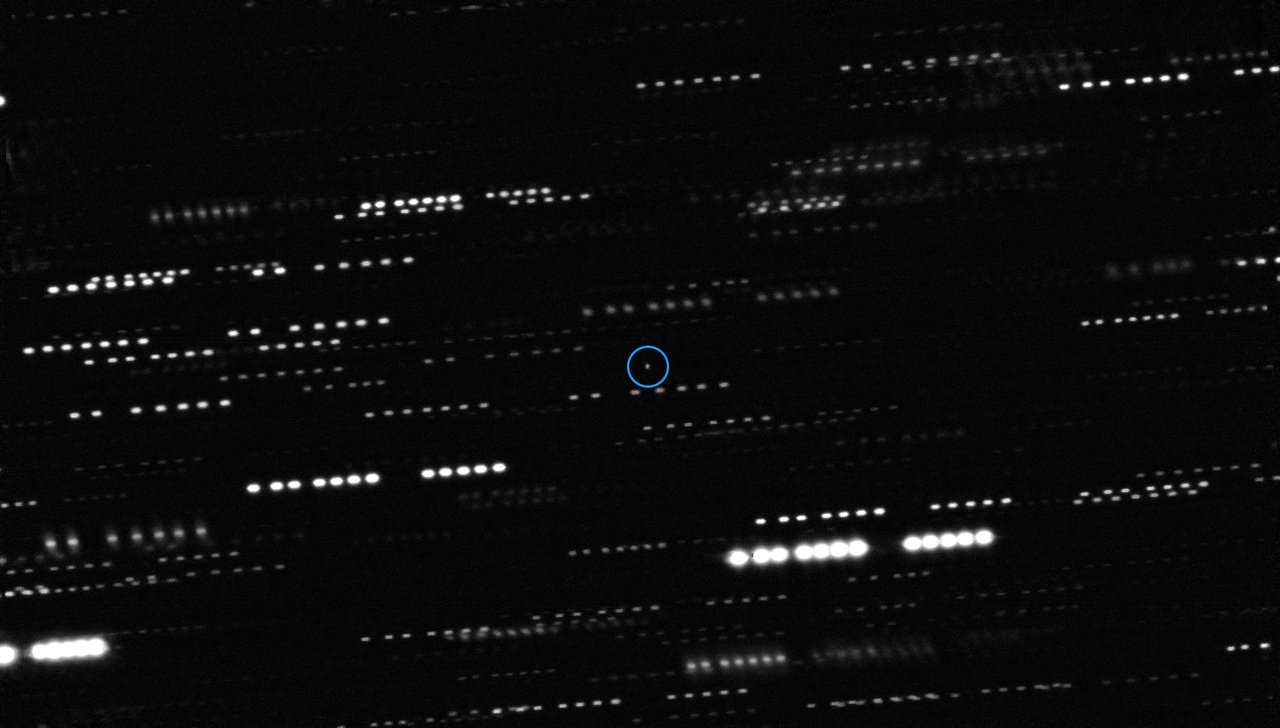
Pan-STARRS1 discovered ʻOumuamua on 19 October 2017, after it had already passed the Sun. Telescopes saw only an unresolved point of light. Tracking that point nevertheless established something decisive: it had arrived from beyond the Solar System and would leave again.
What does 3I/ATLAS reveal about comets from other stars?
The ATLAS survey reported 3I/ATLAS on 1 July 2025. Its unbound trajectory identified an interstellar visitor, while its active coma gave telescopes access to gas and ice grains. Observations extending into 2026 turned that brief passage into a comparison with the ingredients of our own Solar System.