
Added launch after Comet Interceptor moves away from launching with ARIEL.
Update ↗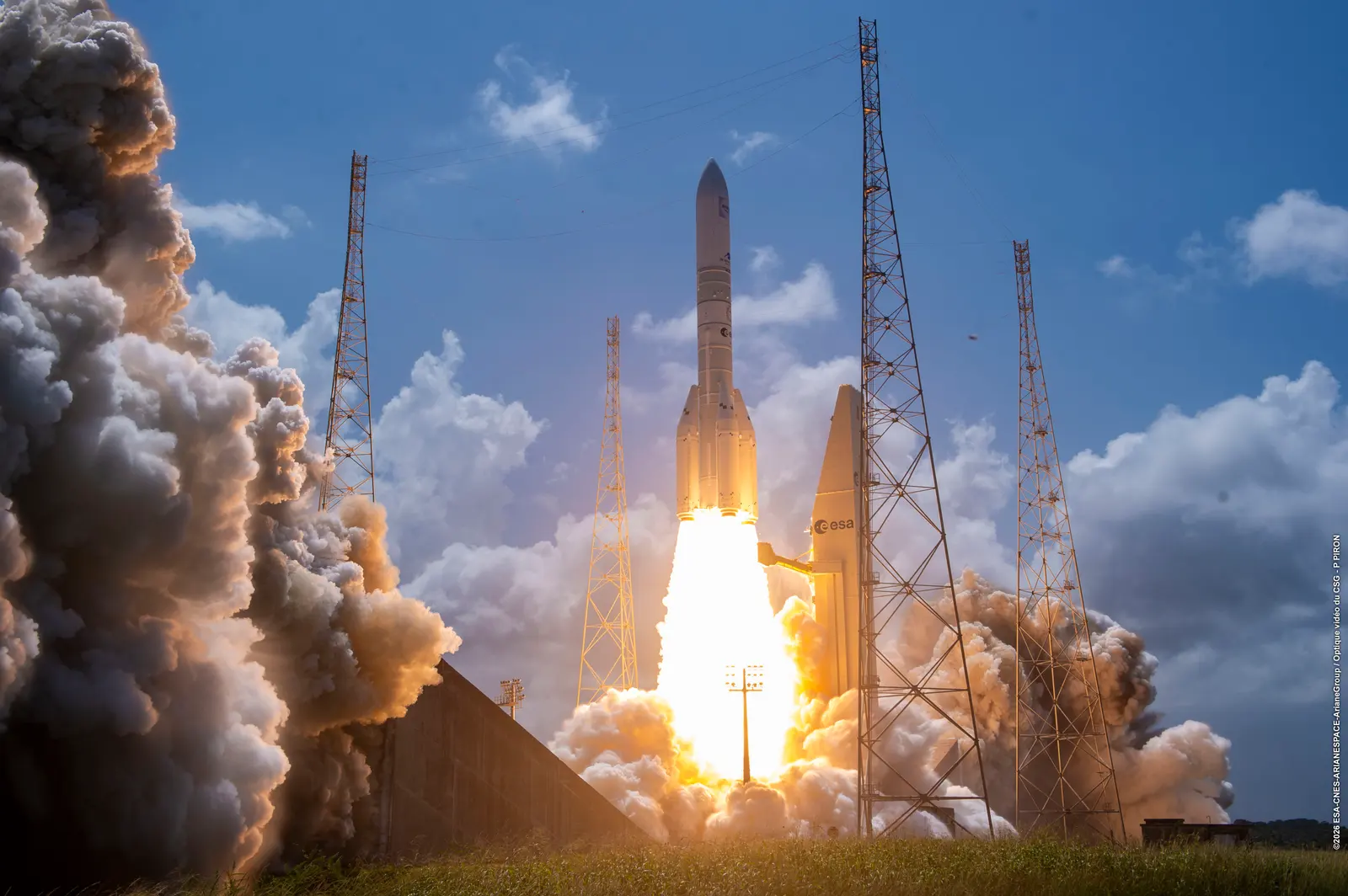
Arianespace日程未定
Comet Interceptor
Ariane 64
ミッションの目的概要は英語
ESA's Comet Interceptor consists of three spacecraft which will be positioned at the Sun-Earth Lagrange point L2, where they will wait for a long-period comet or an interstellar object to come by. Once the desired target appears, the spacecraft will separate and perform a flyby of the target, compiling a detailed 3D profile of a comet.
2028年8月・日付未定
保存したミッションはマイページで確認できます。 リマインダーや予定変更の通知を受け取るには、iPhoneアプリでこのミッションをフォローしてください。
公表されている予定
2028年8月。日付と時刻は未定です。
発表元の更新:
発表元を確認:Launch Library ↗
ミッションの更新
発表元からのお知らせ
このページを表示している間、予定の変更を確認します。
このタブを開いて表示している間だけ、通知を受け取れます。
目標時刻まで
日時未定
打ち上げ予定は変更される場合があります。
発射場所Guiana Space Centre, French Guiana
関連記事・英語
Comet Interceptor: why launch before choosing a comet?
Comet Interceptor will wait in space for a reachable comet, then use three spacecraft to study it from different positions.
In this report
ESA’s upcoming Comet Interceptor mission is being built for a destination astronomers may not discover until after launch. The reason is practical: a newly found comet can sweep through the inner Solar System before a spacecraft built specifically to visit it would be ready. Comet Interceptor will already be waiting in space. [1]
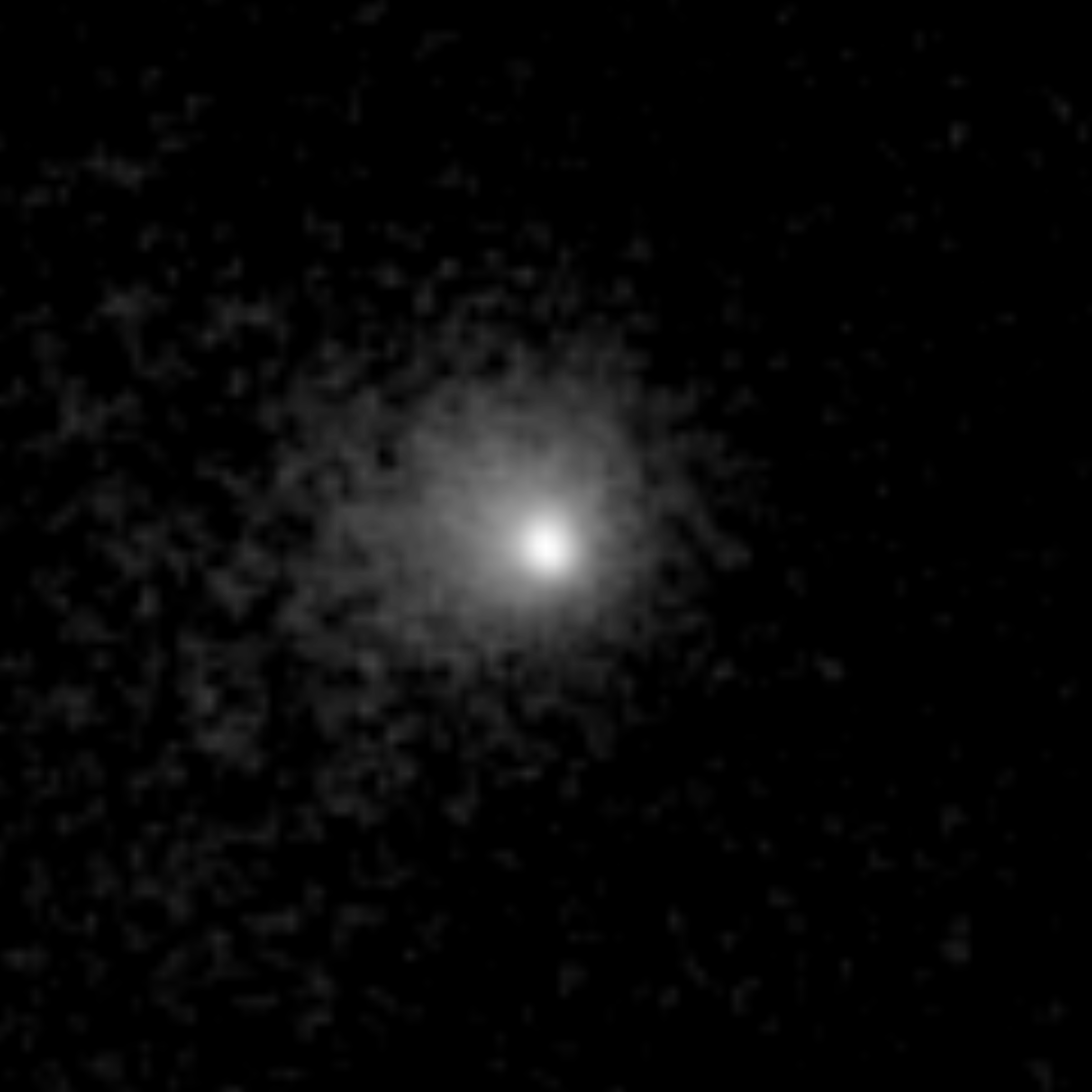
A recent discovery shows how that search could work. On 19 October 2026, ESA reported that Euclid, a telescope designed to map distant galaxies, had found a previously unknown comet. Software picked out its moving streak in September images. Follow-up observations helped the Minor Planet Center confirm C/2026 S1 (Euclid) on 8 October. [2]
This comet is not a suitable target for Comet Interceptor, ESA says. The useful result was the discovery-and-alert process: a real rehearsal for coordinating a telescope that finds a moving object with a future mission waiting for one. [2]
Get into space before the clock starts
The main spacecraft and two smaller probes will initially travel together to the Sun–Earth L2 region, about 1.5 million kilometres beyond Earth, away from the Sun. There they can wait for a reachable target. [1]
Finding a comet will not automatically make it a destination. Its path must bring it within the spacecraft’s reach. JAXA describes a search that can continue for up to three or four years while the mission waits at L2. Once a suitable object is chosen, the spacecraft can leave for an encounter. [3]
Three views of the same moment
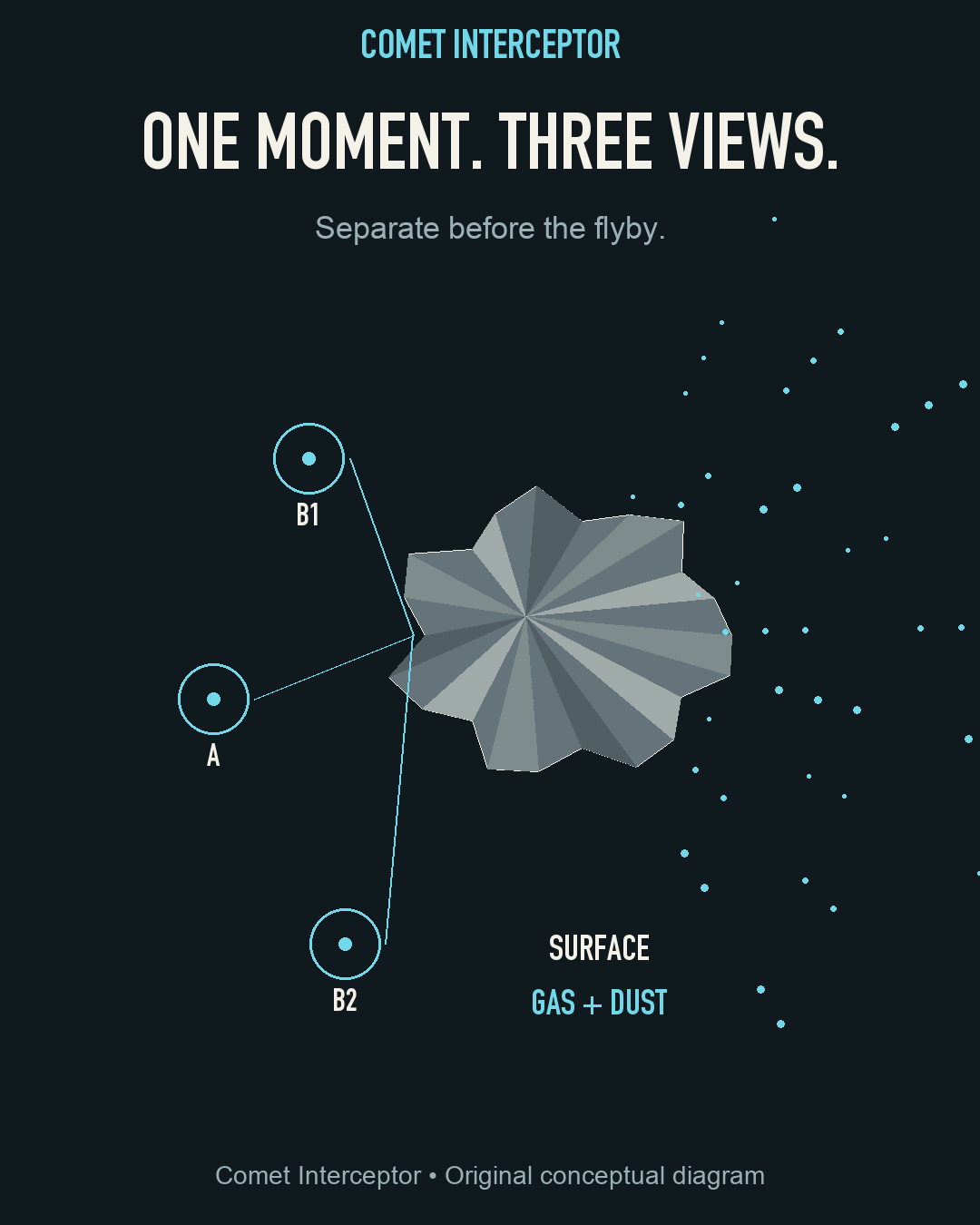
The encounter will be a flyby. Before reaching the comet, the two probes will separate from the main spacecraft. Their instruments will observe from different positions, measuring the nucleus and the gas, dust and charged particles around it. [4]
The views are complementary, not three copies of the same photograph. Cameras on the main spacecraft and both probes will examine the nucleus from different directions. The main spacecraft’s MANiaC instrument will analyse particles and molecules from the coma, while the Japanese probe’s hydrogen imager will help track the comet’s water production. [4]
That arrangement answers a problem a single spacecraft cannot easily resolve. A changing measurement could mean the spacecraft has entered a different part of the comet’s surroundings, or that the surroundings themselves are changing with time. Simultaneous measurements at several locations help distinguish the two. [3]
A less-altered sample of the Solar System
Earlier close-up comet missions visited objects that had repeatedly approached the Sun. Those passages heat the ice and release gas and dust, altering what scientists can see. Comet Interceptor aims to examine a comet that has rarely or never made that journey before, then compare it with the better-known returning comets. [5]
The target must still be reachable, and the flyby cannot revisit every feature it sees. Waiting near L2 buys time before the encounter; observing from three positions makes better use of the short encounter itself. [1] [3]
Sources and credits (7)
- Comet Interceptor factsheetESA · Checked 2026-11-13
- Euclid discovers new cometESA · Checked 2026-11-13
- Comet Interceptor mission overviewJAXA/ISAS · Checked 2026-11-13
- Comet Interceptor's spacecraft and instrumentsESA · Checked 2026-11-13
- Top five questions Comet Interceptor will help answerESA · Checked 2026-11-13
- Eight Euclid VIS exposures of C/2026 S1ESA · Checked 2026-11-13
- Creative Commons Attribution-ShareAlike 3.0 IGOCreative Commons · Checked 2026-11-13
ミッションのデータ
- 打ち上げ機
- Ariane 64
- ミッションの種類
- Planetary Science
- 投入先の軌道
- Heliocentric N/A
- Launch pad
- Ariane Launch Area 4
- 運用機関
- Arianespace
機体の構成
公表された仕様と、この機体の飛行歴。
打ち上げ機
Ariane 64
機体の説明・英語
Ariane 6 variant with four solid boosters, enabling heavier payloads.
- 高さ
- 63 m
- 直径
- 5.4 m
- 段数
- 2
- 記録された打ち上げ数
- 2
- 初飛行
- 2026-02-12
打ち上げ可能時間帯
詳しい打ち上げ可能時間帯は、まだ公表されていません。
発射場所
Guiana Space Centre, French Guiana
発射場所Ariane Launch Area 4
Drag to rotate
この表示について
Published destination: Heliocentric N/A.
NASA geography with illustrative lighting. No live tracking or simulated ascent. NASA Blue Marble source.
現地で見る
見学前に確認すること
Public viewing access varies by launch site. Check the operator’s official information before travelling.
延期に備えて日程に余裕を持ち、当日も予定時刻、現地の天気、道路の規制を確認してください。
出発前の確認
- 予定日時と打ち上げ可能時間帯を確認する。
- 公式の見学場所と、予約の要否を確認する。
- 許可された見学場所を利用する。発射台へ向かわない。
- 現地で見られない場合に備えて、配信のリンクを控えておく。
中継・出典
ミッションの中継
配信リンクは、まだ公開されていません。
関連する資料
Launch Library Android テスト版参加グループを開く クローズドテスト版1.6.0(4)では、サインイン、プレミアム、通知を利用できません。まずGoogleグループに参加し、同じGoogleアカウントでGoogle Playのテストに登録 ↗してください。