
NET March.
Update ↗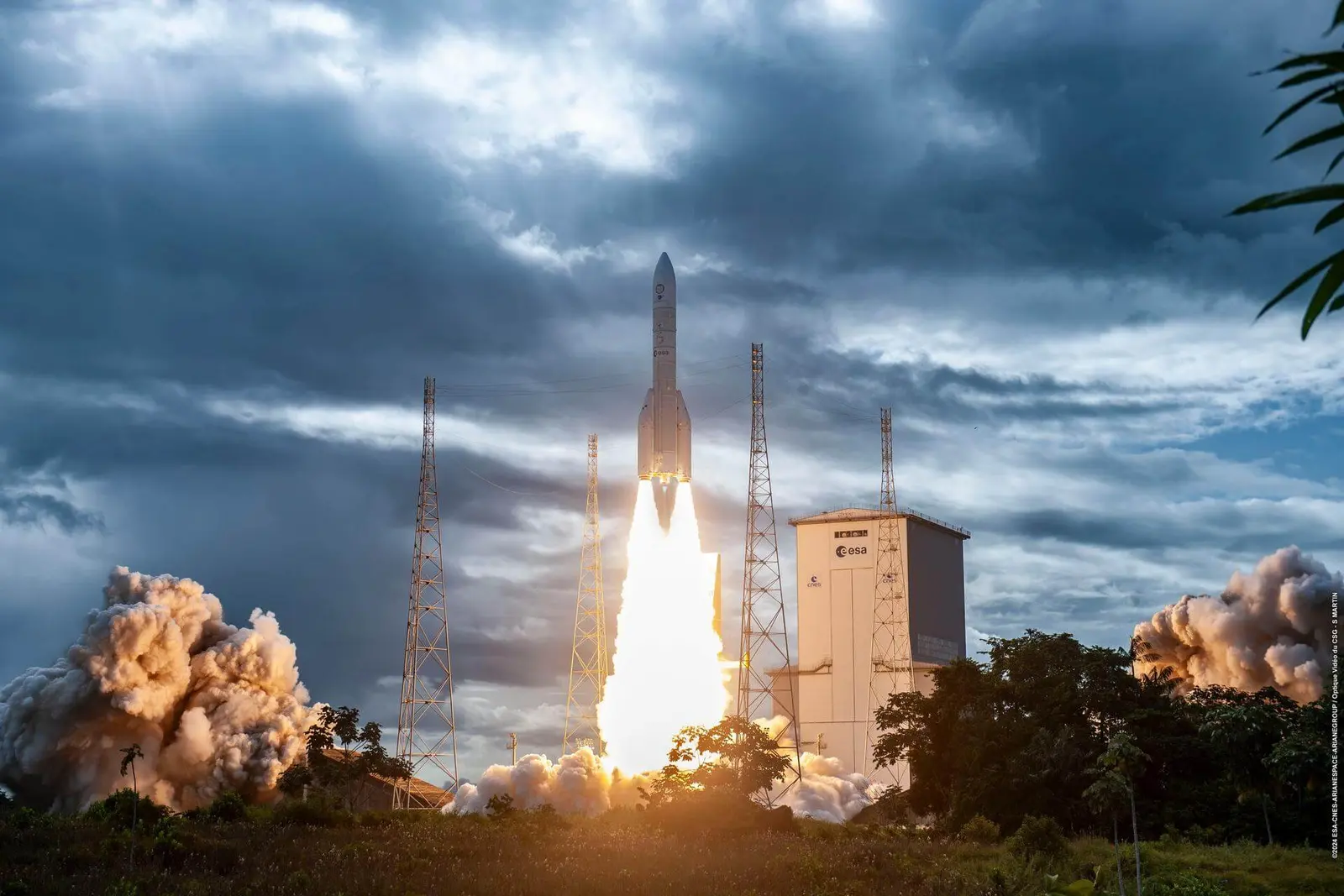
Arianespace日程未定
PLATO
Ariane 62 Block 2
ミッションの目的概要は英語
ESA’s PLATO mission is planned for a 2027 launch on Ariane 6. Its 26 cameras will measure changes in starlight to search for transiting planets and characterise their host stars. Repeated transits reveal orbital periods; interpreting sizes and confirming candidates requires stellar information and further checks.
2027年3月・日付未定
保存したミッションはマイページで確認できます。 リマインダーや予定変更の通知を受け取るには、iPhoneアプリでこのミッションをフォローしてください。
公表されている予定
2027年3月。日付と時刻は未定です。
発表元の更新:
発表元を確認:Plato ↗・Launch Library ↗
このページを表示している間、予定の変更を確認します。
このタブを開いて表示している間だけ、通知を受け取れます。
目標時刻まで
日時未定
打ち上げ予定は変更される場合があります。
発射場所Guiana Space Centre, French Guiana
関連記事・英語
How PLATO will find unseen planets in dips of starlight
A planet crossing a star blocks a little light. PLATO’s upcoming mission will look for that repeating signal—but a dip alone is not a confirmed world.
In this report
ESA’s PLATO spacecraft is preparing for a planned 2027 launch on Ariane 6. Its planet search begins with a question: how can a tiny, repeated dip in a star’s brightness reveal a world we cannot resolve in a picture? The spacecraft will watch starlight with 26 cameras. The useful clue is the light a planet blocks, rather than a photograph of its surface. [1] [2] [3]
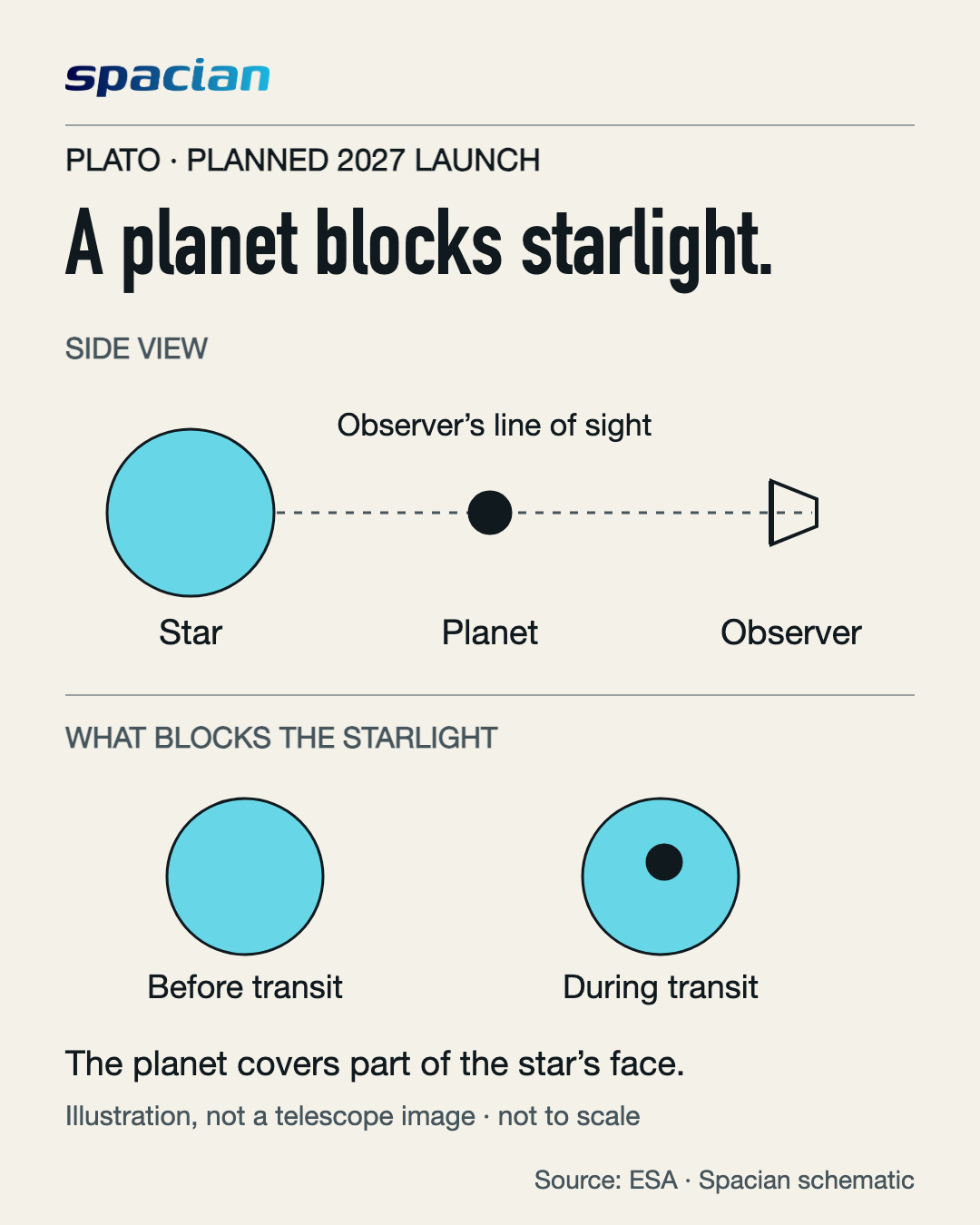
The planet passes between us and its star
A transit happens when a planet crosses the star’s face from an observer’s point of view. During that crossing, the planet hides a small part of the luminous surface. A telescope measuring the star receives a little less light. Before and after the crossing, the blocked area disappears and the measured brightness rises again. [3]
The alignment matters. A planet can orbit a star without ever crossing its face from our direction. A transit search therefore samples systems whose geometry makes a crossing visible; a flat brightness record is not, by itself, evidence that a star has no planets. The black disk in our illustration makes the geometry legible. It is not a resolved image PLATO will produce. [3]
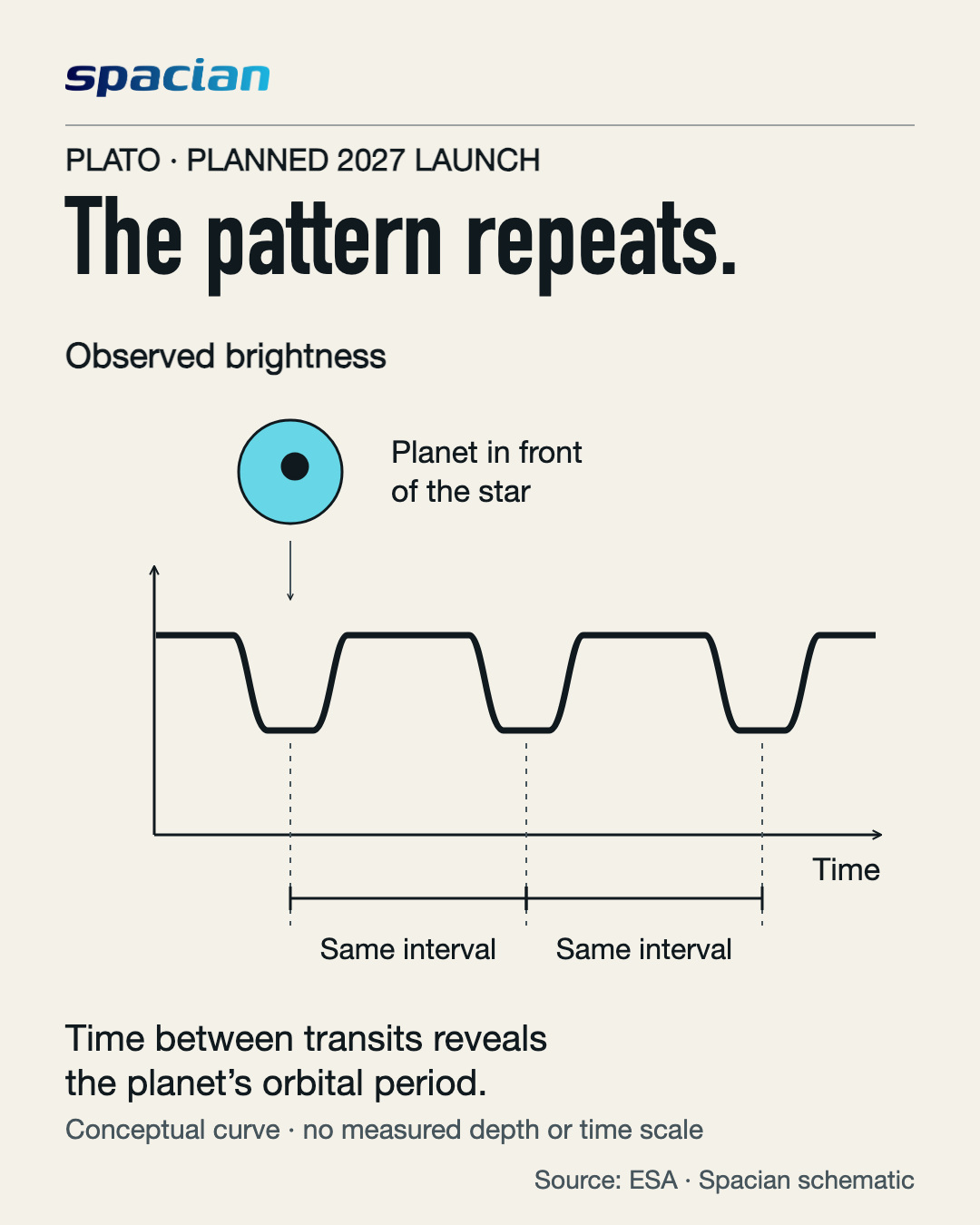
The repetition adds a clock
One dimming event is only a clue. If a planet returns across the star on successive orbits, the dips recur. The time between corresponding crossings gives its orbital period: how long that planet takes to complete a circuit. Watching for a pattern is more informative than treating an isolated low point as a discovery. [3]
The star is part of the measurement
The depth of a transit is connected to how much of the star the planet covers. A deeper dip can indicate a larger planet relative to its star. Turning that relative measurement into a planetary radius also requires the star’s size. The light curve does not hand researchers a complete physical description of the world by itself. [6]
That is one reason PLATO will study the stars as well as the planets. ESA plans to use tiny stellar variations, including oscillations, to improve estimates of host-star properties. Those measurements help interpret the planetary systems around them. Finding a small world and learning what that world is like are related tasks, with different evidence requirements. [2]
Twenty-six cameras, two observing cadences
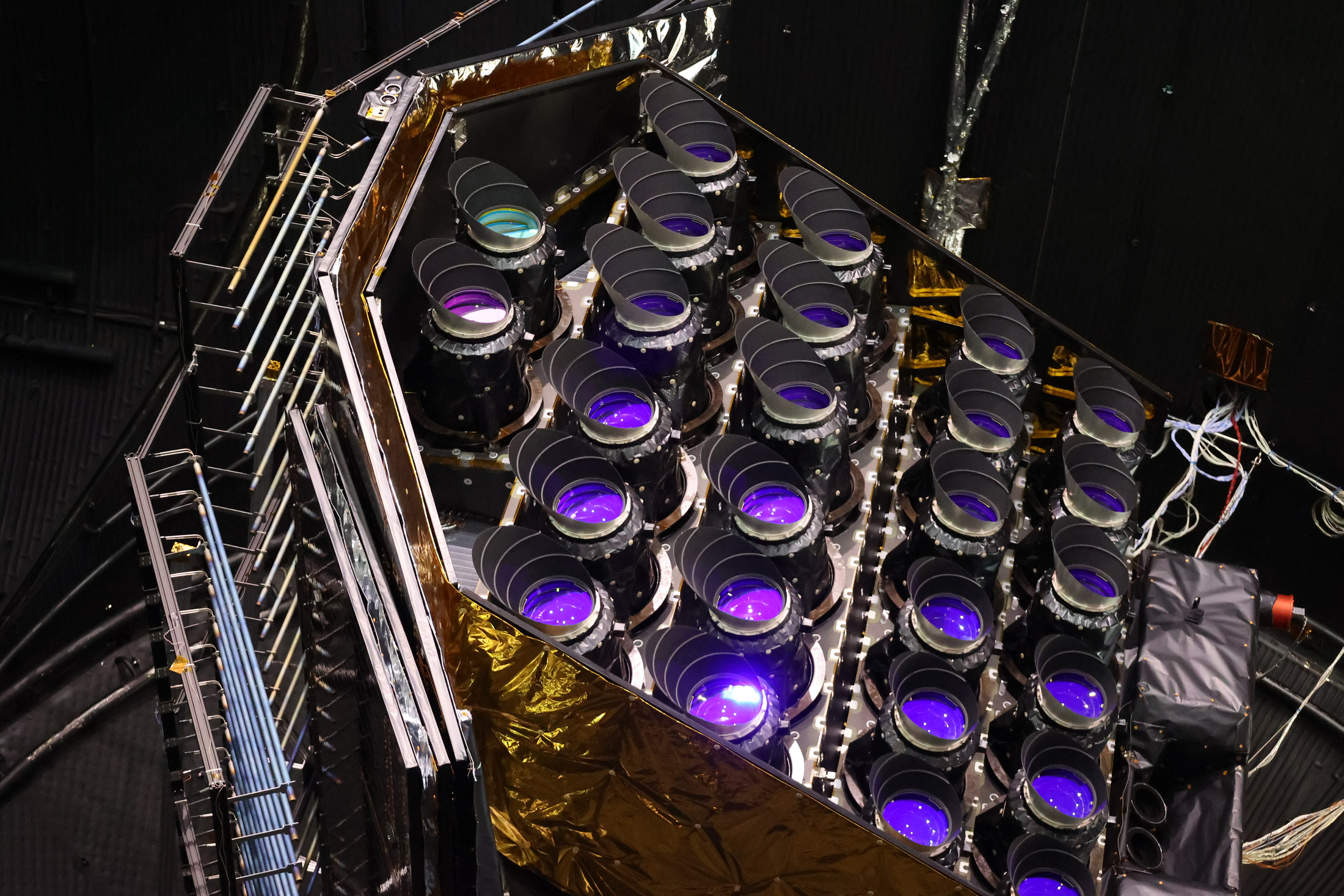
PLATO uses 24 normal cameras, which acquire images every 25 seconds, and two fast cameras, which acquire images every 2.5 seconds. The fast pair also contributes to observations of bright stars and spacecraft guidance. Combining cameras helps the mission observe a broad field while measuring small changes in starlight. [4] [2]
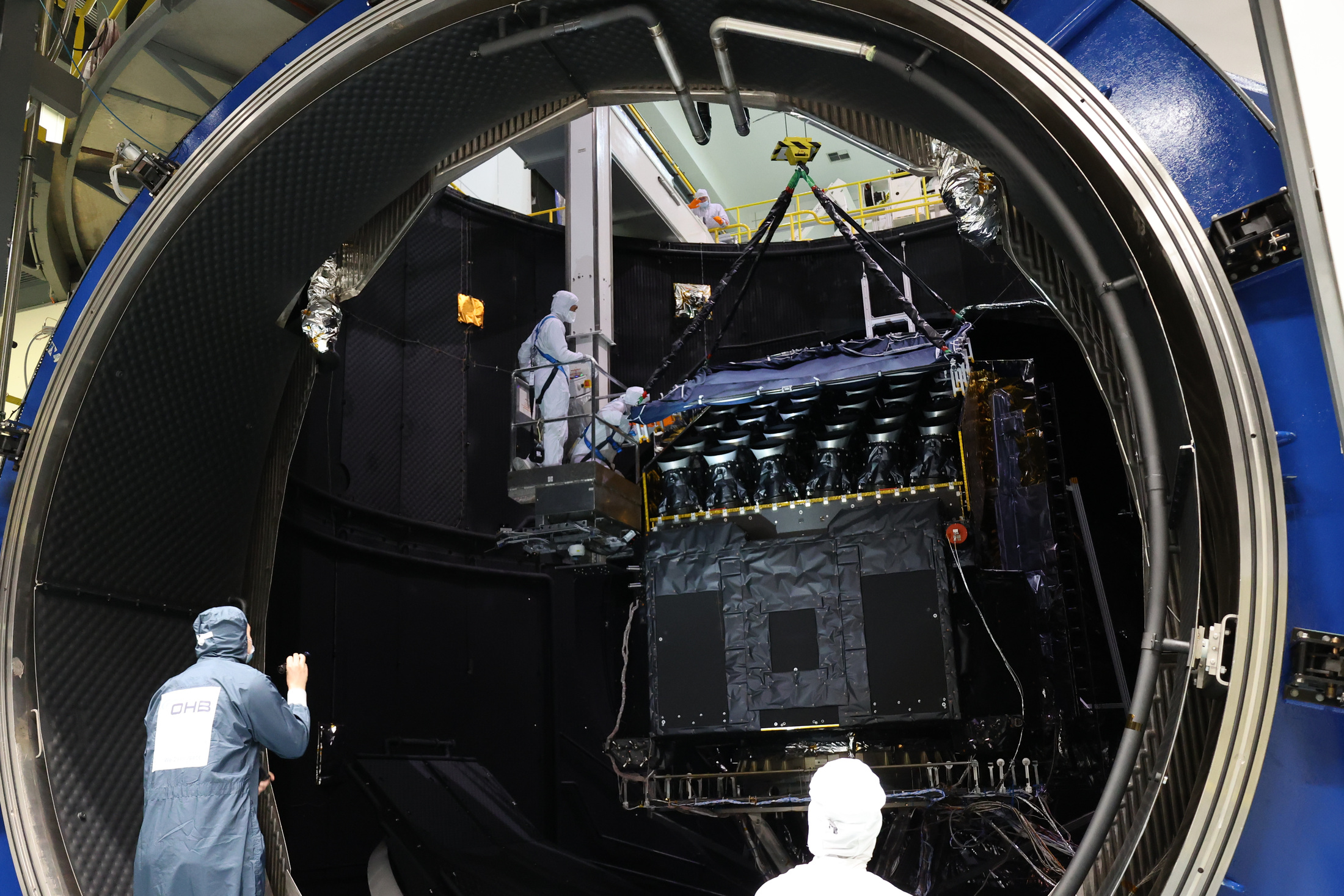
Such measurements depend on the behaviour of the instrument itself. In its April 2026 account of space-like tests, ESA described checking the cameras under thermal conditions relevant to flight. Their optical focus is fine-tuned by controlling the temperature of the camera tubes. These ground tests address the stability needed to tell a real brightness signal from an instrumental response. They are preparation for observations, not a report of a newly found planet. [5]
A signal still needs checking
Repeated dips are not automatically a confirmed planet. An eclipsing star system or another source of contamination can imitate a planetary signal. Researchers check alternatives and use further observations to establish what produced the change. NASA’s explanation of transit follow-up makes this distinction explicit; ESA likewise plans PLATO discoveries to support later investigation by other observatories. [6] [2]
The answer to the opening question is a sequence: a crossing blocks light; repeated crossings reveal a period; knowledge of the star helps translate the signal into a planet’s properties; follow-up tests the interpretation. PLATO’s upcoming launch will carry the cameras that make those measurements possible. A dip is the start of the investigation. [3] [2] [6]
Watch the film
Loading the player connects to YouTube.
Follow the evidence from a dip in starlight to tests of a possible planet, and see why PLATO needs precise cameras and stellar measurements.
Sources and credits (12)
- PLATO mission overviewESA · Checked 2026-11-02
- PLATO factsheetESA · Checked 2026-11-02
- How to find an exoplanetESA · Checked 2026-11-02
- PLATO’s camerasESA · Checked 2026-11-02
- PLATO aces space-like testsESA · Checked 2026-11-02
- 10 steps to confirm a planet around another starNASA · Checked 2026-11-02
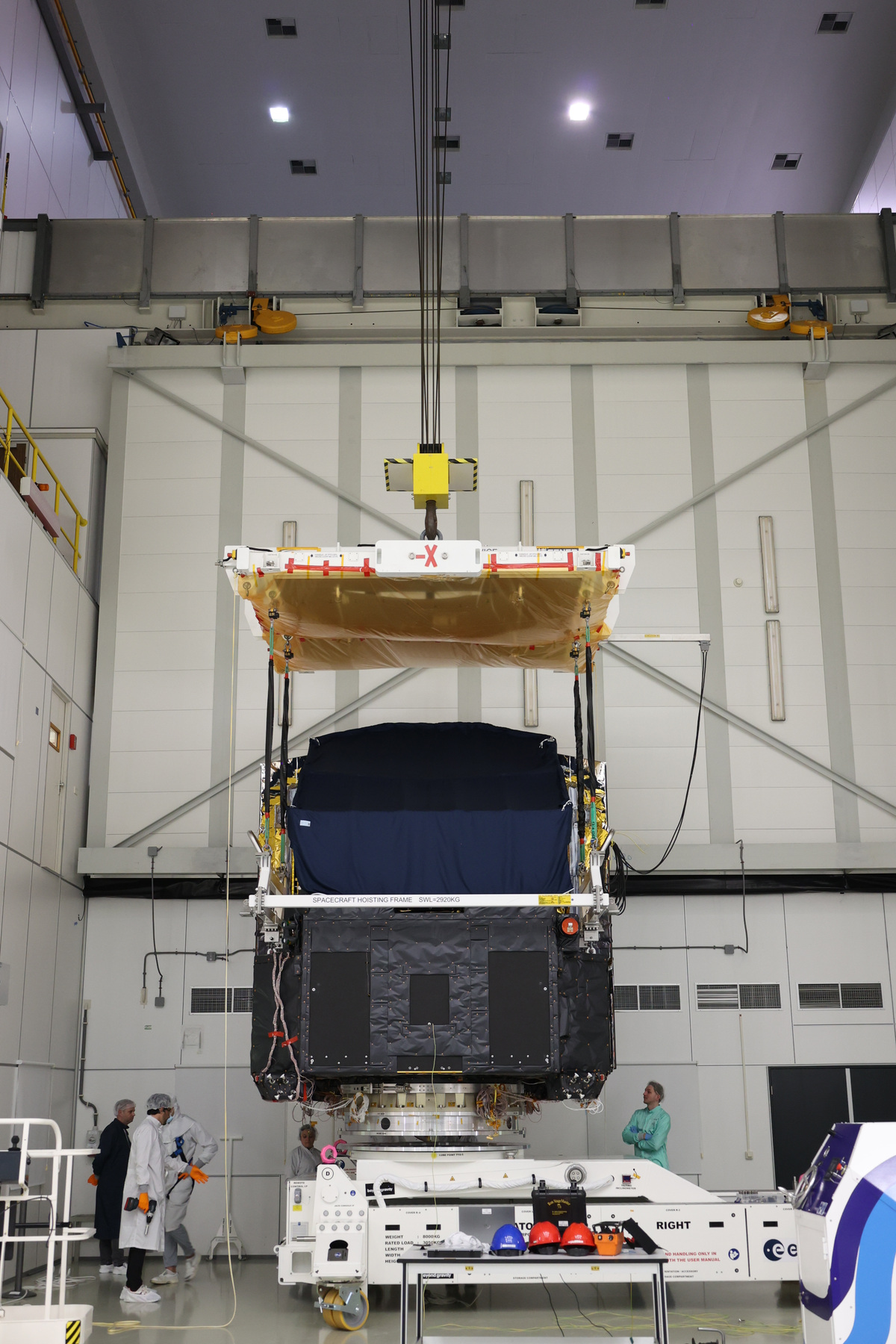
- PLATO hardware after space-like testing at ESTEC; photo published23April2026, not a current launch.ESA · Checked 2026-11-02
- PLATO camera array seen from the opened Large Space Simulator; published23April2026.ESA · Checked 2026-11-02
- PLATO being lifted out of the Large Space Simulator after ground tests; published23April2026.ESA · Checked 2026-11-02
- PLATO payload and service-module assembly, 11 June 2025ESA Television · Checked 2026-11-02
- PLATO camera structural and thermal test replicaESA · Checked 2026-11-02
- How to Find a Planet You Cannot See | PLATOSpacian · Checked 2026-11-13
ミッションのデータ
- 打ち上げ機
- Ariane 62 Block 2
- ミッションの種類
- Astrophysics
- 投入先の軌道
- Sun-Earth L2
- Launch pad
- Ariane Launch Area 4
- 運用機関
- Arianespace
機体の構成
公表された仕様と、この機体の飛行歴。
打ち上げ機
Ariane 62 Block 2
機体の説明・英語
Ariane 6 variant with two upgraded P160C solid rocket boosters.
- 記録された打ち上げ数
- 0
打ち上げ可能時間帯
詳しい打ち上げ可能時間帯は、まだ公表されていません。
発射場所
Guiana Space Centre, French Guiana

発射場所Ariane Launch Area 4
Drag to rotate
この表示について
Published destination: Sun-Earth L2.
NASA geography with illustrative lighting. No live tracking or simulated ascent. NASA Blue Marble source.
現地で見る
見学前に確認すること
Public viewing access varies by launch site. Check the operator’s official information before travelling.
延期に備えて日程に余裕を持ち、当日も予定時刻、現地の天気、道路の規制を確認してください。
出発前の確認
- 予定日時と打ち上げ可能時間帯を確認する。
- 公式の見学場所と、予約の要否を確認する。
- 許可された見学場所を利用する。発射台へ向かわない。
- 現地で見られない場合に備えて、配信のリンクを控えておく。
中継・出典
ミッションの中継
配信リンクは、まだ公開されていません。
 Android テスト版参加グループを開く クローズドテスト版1.6.0(4)では、サインイン、プレミアム、通知を利用できません。まずGoogleグループに参加し、同じGoogleアカウントでGoogle Playのテストに登録 ↗してください。