

Why does the lightest rocket fuel need the largest tank?
Start with Artemis IV’s SLS core stage, then compare equal fuel masses before adding engines, oxygen and storage.
A light fuel can require a large tank
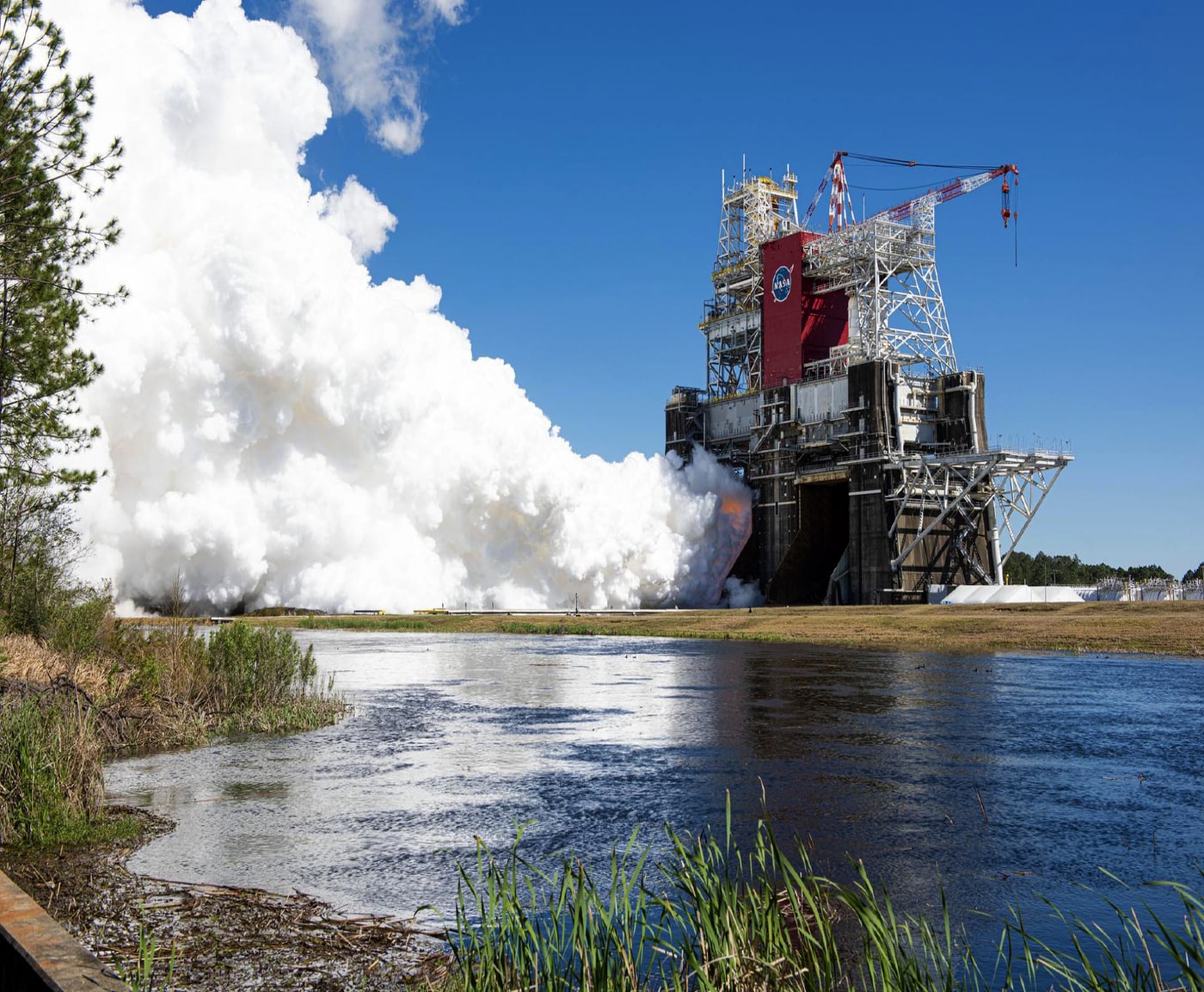
The upcoming Artemis IV mission will use NASA’s Space Launch System. Its core stage feeds liquid hydrogen and liquid oxygen to four RS-25 engines. Hydrogen is an extremely light liquid, yet it demands a large tank. Why choose it when denser kerosene or methane could occupy less space? [1] [2]
The choice begins with two different questions: how much propellant mass must the rocket carry, and how much volume will that mass occupy? A fuel can help one part of that problem while making another harder. The useful comparison follows the complete stage—engines, oxygen, tanks and thermal control. [2] [1]
Fuel is only part of the load
A chemical rocket carries its oxidizer as well as its fuel. The three fuel choices discussed here can be paired with liquid oxygen, often abbreviated LOX. RP-1 is a refined kerosene; methane and hydrogen are stored as very cold liquids. Kerosene’s easier fuel storage does not remove the need to manage the oxygen tank. [5] [4] [2]
When an engine’s performance is quoted per unit of propellant, both fuel and oxidizer count. Comparing a kilogram of fuel alone with a kilogram of the complete mixture would answer a different question. First isolate the volume effect; then bring oxygen and the rest of the vehicle back into the calculation. [3]
Hold the fuel mass fixed
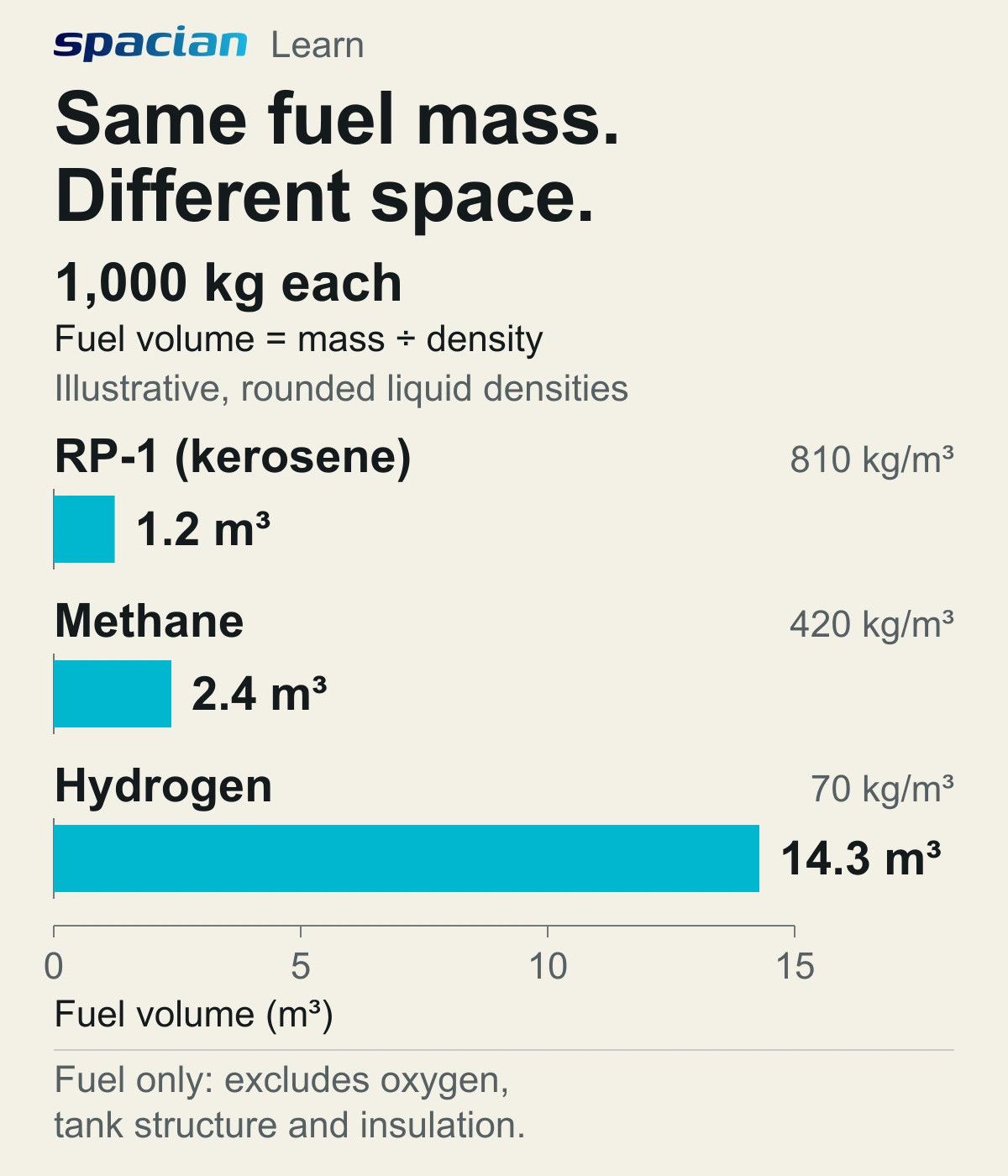
Take an illustrative 1,000 kilograms of each liquid fuel. A NASA-hosted propulsion course uses rounded densities of 810 kilograms per cubic metre for RP-1, 420 for methane and 70 for hydrogen. Dividing mass by density gives approximately 1.2, 2.4 and 14.3 cubic metres respectively. [2]
The hydrogen occupies roughly twelve times the fuel volume of the RP-1 in this example. These are teaching values, rather than a tank design: actual density depends on storage conditions. The comparison holds fuel mass fixed; oxygen, tank structure and engine performance belong in the next step. [2]
The engine measures a different advantage
An engine accelerates exhaust to produce thrust. Specific impulse expresses thrust relative to the rate at which propellant weight flows through the engine. Higher specific impulse means more impulse from a given propellant mass under the stated engine conditions. It is an engine-and-propellant result, rather than a ranking of fuel density. [3]
This is why hydrogen remains attractive despite its bulky storage. Oxygen–hydrogen engines can offer high specific impulse. The benefit must be assessed alongside the larger fuel volume and the mass and layout of the systems needed to contain it. The same fuel can make sense in one stage architecture and be less useful in another. [2]
Kerosene buys compact storage
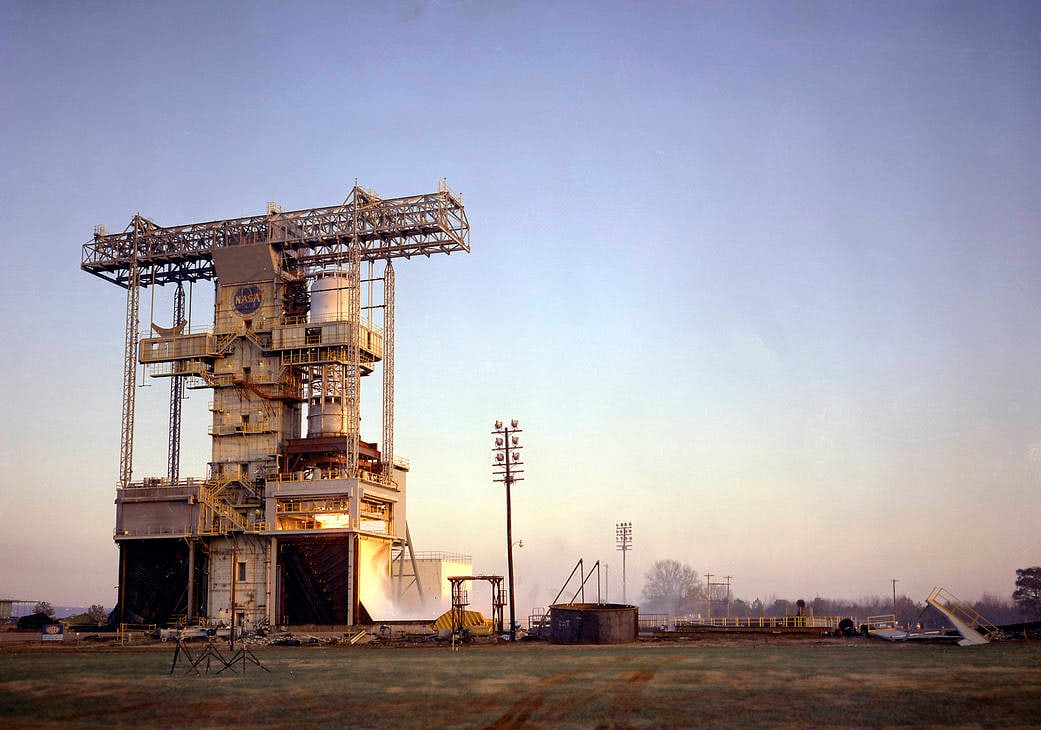
RP-1 places more fuel mass inside a given volume. NASA’s Saturn V used RP-1 and liquid oxygen in the F-1 engines of its first stage. That is a concrete example of a dense hydrocarbon fuel powering a large booster, while the hydrogen-burning SLS core stage shows why density alone does not decide every launcher’s architecture. [5] [1] [2]
A smaller required fuel volume can ease packaging, but selecting an engine also sets pumps, combustion hardware and operating conditions. The propellant mixture ratio changes how much oxygen accompanies the fuel. A fair stage comparison therefore includes both tanks and their supporting hardware. [2]
Methane sits between the two in this volume comparison
The illustrative methane volume is larger than RP-1’s and much smaller than hydrogen’s. Methane still needs cryogenic storage. It offers designers another combination of fuel properties to evaluate against the engine, tank arrangement and intended operating cycle. [2] [4]
ESA’s Prometheus demonstrator pairs liquid methane with liquid oxygen and is being developed for reusable launch systems. In tests on 29 October 2026, it demonstrated repeated ignition using engine inlet pressures. That result concerns a tested engine and starting system: choosing methane is one part of the design work needed for repeated flights. [7]
Storage time changes the problem
Hydrogen, methane and oxygen require systems that keep them sufficiently cold. Heat leaking into a cryogenic tank can warm its contents and cause liquid to boil. NASA’s cryogenic-fluid work addresses storage, transfer and measurement because a long wait in space creates different demands from a short ascent. [4] [6]
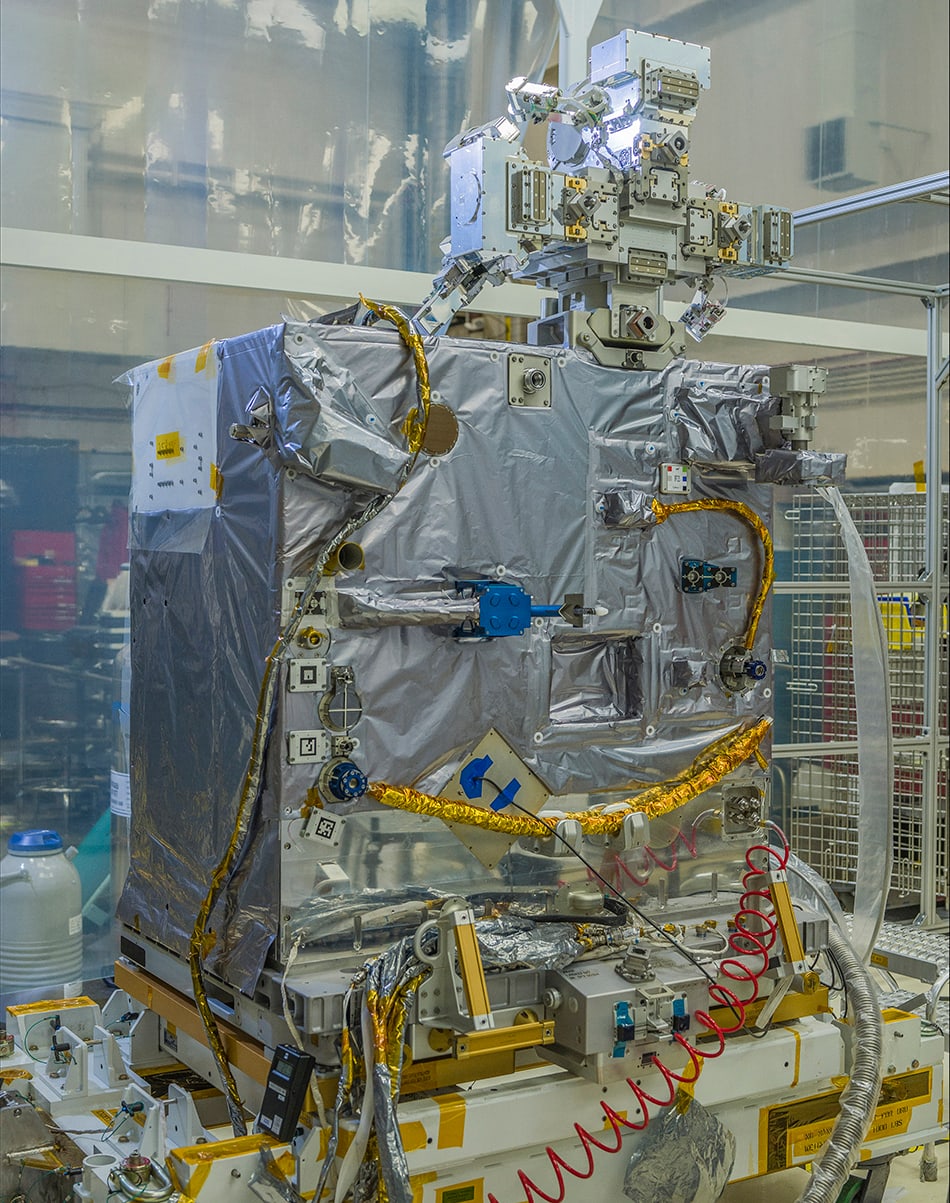
Robotic Refueling Mission 3 provides a measured methane-storage example. NASA reports four months of storage with zero boil-off, using active cryocoolers and multilayer insulation. The cooling equipment and insulation are part of the flight system; the useful fuel choice depends on how the mission will keep and use its propellant. [6]
Choose for the complete stage
The lightest liquid in the comparison needs the most fuel volume because its density is lowest. Its engine performance can still justify that storage burden. Kerosene provides compact fuel storage; methane offers another balance, with its own cryogenic requirements and engine-development choices. [2] [4] [7]
For Artemis IV’s SLS core stage, NASA’s chosen system is hydrogen and oxygen feeding RS-25 engines. For another stage, the useful answer may change with the required maneuver, storage duration and vehicle architecture. Mass, volume and performance must be evaluated together to understand the choice. [1] [3] [4]
Sources & image credits
- NASA · SLS core stage ↗
- NASA-hosted Rocket Propulsion Fundamentals · density table, PDF page 14 ↗
- NASA Glenn · Specific Impulse ↗
- NASA · Cryogenic Fluid Management ↗
- NASA · F-1 static test at Marshall, 1966 ↗
- NASA · Robotic Refueling Mission 3 ↗
- ESA · Prometheus reusable engine tests, 6 November 2026 ↗
- Spacian original: equal fuel mass, animated volume comparison ↗