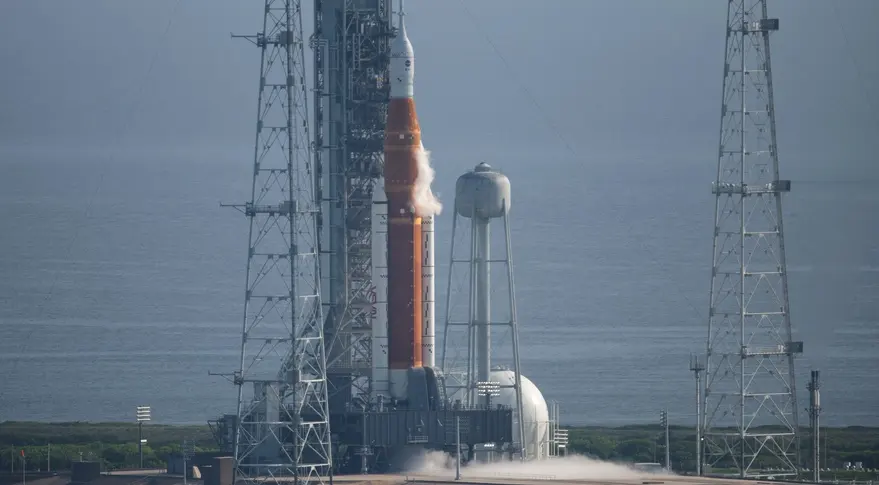
NASA officials said Thursday they hope to try again to launch the Artemis 1 moon rocket from the Kennedy Space Center as soon as Sept. 23 or 27, but that schedule comes with two big caveats: A repair to a leaky liquid hydrogen fueling line must hold tight during a tanking test next weekend, and the Space Force’s Eastern Range has to extend the certification of batteries on the moon rocket’s flight safety system.
The FCC wants to require operators of low Earth orbit satellites to deorbit their spacecraft within five years after their mission ends, a much shorter timeframe than currently required.
A joint U.S.-French Earth science mission is ready to be delivered to California for a launch now scheduled for early December, a slight delay caused in part because of transportation issues.
Summary supplied by SpaceNews.
NASA
NASA to Discuss Status of Next Artemis I Moon Mission Launch Attempt
Source link unavailable
Read summary
NASA will hold a media teleconference at 11 a.m. EDT Thursday, Sept. 8, to discuss next steps for the Artemis I mission to launch the Space Launch System (SLS) rocket and Orion spacecraft from the agency’s Kennedy Space Center in Florida.
Summary supplied by NASA.
NASA
NASA Taps Axiom Space for First Artemis Moonwalking Spacesuits
Source link unavailable
Read summary
NASA has selected Axiom Space to deliver a moonwalking system for the Artemis III mission, which will land Americans on the surface of the Moon for the first time in over 50 years. This award – the first one under a competitive spacesuits contract – is for a task order to develop a next generation Artemis spacesuit and supporting systems, and to de
Summary supplied by NASA.
NASA
NASA Awards Contract for Marshall’s Mission Operations
Source link unavailable
Read summary
NASA has awarded the Marshall Operations Systems, Services, and Integration II (MOSSI II) contract to Teledyne Brown Engineering Inc. of Huntsville, Alabama.
U.S. defense and intelligence agencies are not taking advantage of available commercial imagery due to slow and cumbersome procurement methods, said a GAO report.
Technicians at NASA’s Kennedy Space Center will repair a leak in a liquid hydrogen fueling line on the Artemis 1 moon rocket the launch pad rather than inside the Vehicle Assembly Building, a decision the agency says will enable teams to test the repair under cryogenic conditions.
Europe’s Ariane 5 rocket returned to action on September 7, deploying a high-power communications satellite for French operator Eutelsat. Liftoff from the Centre Spatial Guyanais in Kourou, French Guiana occurred on time at 6:45 PM local time (21:45 UTC) at the opening of an 86-minute launch window.
Skyroot Aerospace says the round will fund “infrastructure and initial developmental launches, enabling us to achieve commercial operations next year.”
BAE Systems said Sept. 7 it is developing its first multi-sensor satellite cluster to gather intelligence for military and disaster response needs in 2024.
Kall Morris Inc. announced Sept. 7 it received three study contracts for debris-remediation technologies under the Space Force’s Orbital Prime program.
OneWeb took a $229 million charge this year linked to the termination of its Soyuz launch contract and dozens of satellites stranded in Kazakhstan after Russia’s invasion of Ukraine.
A powerful Eutelsat commercial communications satellite launched Wednesday aboard an Ariane 5 rocket from French Guiana, heading into orbit on a mission expected to last more than 15 years to provide broadband connectivity to rural households, ships, and airplane passengers across Europe.
Rocket Lab has signed a cooperative agreement with the U.S. military to explore the possibility of using its space launch vehicles to transport cargo around the world.
A few busy days are behind the Chinese space program. Not only did three orbital launches occur from China, but also, the Shenzhou-14 crew performed an EVA outside of the Tiangong space station. Additionally, a newly shared photo of the Chinese ZQ-2 rocket shows a close race against the American Terran 1 and Starship vehicles to be the first methane-fueled rocket in orbit.
An Ariane 5 rocket is set to blast off Wednesday from French Guiana — a day later than planned due to a poor weather forecast Tuesday — with a Eutelsat-owned satellite designed to beam broadband internet signals across Europe from a position in geostationary orbit.
The Defense Department released an updated policy document that recognizes space “as a priority domain of national military power” and formally adopts rules for safe operations in space.
South Korea’s first robotic lunar orbiter is looping back to the moon from the L1 Lagrange point after successfully conducting a critical trajectory correction maneuver Sept. 2, a milestone in its voyage toward the moon.
NASA will attempt to fix on the pad a liquid hydrogen seal that caused a Space Launch System scrub, keeping open the option to proceed with a new launch attempt later this month.
The seven members of the Expedition 67 crew aboard the International Space Station (ISS) had yet another action-packed month in August 2022. From spacewalks to research to cargo vehicle departures, the crew aboard the orbiting laboratory and mission teams back on Earth stayed busy.
Saber Astronautics announced Sept. 5 the U.S. Space Force has extended the company’s contract to develop a space domain awareness tool designed for satellite operators.
Work to assemble a Long March 5B heavy-lift rocket is underway at Wenchang spaceport as China prepares to complete the construction of its Tiangong space station.
SpaceX launched another Falcon 9 Block 5 on Sunday, September 4 at 10:09 PM EDT (02:09 UTC on September 5). Lifting off from Space Launch Complex 40 (SLC-40) at the Cape Canaveral Space Force Station in Florida, this mission carried 51 Starlink satellites, as well as the rideshare Varuna-TDM, to low-Earth orbit (LEO). It marks the 40th Falcon 9 launch of 2022–a launch every 6.2 days.
SpaceX launched a Falcon 9 rocket Sunday night with 51 more Starlink internet satellites and a rideshare payload that will use a Spaceflight-built orbital transfer vehicle to climb into a higher orbit to test broadband communications technology for Boeing. Liftoff from Cape Canaveral occurred at 10:09 p.m. EDT Sunday (0209 GMT Monday).
"Every time we saw a leak, it pretty quickly exceeded our flammability limits."
Summary supplied by Arstechnica.
NASA
NASA to Provide Artemis I Launch Update Saturday
Source link unavailable
Read summary
Following the Artemis I launch scrub Saturday from Launch Complex 39B at NASA’s Kennedy Space Center in Florida, the agency will hold a media briefing no earlier than 4 p.m. EDT on Saturday Sept. 3, to discuss mission status.
NASA called off a second attempt to conduct the inaugural launch of the Space Launch System Sept. 3 after failing to resolve a liquid hydrogen leak during fueling of the rocket.
The sun-studying Solar Orbiter spacecraft will swing by Venus on Saturday (Sept. 3) and gather bonus observations of our neighbor planet's mysterious magnetic field.
NASA has scrubbed the second launch attempt of the Artemis I mission from the Kennedy Space Center in Florida after a liquid hydrogen (LH2) leak was detected at the vehicle-to-ground interface on the LH2 Tail Service Mast Umbilical (TSMU).
NASA’s star-crossed Space Launch System moon rocket was grounded for the second time in five days Saturday, this time by a large hydrogen leak in a fuel line quick-disconnect fitting that will delay the $4.1 billion booster’s maiden flight by several weeks, likely into October.
The first unpiloted mission for NASA’s Artemis lunar program aims to prove out the most powerful rocket to ever launch from U.S. soil, and test the function of a human-rated spacecraft traveling more than 40,000 miles beyond the far side of the moon before blazing back through Earth’s atmosphere at nearly 25,000 mph.
Two Russian cosmonauts exited the Poisk airlock Friday to begin a spacewalk outside the International Space Station. Their main goals will be to complete tasks on the European Robotic Arm left unfinished after a spacewalk last month was cut short by a spacesuit battery problem.
The European Service Module (ESM) is part of the necessary hardware to bring people back to the moon. It will not only be used to power Orion on the Artemis I mission, but on the missions to come as well.