

Four bright patches. One galaxy.
Euclid revealed a ring around NGC 6505. Checking what made it required spectra, careful subtraction and a model that could reproduce the arcs.
A clue close to home
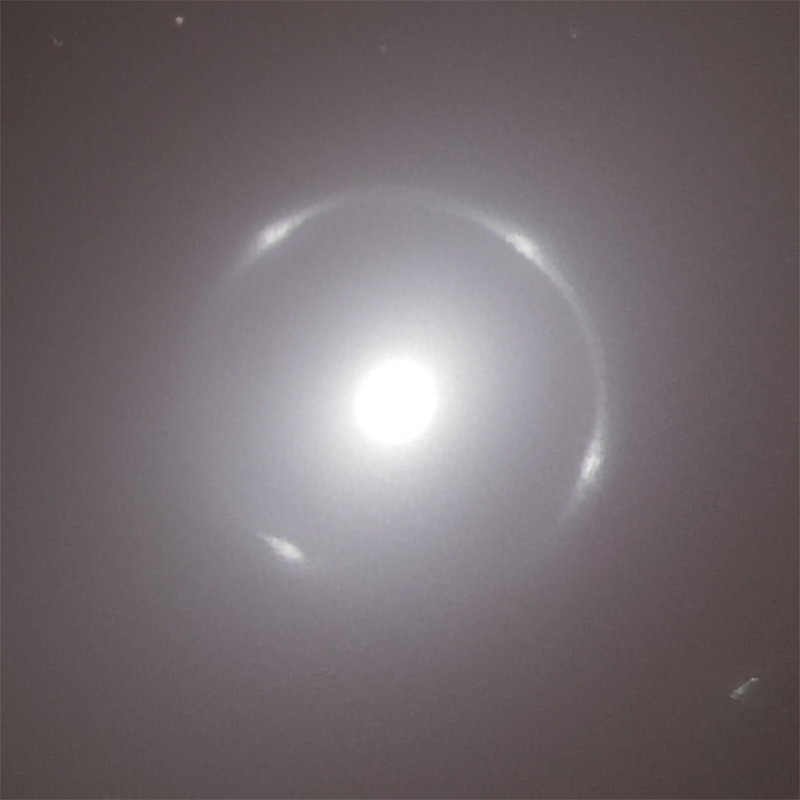
The bright patches around NGC 6505 look like neighbours of the galaxy at the centre. They are repeated views of a different galaxy behind it. Euclid's image makes that explanation inviting. Checking it required something the photograph could not provide: a way to separate the light of two objects along almost the same line of sight. [1] [2]
The discovery was announced in February 2025, not today. The foreground galaxy had been known since the nineteenth century; Euclid's early observations revealed the much fainter structure around it. ESA places the foreground galaxy roughly 590 million light-years away and the background source about 4.4 billion light-years away. A flat image hides that separation. [1] [2]
A picture records directions, not depth
A telescope does not directly attach a distance to each pixel. It records light arriving from different directions. When a massive foreground object changes the paths by which a distant source's light reaches us, the source can appear in several places. With a close enough alignment, the stretched images can join into a ring. [1] [2]
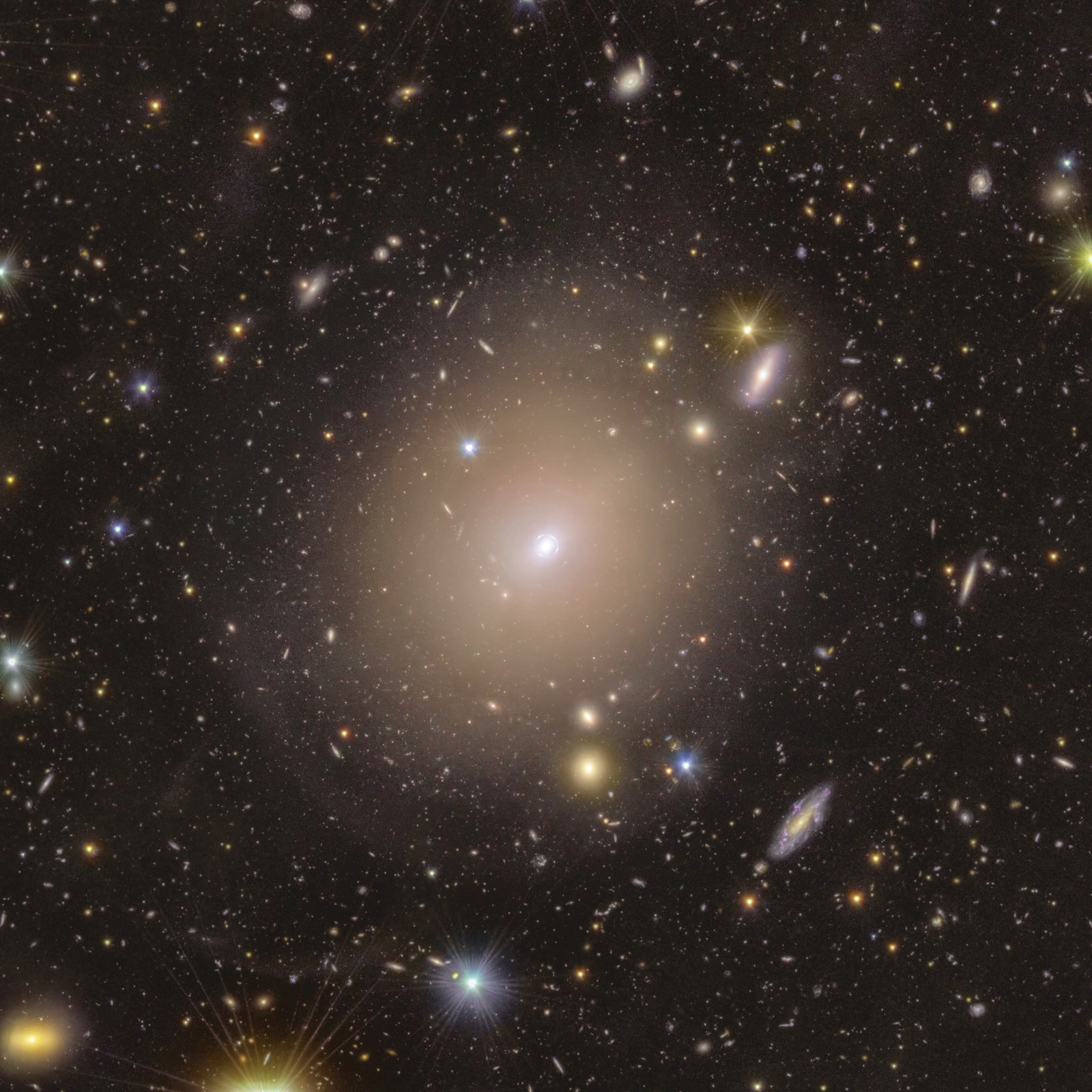
That is why an Einstein ring is not equivalent to Saturn's rings. In Saturn's case, there is material arranged around the planet. In a gravitational lens, the ring is an image of something farther away. Nor does a perfect-looking circle establish that the source galaxy itself is circular. The foreground mass and the alignment have changed its apparent shape. [1] [2]
The first clue did not survive better data
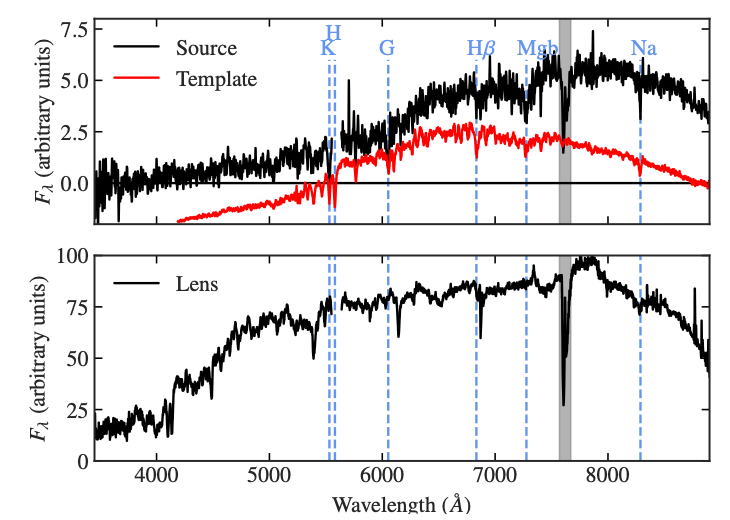
An early ground-based spectrum contained a weak feature that tentatively suggested a source redshift near 1.1. Deeper Keck observations instead supported a redshift near 0.41. The team extracted matching features from the separate bright images; the weakest was only marginal. The better spectrum superseded the provisional clue. [2]
A single uncertain feature is a poor identity check. Several features at the right relative wavelengths provide a stricter test. Redshift is measured by comparing those observed wavelengths with their known counterparts. In an expanding universe, the pattern is displaced towards longer wavelengths. It is the agreement across the pattern, not merely the presence of one convenient dip, that makes the comparison useful. [2]
Subtracting light is not removing gravity
The foreground galaxy contributes light as well as gravity. Its brightness can conceal the fainter source. Researchers modelled and subtracted that foreground light to inspect the background signal. This processing does not undo the gravitational deflection that the photons experienced on their way to the telescope. [2]
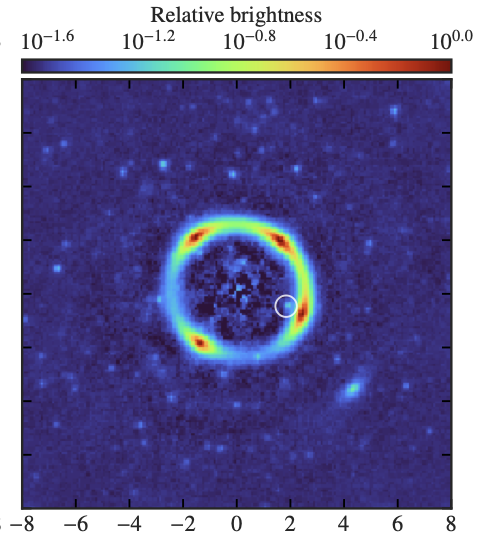
Keep those operations separate. Remove a lens's mass from a physical model and the paths change. Remove an estimate of its light from the recorded data and the paths have already happened: the task is to distinguish overlapping signals. A cleaned image is therefore a processed observation, not a second photograph taken after the galaxy disappeared. [2]
Ask the model to make the image again
A reconstruction works backwards from the observed image to a possible source and lens. Its useful test runs forwards: does that proposed combination reproduce the arcs? The leftover differences, or residuals, reveal where the fit fails. Giving a model more freedom is not automatically an improvement; enough flexibility can let it imitate noise rather than explain a real feature. [2]
The source reconstructed by that calculation depends on the lens model. In the paper’s Figure 6, the researchers show the observation, the modelled image, the residuals and the reconstructed source together. The source-plane panel below is the result of that reconstruction; its white curves mark caustics, where the lens mapping produces very high magnification. [2]
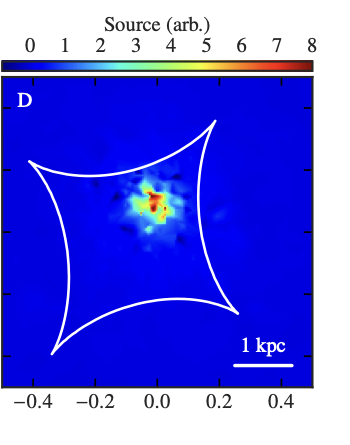
What region did the ring weigh?
The paper inferred about 153 billion solar masses projected inside the Einstein radius. A combined analysis attributed roughly 11% of the projected mass within that central aperture to dark matter. Those are aperture-specific, model-dependent results, not the total galaxy mass or a universal dark-matter percentage. [2]
Imagine looking down a cylinder through the galaxy, with the ring marking its circular boundary on the sky. “Projected inside” includes mass along that line of sight, rather than only matter in a thin circular slice. The gravitational measurement responds to the mass distribution; it does not identify a particle as a star or dark matter. Separating the contributions needs additional evidence and assumptions. [2]
The distinction is the point of the image. We observe arcs. Spectra test where their light comes from. A lens model connects their shape with mass. Additional modelling separates the mass components. Each step answers a different question; none turns the ring into a direct photograph of dark matter. [2]
The aperture and the uncertainty
The paper measures an Einstein radius of about 2.5 arcseconds. Its quoted projected mass within that radius is 1.53 × 10¹¹ solar masses. The combined lensing-and-dynamics analysis gives a projected dark-matter fraction of 11.1%, with a reported range of −3.5/+5.4 percentage points. Stellar-population and dynamical assumptions enter the separation of stellar and dark mass. [2]
Watch the investigation
Spacian’s companion film follows the ring, the spectroscopy and the lens reconstruction. The telescope images and published research figures are identified separately from the film’s explanatory demonstrations. [6] [2]
Loading the player connects to YouTube.
The film separates Euclid observations, published spectra and reconstructions from explanatory demonstrations. The reported central dark-matter fraction depends on the combined model.
Poster: ESA/Euclid/Euclid Consortium/NASA; image processing: J.-C. Cuillandre, G. Anselmi, T. Li · CC BY-SA 3.0 IGO [6]Sources & image credits
- ESA · Euclid discovers a stunning Einstein ring (10 February 2025) ↗
- O’Riordan et al. / Euclid Collaboration · A complete Einstein ring in NGC 6505, A&A 694, A145 (2025) ↗
- Euclid Collaboration · Full research text and figures (arXiv version, February 2025) ↗
- ESA · Wide-field Euclid image of NGC 6505 ↗
- ESA · Close-up of the Einstein ring around NGC 6505 ↗
- Watch Spacian’s Euclid investigation ↗
Related reading and objects
What an eight-minute radio pulse reveals about two stars
A 7.9-minute pulse and a separate 1.3-day cycle let astronomers investigate two unresolved stars—and the magnetized atmosphere between them.

A star vanished. The infrared evidence is harder to read.
N6946-BH1 faded without a normal supernova. Webb found light at its position, but light alone cannot tell us what survived.