

Neptune · natural satellite
Triton
A large moon on a retrograde orbit
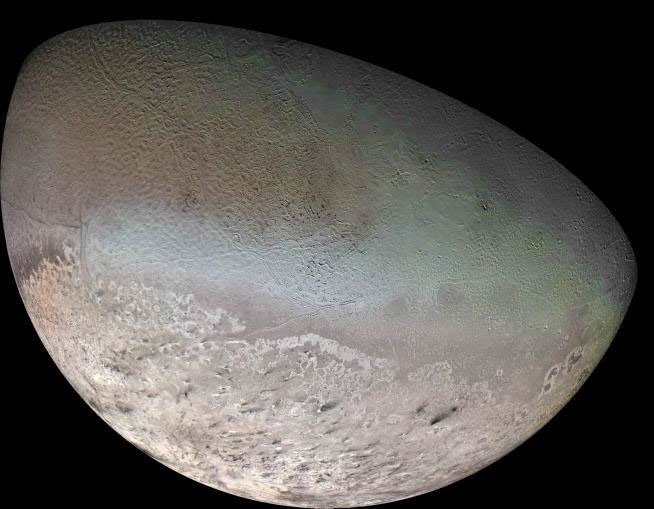
Triton travels around Neptune opposite the planet’s rotation. Voyager 2 observed a nitrogen-rich surface and active dark plumes during its 1989 flyby.
- Mean diameter
- 2,705.2 km
- Mean orbital distance
- 354,800 km from centre
- Orbital period
- 5.879 Earth days
Compared with our Moon
One diameter scale. Circle shapes compare volume-equivalent diameters; irregular moons are not spheres.
Orbit & discovery
- Surface gravity
- 0.781 m/s²
- Discovery
- 1846
- Discoverer / team
- W. Lassell
- Provisional designation
- —
- JPL satellite ID
- 801
- Orbital eccentricity
- 0
- Inclination
- 157.3 degrees
Inclination reference: equatorial. Mean-element epoch: 2000-01-01.5 TDB · NEP098.
Diameters use volume-equivalent mean radii, including for irregular bodies. Mean orbital elements describe an orbit; they are not live positions. Missing physical measurements remain unavailable.
Physical measurements & uncertainties
- Mean radius · km
- 1352.60 ±2.40 [1]
- GM · km³/s²
- 1428.49546 ±0.61603 [NEP097]
- Density · g/cm³
- 2.0649 ±0.0110 [*]
Missions in the Neptune system · 1 records
1 launches · 0 linked events
These records cover the planetary system. A system mission did not necessarily visit this moon. Dedicated targets are marked separately; programme events include the journey and briefings. Launch outcomes do not establish arrival, landing success or present spacecraft operation.
No dedicated-target flight is recorded for this moon.
1 records from the complete 9,386‑record production catalogue.
Sources & measurements
- JPL · IAU-recognized satellite discoveries ↗
- JPL · physical parameters and uncertainties ↗
- JPL · mean orbital elements ↗
- NASA NSSDCA · Jovian sidereal orbital periods ↗
- NASA · planetary exploration history ↗
- NASA · Voyager encounters ↗
- NASA · Galileo ↗
- NASA · Juno ↗
- NASA · Cassini–Huygens ↗
- NASA · New Horizons ↗
- ESA · Juice targets ↗
- NASA · Europa Clipper ↗
- NASA · Dragonfly ↗
- JAXA · MMX ↗