SpaceX’s first launch of the second half of 2022 occurred on Thursday when a Falcon 9 rocket lofted another 53 Starlink satellites into low Earth orbit (LEO). Liftoff occurred at 9:11 AM EDT (13:11 UTC) from Space Launch Complex 40 (SLC-40) at the Cape Canaveral Space Force Station in Florida.
NASA strongly criticized Russia for using the International Space Station to promote its invasion of Ukraine, a break from the agency’s approach of emphasizing ongoing cooperation despite the war.
Indian startup Digantara said July 6 its space-weather monitoring payload ROBI is operational onboard a spent upper stage of India’s Polar Satellite Launch Vehicle.
Virgin Galactic announced July 6 it signed an agreement with a Boeing subsidiary to build two new aircraft that will be used as launch platforms for its next-generation suborbital spaceplanes.
L3Harris is making a strategic investment in laser communications company Mynaric with plans to make increased use of that technology for space and other applications.
Newly-developed orbital and suborbital launch vehicles are being readied for test flights at the Jiuquan spaceport as China’s efforts to foster a commercial space sector advance.
Fifty-three more Starlink internet satellites are fastened to the top of a SpaceX Falcon 9 rocket for liftoff Thursday from Cape Canaveral, the first of five Falcon 9 flights scheduled for July.
If it feels like there are more rockets launching into orbit than ever before, it’s not just you. The world’s launch operators, led by SpaceX and China’s state-run enterprises, launched 72 missions into orbit in the first half of 2022, on pace to break last year’s record of 135 orbital deliveries.
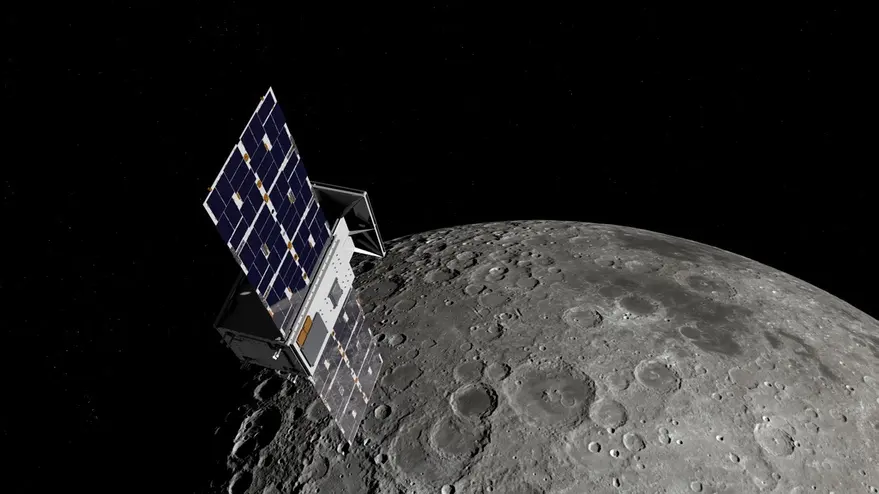
A NASA lunar cubesat mission has lost contact with Earth a day after its deployment, putting into jeopardy its plans to demonstrate the orbit that will be used for later Artemis missions.
Norwegian company Kongsberg Defence & Aerospace will acquire a majority stake in NanoAvionics in a deal that values the smallsat manufacturer at 65 million euros ($67 million).
June 2022 was yet another busy month on the International Space Station (ISS), filled with new spacecraft arrivals, departures, and intriguing research performed by the Expedition 67 crew.
With the first half of 2022 coming to a close, NASA teams are continuing work to resolve the Lucy spacecraft’s solar array issue following its October 2021 launch. Lucy is a first-of-a-kind mission to visit several asteroids in Jupiter’s L4 and L5 Lagrange points. Currently, Lucy is coasting before its first flyby of Earth in October 2022.
The government of New Zealand has formally joined a U.S.-led ban on testing of destructive direct-ascent ASAT weapons in an effort to build momentum for a global prohibition on such tests.
A United Launch Alliance (ULA) Atlas V rocket carrying the USSF-12 mission for the U.S. Space Force’s Space Systems Command lifted off on July 1 at 7:15 p.m. EDT from Space Launch Complex-41 at Cape Canaveral Space Force Station. To date ULA has laun...
NASA is continuing to work with Roscosmos on a seat barter agreement despite missing a self-imposed deadline last month to complete a deal in time to allow exchanges on missions launching this fall.
After a successful Wet Dress Rehearsal (WDR), NASA Exploration Ground Systems (EGS) rolled back the Space Launch System (SLS) rocket to the Vehicle Assembly Building (VAB), which should be the last time this is performed before launch. The Artemis 1 vehicle will now undergo final readiness checks and launch preparations ahead of its debut flight planned for later this year.
Virgin Orbit fired its air-launched rocket into the sky late Friday night off the coast of California, accelerating seven small CubeSat payloads to orbit on the company’s first nighttime mission and clearing the way for teams to base the next Virgin Orbit launch from the United Kingdom later this year.
NASA’s powerful new Space Launch System moon rocket was hauled from its launch pad back to the Vehicle Assembly Building at the Kennedy Space Center Saturday for final repairs, testing and closeouts, moving closer to liftoff later this summer after completing a fueling demonstration last month.
A United Launch Alliance Atlas 5 rocket fired off its launch pad at Cape Canaveral Friday on a six-hour climb to geosynchronous orbit, deploying a classified payload and a U.S. Space Force satellite to test an improved infrared heat-sensitive sensor design that could help detect and track enemy hypersonic missiles.
NASA’s powerful new Space Launch System moon rocket will be hauled from its launch pad back to the Vehicle Assembly Building at the Kennedy Space Center overnight Friday into early Saturday morning for final repairs, testing and closeouts, moving closer to liftoff later this summer after completing a fueling demonstration last month.
A United Launch Alliance Atlas 5 rocket on July 1 launched the USSF-12 mission for the U.S. Space Force. The rocket lifted off at 7:15 p.m. Eastern from Space Launch Complex-41 at Cape Canaveral Space Force Station, Florida.
Agile Space Industries is preparing to consolidate propulsion design, manufacturing and production in a new 1,860-square-meter facility in Durango, Colorado.
United Launch Alliance will deploy a pair of Space Force technology demonstration payloads into geostationary orbit Friday evening. The USSF-12 mission lifted off from Cape Canaveral at 7:15 PM EDT (23:15 UTC) on Friday, following a 24 hour delay from Thursday due to weather as well as additional weather delays early in the Friday window.
OneWeb will launch some of its next-generation satellites on Relativity Space’s next-generation launch vehicle starting as soon as 2025, the companies announced June 30.
The Chinese Academy Sciences is preparing to select a new batch of space missions from proposals to study Earth, the Sun and solar system, and the deeper universe as part of a "New Horizons Program."
Virgin Orbit launched its fifth flight of the LauncherOne rocket, after scrubbing an attempt on Wednesday because the propellant temperature was deemed to be “slightly out of bounds”. That decision was made prior to the take-off of Cosmic Girl, the carrier aircraft.
NASA and SpaceX have decided to delay the company’s next Cargo Dragon launch a third time after discovering a small propellant leak...
Summary supplied by Teslarati.
NASA
NASA Awards Engineering, Technology, Science Contract
Source link unavailable
Read summary
NASA has awarded the JSC Engineering, Technology, and Science (JETS) II contract to Jacobs Technology Inc. of Tullahoma, Tennessee, to provide engineering and scientific products, technical services and related services for the agency’s Johnson Space Center in Houston, other NASA centers and government agencies.