

Why did 51 Pegasi b change the search for planets?
Michel Mayor and Didier Queloz announced 51 Pegasi b in 1995. The planet was a giant on an orbit lasting only about four days—an arrangement absent from our Solar System. The discovery showed why searching only for familiar planetary architectures could hide signals already present in the data.
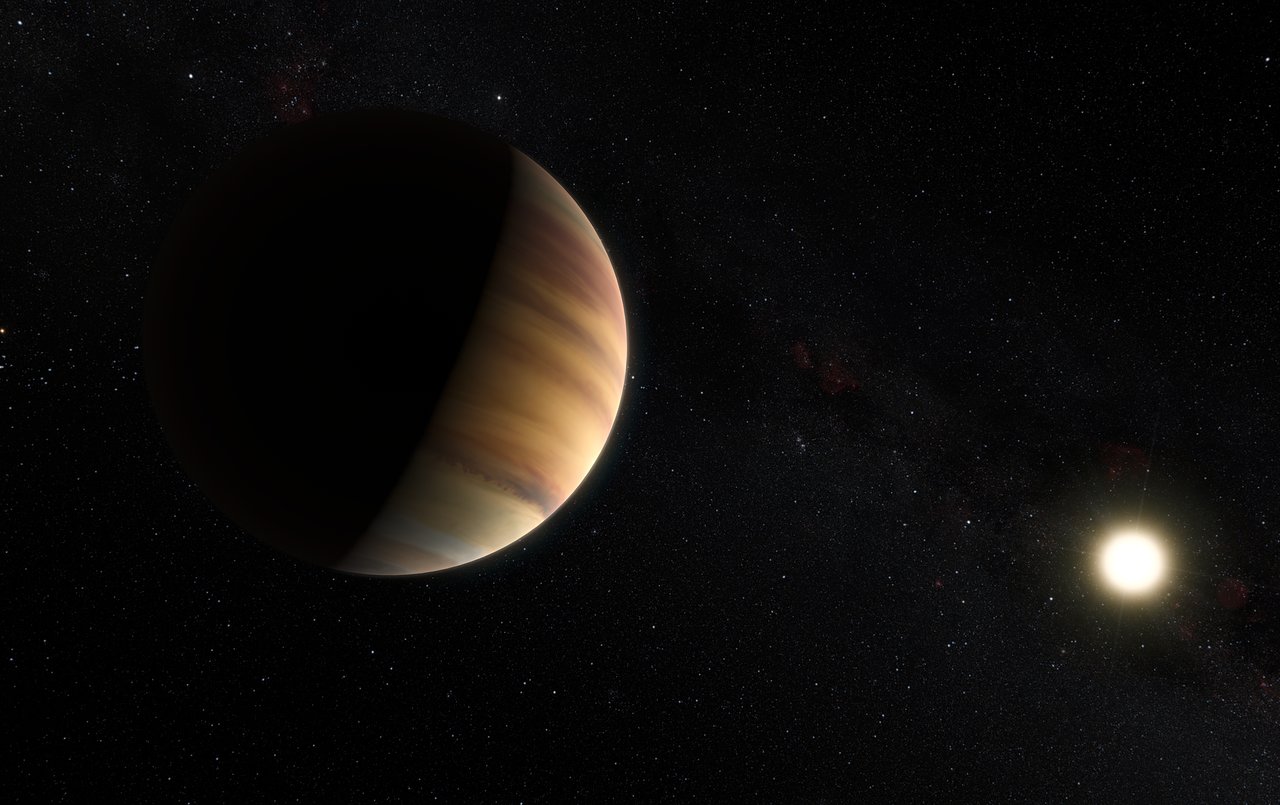
The telescope measured the star’s response
A planet and its star both move around their shared centre of mass. The star’s motion is much smaller, but a spectrograph can detect its component towards and away from Earth. As the star approaches, spectral lines shift towards shorter wavelengths; as it recedes, they shift towards longer ones. [1] [2]
The repeated Doppler pattern revealed an orbital period of about 4.2 days. The planet was inferred from the star’s motion, rather than photographed as a separate bright disk. This radial-velocity method made a faint companion accessible through the light of its much brighter host. [1] [2]
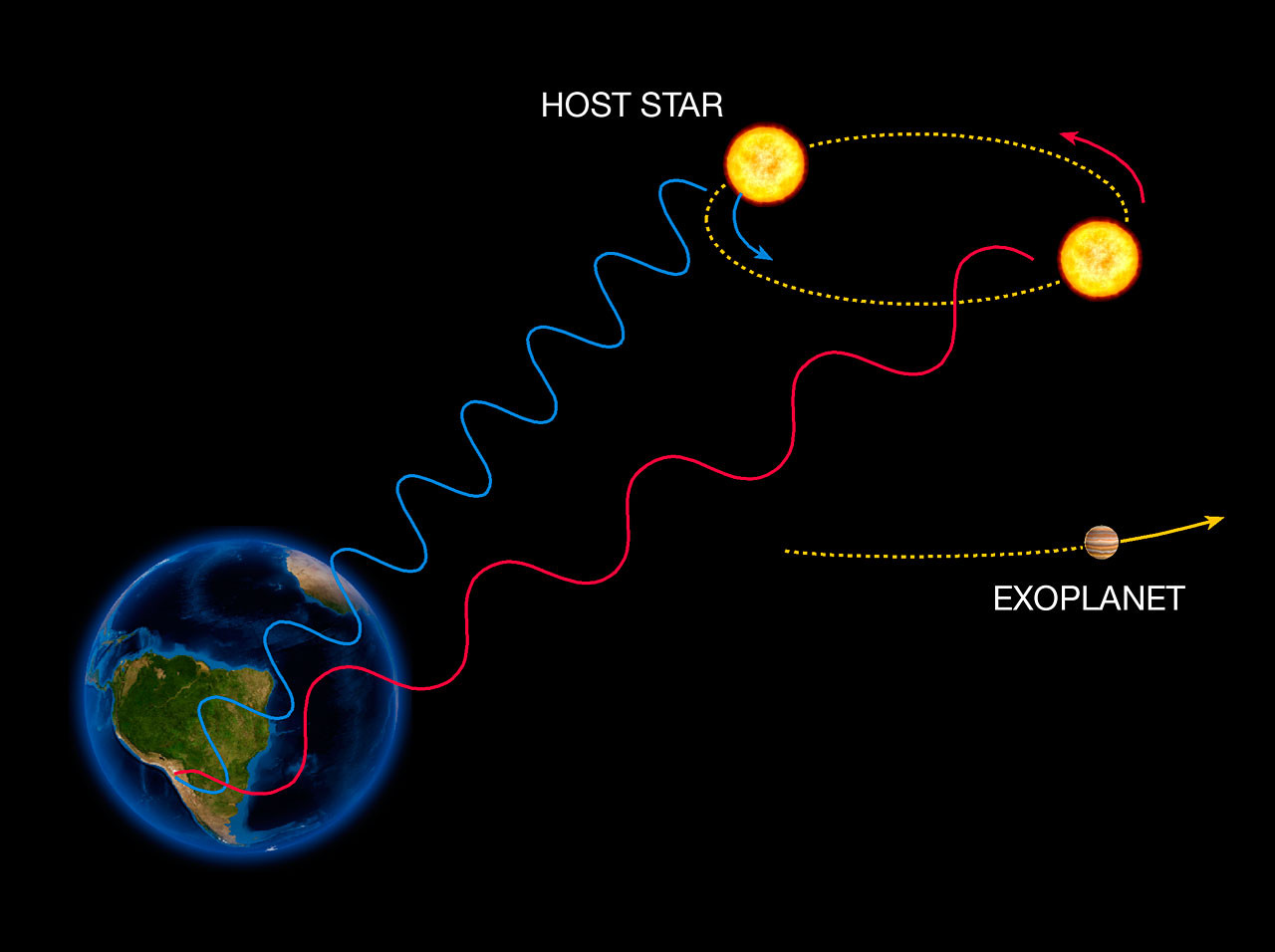
The strength of the signal depends on the companion’s mass, orbital arrangement and viewing angle. A substantial planet in a tight orbit can produce a relatively large, rapidly repeating stellar response. [1] [2]
A short period allowed a fast independent test
The 1995 announcement was initially met with scepticism, in a field with a history of false planet claims. Stellar activity or instrumental changes can sometimes imitate periodic signals, so an orbit-like pattern needs checks against alternatives. [2]
Paul Butler and Geoffrey Marcy had observing time shortly after the announcement. Several nights of measurements covered approximately one orbit and independently confirmed the signal. The unusually short period made that rapid test possible. [2]
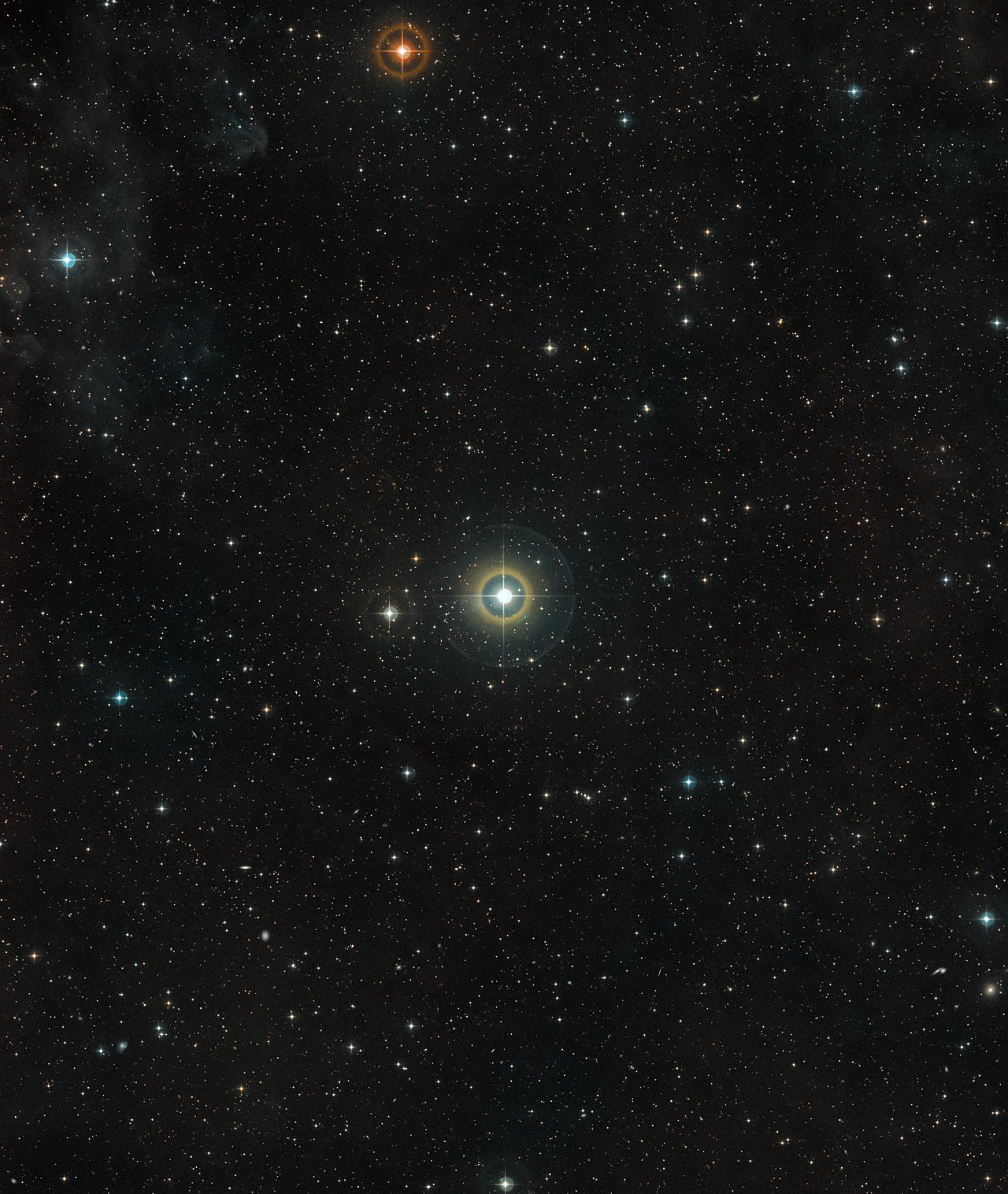
Mayor and Queloz’s discovery became the first confirmed planet around a Sun-like star. It was not the first exoplanet of any kind: planets around a pulsar had already been identified. The distinction identifies what was new without erasing the earlier discoveries. [2]
The orbit challenged a familiar expectation
In our Solar System, Jupiter is far from the Sun and takes nearly twelve years to orbit. 51 Pegasi b lies only about 0.05 astronomical units from its star and completes a year in days. A gas giant could therefore occupy a setting dramatically different from Jupiter’s. [3] [2]
The term hot Jupiter describes that combination of a giant planet and strong stellar irradiation. It is a population label, not a statement that the object has Jupiter’s exact radius, composition or weather. [3] [2]
The discovery forced formation theories to explain how giant planets can end up so close to their hosts. Present-day orbital position is not automatically the place where a planet assembled, making migration and subsequent dynamical evolution central questions. [3] [2]
What observers expect can shape what they find
Early searches often planned around long-period giants resembling Jupiter. A four-day giant could be easier to detect, provided measurements were taken frequently enough and the signal was not rejected because the orbit seemed implausible. [2] [1]
After the discovery, researchers revisited data and found further close-in giants. The change was partly conceptual: an unexpected architecture became a plausible target rather than an obvious mistake. [2] [1]
This also explains why early discovery lists contained many hot Jupiters. Large, short-period signals are comparatively accessible to radial-velocity surveys. Their prominence in an early sample does not establish that most planets have the same architecture. [2] [1]
A Doppler detection leaves further questions
Radial velocity provides an orbital period and a mass constraint that depends on inclination. It does not directly supply a surface photograph or automatically measure a radius. Additional techniques are needed to investigate other properties. [3] [1]
51 Pegasi b changed planet hunting because one secure measurement challenged both an expectation and an observing strategy. The star’s repeating motion demonstrated that other systems could arrange giant planets differently—and that the search had to remain sensitive to configurations unlike our own. [3] [1]
Sources & image credits
Related reading and objects

How do we find planets we cannot see?
ESA’s PLATO mission will look for planets by measuring changes in the light of their stars. Follow one possible signal from a dark silhouette to a repeatable orbit—and see which questions the dip cannot answer.

What does K2-18 b’s spectrum actually establish?
Webb’s first reported spectrum of K2-18 b in 2023 prompted a question that later analyses made more demanding: which atmospheric molecules are securely identified, and which depend on how the small transit signal is processed? The answer determines how far any claim about the planet below can go.