

What does K2-18 b’s spectrum actually establish?
Webb’s first reported spectrum of K2-18 b in 2023 prompted a question that later analyses made more demanding: which atmospheric molecules are securely identified, and which depend on how the small transit signal is processed? The answer determines how far any claim about the planet below can go.

A transit samples the atmospheric rim
K2-18 b is a sub-Neptune, larger than Earth and smaller than Neptune, orbiting a cool star about 120 light-years away. Its size class has no direct counterpart in our Solar System, making Earth-based assumptions about its surface particularly uncertain. [1]
During a transit, a tiny fraction of the star’s light passes through the planet’s atmospheric edge. Gases absorb different wavelengths, changing the measured transit depth across the spectrum. Webb measures those wavelength-dependent differences rather than photographing clouds or an ocean. [1]
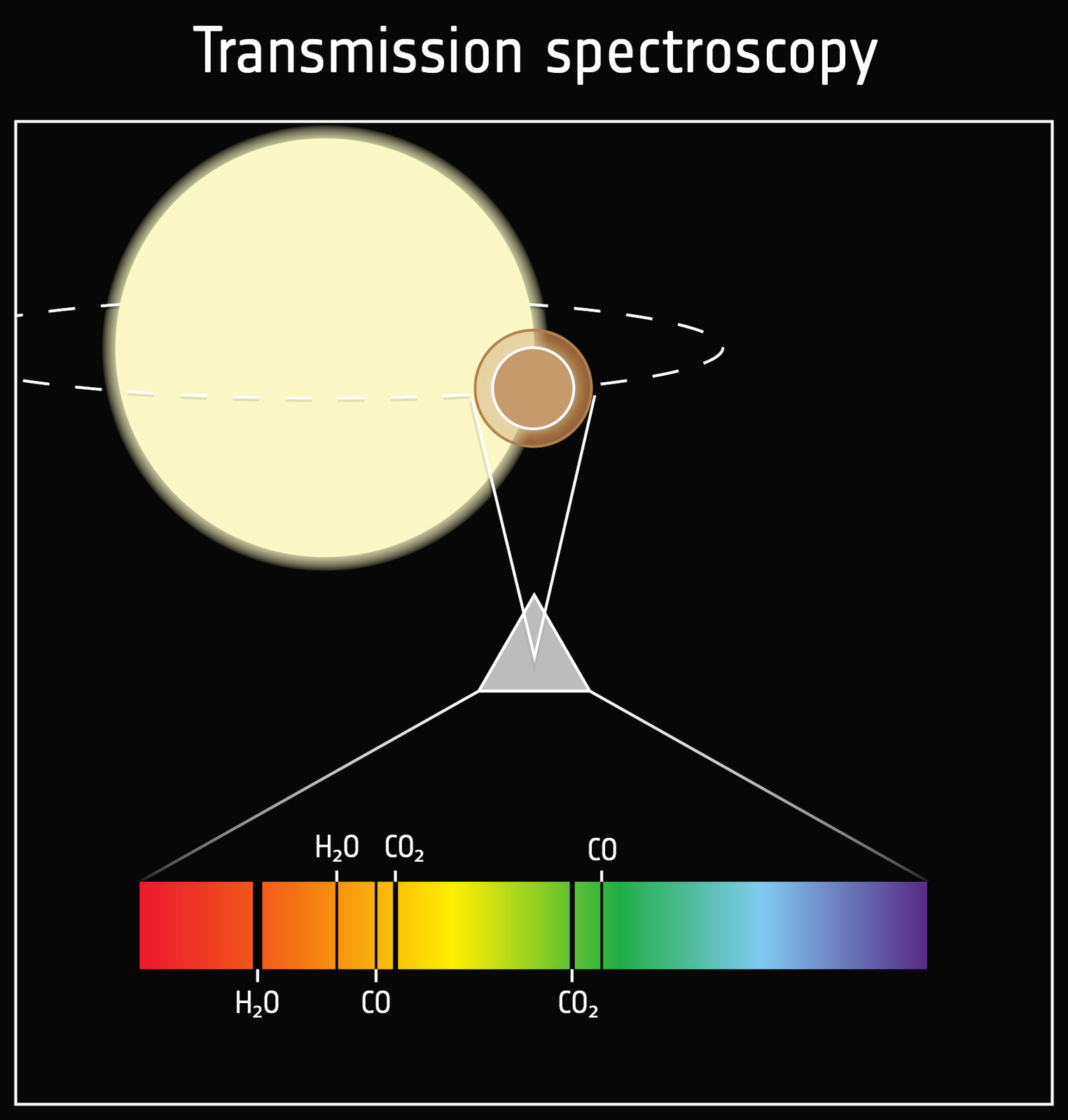
The resulting spectrum contains information about absorbing molecules, temperature, clouds and the atmosphere’s vertical structure. Extracting those properties requires a model of how the light passed through the gas. [1]
A molecular identification must survive alternative analyses
The original 2023 analysis reported methane and carbon dioxide, with a more tentative suggestion of dimethyl sulfide, or DMS. Independent teams subsequently reduced the observations with different pipelines and tested different atmospheric models. [1] [2] [3]
Methane remained the more consistent detection across those studies. Evidence for carbon dioxide varied with the data treatment and modelling choices: some analyses favoured it, while others did not find a statistically reliable detection. The proposed trace-gas signals were less robust still. [1] [2] [3]
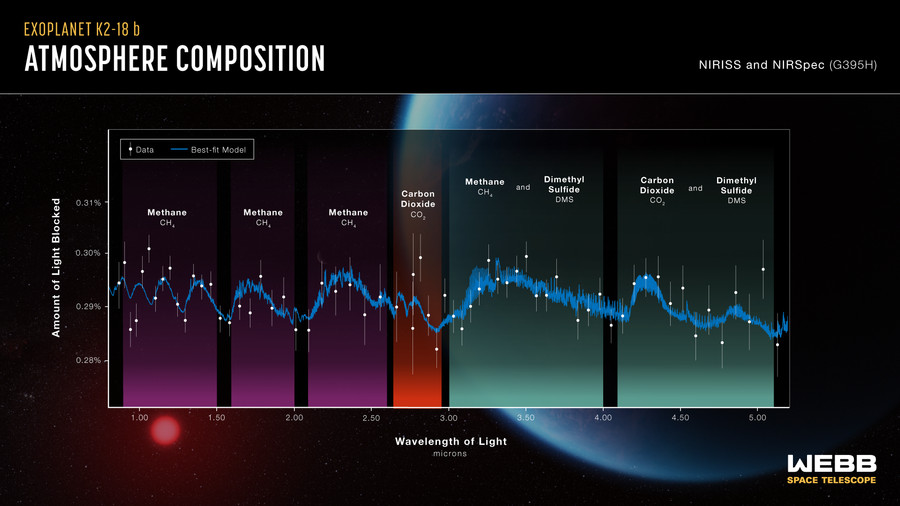
This comparison is part of the measurement. A flexible model can fit small variations in several ways, especially when molecules have overlapping absorption bands. Agreement across independent reductions, wavelength ranges and modelling frameworks matters more than the appearance of one preferred fit. [1] [2] [3]
Instrumental structure can resemble a broad feature
A 2025 reanalysis of the mid-infrared observations found that different choices for combining wavelengths changed the inferred spectrum and its molecular interpretation. Correlated instrumental noise could generate apparently broad features that an atmospheric model then tries to explain. [4] [3]
Stellar effects also matter. Spots on the host star and assumptions about its brightness across the disk can change the recovered transit spectrum. Corrections must distinguish changes in the source of light from absorption by the planet. [4] [3]
Adding more candidate molecules is not automatically a solution. Their abundances can interact with the inferred atmospheric background and with one another, allowing model complexity to change a result even when individual species contribute little distinctive information. [4] [3]
A wider search still requires discriminating observations
A systematic search published in 2026 compared hundreds of possible trace molecules and discussed candidates including DMS. It found promising interpretations under its analysis but called for further observations to distinguish among possible gases and investigate plausible sources. [5] [4]
Other independent analyses found no statistically significant evidence for a biosignature in the available data. Even a secure DMS identification would require its production and survival to be understood in this planetary environment before a biological origin could be established. K2-18 b has no confirmed detection of life. [5] [4]
An atmosphere does not uniquely specify what lies below
One proposed interior is a hydrogen-rich atmosphere above a water ocean, often called a Hycean world. Other models can explain atmospheric properties without requiring a temperate liquid surface, including a mini-Neptune with a much deeper gaseous envelope. [1] [2]
Mass, radius and atmospheric chemistry constrain those possibilities, but they do not uniquely turn a transmission spectrum into a surface map. A planet’s location in the habitable zone supplies an irradiation context rather than resolving its internal pressure and temperature profile. [1] [2]
K2-18 b is scientifically useful because its atmosphere can be measured and competing interpretations can be tested. The strongest current result is a chemical signal that persists across analyses—methane—alongside open questions that require better data before they can support a specific ocean or biological history. [1] [2]
Sources & image credits
- NASA · The original Webb atmospheric analysis, 2023 ↗
- Schmidt and colleagues · Independent reanalysis of the near-infrared spectrum ↗
- Fernández-Rodríguez and colleagues · Atmospheric retrieval and model dependence ↗
- Stevenson and colleagues · Instrumental systematics and evidence standards ↗
- Pica-Ciamarra and colleagues · A systematic search for trace molecules, published 2026 ↗
Related reading and objects
Can the TRAPPIST-1 planets keep atmospheres?
Webb’s observations of TRAPPIST-1 test a question that planet size alone cannot answer: which of its seven rocky worlds, if any, retain substantial atmospheres? The tightly packed system makes repeated measurements possible, but the small active star also contaminates the signals astronomers need.

What does habitable zone mean for TOI-700 d?
TESS discovered TOI-700 d through repeated dips in a cool star’s light, with the result announced in January 2020. Its orbit places it in the star’s habitable zone. That identifies an interesting energy range, while leaving its actual atmosphere and surface conditions to be determined.