

Can the TRAPPIST-1 planets keep atmospheres?
Webb’s observations of TRAPPIST-1 test a question that planet size alone cannot answer: which of its seven rocky worlds, if any, retain substantial atmospheres? The tightly packed system makes repeated measurements possible, but the small active star also contaminates the signals astronomers need.
Seven planets supply a comparison, not seven Earth copies
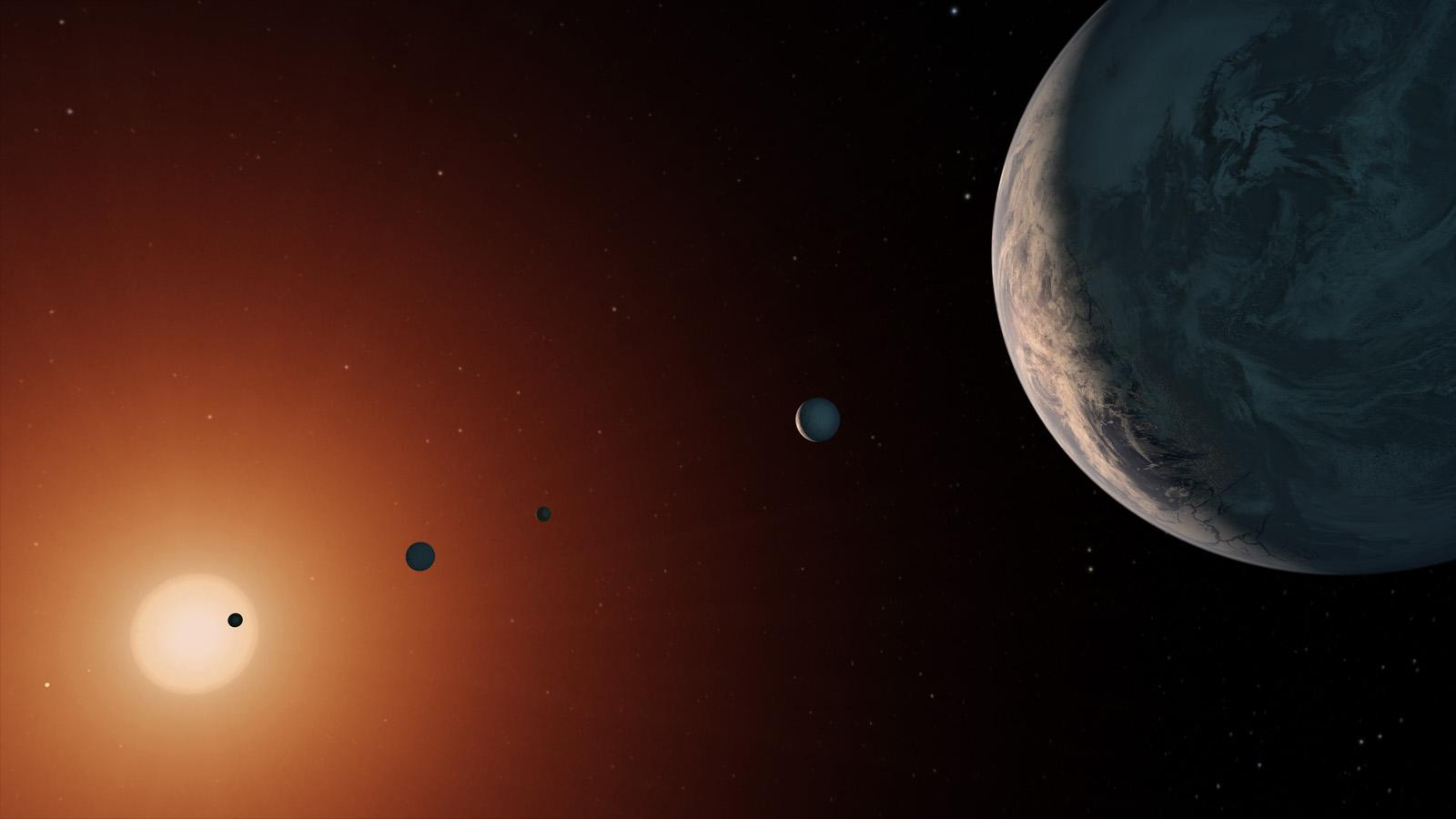
TRAPPIST-1 is an ultra-cool red dwarf about 40 light-years away. Its seven known planets, labelled b through h, are approximately Earth-sized and have densities consistent with rocky compositions. All orbit closer to the star than Mercury does to the Sun. [1]
The star’s low luminosity changes the meaning of those short distances. Several planets receive levels of irradiation that place them within commonly used habitable-zone models. Their orbital periods range from about 1.5 to 19 days, allowing many transits to be observed over a relatively short time. [1]
Earth-sized describes dimensions, while habitable zone describes a range of incident energy under model assumptions. Neither establishes the existence of an atmosphere, a surface ocean or organisms. Atmosphere retention is an earlier physical question that must be tested separately. [1]
Search for wavelengths removed by a thin annulus of gas
During a transit, a planet blocks part of the star. If it has an atmosphere, a small additional fraction of starlight passes through the atmospheric rim. Molecules can absorb particular wavelengths, altering the apparent size of the planet across the spectrum. [1]
TRAPPIST-1’s small stellar disk makes the planets comparatively favourable transit targets. Yet a compact rocky atmosphere produces a much smaller signal than the extended hydrogen envelope of a giant planet. Repeated observations are needed to separate that subtle change from noise and stellar effects. [1]
Ruling out a thick hydrogen-rich atmosphere is useful, but it is not equivalent to ruling out every thinner, heavier atmosphere. The measurement tests the particular signatures that the instrument and analysis can distinguish. [1]
Measure where the absorbed energy goes
A secondary eclipse occurs when a planet passes behind its star. The small loss of the planet’s own infrared contribution allows astronomers to estimate its dayside emission. A phase curve follows the changing contribution as different parts of the planet face the telescope. [1] [2]
An atmosphere can transport heat from the day side to the night side. A strongly heated day side with little detectable night-side emission therefore constrains how efficiently energy is redistributed. [1] [2]
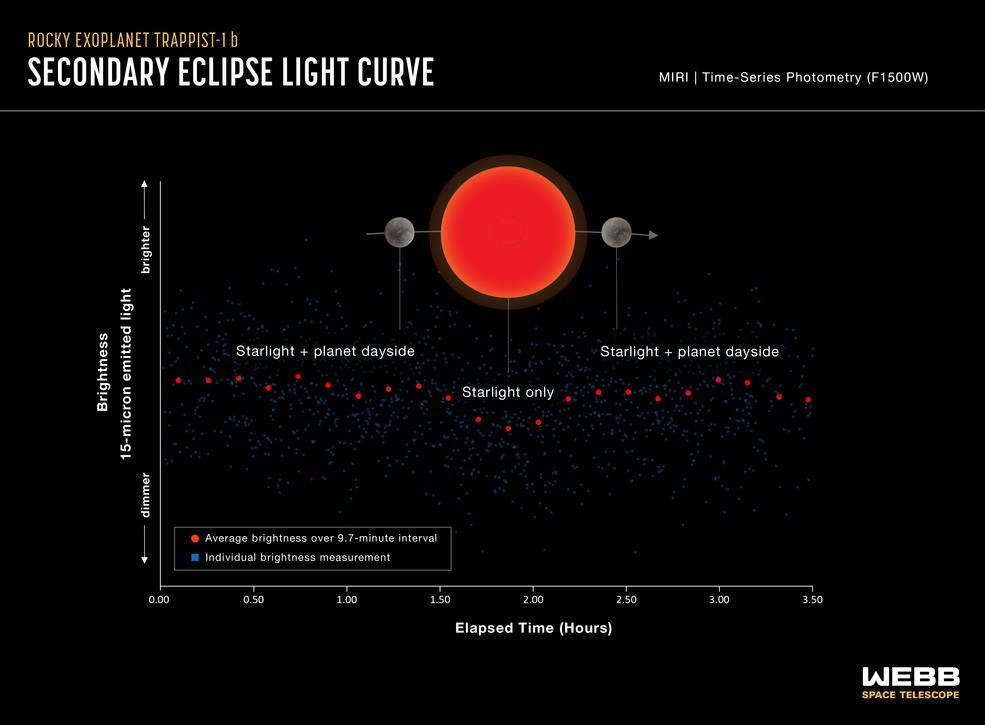
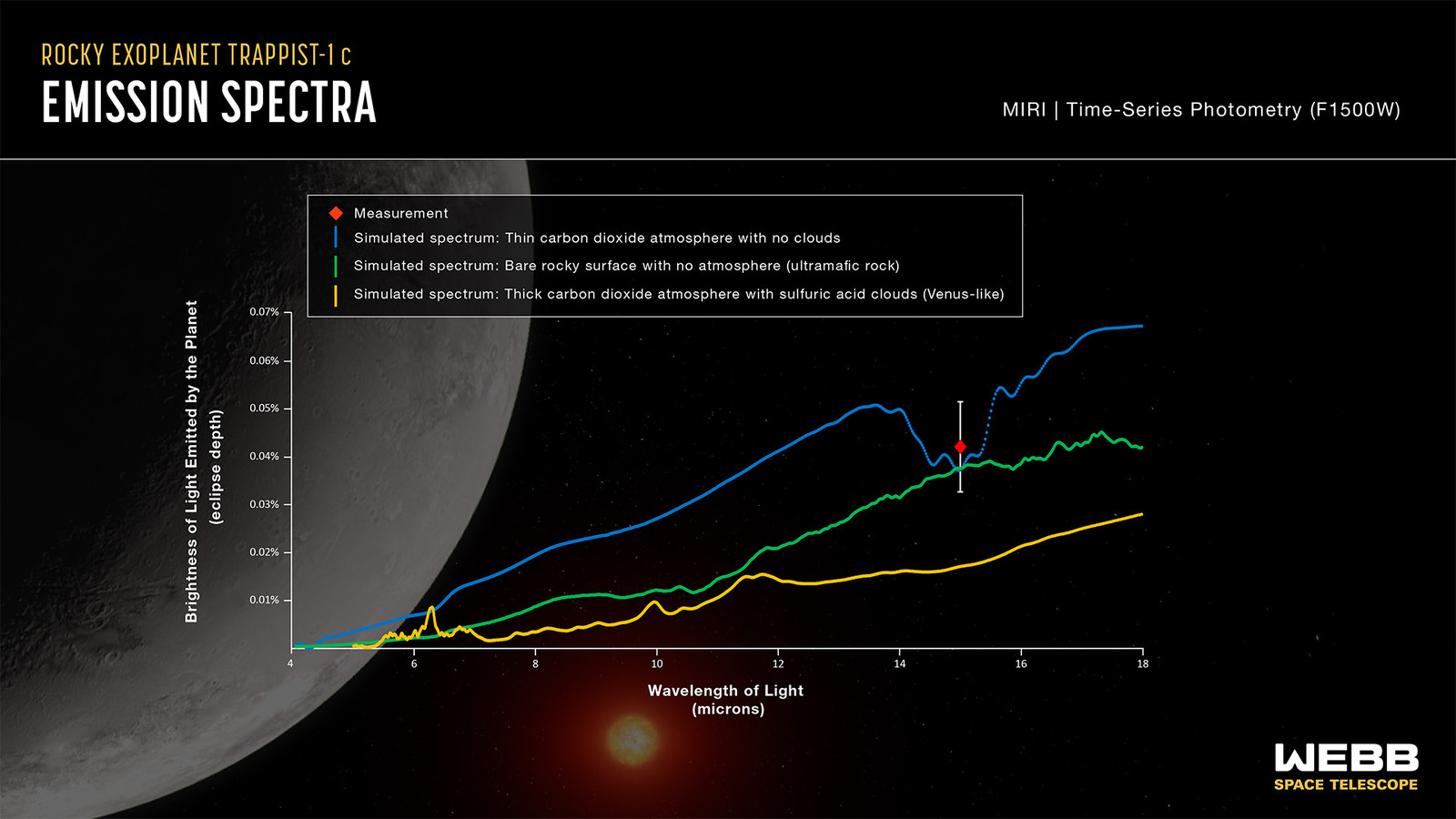
The 2025 phase-curve study of planets b and c strongly disfavoured thick atmospheres with efficient greenhouse effects. Its results favoured an airless interpretation for b, while c could be airless or retain a more tenuous, greenhouse-poor atmosphere. The study did not establish the same outcome for every outer planet. [1] [2]
The light source is not uniform
Cool spots, hotter regions and flares change the star’s spectrum. If the planet crosses a region unlike the average visible stellar surface, the resulting wavelength-dependent signal can resemble an atmospheric feature. [1] [3]
This stellar contamination is especially difficult when the desired planetary signal is small. Combining transits without accounting for changes in the star can increase apparent precision without resolving the underlying ambiguity. [1] [3]
A programme described in late 2025 used closely spaced transits of b and e to investigate a shared stellar contribution. The approach can help only if the star remains sufficiently stable between the observations; a strong flare can break that assumption. The first results illustrated both the promise of the method and its sensitivity to analysis choices. [1] [3]
Why the outer planets need their own evidence
Planets sharing one star still receive different irradiation and can have different masses, volatile supplies and interior histories. The absence of a thick atmosphere on an inner world does not directly determine the condition of a cooler outer neighbour. [1] [2]
TRAPPIST-1 is valuable because it offers a family of related cases. Transits test absorbing gas, thermal observations test energy redistribution, and stellar monitoring tests the background against which both are measured. A convincing atmospheric result must make those evidence chains agree for the specific planet being studied. [1] [2]
Sources & image credits
Related reading and objects
What does habitable zone mean for TOI-700 d?
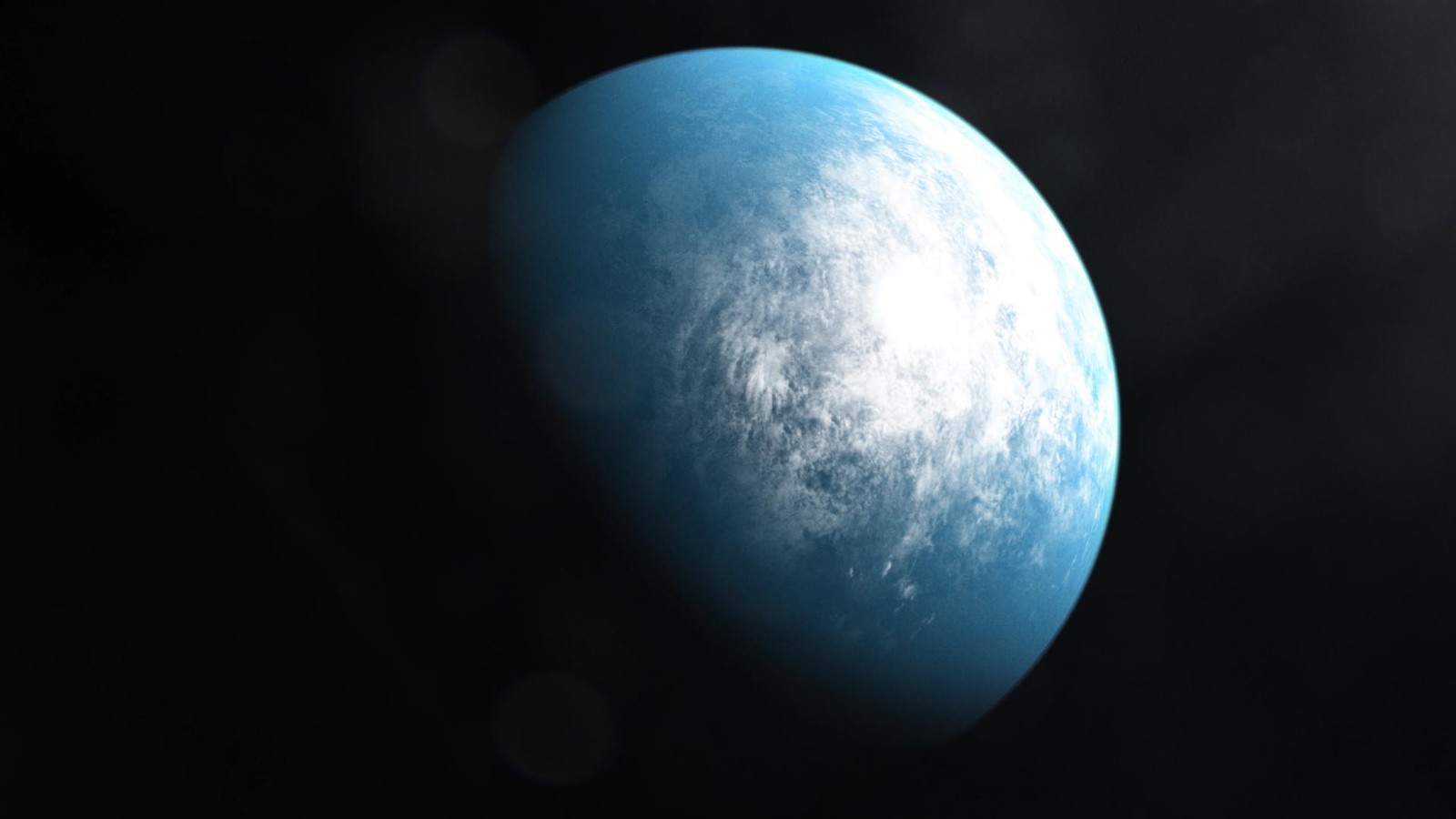
TESS discovered TOI-700 d through repeated dips in a cool star’s light, with the result announced in January 2020. Its orbit places it in the star’s habitable zone. That identifies an interesting energy range, while leaving its actual atmosphere and surface conditions to be determined.
How do we find planets we cannot see?
ESA’s PLATO mission will look for planets by measuring changes in the light of their stars. Follow one possible signal from a dark silhouette to a repeatable orbit—and see which questions the dip cannot answer.