

What did DART change in the Didymos system?
DART struck Dimorphos on 26 September 2022. The target was the small moon of Didymos, allowing researchers to measure a deliberate orbital change in a compact binary system that posed no impact threat to Earth.
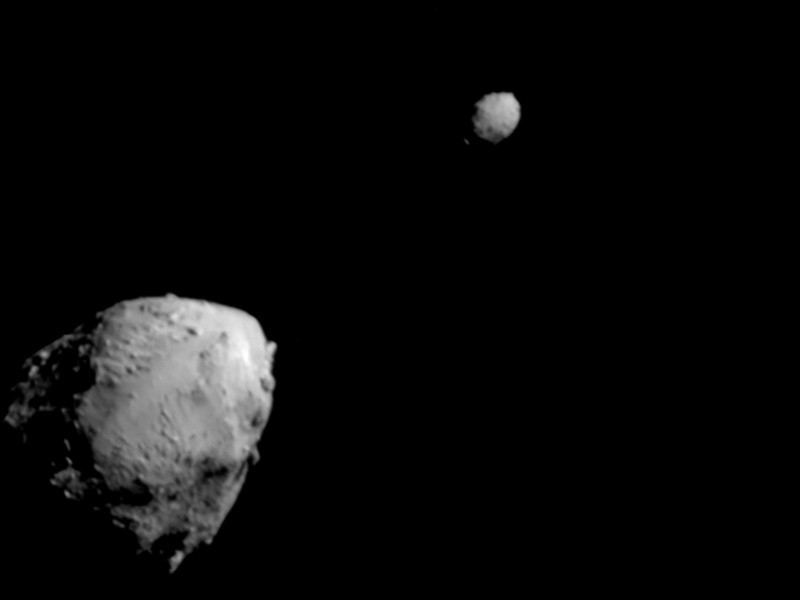
Choose an orbit whose change can be timed
Didymos is about 800 metres across, while its moon Dimorphos is roughly 170 metres across. Before the impact, the moon took about 11 hours and 55 minutes to circle the larger asteroid. [1]
From Earth, the pair produces changes in brightness as one object passes in front of or enters the shadow of the other. Timing those repeated events gives an orbital clock. DART’s experiment could then be judged by comparing the clock before and after the collision. [1]
The spacecraft targeted Dimorphos rather than the larger primary. This arrangement made a small change measurable without needing to move an Earth-threatening asteroid as a first demonstration. The scientific question was how efficiently a kinetic impact could alter motion. [1]
The spacecraft transferred more than a dent
DART’s final images showed a boulder-covered surface immediately before contact. The collision transferred momentum from the spacecraft into the moon and launched a large cloud of material away from it. LICIACube, a small Italian spacecraft released before impact, photographed the resulting ejecta. [1] [2]
The escaping material supplied an additional recoil. As fragments carried momentum away in one direction, the remaining asteroid experienced a push in the other. The effectiveness of the impact therefore depended on how the target excavated and released material, not just on the spacecraft’s incoming momentum. [1] [2]
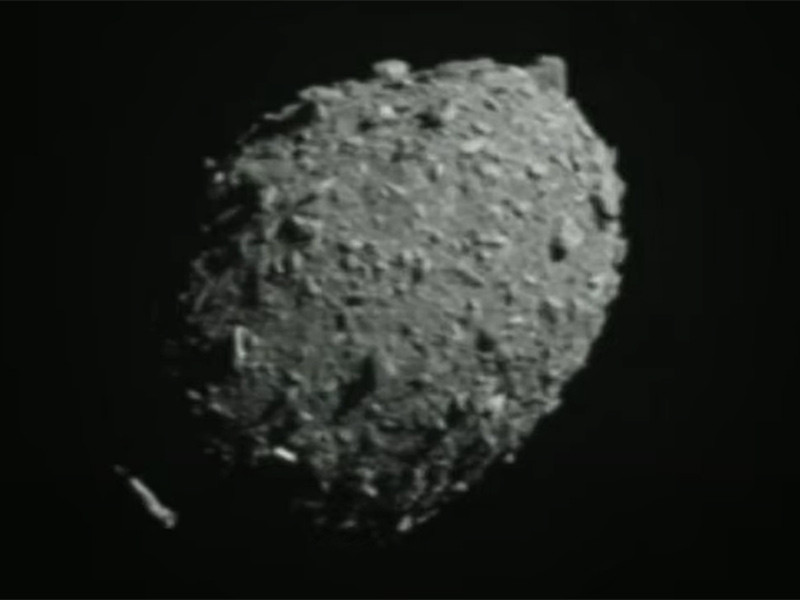
That is one reason asteroid structure matters for planetary defence. A loosely assembled rubble pile can respond differently from a coherent rock, changing the shape, ejecta distribution and resulting deflection. [1] [2]
The moon’s circuit became faster
Earth-based observations established that Dimorphos’s orbital period shortened by about 33 minutes. A refined analysis reported in 2024 put the change at approximately 33 minutes and 15 seconds and found that the orbit was no longer circular. [1] [2]
The change was a shortening of the moon’s orbit around Didymos, not a 33-minute reduction in the pair’s year around the Sun. These are separate motions on very different scales. [1] [2]
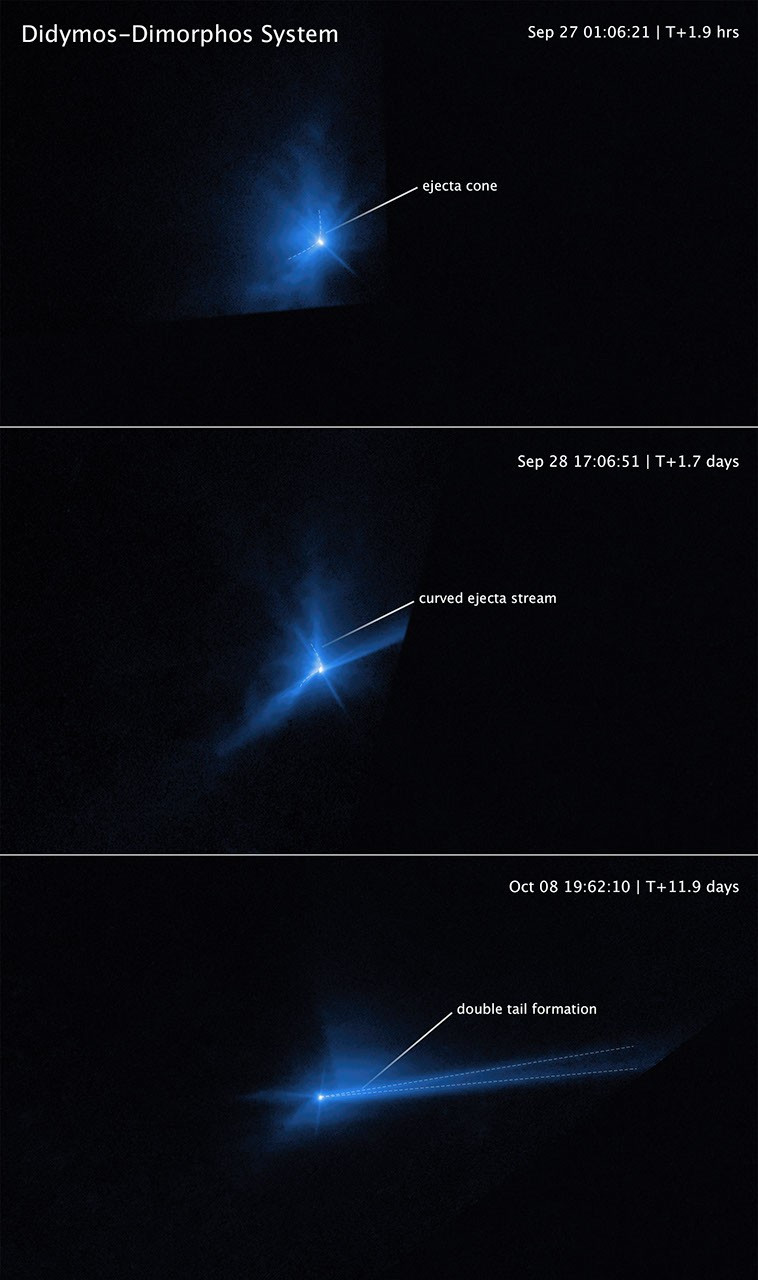
Combining brightness observations with modelling also indicated that Dimorphos changed shape, becoming more elongated. The experiment therefore modified both orbital motion and the physical target. Interpreting later measurements requires accounting for the body that remained after the collision. [1] [2]
A much smaller change affected the entire pair
Research reported in March 2026 identified a change in the Didymos system’s motion around the Sun as well. Because Didymos and Dimorphos are gravitationally coupled, momentum delivered to one member can alter the motion of the binary system as a whole. [3]
The pair’s roughly 770-day year changed by just 0.15 seconds, far less than the 33-minute change in the moon’s circuit. Detecting it required precise observations and modelling over time. The difference in scale matters: the entire binary has much more mass than Dimorphos alone. [3]
The two measurements demonstrate different parts of the same event: a large relative response within the binary and a much smaller change in the system’s heliocentric trajectory. [3]
The result is a calibrated experiment
DART demonstrated that a spacecraft impact can deliberately alter an asteroid’s motion. It also showed why a useful defence capability needs measurements of mass, internal structure, ejecta and warning time, not merely the ability to hit a target. [1] [2] [3]
The Didymos system provided a controlled test whose outcome could be checked from Earth. Its changed orbital clock is the clearest result, while the altered shape and escaping fragments explain how that result was produced. Together they turn a successful collision into evidence for planning a future deflection under different conditions. [1] [2] [3]
Sources & image credits
Related reading and objects
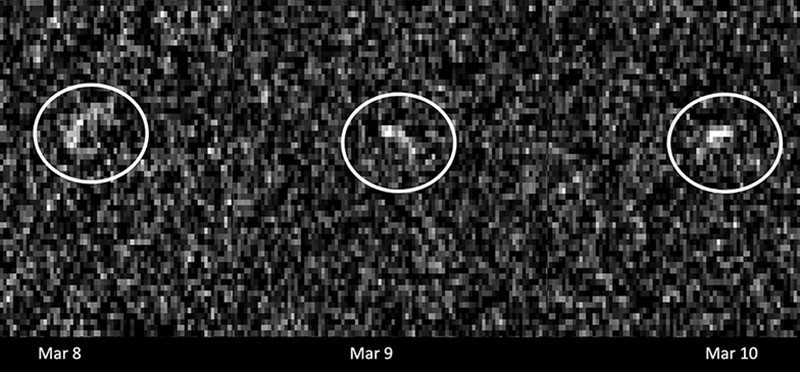
What will happen when Apophis passes Earth in 2029?
On 13 April 2029, Apophis will pass about 32,000 kilometres above Earth’s surface. It will be a close encounter, but NASA’s refined orbit rules out an Earth impact for at least the next century. The scientific opportunity is to observe how a small asteroid responds to a strong gravitational encounter.
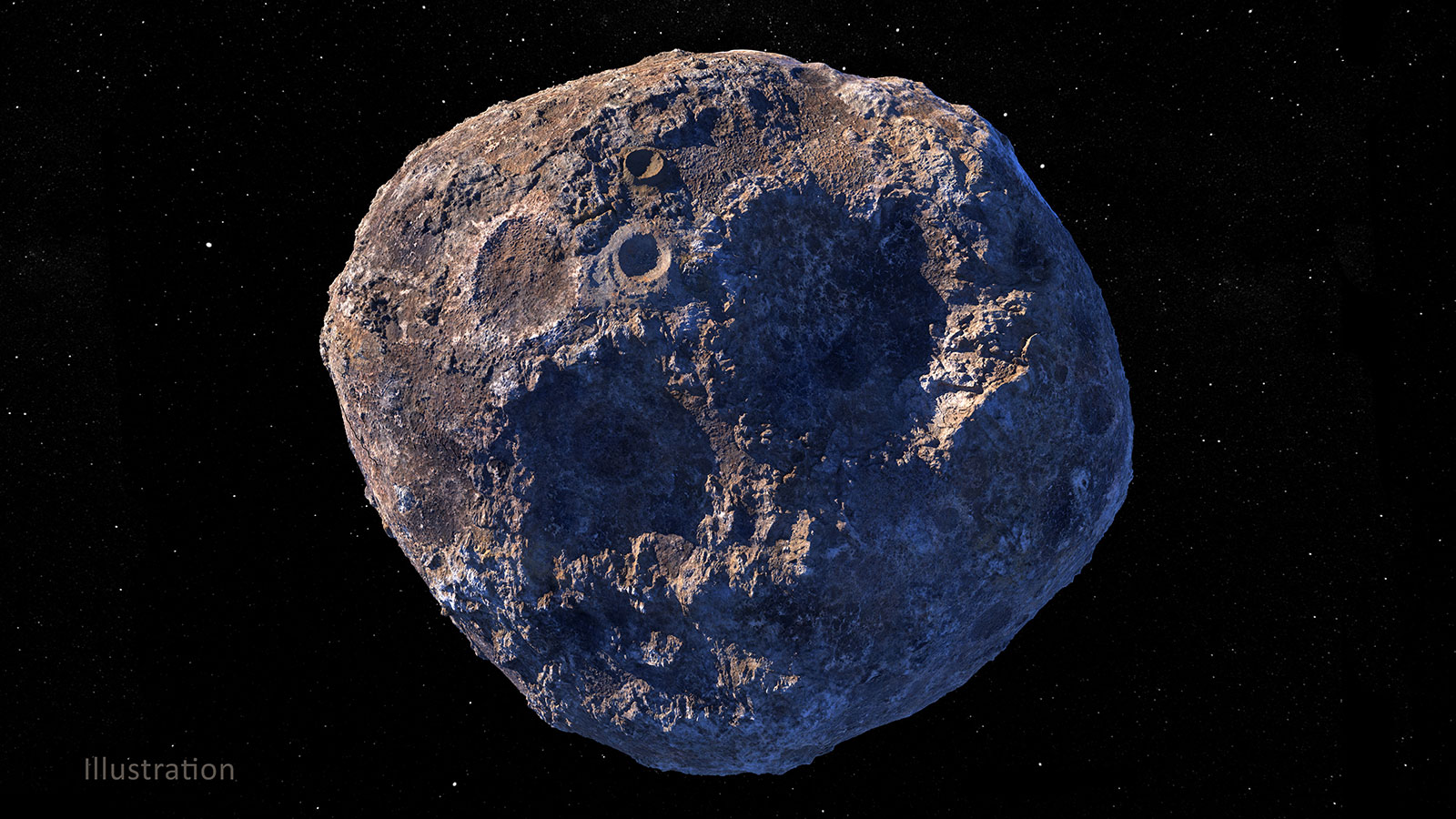
Is Psyche really the exposed core of a lost planet?
Psyche reflects radar strongly and appears to contain substantial metal. That made it a candidate remnant of a planetesimal’s core, exposed after collisions removed outer rock. NASA’s Psyche mission is designed to test that interpretation rather than assume it.