

How did Eris change the definition of a planet?
Eris was identified in 2005 as a distant world comparable to Pluto. Its discovery forced a practical choice: keep adding planets as similar bodies appeared, or define what separated the major planets from this growing outer population.
A second Pluto-sized world made the problem concrete
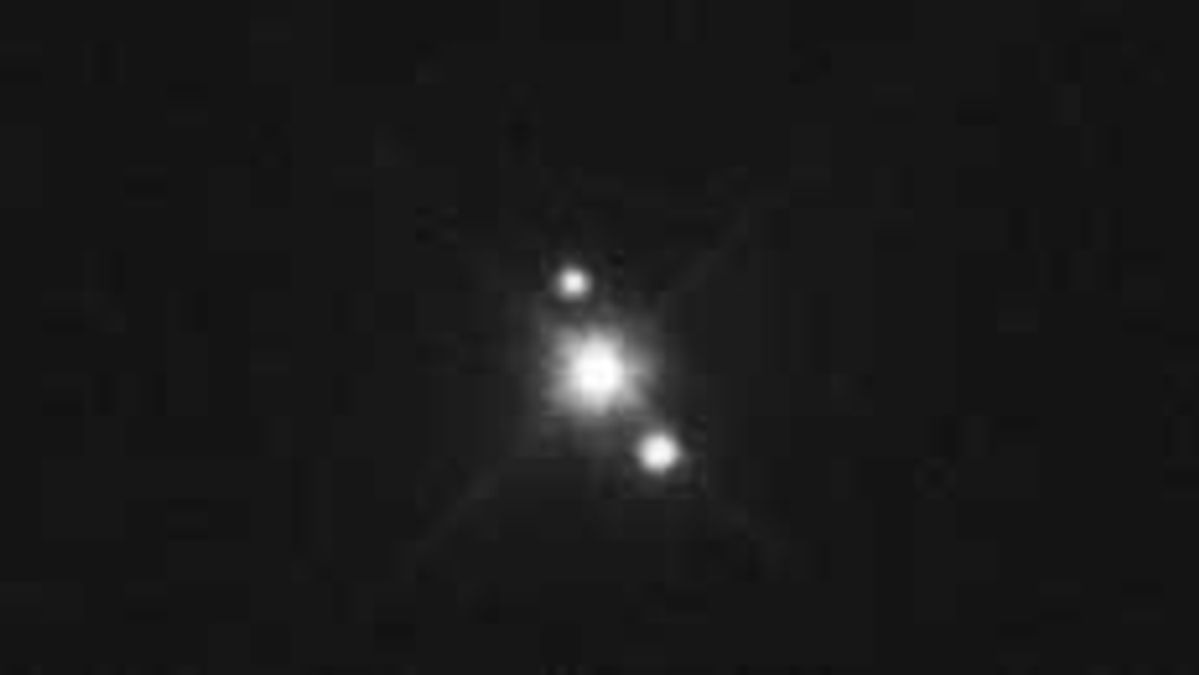
The discovery team found Eris in survey images obtained in 2003 and identified its significance in 2005. It was far beyond Neptune, on a markedly inclined and elongated orbit. Its brightness implied a substantial body, but brightness alone could not determine its diameter. [1]
A small, highly reflective object can appear as bright as a larger, darker one. Before a precise size measurement, estimates depend on assumptions about how much sunlight the surface reflects. Eris therefore entered the classification debate while some of its basic physical properties were still being refined. [1]
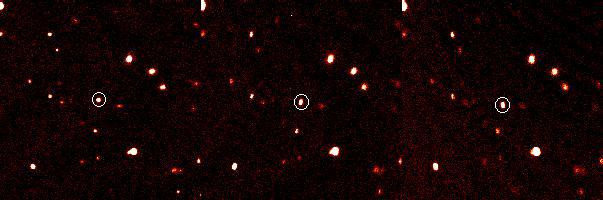
The central issue was broader than which of two bodies was a little larger. Surveys were revealing an outer population containing worlds that shared important properties with Pluto. A definition had to work for that population as well as the familiar historical list. [1]
A moon and a background star supplied different measurements
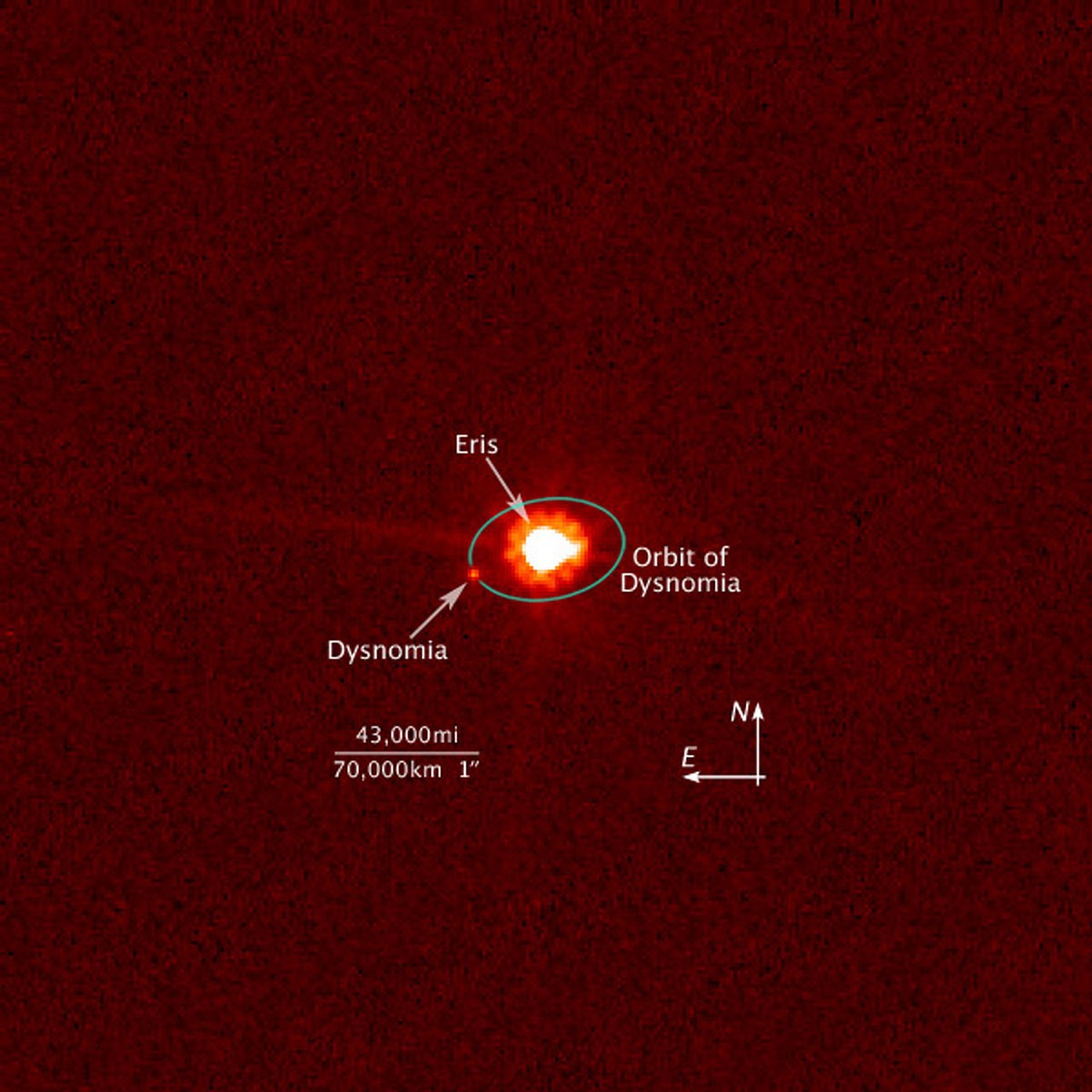
Eris’s moon Dysnomia provided a gravitational test. Measuring a satellite’s orbit allows astronomers to infer the mass of the system. That established Eris as more massive than Pluto, even though their diameters are similar. [1] [2]
A stellar occultation in November 2010 supplied a more direct size constraint. Observers timed the disappearance and reappearance of a background star as Eris passed in front of it. Combining observations from different locations traced chords across its silhouette. [1] [2]
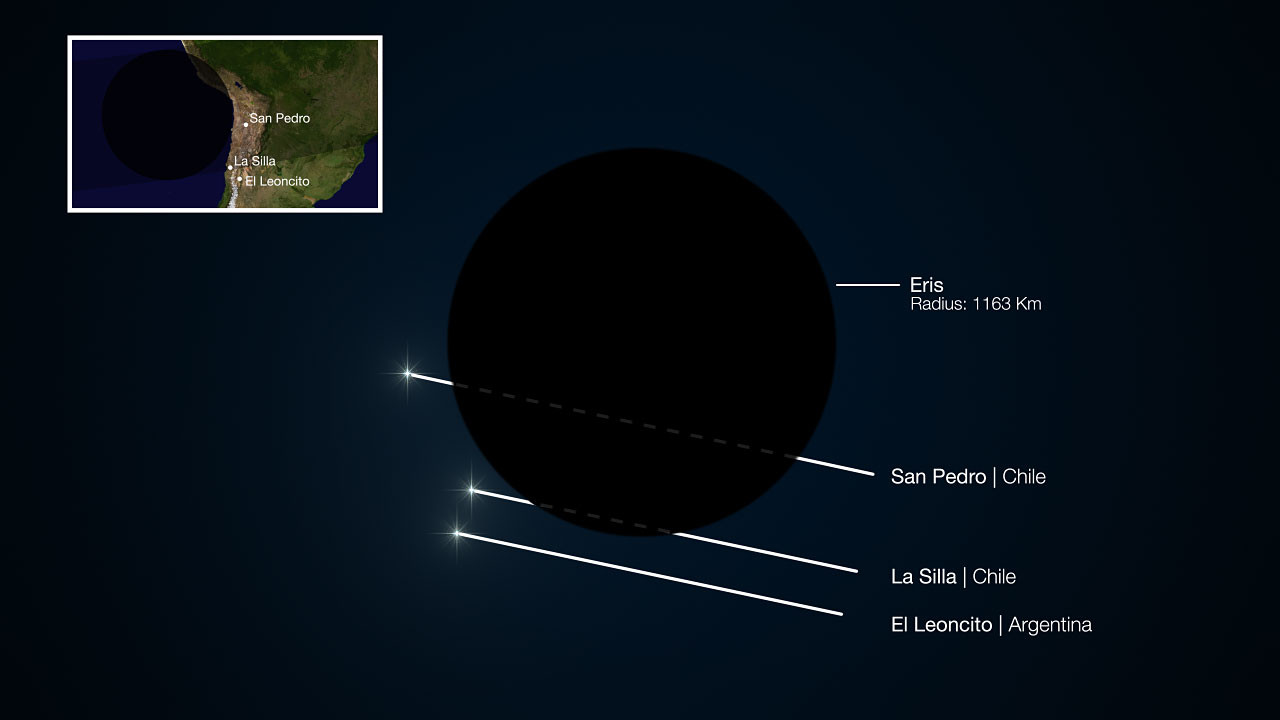
The analysis reported a diameter of about 2,326 kilometres. New Horizons later measured Pluto at about 2,377 kilometres, making Pluto slightly larger in diameter. The comparison demonstrates why “larger” and “more massive” must be kept separate: density links mass to volume, and two similarly sized worlds can contain different proportions of rock and ice. [1] [2]
The IAU chose three conditions
In August 2006, the International Astronomical Union adopted a definition for planets in the Solar System. A planet must orbit the Sun, have enough self-gravity to assume a nearly round equilibrium shape, and have cleared the neighbourhood around its orbit. [3]
A dwarf planet meets the first two conditions but has not cleared its orbital neighbourhood and is not a satellite. Under that definition, Pluto, Eris and Ceres belong to a distinct class rather than extending the list of eight major planets. [3]
The clearing condition concerns gravitational dominance over the relevant orbital region. It does not require an absolutely empty path: the major planets still coexist with asteroids, dust and other small bodies. Reading it as “nothing else ever crosses the orbit” would misstate the distinction. [3]
A category does not erase geological complexity
The classification says something about an object’s orbital setting. It does not measure the diversity of its surface or decide whether it deserves exploration. Pluto remained a world with an atmosphere, mountains and mobile nitrogen ice after its label changed. [1] [2] [4]
Eris is much less closely observed. Its bright surface and methane signatures can be studied remotely, while seasonal changes in volatile ice remain subjects for investigation. There is no spacecraft close-up comparable to New Horizons’ Pluto images. [1] [2] [4]
The size and mass measurements continue to matter independently of the terminology. Together they constrain bulk composition and the history of this cold outer body. [1] [2] [4]
What the discovery actually changed
Eris exposed a mismatch between a traditional list and an increasingly well-observed Solar System. The 2006 decision resolved that mismatch through an orbital and physical definition, producing a stable eight-planet list within the IAU’s usage. [3] [1]
The more lasting scientific result is the population itself. Eris showed that Pluto was not an isolated exception beyond Neptune. Both are substantial members of a wider set of icy worlds whose masses, moons and surface chemistry preserve evidence of how the outer Solar System formed. [3] [1]
Sources & image credits
Related reading and objects
Why is Pluto a dwarf planet?
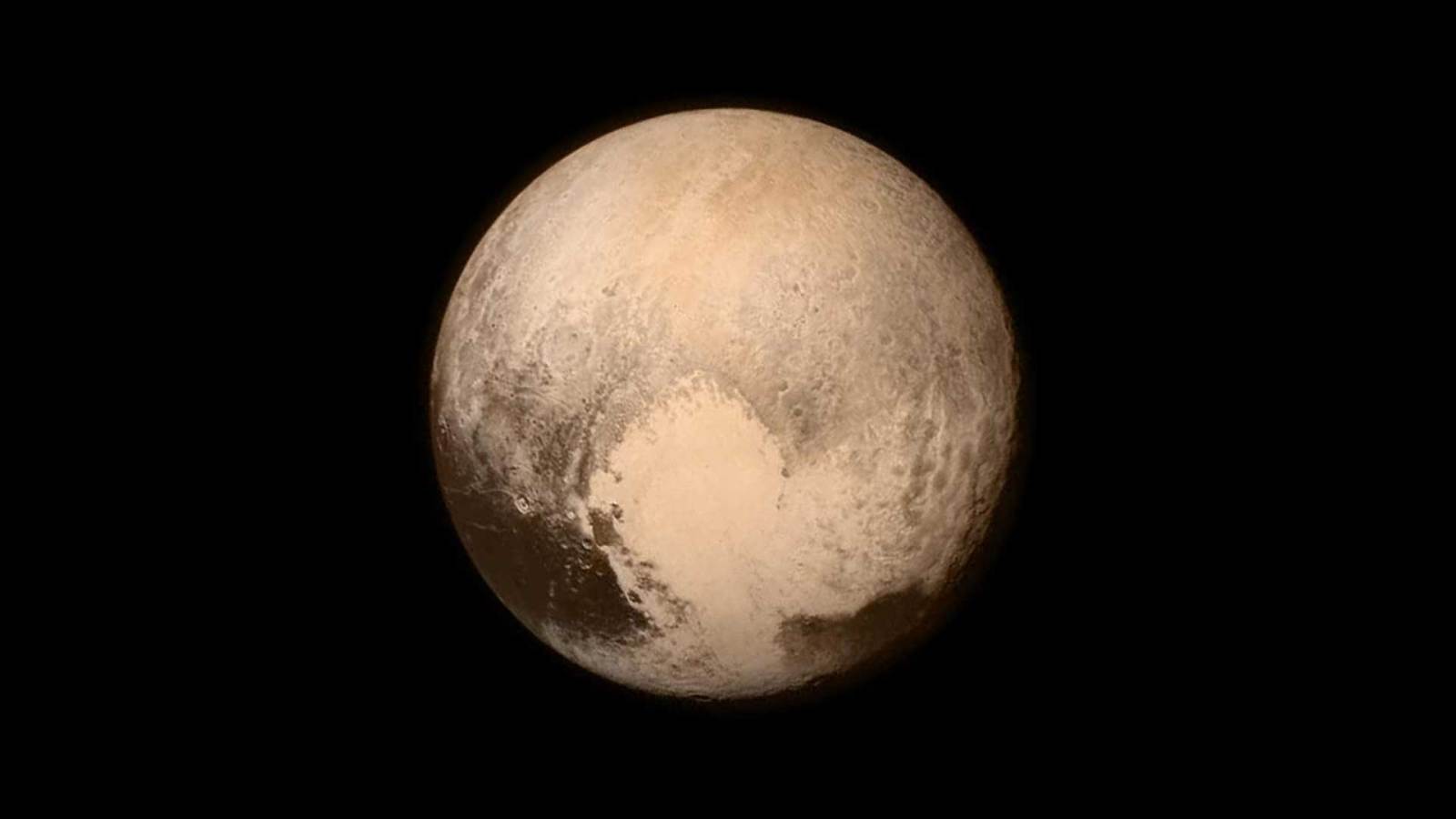
When New Horizons flew past Pluto in July 2015, the former ninth planet became a world of mountains and glaciers. Its new classification had changed its place in a list, but the flyby showed how much remained to explain about the place itself.
How did a star reveal Haumea’s ring?
On 21 January 2017, observers at several European sites watched Haumea pass in front of a star. The main disappearance measured the dwarf planet’s silhouette. Smaller, separate dips in the starlight revealed material orbiting around it.