

How did a star reveal Haumea’s ring?
On 21 January 2017, observers at several European sites watched Haumea pass in front of a star. The main disappearance measured the dwarf planet’s silhouette. Smaller, separate dips in the starlight revealed material orbiting around it.
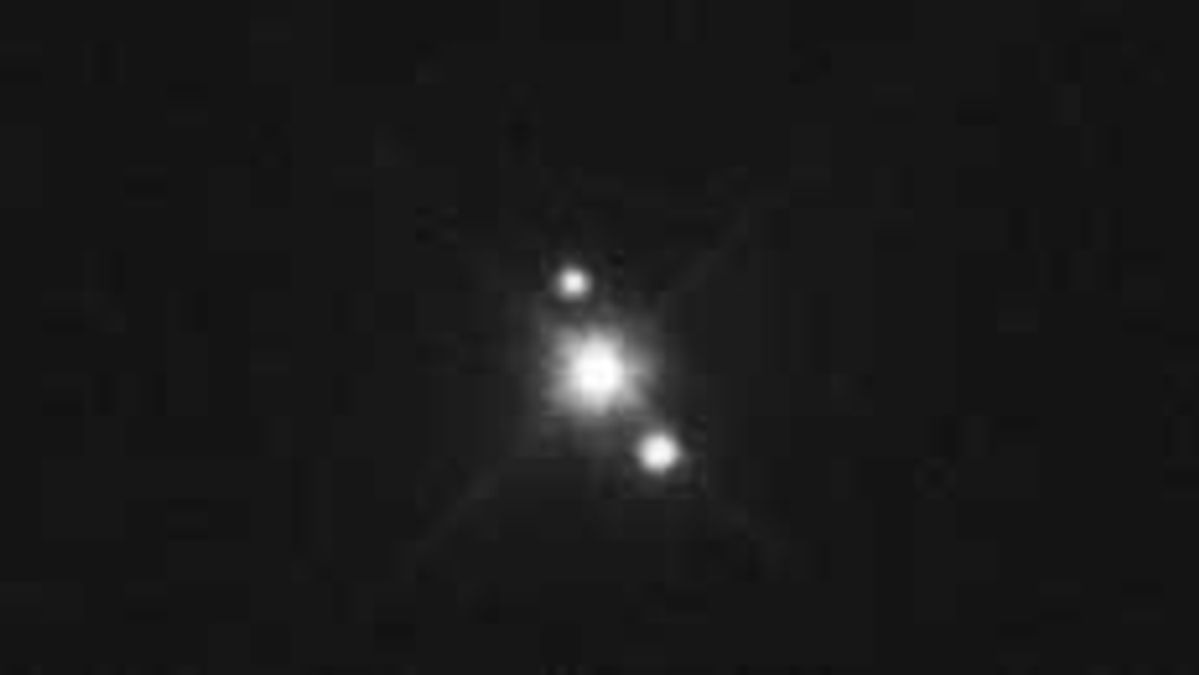
Use a moving shadow as a measuring instrument
Haumea is so distant that a telescope does not routinely resolve its surface into a detailed map. An occultation offers another route: the dwarf planet blocks light from a much more distant star and casts a moving shadow across Earth. [1] [2]
At each observing site, the duration of the main disappearance measures a different path through that shadow. With the relative motion known, a timing becomes a chord across the projected body. Several chords together constrain a silhouette far more precisely than a single point of light. [1] [2]
Observers using twelve instruments at ten observatories coordinated their measurements for the 2017 event. The different vantage points were essential: one timing could measure a width, while a network could test the overall projected shape. [1] [2]
Something blocked light outside the main body
The light curves contained secondary dimmings around the main occultation. Their timings and placement were consistent with a narrow ring surrounding Haumea. The star supplied the illumination, and the ring particles removed part of that light as they crossed the line of sight. [1] [2]
The discovery did not depend on seeing a Saturn-like ring spread across a close-up photograph. It came from a repeated geometric pattern in measured brightness. A model had to explain the smaller events at the different sites as well as the central disappearance. [1] [2]
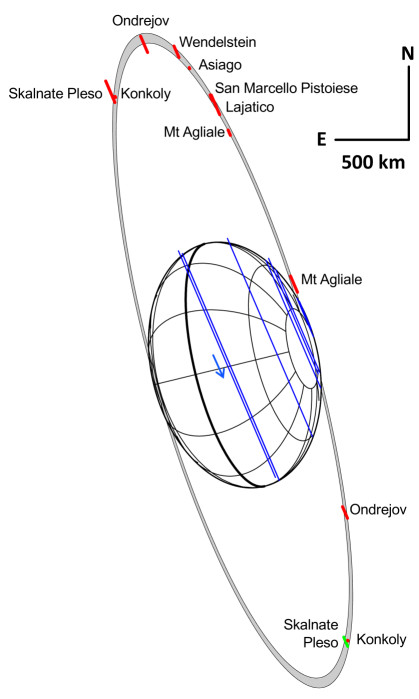
The inferred ring was about 70 kilometres wide, at a radius of roughly 2,300 kilometres from Haumea’s centre. Those are modelled dimensions from the occultation, with uncertainties, rather than a claim of a perfectly uniform sharp-edged band. [1] [2]
The central world is strongly elongated
Haumea completes a rotation in about 3.9 hours. Its rapid spin is associated with a markedly elongated shape, so one ordinary spherical diameter cannot describe it adequately. The silhouette also depends on which rotational orientation faces Earth during the occultation. [3] [1]
That geometry affects estimates of volume and density. Measuring a projected outline, combining it with the rotation and interpreting the three-dimensional shape are separate steps. A new shape constraint can therefore change inferred density without changing a gravitational mass measurement. [3] [1]
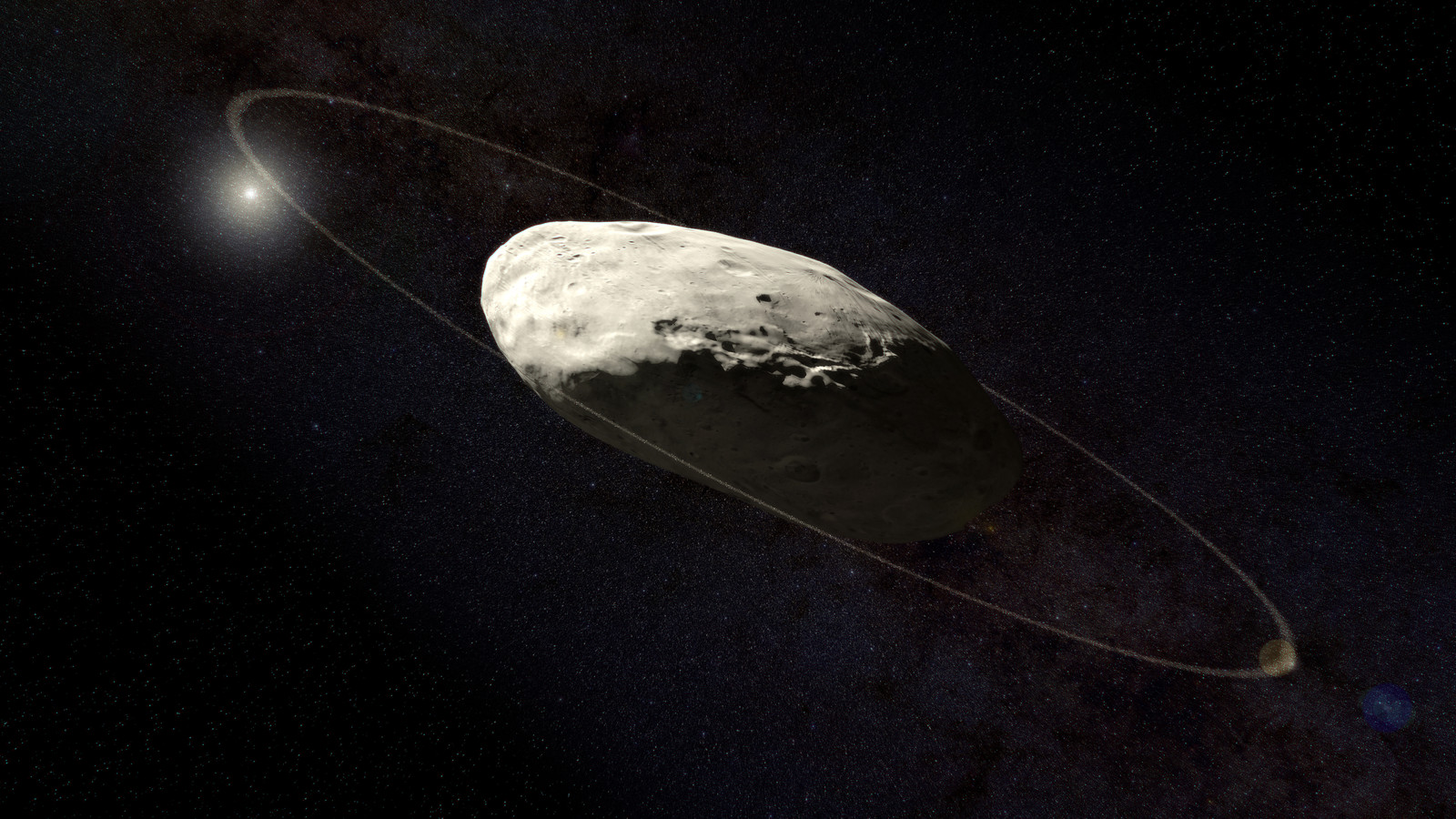
The ring adds another contribution to the system’s reflected light. Understanding how bright Haumea itself is requires separating the body, ring and moons rather than assigning all detected light to one surface. [3] [1]
The ring belongs to an organised system
The occultation analysis placed the ring close to Haumea’s equatorial plane and the orbital plane of its larger moon, Hiʻiaka. The ring’s orbital period lies near a 3:1 relationship with the dwarf planet’s rotation: particles take about three rotations of Haumea to complete one circuit. [1] [3]
That relationship concerns ring motion relative to spin. It should not be confused with the much longer year in which the entire system travels around the Sun. The two known moons, Hiʻiaka and Namaka, add further clues to the system’s formation and dynamics. [1] [3]
Possible ring origins include collision debris or material released from the rapidly rotating body. The occultation established evidence for the ring, but it did not uniquely identify which history produced it. [1] [3]
A faint object can reveal a structured environment
Haumea joined the evidence that rings are not confined to giant planets. Small-body rings can be difficult to detect because the surrounding material is faint and the necessary alignments are brief. [1] [3]
The telescopes measured when a background star lost light. Coordinated timings transformed those brief changes into a model of an elongated world, its orientation and the narrow band orbiting it. [1] [3]
Sources & image credits
Related reading and objects
What does a dark moon reveal about Makemake?
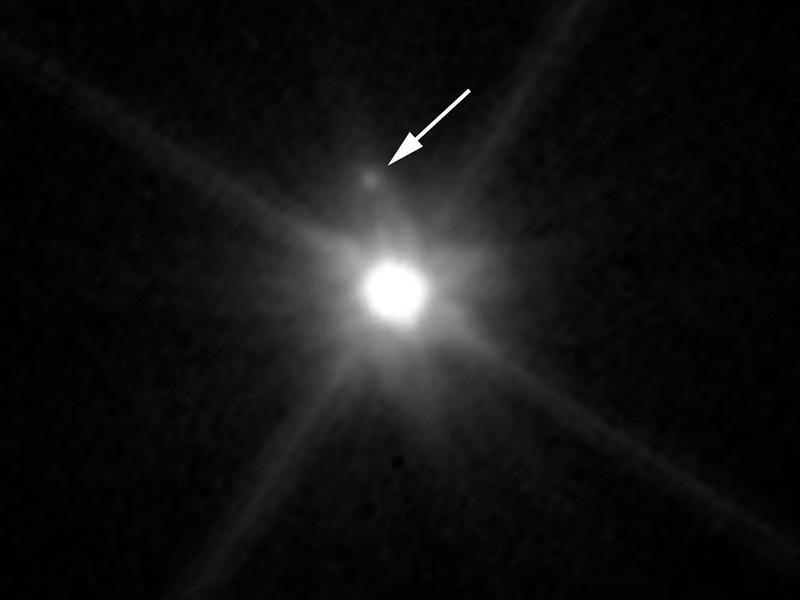
In April 2015, Hubble recorded a faint point beside the bright dwarf planet Makemake. Announced in 2016 and nicknamed MK 2, the companion offered a way to measure the system’s mass and explain part of its combined thermal emission.
How did Eris change the definition of a planet?
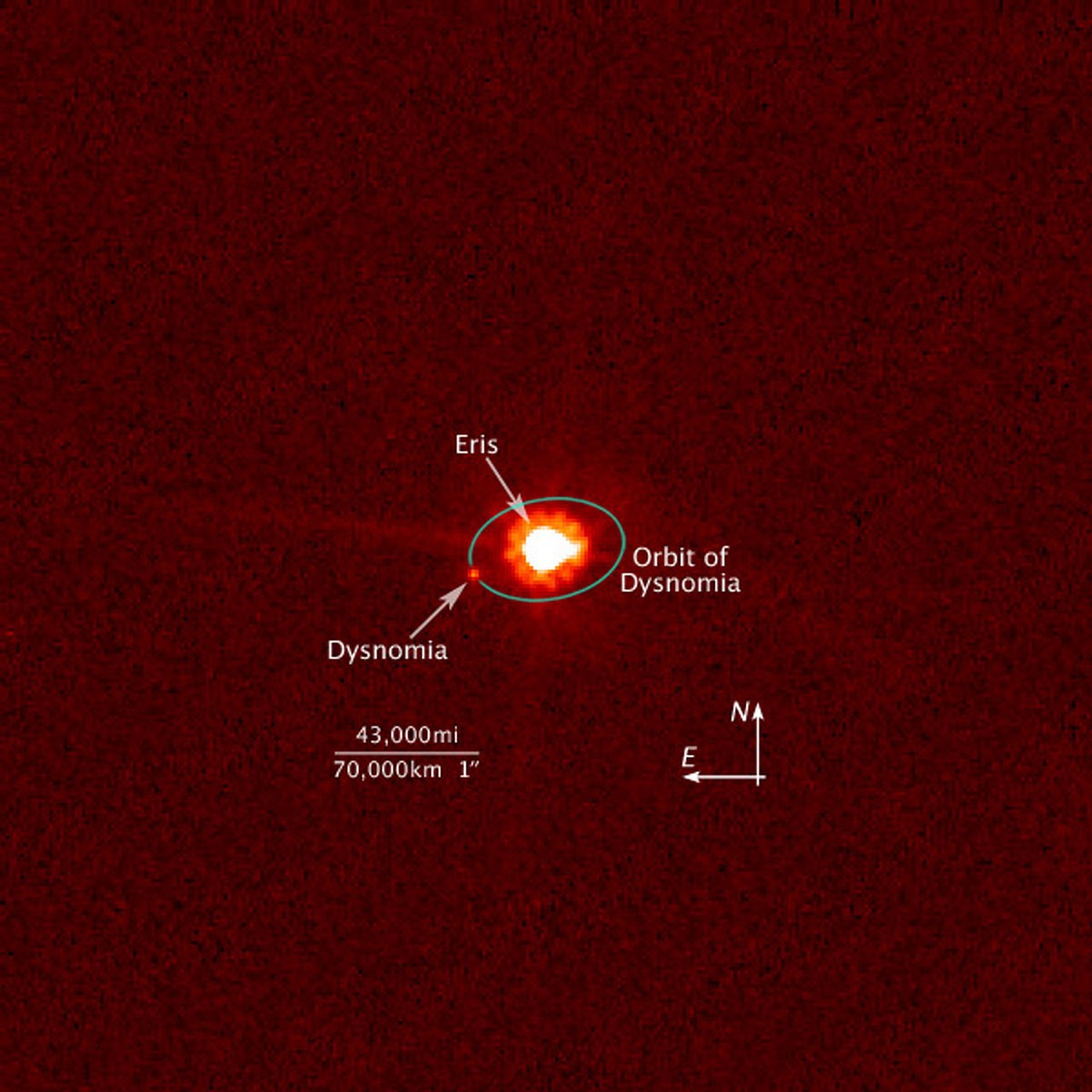
Eris was identified in 2005 as a distant world comparable to Pluto. Its discovery forced a practical choice: keep adding planets as similar bodies appeared, or define what separated the major planets from this growing outer population.