

What does a dark moon reveal about Makemake?
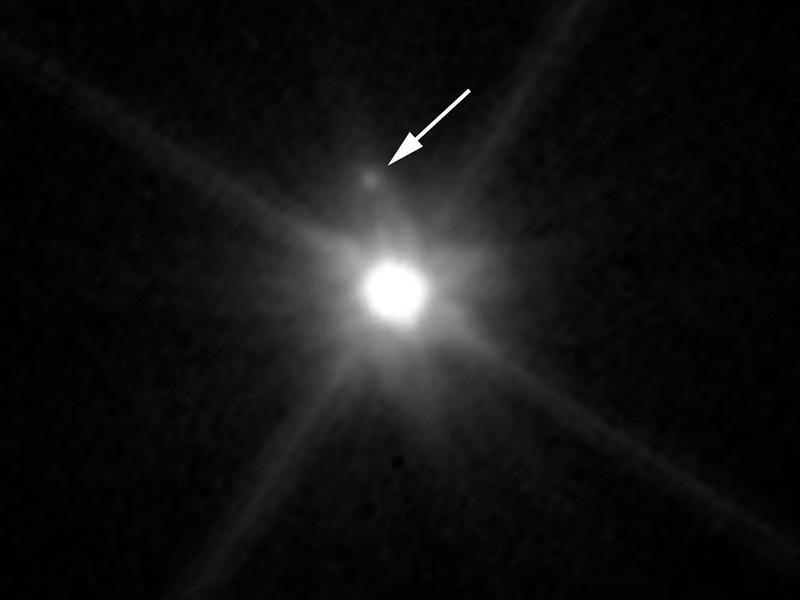
In April 2015, Hubble recorded a faint point beside the bright dwarf planet Makemake. Announced in 2016 and nicknamed MK 2, the companion offered a way to measure the system’s mass and explain part of its combined thermal emission.
A nearby companion can be hidden in plain sight
Makemake is a bright, ice-covered member of the population beyond Neptune. A small moon close to it on the sky is difficult to separate from the dwarf planet’s glare, even when the moon is not physically very close to its surface. [1]
Hubble’s Wide Field Camera 3 resolved the companion in observations made in April 2015. The object was more than 1,300 times fainter than Makemake. That contrast explains why a search can fail even when a moon is present: viewing geometry and the spreading of the brighter object’s light affect detectability. [1]
The discovery designation is S/2015 (136472) 1. MK 2 is a convenient nickname, rather than a separate object. Keeping the identity consistent matters when comparing discovery images, orbital measurements and later thermal studies. [1]
Turn a moving point into a gravitational measurement
A moon’s orbit responds to the mass of the system. If observers determine its true orbital size and period, Kepler’s relation allows them to infer the combined mass. For a small companion, most of that mass belongs to the dwarf planet. [1] [2]
A single image supplies a projected separation, not a complete orbit. Repeated observations are needed to establish orientation, eccentricity and period. The discovery paper therefore treated orbital interpretations as preliminary rather than turning one apparent distance into a precise mass. [1] [2]
Once mass is combined with a reliable volume, density becomes available. That helps constrain the proportions of rock and ice within a world whose surface can only be studied remotely. The companion acts as a gravitational probe of material hidden below the bright exterior. [1] [2]
Two unresolved bodies can imitate one patchy surface
Earlier infrared observations had found more thermal emission than a simple uniformly bright, cold Makemake seemed to explain. One possibility was darker areas on the dwarf planet: dark ground absorbs more sunlight and can become warmer than reflective ice. [1] [3]
A dark moon offers another contribution. If the infrared telescope cannot separate the pair, their thermal emissions blend into one measurement. Some of the apparently warm component could then come from the companion rather than a large dark patch on Makemake itself. [1] [3]
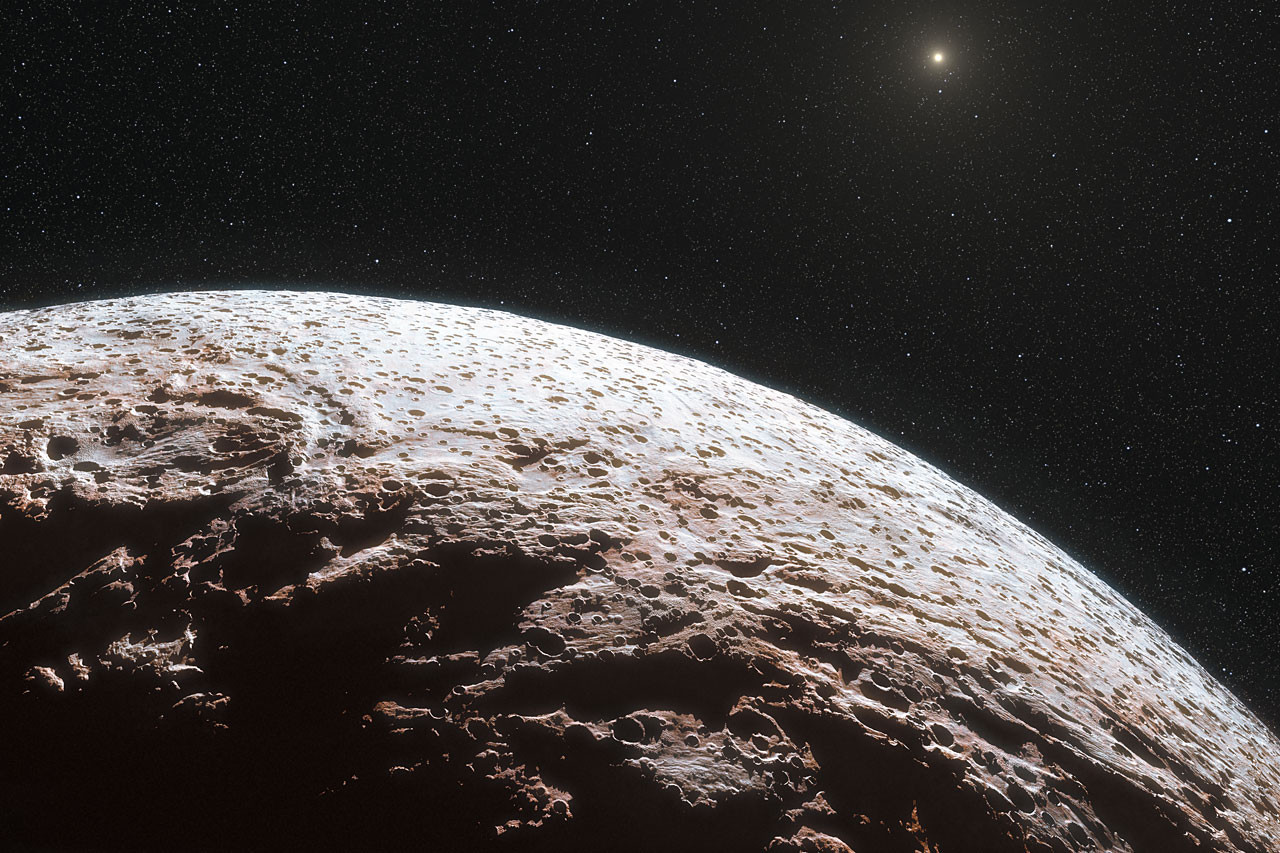
The discovery paper proposed this as a way to explain the system’s thermal behaviour. It did not turn MK 2 into a resolved thermal map. Distinguishing the contributions requires models of sizes, reflectivity and temperatures, constrained by observations at different wavelengths. [1] [3]
Brightness is not a direct size measurement
The moon’s initial diameter estimate depended on an assumed dark surface. The same faint reflected light could come from a smaller, brighter object or a larger, darker one. Reflected light and thermal emission together help reduce that ambiguity. [1] [3]
The contrast with Makemake is scientifically useful even before every parameter is settled. A bright dwarf planet and dark companion might preserve different volatile histories, surface processing or formation conditions. Their different appearances need an explanation, rather than an assumption that neighbouring bodies must have matching ice coatings. [1] [3]
A small companion changes the questions we can ask
Makemake has methane ice on its cold surface, but no spacecraft has mapped it at close range. Hubble’s discovery did not provide mountains or craters comparable to those seen on Pluto. It provided a second point whose movement and radiation could be measured. [2] [1]
That is the practical answer to why a faint moon matters. Its orbit tests the system’s mass, while its separate surface can explain part of the combined light and heat. The companion turns one unresolved source into a physical system with properties that can be checked against one another. [2] [1]
Sources & image credits
Related reading and objects
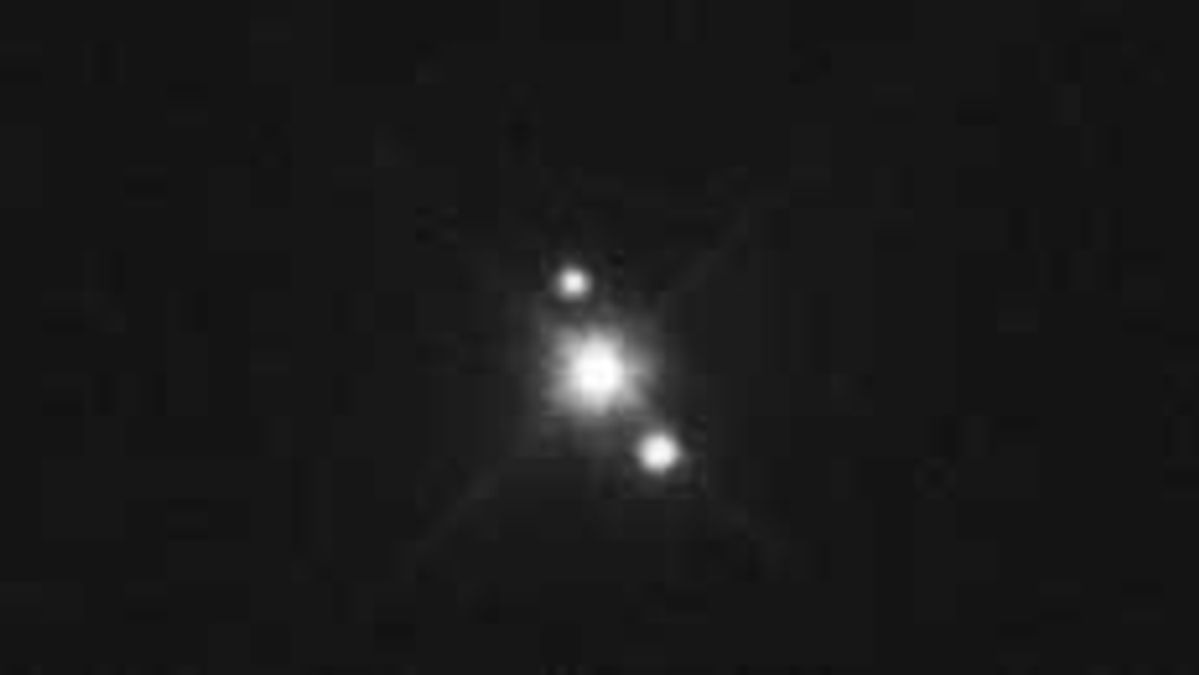
How did a star reveal Haumea’s ring?
On 21 January 2017, observers at several European sites watched Haumea pass in front of a star. The main disappearance measured the dwarf planet’s silhouette. Smaller, separate dips in the starlight revealed material orbiting around it.
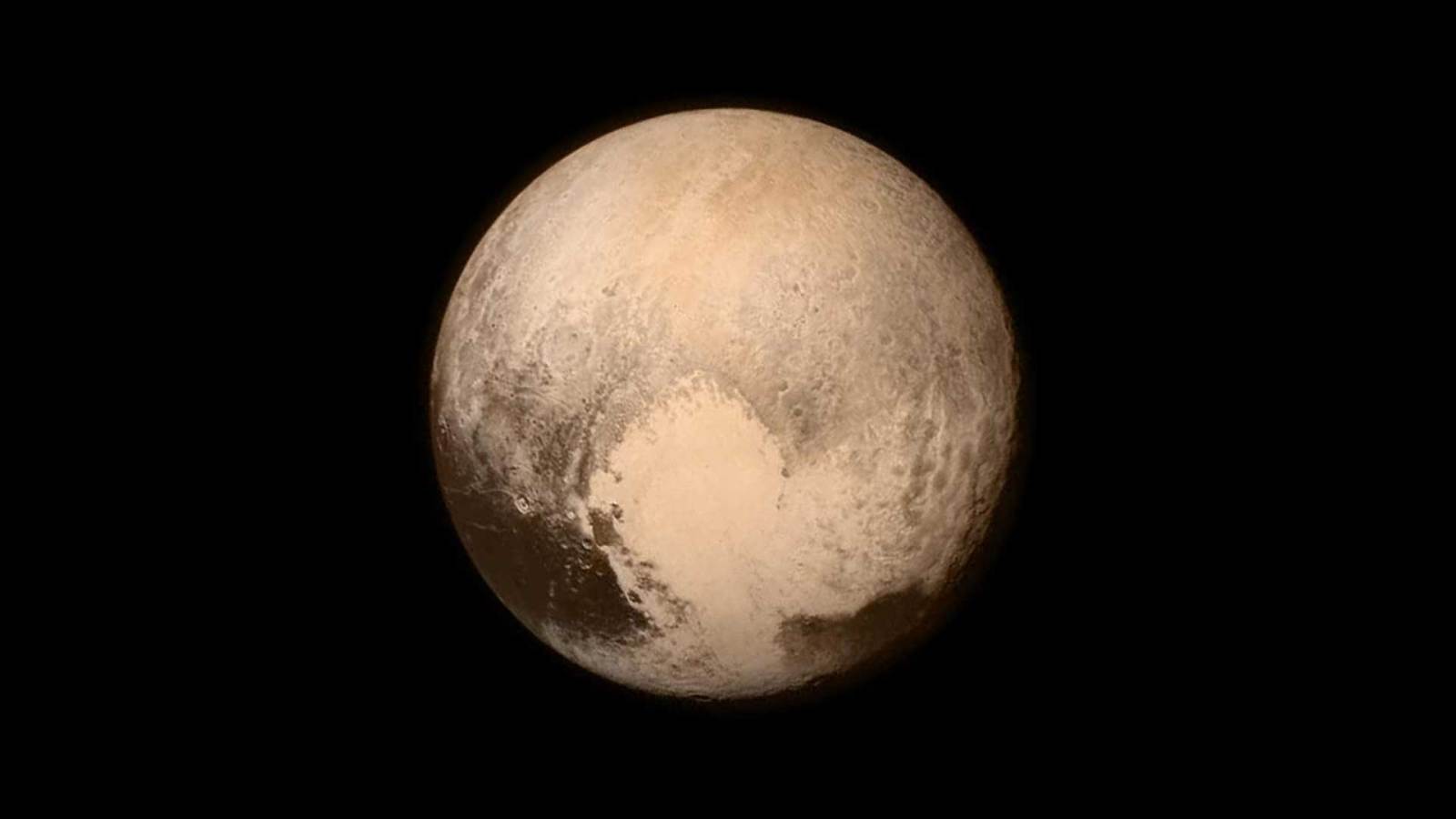
Why is Pluto a dwarf planet?
When New Horizons flew past Pluto in July 2015, the former ninth planet became a world of mountains and glaciers. Its new classification had changed its place in a list, but the flyby showed how much remained to explain about the place itself.