Deep space / Field notes
What are Lagrange points, and why is Webb at L2?
The view starts with choosing where to look from.
- Lagrange points in a two-body system
- 5
- Earth to Sun–Earth L2
- ≈1.5 million km
- Approximate one-way light time
- ≈5 seconds
A useful balance in a moving system
Lagrange points are five positions associated with two orbiting bodies. Their combined gravity allows a small object to keep the same relative arrangement while orbiting with the system. They are useful places to operate spacecraft, but they are not places where gravity disappears.
Toward the Sun
A useful vantage point for watching the Sun.
Beyond Earth
A useful region for observatories such as Webb.
Ahead and behind
The triangular points lead and trail the smaller body.
Why Webb uses L2
Sun–Earth L2 lies beyond Earth, away from the Sun, about 1.5 million kilometers from us. Webb travels around the Sun while moving in a large orbit around L2. This geometry keeps the Sun, Earth and Moon toward the sunshield side, helping the telescope stay cold for infrared observations.
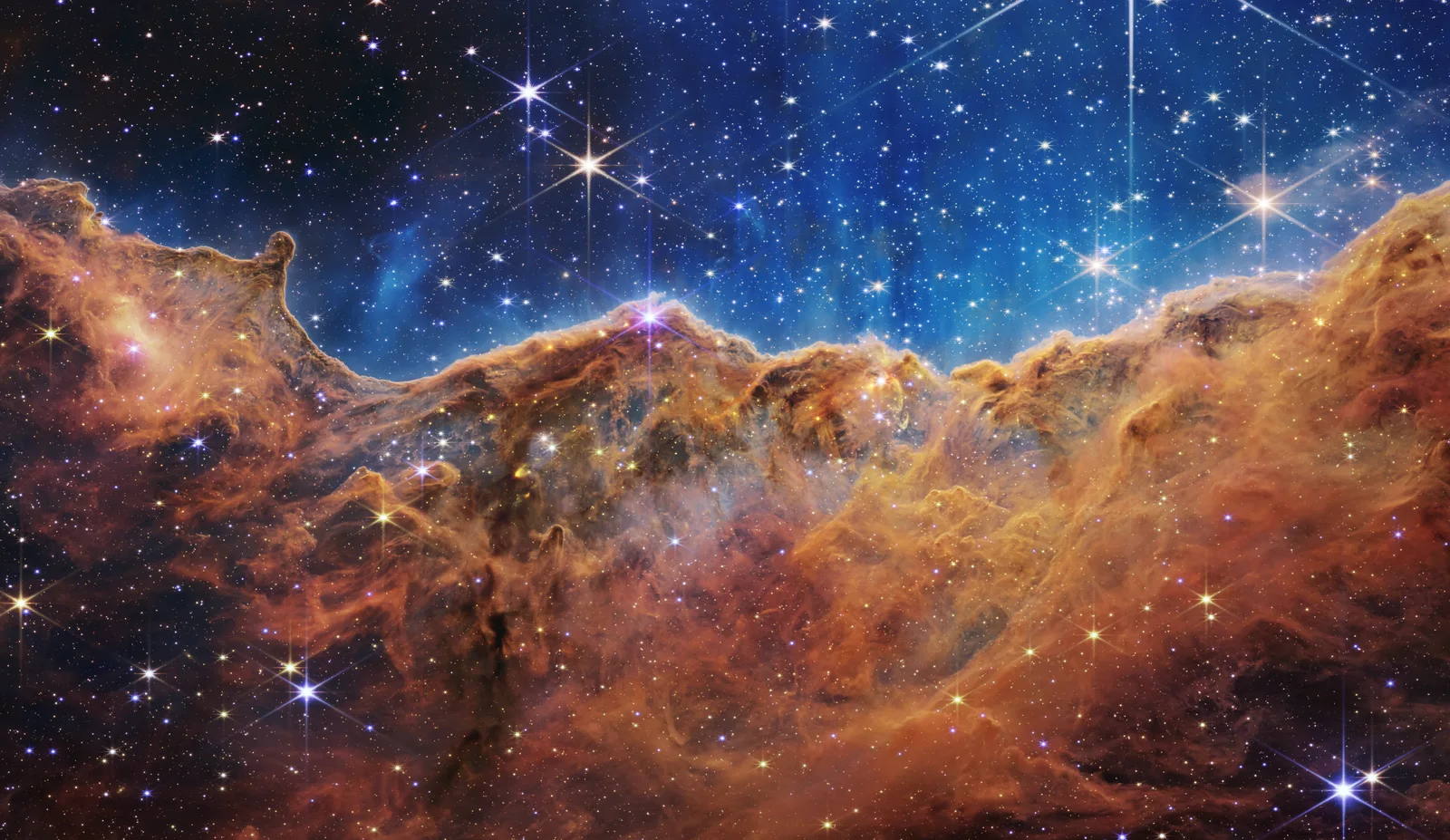
What the Cosmic Cliffs actually show
These glowing “mountains” are gas and dust in a star-forming region, not a solid planetary landscape. Webb’s infrared observations reveal structures and young stars that are difficult to see through dust at visible wavelengths. The image maps infrared measurements into colors our eyes can see.
An orbit still needs attention
L1, L2 and L3 are unstable equilibrium points: a spacecraft near them needs corrections to stay on its intended path. Webb does not sit motionless on a dot. Its halo orbit also avoids Earth’s shadow, keeping sunlight available for its solar panels.
Is L2 on the far side of the Moon?
No. Sun–Earth L2 belongs to the Sun–Earth system, well beyond the Moon’s orbit. The Earth–Moon system has its own Lagrange points. The name L2 only makes sense when you specify the two main bodies.
From the complete catalog
Meet the missions.
Search by name across every launch and event record. Results keep their source IDs, dates and reported outcomes.
Sources & further reading
NASA · What are Lagrange points? ↗NASA · Webb’s orbit ↗NASA · Exploring the Cosmic Cliffs ↗Science explanations and historical imagery are reviewed separately from changing mission records. Sources and corrections