Mars / Field notes
Mars missions explained: orbiters, landers and rovers
A landscape you can photograph. A world you cannot control in real time.
- Length of a Martian day
- 24.6 hours
- One Martian year
- 687 Earth days
- Illustrative one-way radio delay
- Up to ~22 min
Three ways to read a planet
Orbiters study wide areas from above. Landers investigate a fixed place on the surface. Rovers travel between sites and examine rocks up close. Their measurements answer different questions, so a spectacular rover image is one part of a much larger planetary investigation.
The wide view
Look across terrain, weather and the atmosphere.
A place in detail
Study one location and its surrounding conditions.
Follow the rocks
Travel between outcrops and compare different sites.
The landscape holds the clues
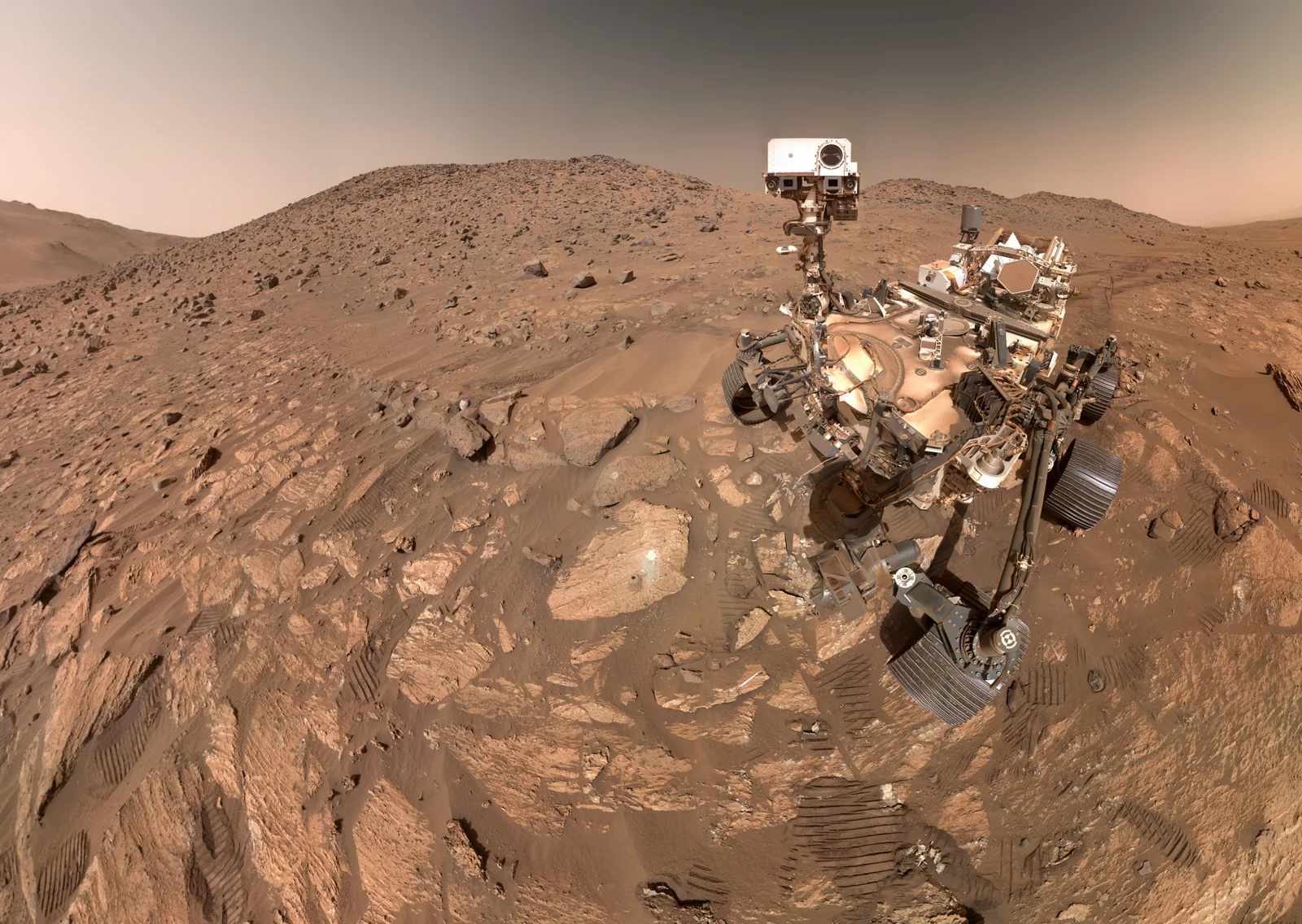
Perseverance’s 2024 selfie at Cheyava Falls shows the rover in an ancient river valley near Jezero Crater. The image combines 62 exposures from a camera on its robotic arm. The mission investigates geology and past environments, including the search for signs of ancient microbial life; a photograph alone cannot establish that life existed.
Why the radio conversation takes time
Earth and Mars move around the Sun, continually changing their separation. A radio signal travels at the speed of light, so commands and replies arrive after a delay. NASA’s example Mars mission profiles reach roughly 22 minutes one way. That is a planning example, not today’s measured delay or a fixed value for every flight.
Read the mission, then the milestone
A launch record, arrival event and surface operation can be distinct catalog entries. Search by spacecraft name to connect them, check the record type and read the published status. The archive includes launches and events from the complete catalog, with uncertain and missing dates kept visible.
Is Mars red everywhere?
Iron-bearing minerals give much of Mars its rusty appearance, but its rocks and landscapes vary. Scientific images may be color-enhanced or white-balanced; read the image caption before treating the colors as a human-eye view.
From the complete catalog
Meet the missions.
Search by name across every launch and event record. Results keep their source IDs, dates and reported outcomes.
Sources & further reading
NASA · Mars facts ↗NASA · Perseverance at Cheyava Falls ↗NASA · Mars communications delay ↗Science explanations and historical imagery are reviewed separately from changing mission records. Sources and corrections