

How can we see a black hole in M87?
On 10 April 2019, the Event Horizon Telescope collaboration released an image of a bright ring surrounding a dark centre in M87. The observations measured radiation from hot material near a supermassive black hole, where gravity strongly changes the paths of light.
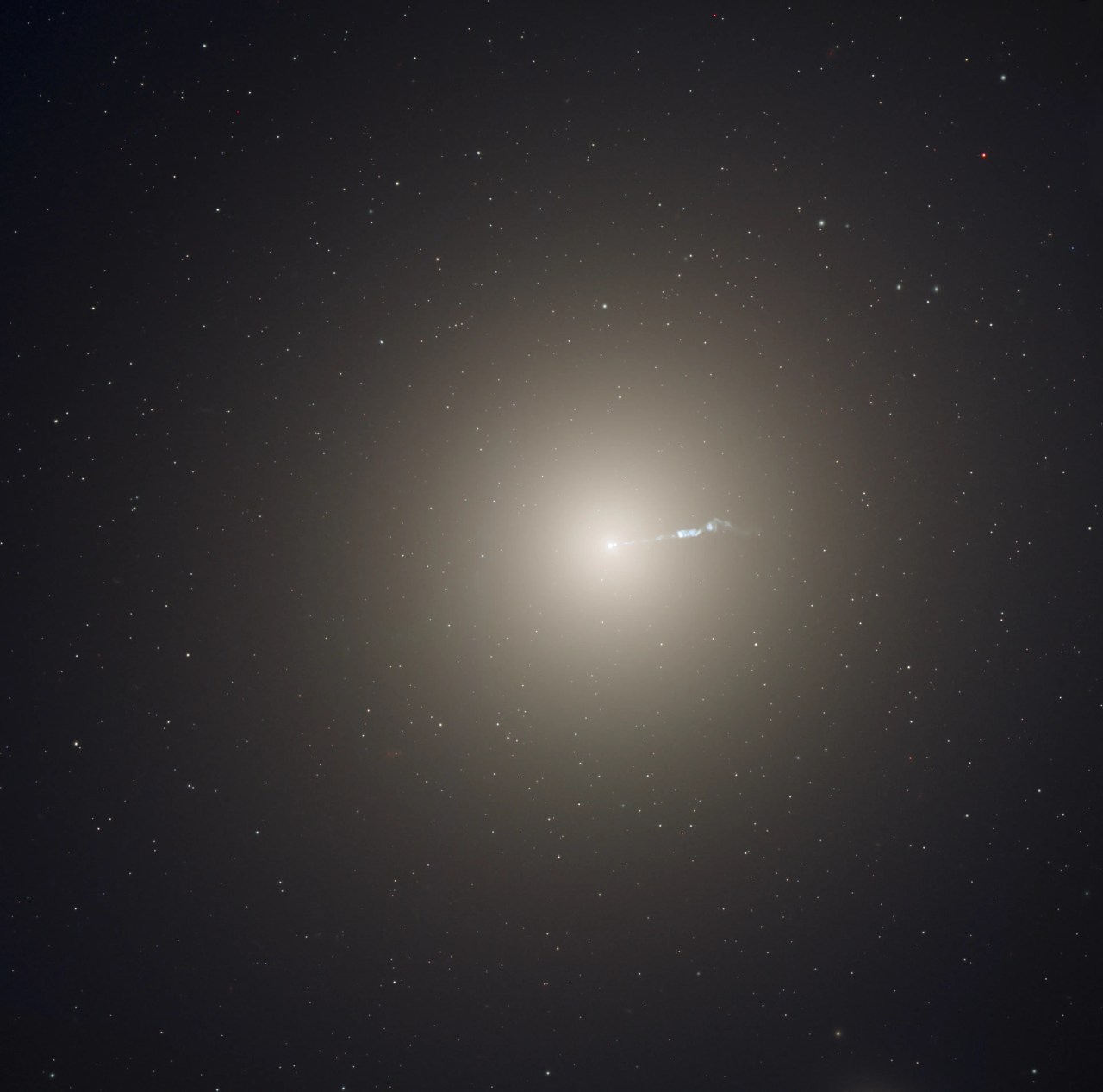
M87 and M87* are different scales
M87 is a giant elliptical galaxy in the Virgo cluster, roughly 54–55 million light-years away. Its broad glow contains an enormous stellar population and thousands of globular clusters. It does not have the conspicuous spiral arms of a galaxy such as the Whirlpool. [1]
M87* names the supermassive black hole at its centre. The galaxy and black hole belong to the same system, but a global photograph of the galaxy cannot resolve the immediate black-hole environment. [1]
Hubble shows a jet emerging from the central region across a much larger scale than the EHT ring. Connecting those views requires remembering how dramatically the field of view changes between instruments. [1]
Combine radio telescopes across Earth
The EHT used very-long-baseline interferometry to combine observations from widely separated radio facilities. The separation between stations supplied the resolving power needed to investigate a structure only tens of microarcseconds across on the sky. [2] [3]
The 2019 release used observations collected in April 2017 at a wavelength of about 1.3 millimetres. It was not a visible-light exposure through one enormous mirror. Recorded signals from the different stations were correlated and used to reconstruct the distribution of emission. [2] [3]
Sparse sampling makes image reconstruction a scientific problem. The collaboration compared methods and tested which features persisted under different assumptions. The ring-like structure was a robust result across those analyses. [2] [3]
The dark region is an effect of gravity
Hot material near the black hole emits radiation. Strong gravity bends the paths of that radiation, and some light is captured rather than reaching an observer. The resulting image contains a bright surrounding structure and a central depression commonly called the shadow. [2] [4] [3]
The shadow is not a photograph of a solid black surface. Nor is its visible boundary identical to the event horizon. The horizon is the boundary beyond which light cannot escape; lensing and the emission geometry determine the larger apparent pattern around it. [2] [4] [3]

The observed size and shape could be compared with predictions for a supermassive black hole. In the original analysis, the measurements were consistent with a mass of roughly 6.5 billion Suns, with uncertainty attached to the inferred scale and model. [2] [4] [3]
Why one part of the ring is brighter
The emitting plasma is moving rapidly. Motion towards an observer can enhance observed emission through relativistic effects, while material moving away contributes differently. That helps explain why the reconstructed ring is not uniformly bright. [2] [3]
The orange display is assigned colour for radio intensity. It does not show the colour a nearby human eye would necessarily perceive. Its useful information is the distribution and relative strength of emission reconstructed from the measurements. [2] [3]
The image records a dynamic environment. Later observations can test changes in the bright pattern while investigating whether the overall ring size remains consistent. [2] [3]
Escaping material originates outside the horizon
M87’s long jet contains material accelerated to nearly the speed of light. It is associated with the accretion flow and magnetic environment around the black hole, rather than matter climbing back out after crossing the event horizon. [1] [2]
The EHT image and Hubble’s jet view therefore investigate related processes on very different scales. One resolves emission shaped by extreme gravity close to the central object; the other shows how energy and material reach far into the surrounding galaxy. [1] [2]
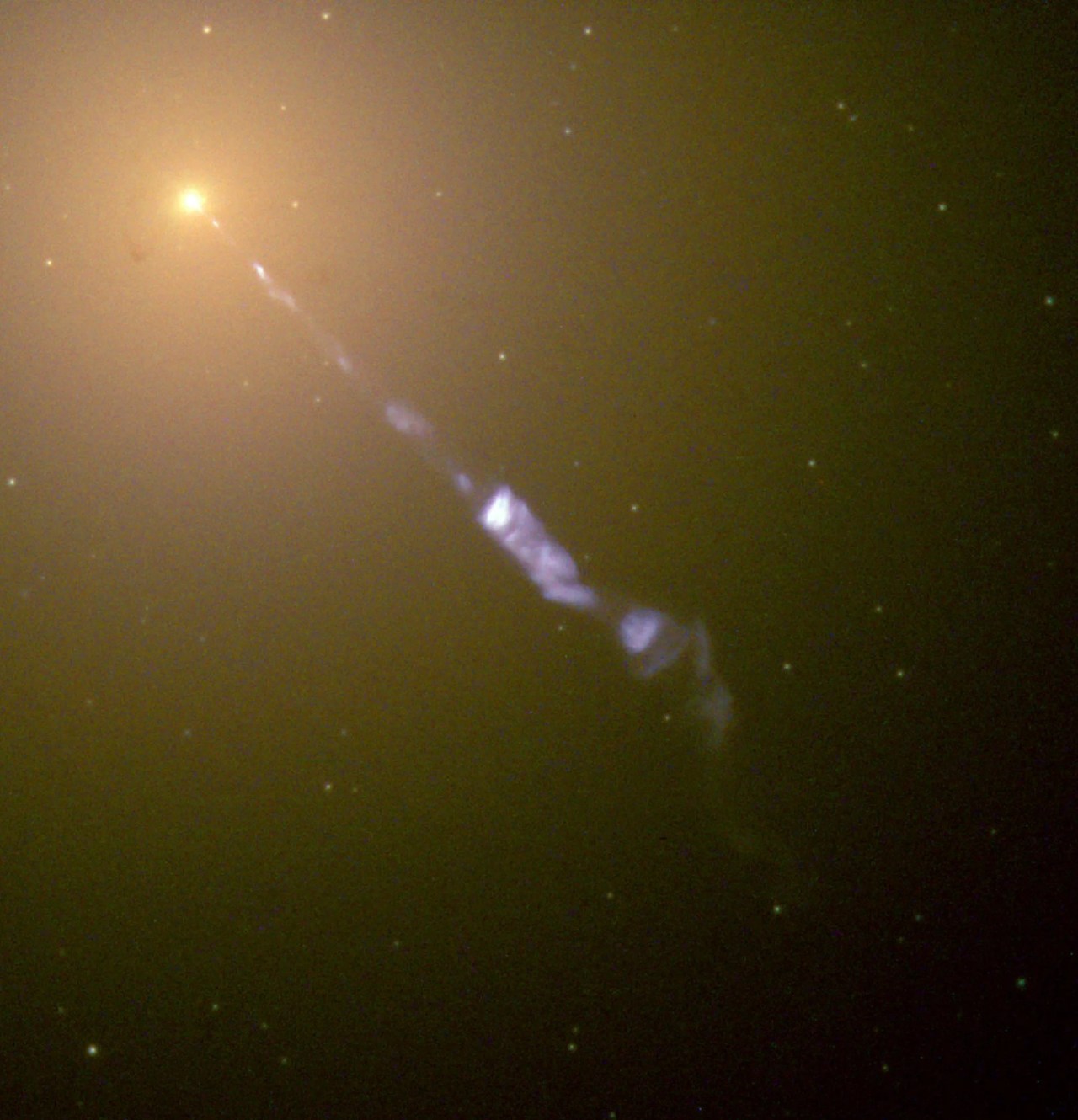
We see the black hole through its effects on light and matter. M87’s importance is that those effects can be measured from the galaxy-wide setting down to a ring whose size tests the physics of the central object itself. [1] [2]
Sources & image credits
Related reading and objects
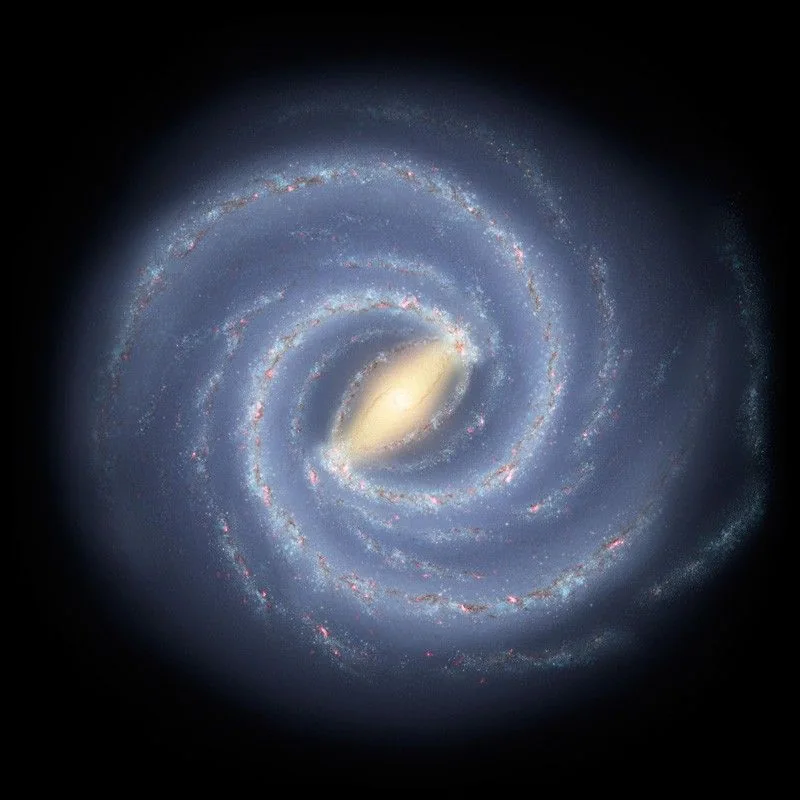
How do we map the Milky Way from inside it?
ESA’s Gaia mission repeatedly measured stars across the sky from 2014 to 2025. Those observations address a problem no external photograph can solve for us: the Solar System sits inside the Milky Way’s dusty disk, so its structure must be reconstructed from within.
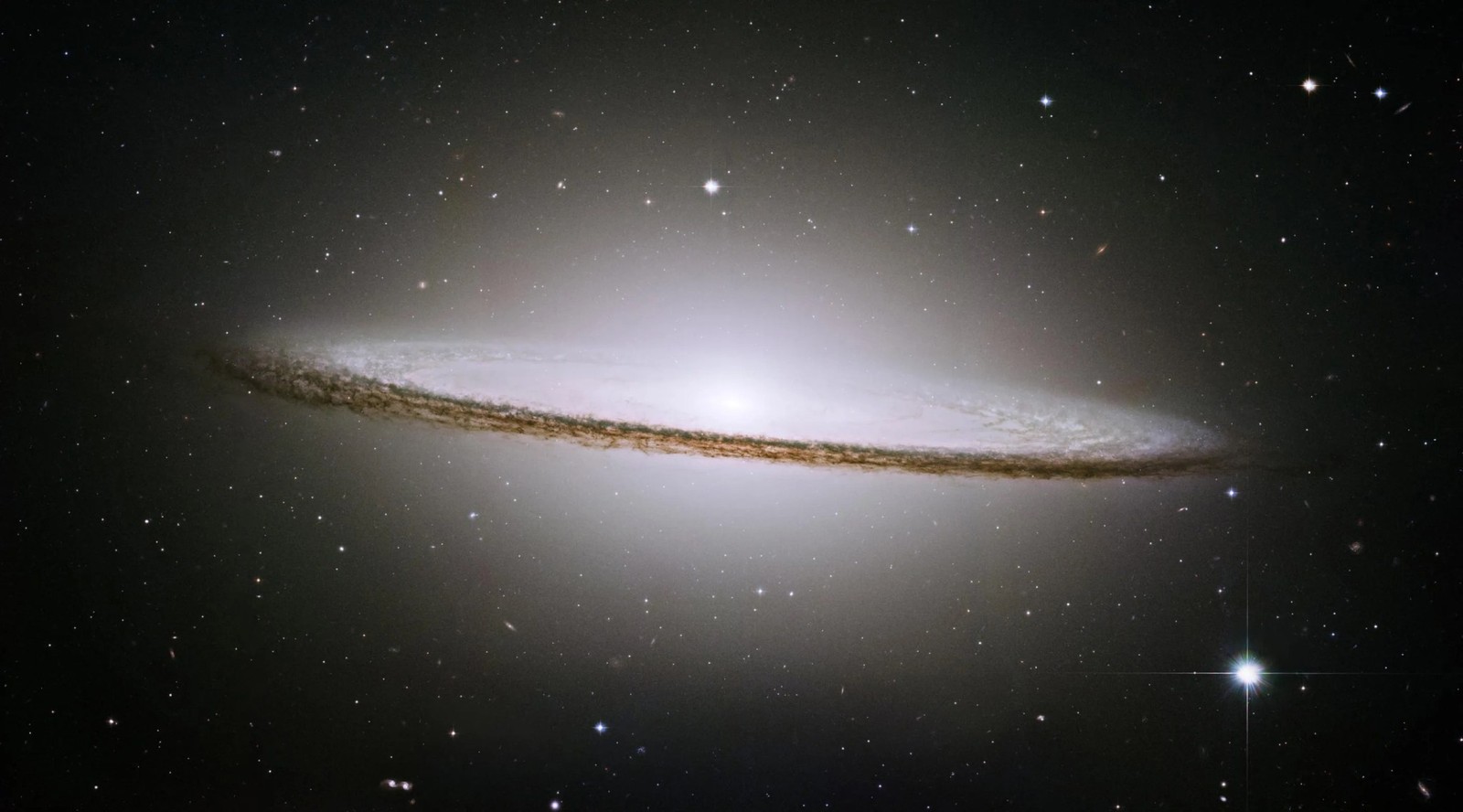
Why does the Sombrero Galaxy look different in infrared?
Hubble’s Sombrero Galaxy has a brilliant central bulge crossed by a dark dust lane. Webb’s mid-infrared view makes the bulge much less prominent and reveals a structured ring. The galaxy did not transform between the images; the instruments emphasise different material.