

Why does the Sombrero Galaxy look different in infrared?
Hubble’s Sombrero Galaxy has a brilliant central bulge crossed by a dark dust lane. Webb’s mid-infrared view makes the bulge much less prominent and reveals a structured ring. The galaxy did not transform between the images; the instruments emphasise different material.
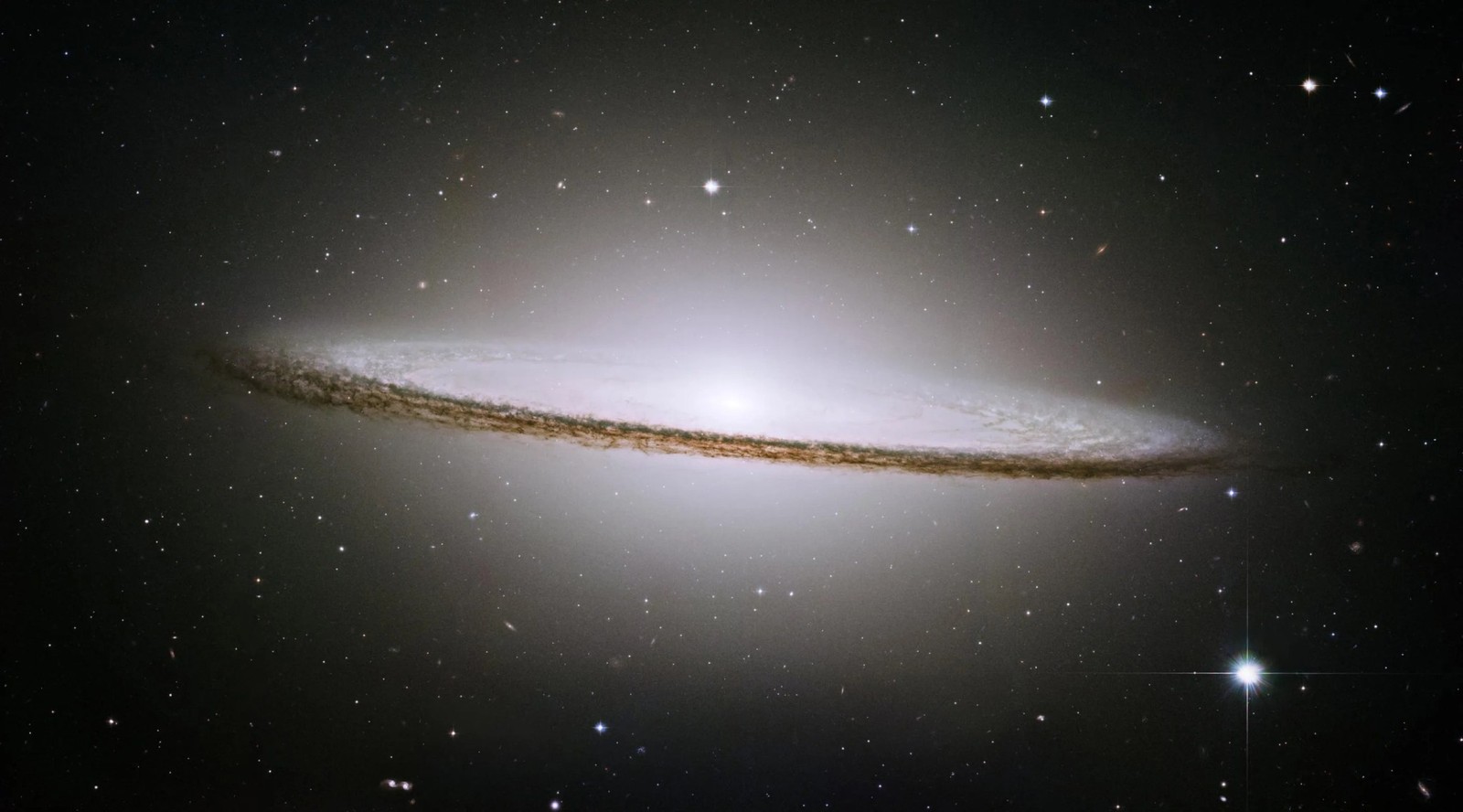
A near-edge-on disk makes the hat shape
The Sombrero Galaxy, M104, lies about 30 million light-years away. Its disk is viewed nearly edge-on, placing a long band of dusty material across the bright central stellar distribution. That geometry produces the broad-brimmed appearance behind its nickname. [1]
The dark band blocks and scatters some of the starlight behind it. It is material in the galaxy, not a crack or a gap separating two halves. The surrounding glow comes from stars spread through a much larger volume. [1]
The orientation helps reveal the contrast between a flattened disk and a central bulge. It also layers different regions along one line of sight, so the image needs wavelength information to separate their contributions. [1]
Stars dominate the familiar portrait
Hubble’s visible-light mosaic emphasises the bright bulge, the thin dark lane and the galaxy’s surrounding population of globular clusters. The clusters are dense groups of old stars associated with the wider galactic system. [1]
A dark feature in that image need not contain less material. Dust can make a dense region look faint because it prevents light from reaching the telescope. An observer cannot infer the distribution of all mass by treating brightness as a uniform material map. [1]
The visible portrait establishes the large-scale geometry. Infrared observations then test which parts of the same structure were hidden or outshone by the stellar glow. [1]
Some stellar light still meets an obscuring ring
Webb’s NIRCam view, released in June 2025, shows the densely packed central stars while retaining a strong dark ring where dust blocks some background starlight. Longer wavelengths can penetrate dust more effectively than visible light, but that does not make every dusty region transparent. [2] [3]
NIRCam also reveals fine structure and differences within the disk. Comparing its view with Hubble helps distinguish a real concentration of stars from an apparent change produced by extinction. [2] [3]
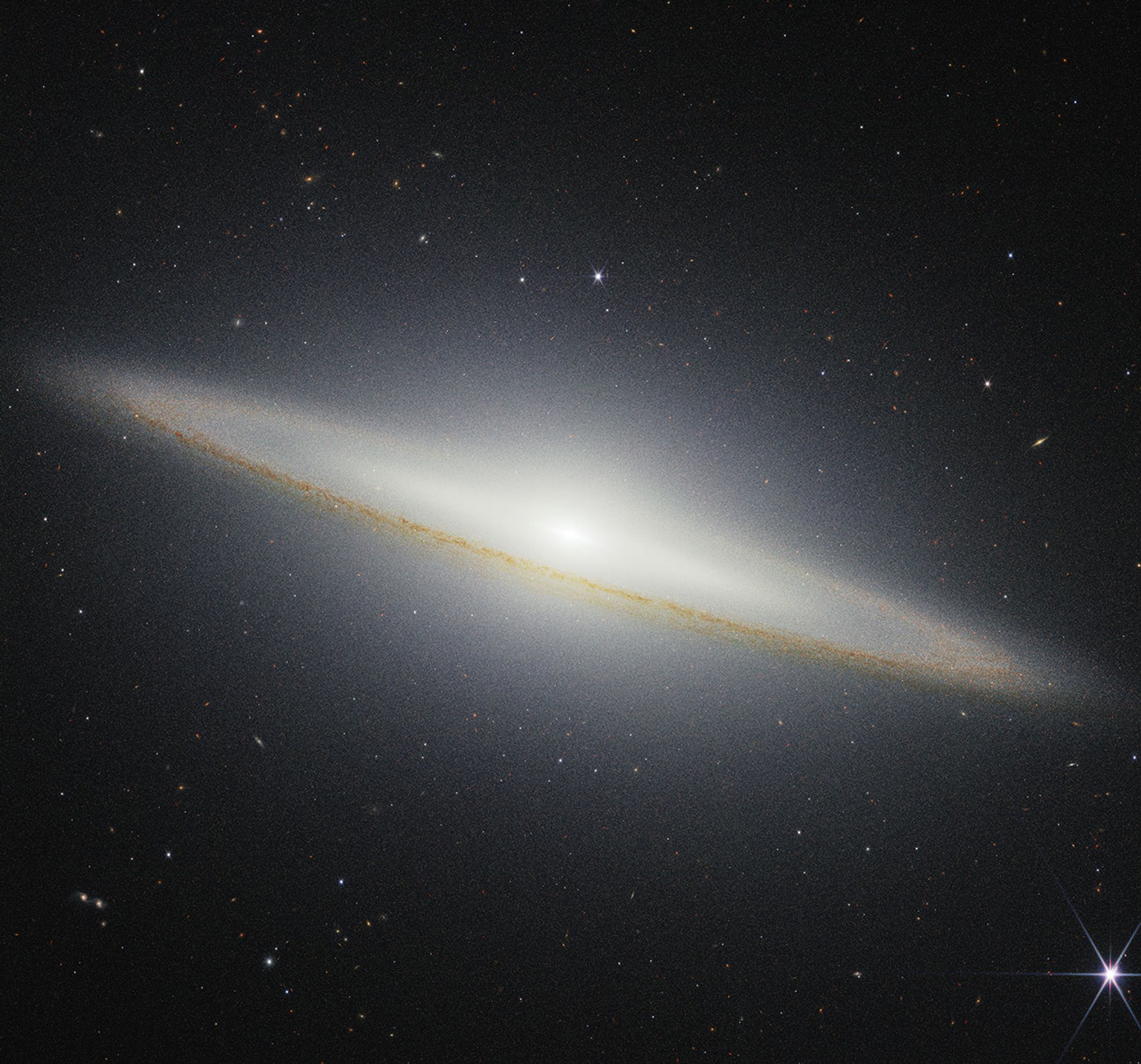
The comparison is between wavelength ranges, instruments and processed displays. Their colours identify selected signals; they are not interchangeable photographs taken with the same filter and exposure. [2] [3]
Dust becomes conspicuous emission
At mid-infrared wavelengths, MIRI emphasises emission from dust and associated material. The broad stellar bulge becomes less dominant, while the outer ring appears detailed and clumpy. [2] [3]
This is the same material that can obscure stars in another band. Absorbing radiation and emitting at longer wavelengths lets dust act as both an obstacle and a source of information. The apparent change in shape therefore follows from which component dominates the recorded light. [2] [3]
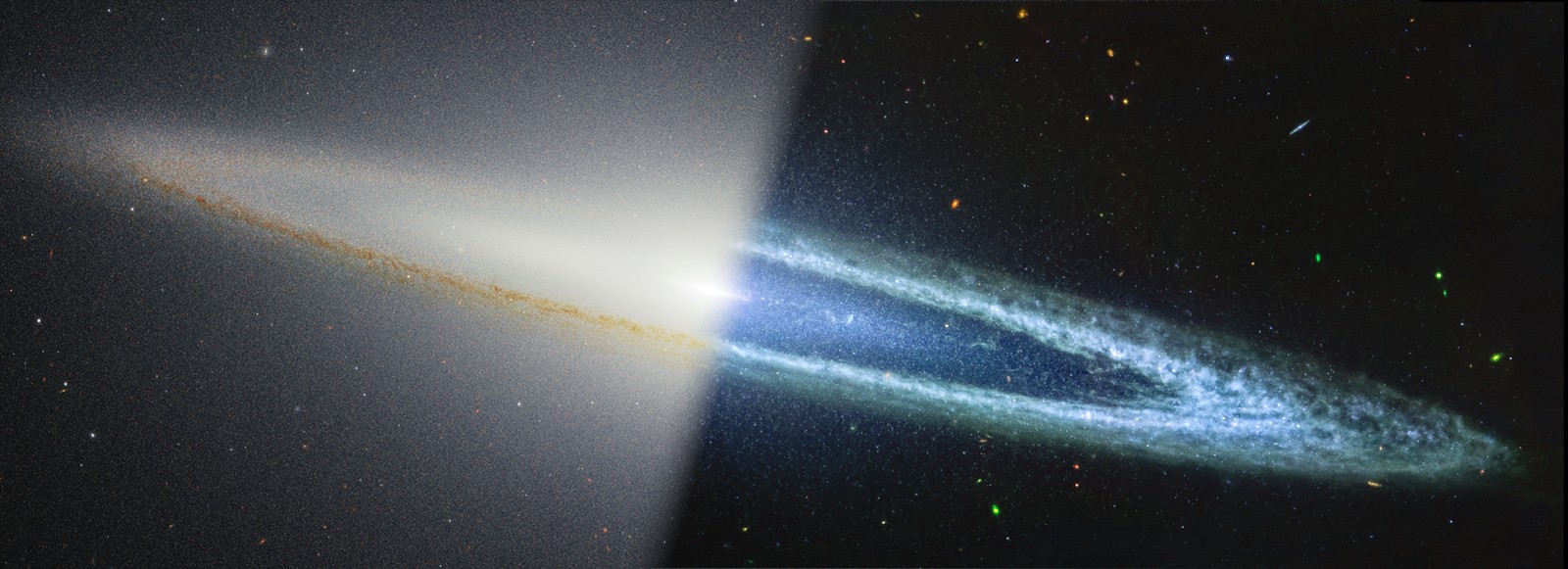
Webb’s paired observations also reveal structure within the central disk, including a warped appearance. Features that seem smooth in one image can separate into smaller components when observed with a different wavelength response and resolution. [2] [3]
Put the views together before choosing a history
A ring with clumps is not automatically proof of exceptionally rapid star formation. Researchers must compare emission diagnostics, gas and stellar populations to establish how actively a region is forming stars. Dust structure alone answers only part of that question. [1] [2]
Likewise, a massive central black hole does not make the entire visible bulge an image of the black hole. The galaxy contains stars, dust, gas and clusters on scales far larger than the immediate accretion environment. [1] [2]
The Sombrero’s three views make a practical lesson visible: a galaxy’s apparent form depends on its viewing angle and on what light is measured. Hubble maps the stellar glow and obscuration, NIRCam adds a different view through the dusty disk, and MIRI reveals material that shines most clearly farther into the infrared. [1] [2]
Sources & image credits
Related reading and objects
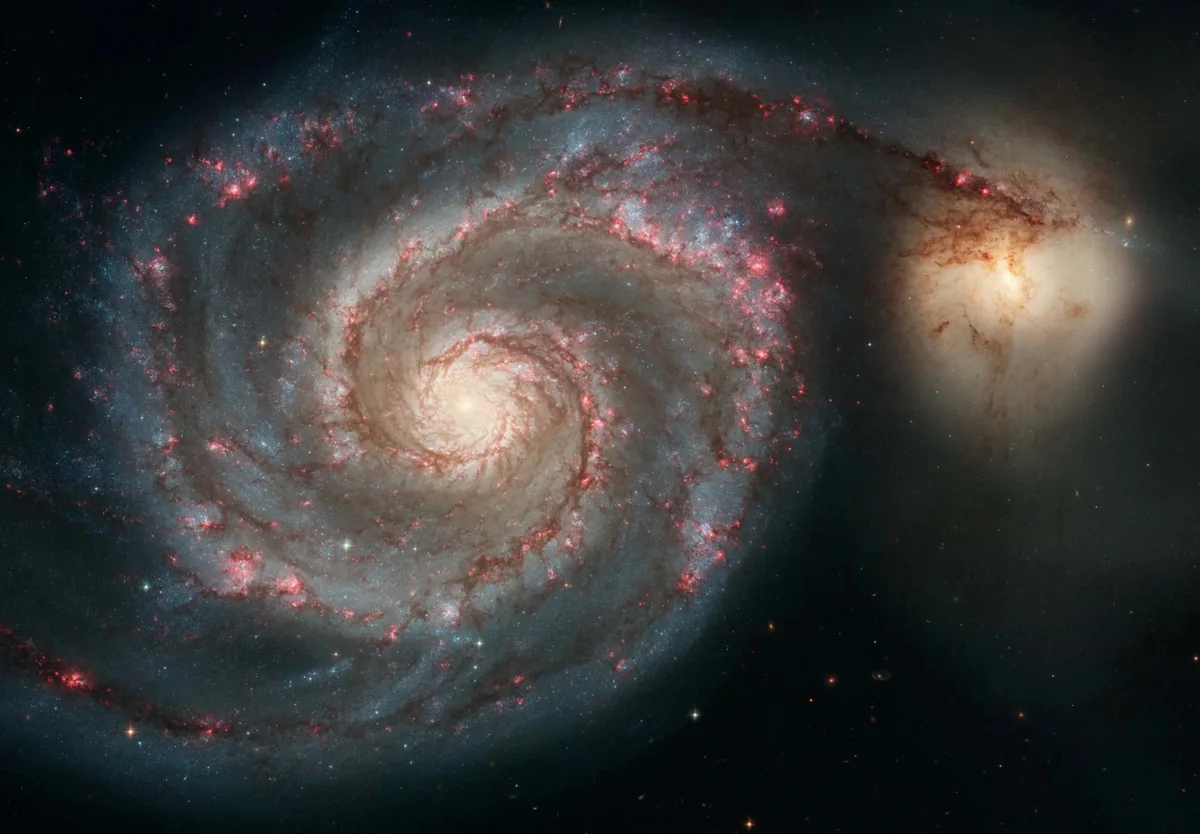
What makes the Whirlpool Galaxy’s spiral arms?
Hubble’s view of the Whirlpool Galaxy shows blue star clusters and pink star-forming regions along two prominent arms. The nearby companion NGC 5195 adds a gravitational disturbance. The arms are a changing pattern in a rotating galaxy, not rigid strips of material.
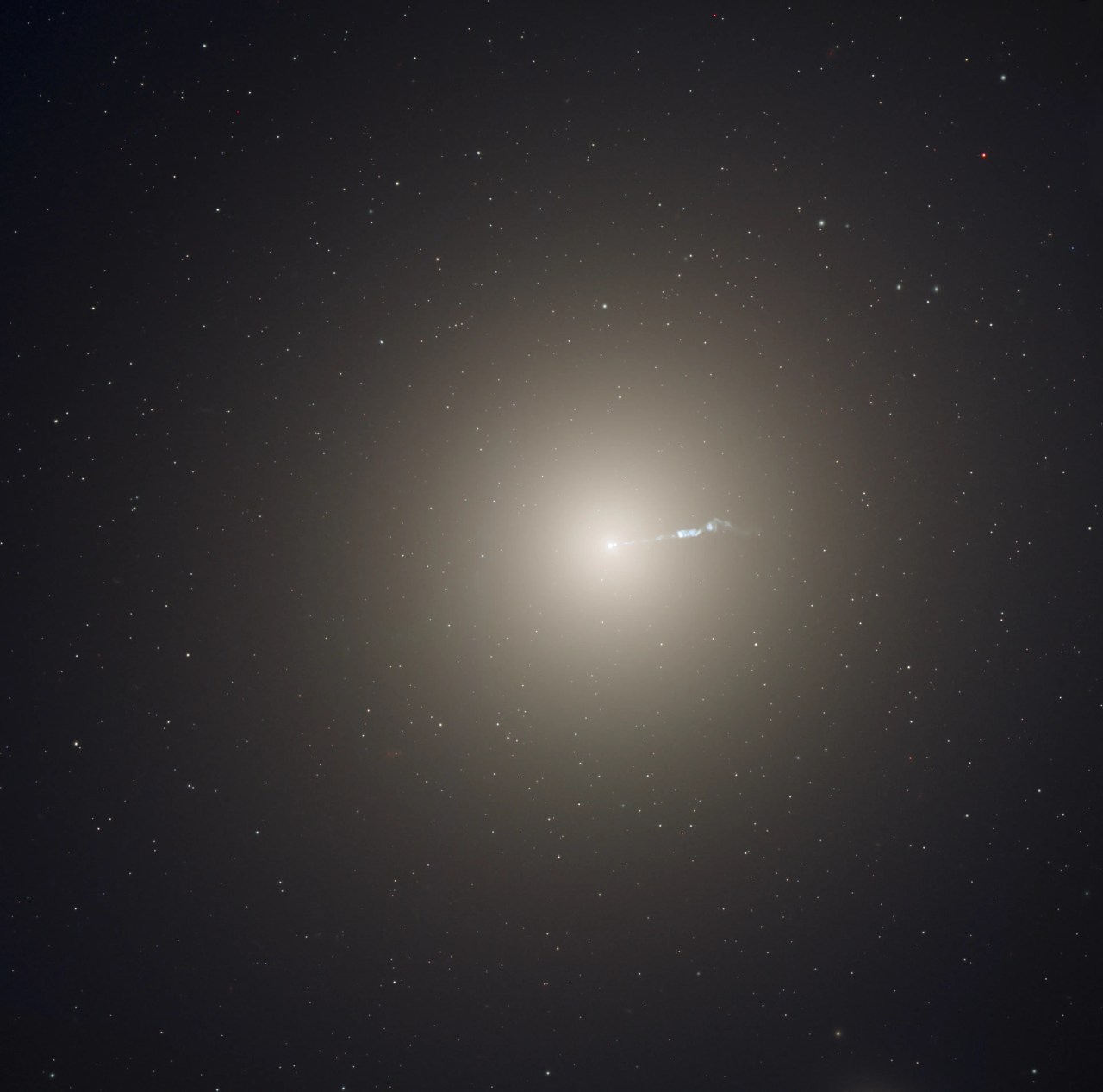
How can we see a black hole in M87?
On 10 April 2019, the Event Horizon Telescope collaboration released an image of a bright ring surrounding a dark centre in M87. The observations measured radiation from hot material near a supermassive black hole, where gravity strongly changes the paths of light.