

What makes the Whirlpool Galaxy’s spiral arms?
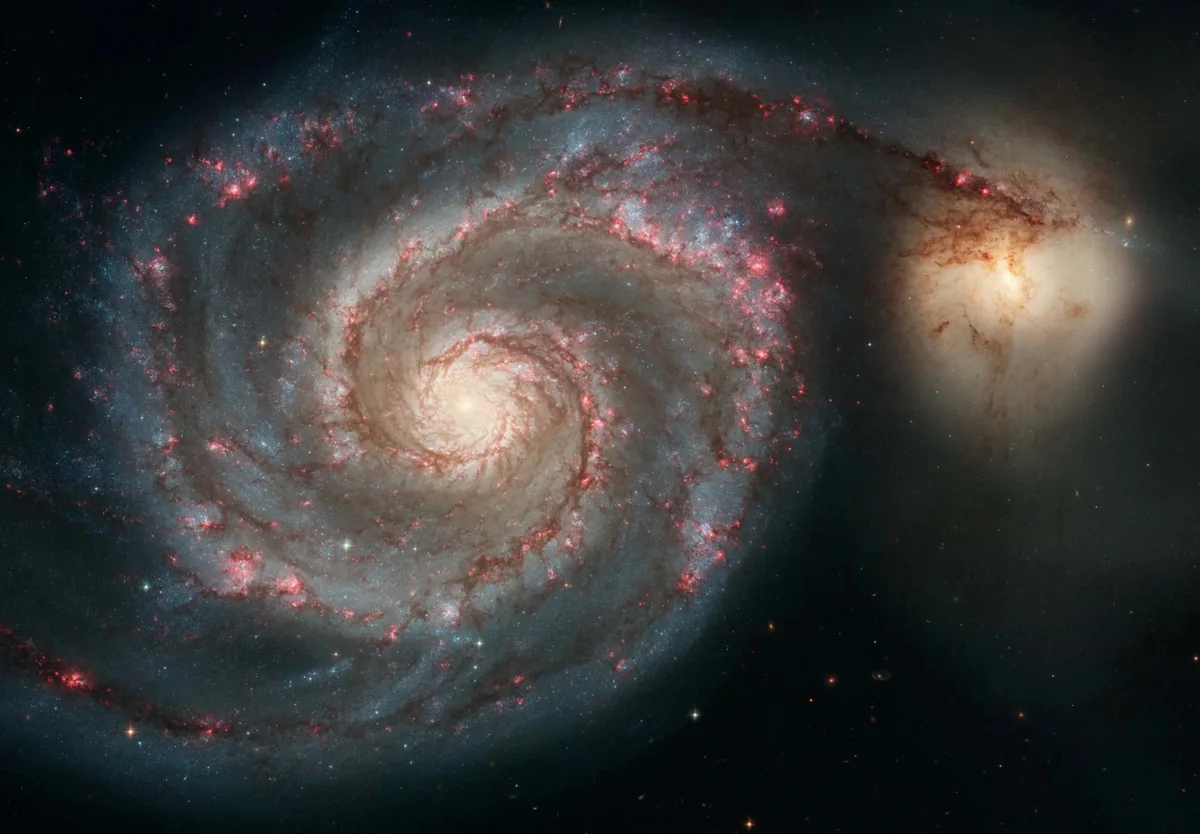
Hubble’s view of the Whirlpool Galaxy shows blue star clusters and pink star-forming regions along two prominent arms. The nearby companion NGC 5195 adds a gravitational disturbance. The arms are a changing pattern in a rotating galaxy, not rigid strips of material.
Separate the stars from the structure they trace
The Whirlpool, also known as M51 or NGC 5194, is a grand-design spiral galaxy. Its comparatively face-on orientation makes the long arms easy to follow, while the central region glows with a different mixture of stellar populations. [1] [2]
Stars and gas orbit within the galaxy. The visible spiral pattern is not a solid object turning like a painted wheel. Regions of enhanced density and the gravitational response of the disk can organise material into arms while individual stars continue on their own trajectories. [1] [2]
Young, luminous stars make parts of the pattern especially conspicuous. Their short lifetimes mean they trace relatively recent star formation, rather than outlining every star belonging to the galaxy. [1] [2]
Gas turns an arm into a site of star birth
Gas gathered or compressed in the spiral structure can form dense clouds. Where parts of those clouds collapse, new stars appear. Massive young stars then ionise surrounding hydrogen and contribute the bright emission associated with stellar nurseries. [1]
In the Hubble image, blue clusters and pink or reddish emission trace different aspects of this activity. Dust lanes mark cooler material that can hide the stars forming within it. The photograph therefore combines existing stellar populations with the gas and dust participating in the next generation. [1]
Not every bright feature is a star, and not every dark region is empty. Interpreting the arm requires separating light from stars, emission from gas and absorption by intervening dust. [1]
An encounter can strengthen the pattern
NGC 5195 appears near the end of one prominent arm. Hubble observations place it behind the main disk in the projected view. The pair’s gravitational interaction is thought to help explain the striking arm structure and associated star formation. [1]
Tidal forces arise because the companion pulls differently on different parts of the disk. They can distort or redistribute material over long periods, affecting where gas becomes concentrated. [1]
A static image cannot show the entire encounter history. The present alignment is one stage of a system evolving over hundreds of millions of years. Models have to reproduce the structure and relative motion rather than assuming the apparent touching point is a literal collision happening now. [1]
Dust changes from an obstacle into a subject
Near-infrared light can reveal stars hidden more strongly at visible wavelengths. In a Hubble analysis, researchers combined visible and near-infrared observations and subtracted starlight to investigate the distribution of dust more directly. [1] [3]
That processed map is not simply a second ordinary photograph. Its purpose is to isolate a component that would otherwise be mixed with the glow of stars. Comparing the result with the visible image reveals how dust is arranged along the spiral structure. [1] [3]
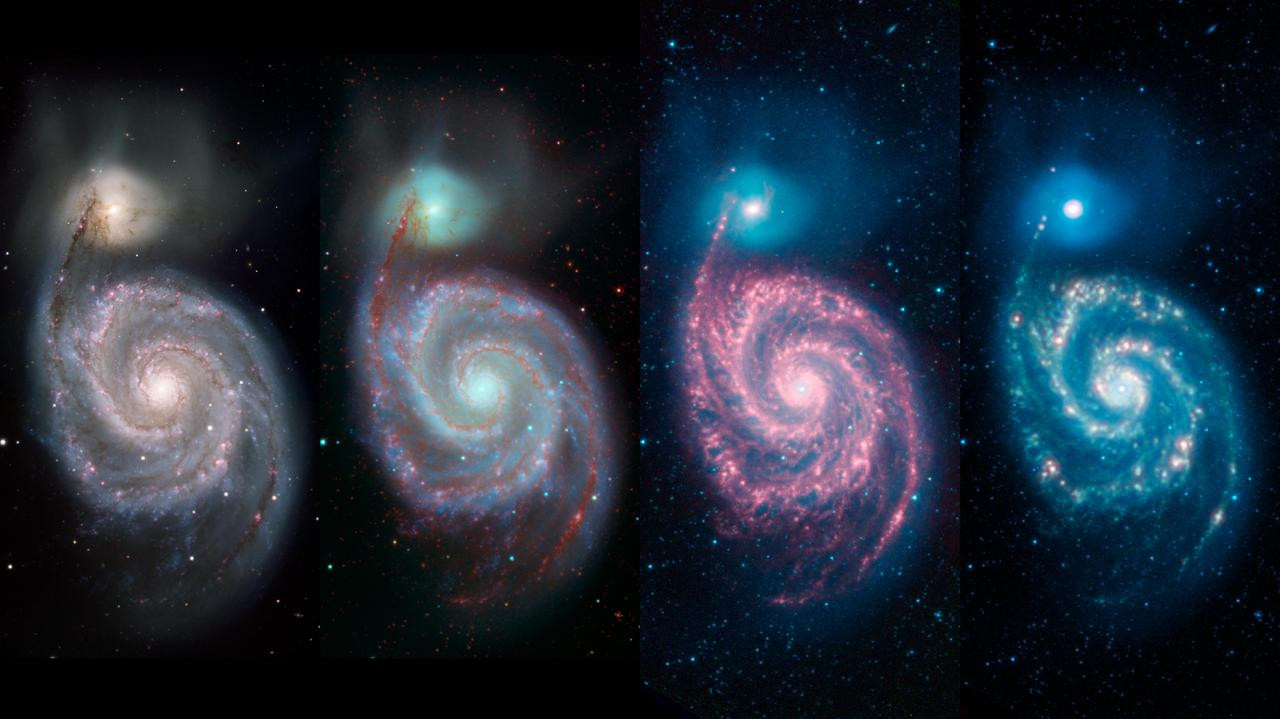
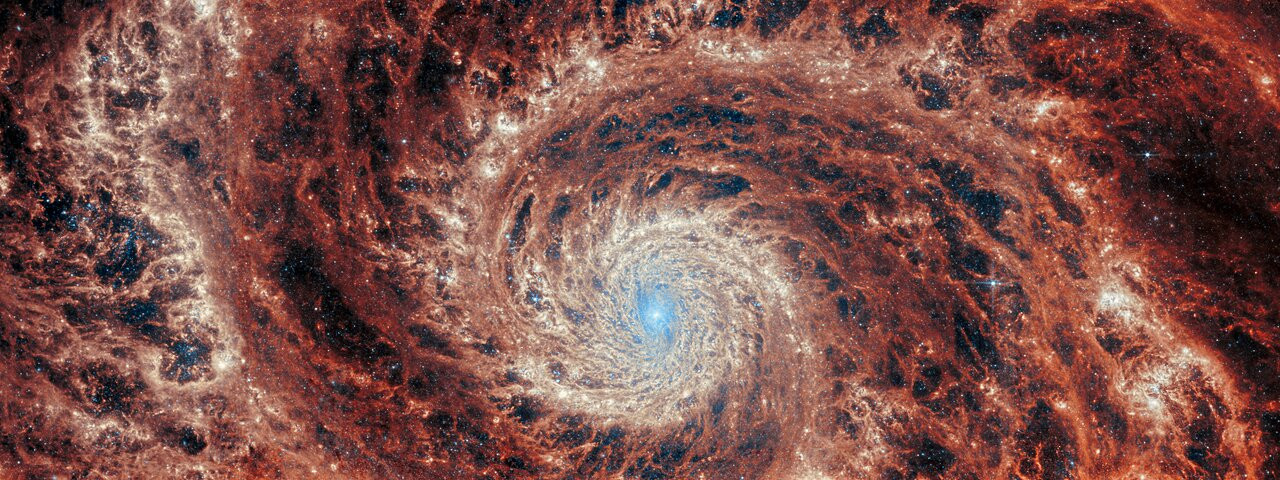
Webb’s infrared observations supply further views of warm dust and embedded regions. Different instruments respond to different wavelengths, so the apparent prominence of an arm or knot depends partly on which physical component the observation emphasises. [1] [3]
The arms are useful because several processes meet there
M51 lies roughly 31 million light-years away, close enough for telescopes to resolve many structures within its disk. The galaxy offers a comparison between a large-scale gravitational pattern and the smaller clouds where stars form. [1] [2]
Its arms connect the stages: gravity organises material, dense gas supports star formation, and young stars alter and illuminate the surrounding medium. The companion changes the setting in which that cycle operates. Reading the Whirlpool in several wavelengths turns an elegant spiral into evidence of a disk continually rearranging its material. [1] [2]
Sources & image credits
Related reading and objects
Why is Triangulum full of bright stellar nurseries?
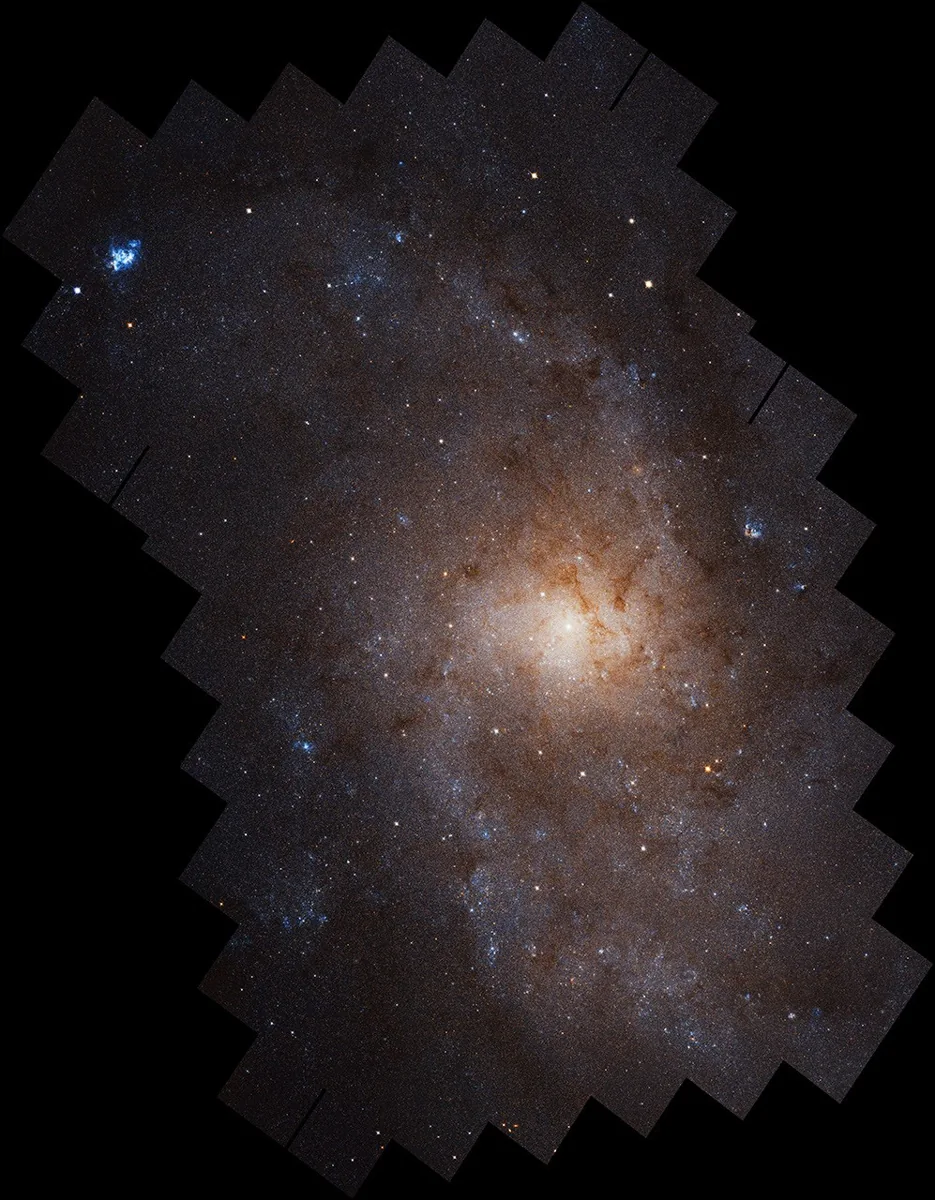
Hubble’s mosaic of Triangulum resolves nearly 25 million stars. Within the same galaxy, Webb’s 2024 images of NGC 604 show massive young stars excavating cavities in their birth cloud. Together the observations connect a galaxy-wide pattern with the physics inside one nursery.
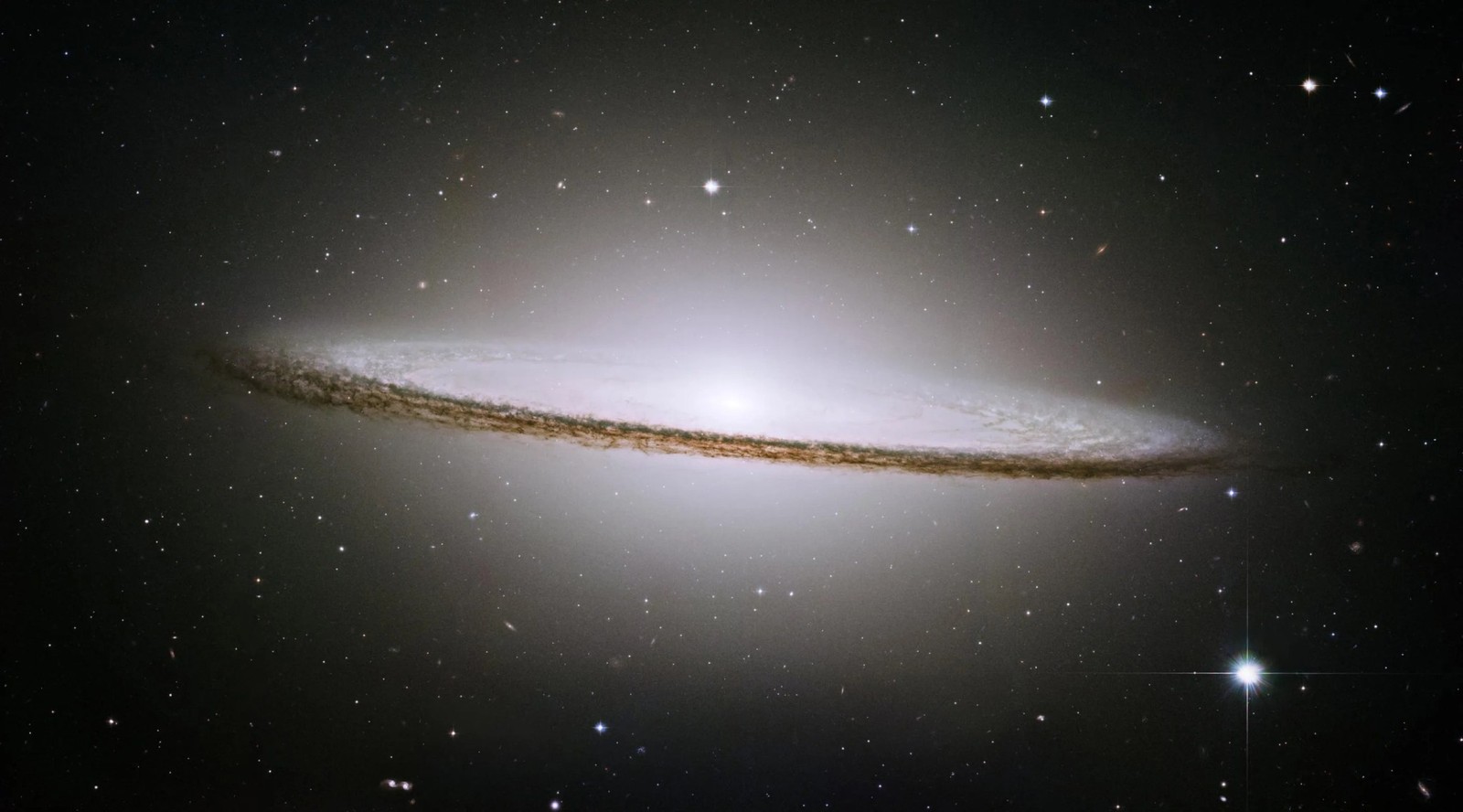
Why does the Sombrero Galaxy look different in infrared?
Hubble’s Sombrero Galaxy has a brilliant central bulge crossed by a dark dust lane. Webb’s mid-infrared view makes the bulge much less prominent and reveals a structured ring. The galaxy did not transform between the images; the instruments emphasise different material.