

Why is Triangulum full of bright stellar nurseries?
Hubble’s mosaic of Triangulum resolves nearly 25 million stars. Within the same galaxy, Webb’s 2024 images of NGC 604 show massive young stars excavating cavities in their birth cloud. Together the observations connect a galaxy-wide pattern with the physics inside one nursery.
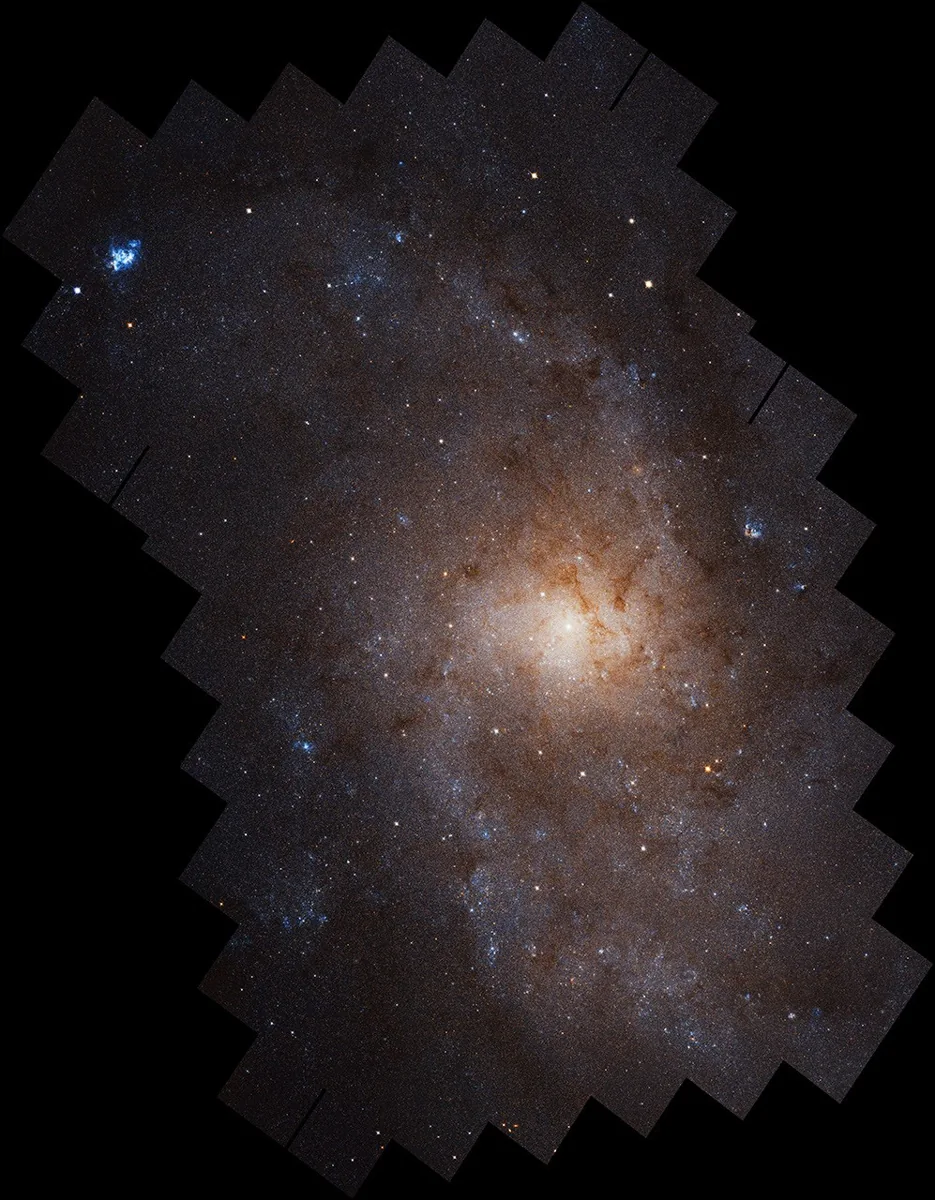
A neighbouring spiral exposes its structure
Triangulum, or M33, is a spiral member of the Local Group. Its comparatively face-on orientation allows astronomers to examine the distribution of stars, gas and dust without looking through an almost edge-on disk. [1]
The Hubble mosaic combined 54 fields observed in 2017 and 2018. It spans about 19,400 light-years and resolves nearly 25 million stars, providing a detailed sample rather than a complete view of every part of the galaxy. [1]
Bright concentrations of young stars stand out across that field. The survey team found a much higher star-formation intensity than in the particular Andromeda region surveyed in 2015. That is a comparison between observed areas, not a claim that every part of Triangulum produces stars at one uniform rate. [1]
Stars begin in a different environment from the bright cavity
Stars form from dense, cold gas that can collapse under gravity. The brilliant region visible after massive stars appear has already been changed by those stars. An illuminated cavity therefore records feedback as well as the conditions of star formation. [2] [3]
NGC 604 contains more than 200 very hot, massive O- and B-type stars. Their radiation ionises nearby gas, and their powerful winds push material away. The cluster creates openings and compressed boundaries within the cloud that supplied it. [2] [3]
The cloud is not passive scenery. Its structure affects how gas is exposed, heated or shielded, while the stars continually alter that structure. Understanding a stellar nursery requires following this exchange rather than counting the brightest points alone. [2] [3]
Follow cavities and their boundaries
Webb’s NIRCam images show stretched filaments, bright edges and large clearings. Those shapes reveal where winds and radiation have changed the surrounding material. Ionised gas and carbon-bearing molecules contribute emission in different parts of the image. [2]
The displayed colours encode selected infrared wavelengths. They separate signals that a human eye could not see directly, helping researchers distinguish molecular material, ionised gas and stars. [2]
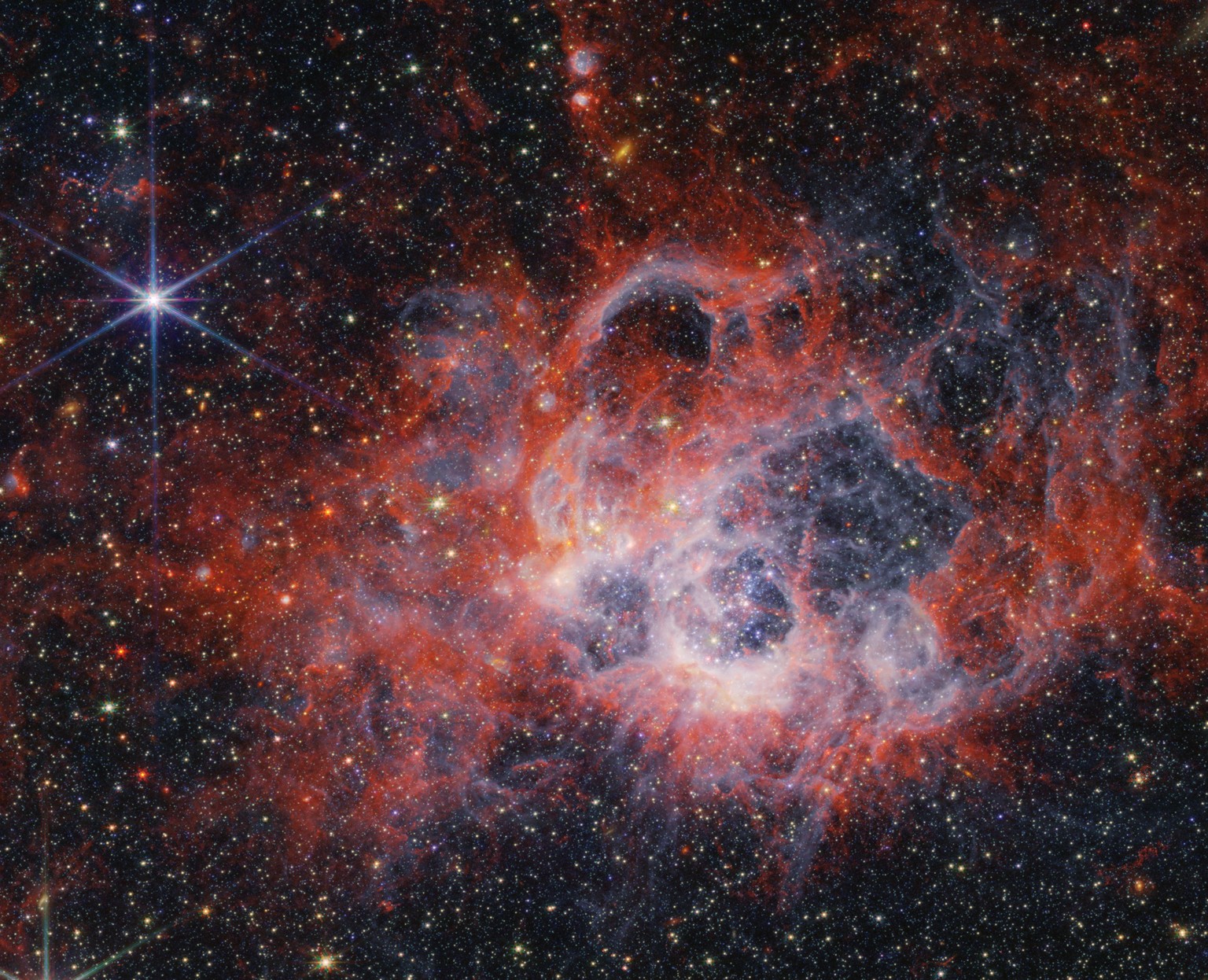
Some structures that appeared disconnected in visible-light images can be traced through diffuse gas in the infrared. The longer wavelengths therefore add relationships between features, rather than simply making the same visible scene sharper. [2]
Fewer stars can reveal more material
In Webb’s MIRI view, many hot stars become less prominent while cooler gas and dust stand out. A star-rich near-infrared image and a dust-rich mid-infrared image are observations of the same region weighted towards different emitters. [2]
This comparison prevents a misleading interpretation: fewer visible stellar points do not mean stars disappeared between exposures. The instrument’s wavelength range changes which components dominate the image. [2]
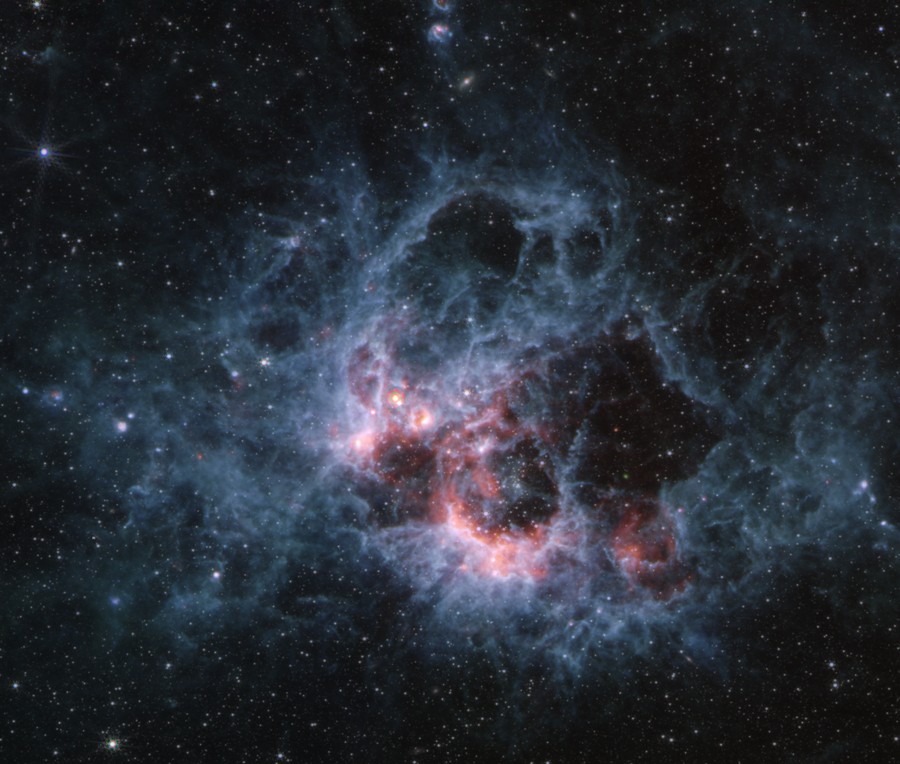
NGC 604 extends roughly 1,300 light-years across and is estimated to be only a few million years old. Its young age and concentration of massive stars make it useful for investigating how feedback reshapes a cloud early in its evolution. [2]
Connect the nursery to the spiral
Hubble supplies the broader stellar distribution in Triangulum, while Webb investigates the material around one prominent group of young stars. Combining the scales links an apparent patch of star formation to winds, radiation and cloud structure. [1] [2]
The observations establish active star formation; they do not yet supply one complete explanation for every difference between Triangulum and neighbouring spirals. Gas supply and past interactions must also be considered. The useful result is a connected picture of where young stars occur and how those stars begin changing the material around them. [1] [2]
Sources & image credits
Related reading and objects
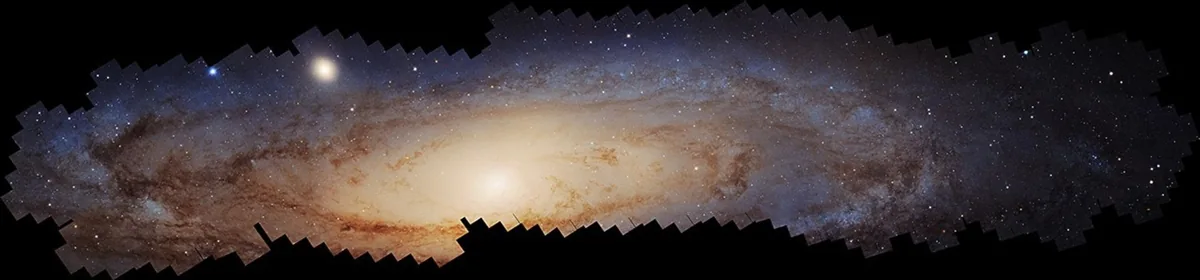
What do Andromeda’s stars reveal about its history?
A Hubble panorama released in January 2025 resolves roughly 200 million stars across Andromeda. By comparing their colours, brightnesses and locations, astronomers can investigate how our nearest large galactic neighbour assembled its disk.
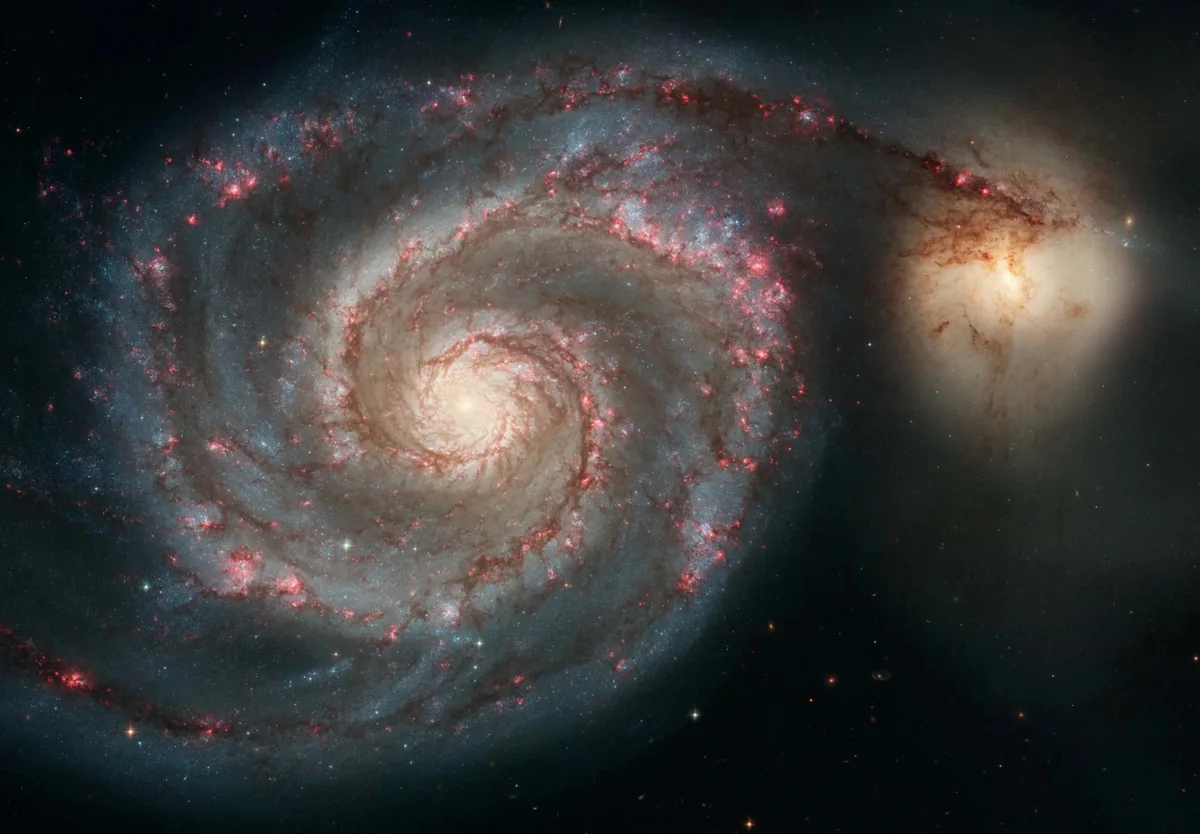
What makes the Whirlpool Galaxy’s spiral arms?
Hubble’s view of the Whirlpool Galaxy shows blue star clusters and pink star-forming regions along two prominent arms. The nearby companion NGC 5195 adds a gravitational disturbance. The arms are a changing pattern in a rotating galaxy, not rigid strips of material.