

How do we map the Milky Way from inside it?
ESA’s Gaia mission repeatedly measured stars across the sky from 2014 to 2025. Those observations address a problem no external photograph can solve for us: the Solar System sits inside the Milky Way’s dusty disk, so its structure must be reconstructed from within.
The bright band is a view through the disk
On a dark night, the Milky Way appears as a broad, uneven band. Looking along the galaxy’s disk places many stars in the same line of sight; looking away from that plane generally looks through less of the disk. The band is a perspective effect within a much larger structure. [1] [2]
A photograph records directions and brightnesses, not the distance to every star. A faint nearby star can overlap a luminous distant one, while dust can dim or hide both. Turning the sky into a three-dimensional map requires additional measurements. [1] [2]
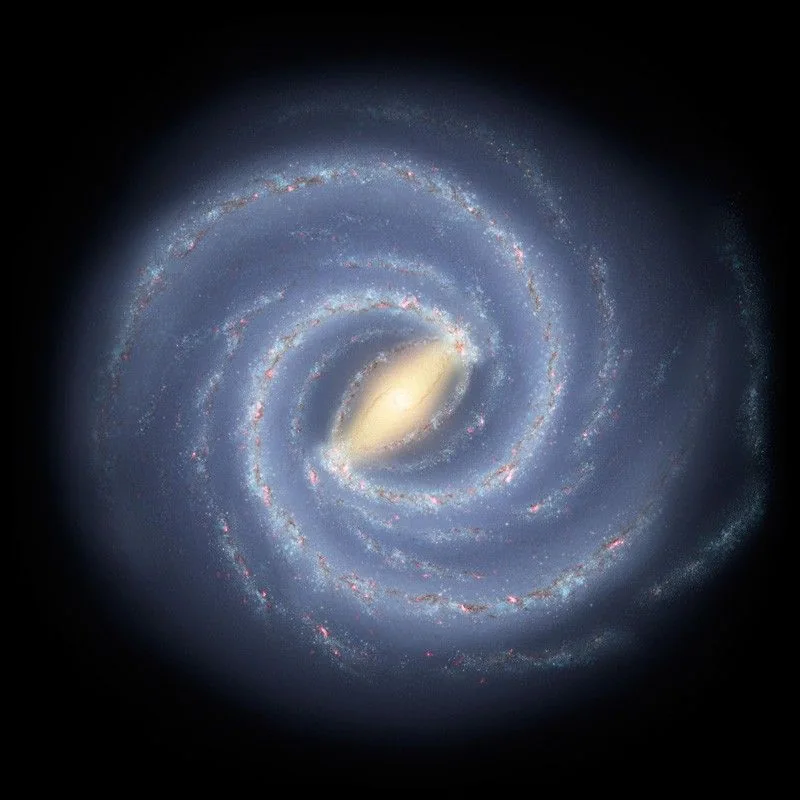
The familiar top-down illustrations of the Milky Way combine those measurements with models. They are reconstructions, not photographs taken by a spacecraft above the whole galaxy. [1] [2]
Let Earth’s changing viewpoint supply a baseline
As an observatory moves around the Sun, a nearby star appears to shift slightly against more distant sources. That annual parallax is a geometric distance indicator: a smaller shift generally corresponds to a more distant star. [3] [2]
Repeated observations are essential because stars also move through space. The analysis separates the annual pattern from the star’s own apparent motion, along with instrumental effects. A single pair of positions cannot reliably solve every component. [3] [2]
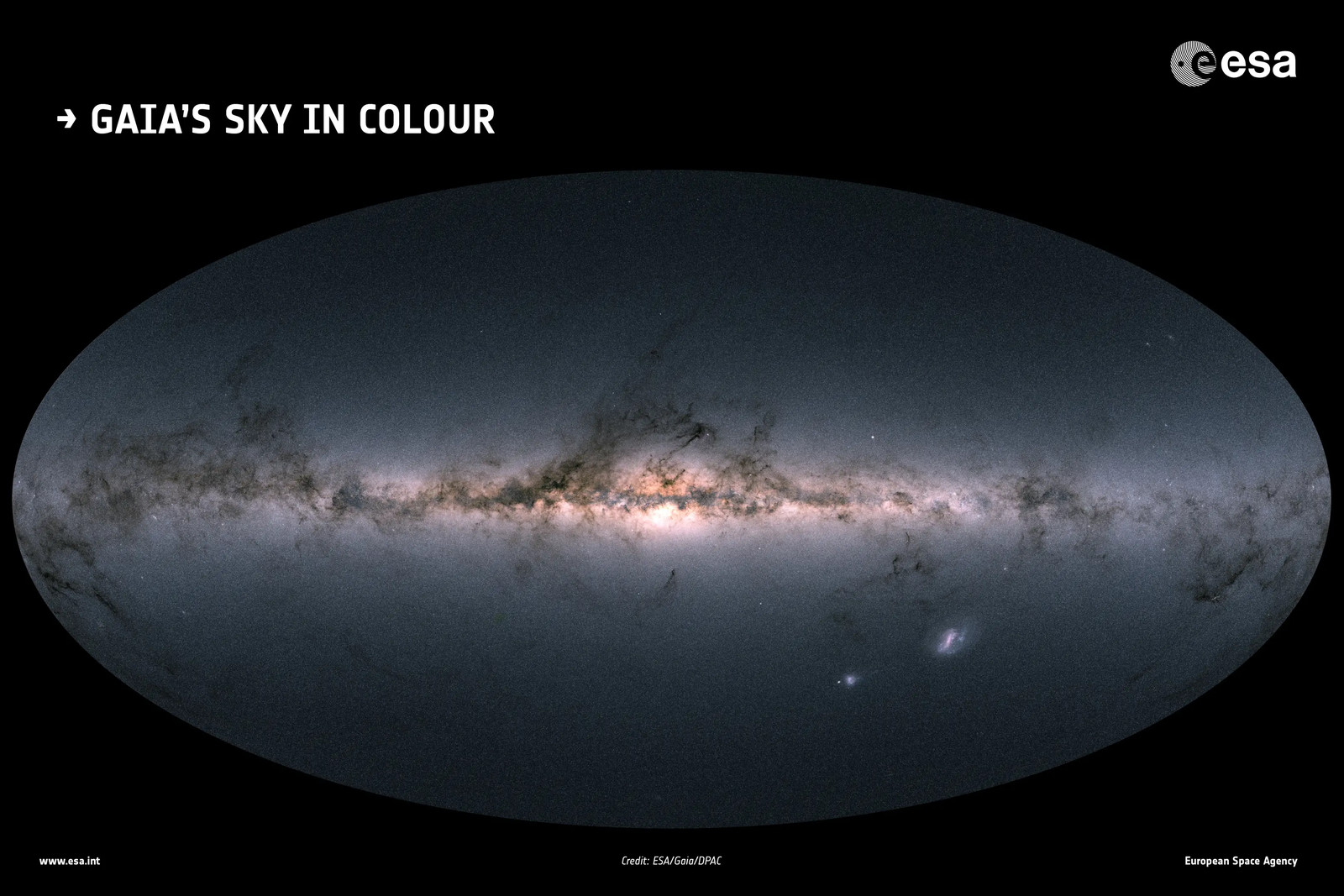
Gaia’s survey brought this method to an enormous stellar population. The resulting catalogue contains uncertainties and varying precision; a measured parallax is not equally informative for every star. Those limits must remain part of any map assembled from it. [3] [2]
Different wavelengths recover different pieces
Interstellar dust blocks and reddens visible starlight, especially along crowded paths through the disk. A dark patch on the sky can therefore mean obscuration rather than an empty region without stars. [1] [2]
Infrared observations penetrate some dusty regions more effectively, while radio observations trace gas that may be difficult to investigate through visible light. Combining wavelengths helps separate the distribution of stars from the material between them. [1] [2]
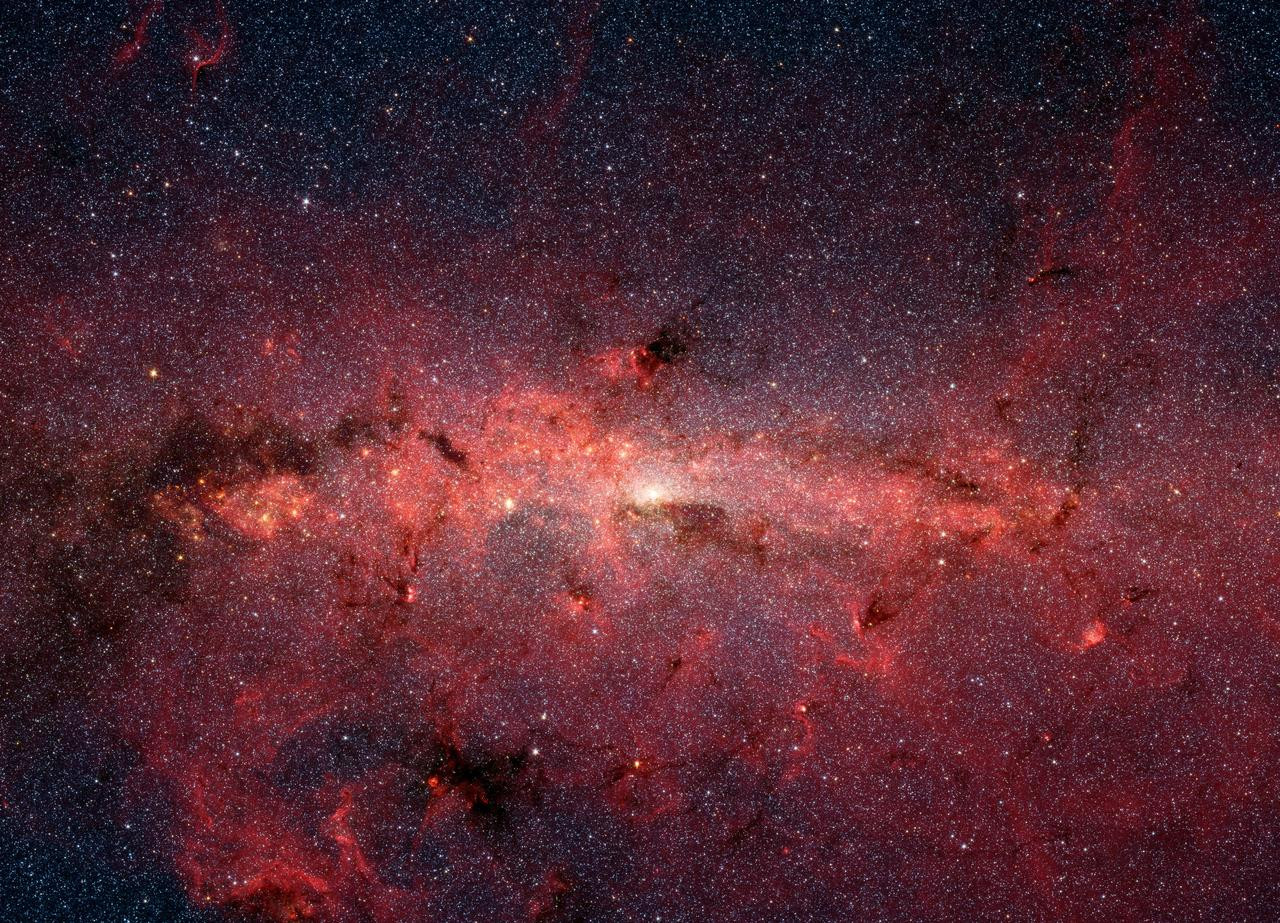
No wavelength produces an unobstructed, complete census of every component. Different surveys have different sensitivity, resolution and selection effects. Their value comes from overlapping constraints rather than assuming one colourful all-sky image contains the entire galaxy. [1] [2]
Stars trace the gravitational structure
Position changes across the sky provide proper motions. Spectra can add motion towards or away from us through Doppler shifts. Combined with distance, these measurements describe how stars move through the galaxy in three dimensions. [2] [3]
Groups of stars sharing motions and chemical properties can preserve evidence of a common origin or an earlier encounter. A galaxy that looks like one continuous band can contain populations assembled through different histories. [2] [3]
Stellar motions also constrain gravity. Models of the disk, central regions and surrounding halo must reproduce the observed movement, so the map is a dynamical reconstruction as well as a set of locations. [2] [3]
What an external view can and cannot show
Astronomers combine distances, stellar populations, gas distributions and motion to infer the Milky Way’s overall structure. External spiral galaxies provide comparisons, but they cannot uniquely determine the arrangement of our own arms or every region hidden behind dust. [1] [2]
The Solar System is one location within that structure, rather than the centre from which everything expands. Its sky view is valuable precisely because nearby stars can be measured in detail, even while the full galaxy cannot be photographed from outside. [1] [2]
A useful Milky Way map therefore carries two things together: the measured evidence and the reconstruction built from it. Parallax supplies depth, different wavelengths recover obscured material, and motion tests whether the proposed arrangement makes physical sense. [1] [2]
Sources & image credits
Related reading and objects
What do Andromeda’s stars reveal about its history?
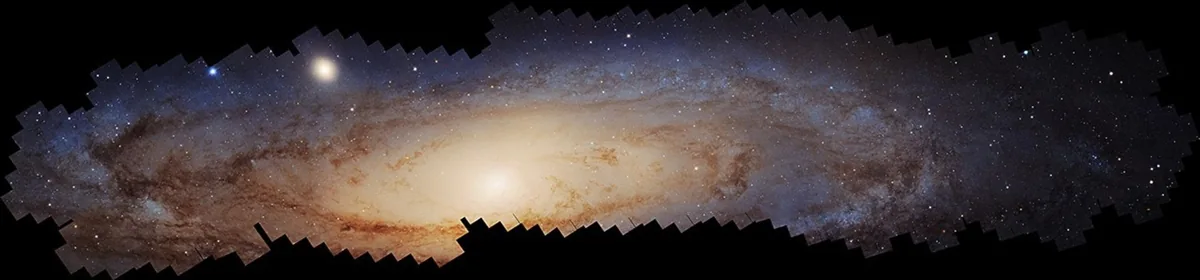
A Hubble panorama released in January 2025 resolves roughly 200 million stars across Andromeda. By comparing their colours, brightnesses and locations, astronomers can investigate how our nearest large galactic neighbour assembled its disk.
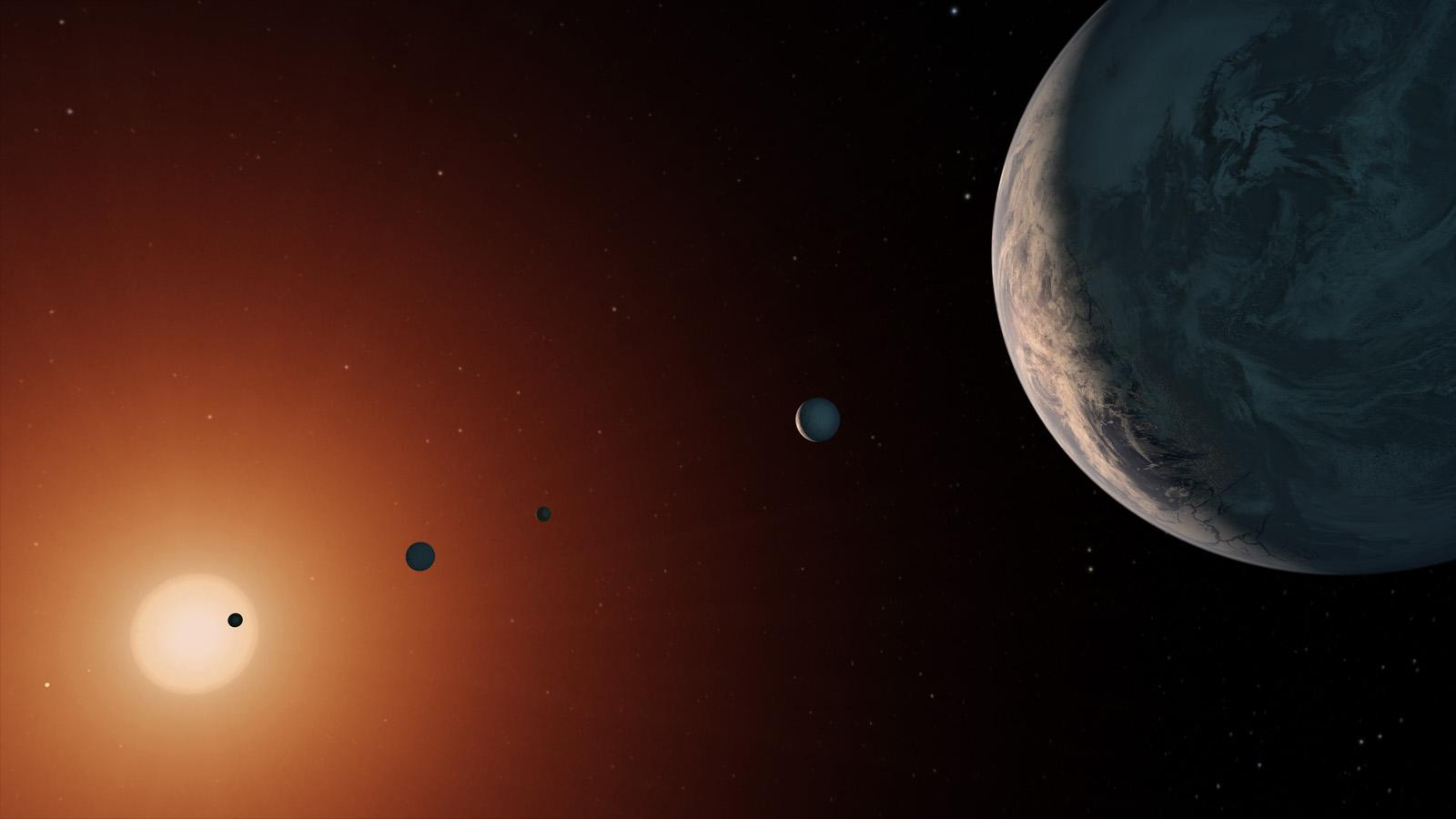
Can the TRAPPIST-1 planets keep atmospheres?
Webb’s observations of TRAPPIST-1 test a question that planet size alone cannot answer: which of its seven rocky worlds, if any, retain substantial atmospheres? The tightly packed system makes repeated measurements possible, but the small active star also contaminates the signals astronomers need.