

Why is the Sun’s corona hotter than its surface?
Move outward from the Sun’s visible surface and the temperature first falls, then climbs to more than a million degrees. Parker Solar Probe flies through this thin, hot atmosphere to find where its energy comes from.
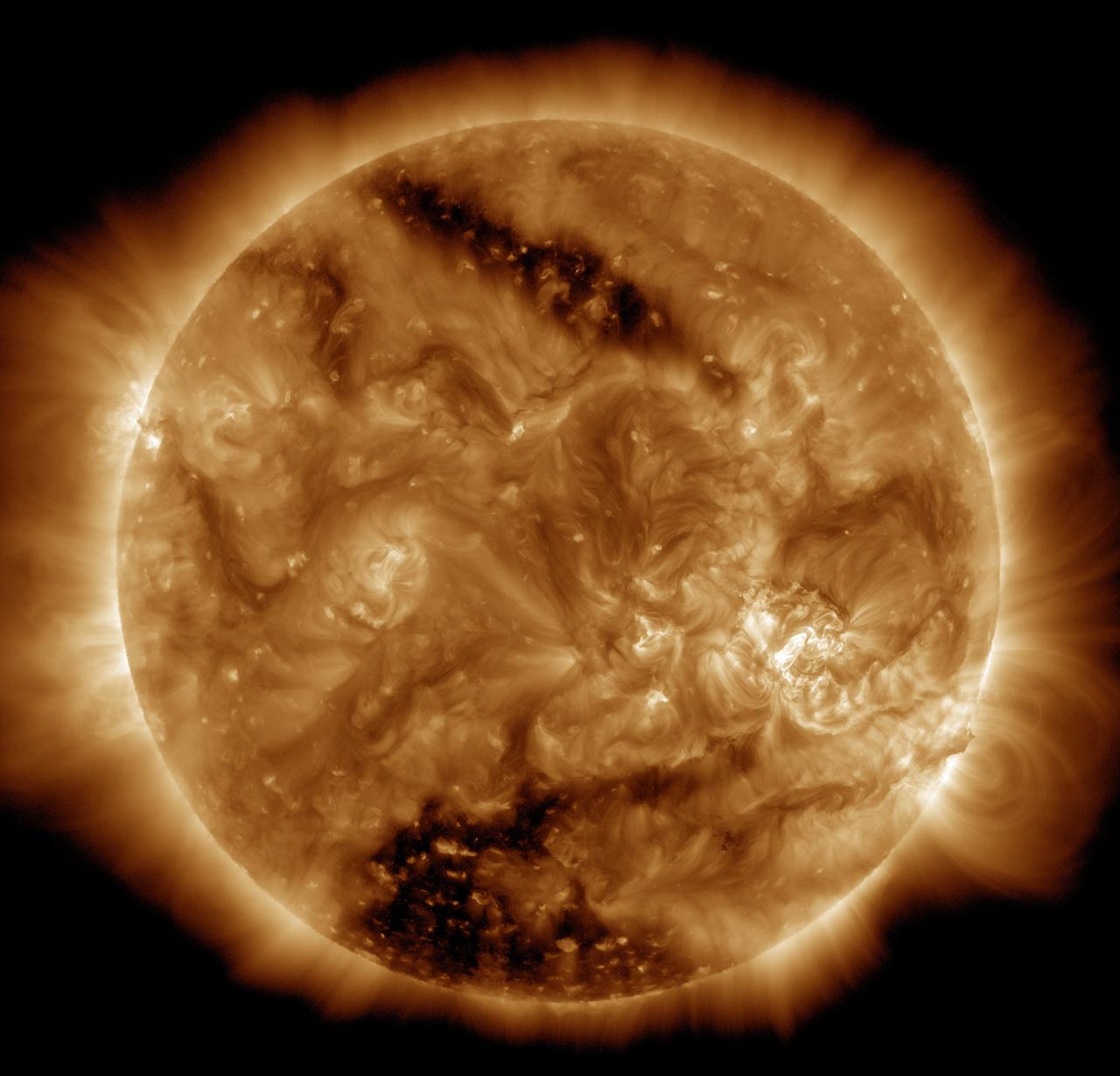
Two temperatures, two different layers
The bright disk in an ordinary image of the Sun is the photosphere, a layer at roughly 5,500°C. Above it lie the chromosphere and the much more rarefied corona. During a total solar eclipse, the Moon hides the bright photosphere and the corona becomes visible as a pale extended crown. Instruments can also isolate this region by observing ultraviolet and X-ray emission. [1] [2]
The corona’s temperature exceeds a million degrees. This cannot be explained simply by placing gas farther from the hot core: outward through the visible layers, the temperature had been falling. Something carries energy across the cooler layers and deposits it higher up. Identifying that transfer is the coronal heating problem. [1] [2]

Temperature also needs to be separated from density. The corona’s particles have high energies, but there are far fewer of them than in the lower atmosphere. A million-degree corona is not a dense furnace surrounding a cooler solid ball. The Sun has no solid surface, and its different layers exchange energy in different ways. [1] [2]
The moving surface stresses a magnetic field
Below the photosphere, rising and sinking plasma transports energy by convection. This electrically conducting material is threaded by magnetic fields. Its motion continually moves the places where magnetic structures meet the surface, stressing and rearranging fields that extend upward. [3] [2]
A magnetic field stores energy. When its configuration changes through magnetic reconnection, some of that energy can accelerate particles and heat plasma. Large eruptions make the process conspicuous, but maintaining the corona requires a continuing energy supply. Many small releases, often discussed as nanoflares, could contribute without producing a spectacular flare each time. [3] [2]
Motion can also launch waves along the magnetic field. Alfvén waves involve linked disturbances of the field and plasma. They offer a way to carry energy upward without transporting a parcel of million-degree material straight through every intervening layer. To heat the corona, the waves must eventually transfer some of their organised energy into particle motion. [3] [2]
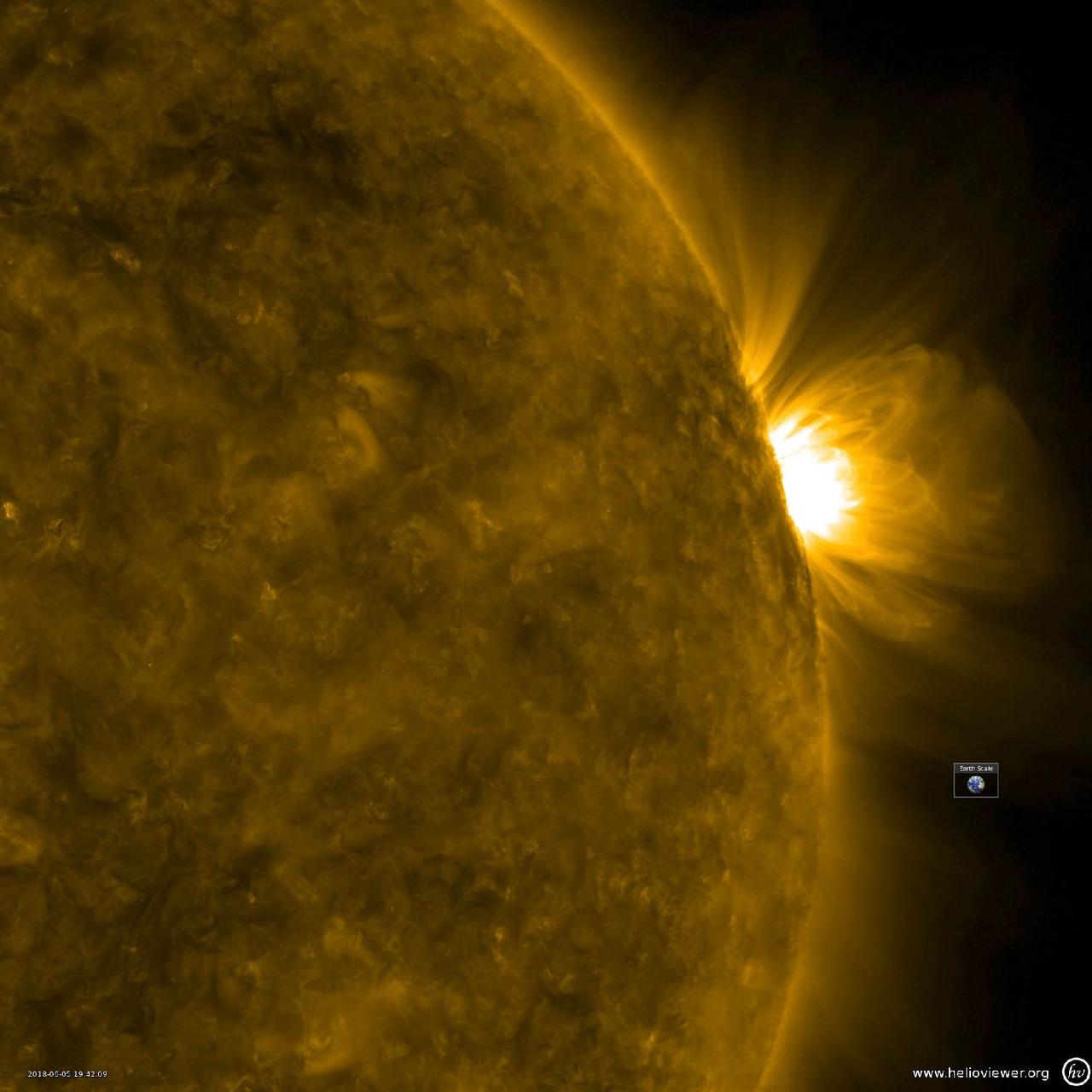
Follow the same wind at two distances
The question is not settled by seeing a loop or detecting a wave. Scientists need an energy budget: how much energy travels outward, how much disappears from the disturbance, and whether the particles gain the corresponding energy. Different structures and solar-wind streams may favour different processes. [4] [5]
A 2024 study combined Parker Solar Probe and Solar Orbiter observations of a fast solar-wind stream. Parker sampled it nearer the Sun; Solar Orbiter measured it farther out. Large magnetic deflections carried less energy at the second location, while the wind had accelerated and cooled less than a freely expanding stream would. The comparison linked lost wave energy with acceleration and heating in that stream. [4] [5]
That is a measured contribution to a specific flow, rather than a universal solution for every part of the corona. Closed magnetic loops, open fields above coronal holes and erupting regions have different geometries. Explaining the whole atmosphere requires understanding how the available mechanisms work in each setting. [4] [5]
Why fly into it?
A telescope records light integrated along its line of sight. Parker can instead sample local particles and electric and magnetic fields together. In April 2021 it crossed into a region where magnetic disturbances could still travel back toward the Sun, inside the Alfvén critical surface. The crossing established that the spacecraft had entered the magnetically connected corona. [5] [2]
This boundary is uneven and changes with conditions. Crossing it is not like touching a solid surface. Repeated passages let researchers compare the wind before and after it becomes detached from two-way communication with the Sun, while remote images show the larger structures around the spacecraft. [5] [2]
The hot corona therefore points to a more precise question than “why does heat rise?” Energy generated inside the Sun can leave the lower atmosphere in magnetic form, then become heat and motion above it. Parker and the other observatories test the steps of that conversion, connecting a pale eclipse crown with the solar wind that eventually reaches Earth. [5] [2]
Sources & image credits
Related reading and objects

Reading Earth’s magnetic field from orbit
ESA launched three Swarm satellites to measure a field made mostly thousands of kilometres beneath our feet. Their instruments also detect magnetised rocks, currents in space and even moving seawater. To understand Earth’s magnetic field, they must separate those signals.
How do we find planets we cannot see?
ESA’s PLATO mission will look for planets by measuring changes in the light of their stars. Follow one possible signal from a dark silhouette to a repeatable orbit—and see which questions the dip cannot answer.