
Launch success
Update ↗
Rocket LabLaunch Successful
The Owl’s Night Continues (StriX-β)
Electron
Historical mission record
This page records Electron | The Owl’s Night Continues (StriX-β) and its reported outcome: Launch Successful. The date above is a historical record.
Source record updated . This is a source update, not a confirmed launch time.
Check the source: The Owl's Night Continues ↗ · Launch Library ↗ · Flight Club ↗
The latest on this mission
What changed?
Mission status
Launch Successful
Status reported by the mission data provider.
LAUNCH SITERocket Lab Launch Complex 1, Mahia Peninsula, New Zealand
Mission
StriX β is a Japanese synthetic aperture radar satellite built by Synspective as a demonstrator for their planned 25 satellite constellation. It will feature an X-band synthetic aperture radar. StriX β is an upgraded version of the StriX α prototype. The satellite features two deployable panes, one side carrying solar cells, the other carrying the X-band radar antenna. The StriX satellite constellation can target data with a ground resolution of 1-3 m, single polarized (VV), and a swath width of more than 10-30 km. The StriX observation modes are Stripmap and Sliding Spotlight mode and each satellite has an SAR antenna that is 5 meters in length and stowed during launch. The simple design of the satellites allows for affordable development of the constellation. StriX β was planned to be launched in 2021 on a Soyuz-2-1a Fregat or Soyuz-2-1b Fregat rideshare mission, but as this mission was delayed, it was re-booked on a dedicated Electron KS launch. Synspective is planning a constellation of 25 satellites called StriX, comprised of 100-kilogram satellites capable of imaging at a resolution of one to three meters. By 2022 the company plans to have six satellites in orbit. The company has not set a date by which it hopes to achieve 25 satellites.
- Launch vehicle
- Electron
- Mission type
- Earth Science
- Destination orbit
- Sun-Synchronous Orbit
- Launch pad
- Rocket Lab Launch Complex 1B
- Provider
- Rocket Lab
- Recovery
- Expended, Expended during its first flight, despite featuring a red interstage.
The vehicle
Published configuration and flight history.

Launch vehicle
Electron
Electron is a two-stage orbital expendable launch vehicle (with an optional third stage) developed by the American aerospace company Rocket Lab. Electron is a small-lift launch vehicle designed to launch small satellites and cubesats to sun-synchronous orbit and low earth orbit. The Electron is the first orbital class rocket to use electric-pump-fed engines, powered by the 9 Rutherford engines on the first stage. It is also used as a suborbital testbed (called HASTE) for hypersonics research.
- Height
- 18 m
- Diameter
- 1.2 m
- Stages
- 3
- Recorded launches
- 80
- First flight
- 2017-05-25
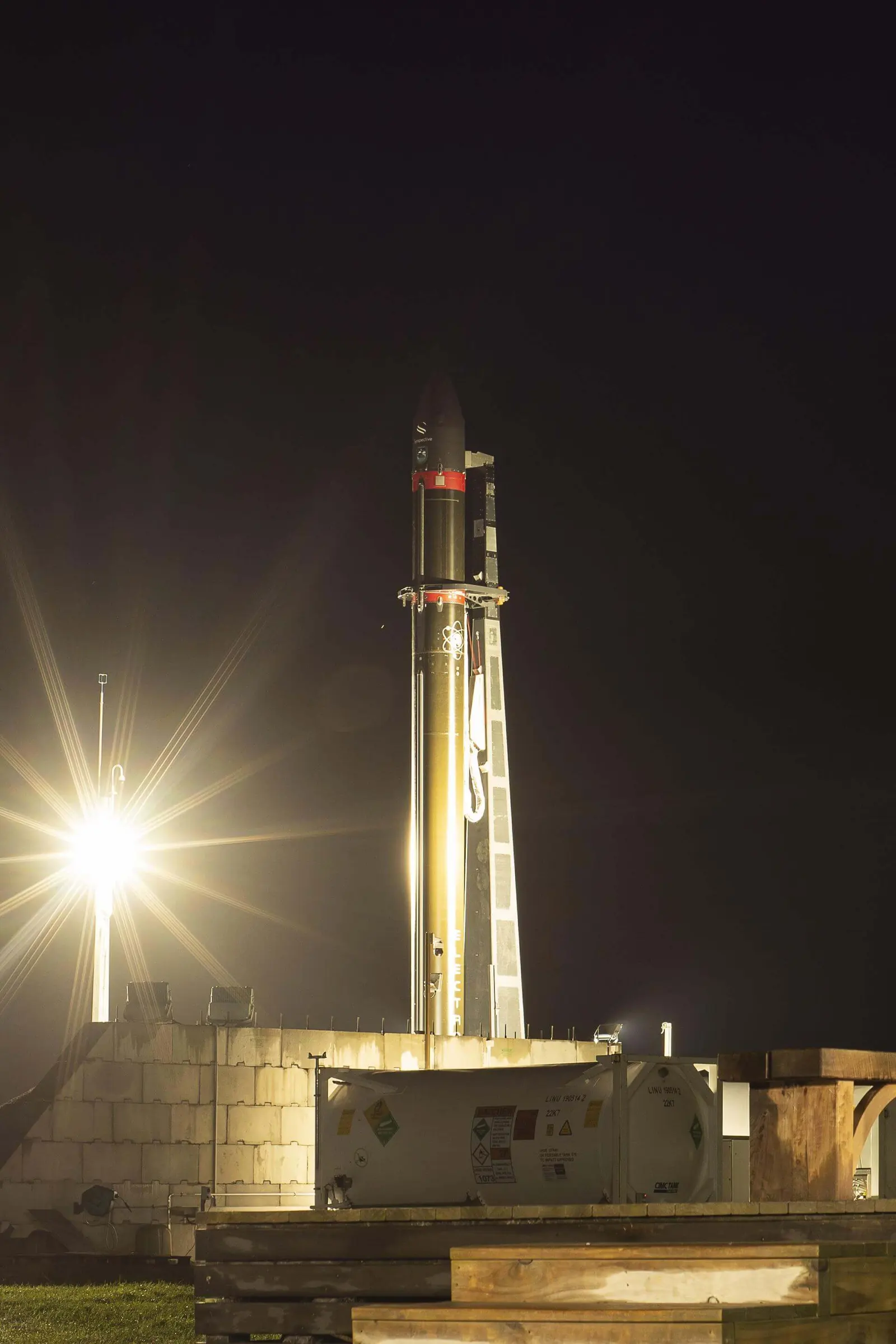
Core
24
Flight 1New
- Recovery
- South Pacific
- Landing method
- Expended
Recorded timing
This is a mission record, not an upcoming calendar appointment.
5 minute windowPublished target
WINDOW OPENS
WINDOW CLOSES
Target ·
The target marker shows its position within the published window. The schedule may change before launch.
Launch site & orbit
Rocket Lab Launch Complex 1, Mahia Peninsula, New Zealand
The mission in perspective
Launch site & orbit
Explore the launch pad, then pull back to see the shape of the destination orbit.
Understand this orbit
Coverage & sources
Links supplied by the mission data provider.
Coverage and times may change.
Explore on iPhone
Browse mission details and discover upcoming launches in Spacian.
Open mission in Spacian ↗