

Comet · 67P
67P/Churyumov-Gerasimenko
A comet followed through its active season
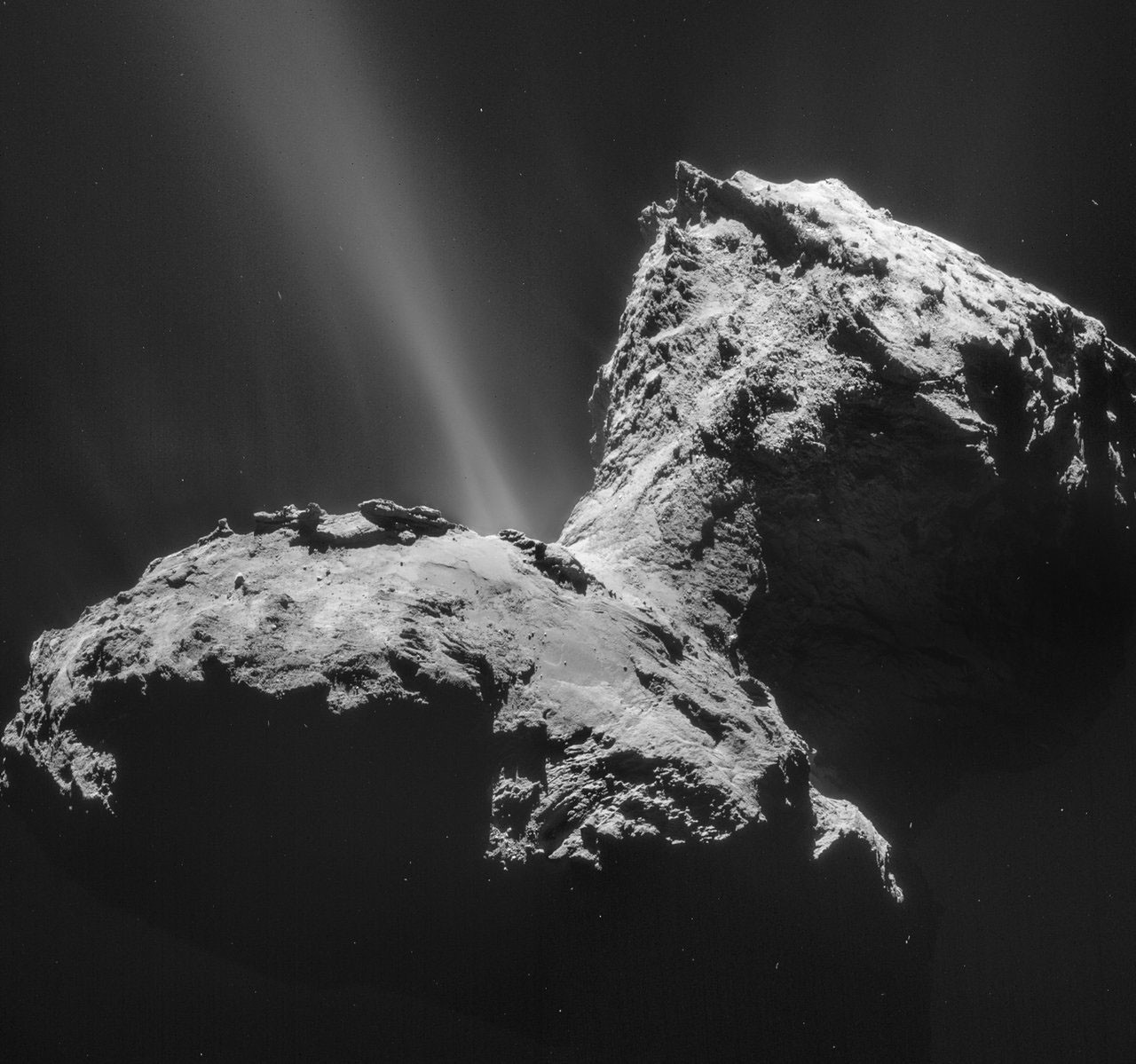
Rosetta orbited comet 67P and released the Philae lander. The mission watched the nucleus change as it approached and receded from the Sun.
Understand this world
From a nucleus to a coma and tailsFollow energy and material from an irregular comet nucleus into its surrounding gas and dust, using Rosetta’s observations of 67P. · 3 minMeasurements
- Effective diameter
- 3.4 km
- Semimajor axis
- 3.462 AU
- Orbital period
- 2,353.076 Earth days
Orbit, physical values and uncertainties
- eccentricity
- .6409081308996354 ± 2.7482E-8
- semi-major axis
- 3.462249490129549 au ± 1.5491E-7
- perihelion distance
- 1.243265640702404 au ± 9.8887E-8
- inclination; angle with respect to x-y ecliptic plane
- 7.040294937543767 deg ± 2.7139E-6
- longitude of the ascending node
- 50.13557377155012 deg ± 2.2797E-5
- argument of perihelion
- 12.79824970228189 deg ± 2.3022E-5
- mean anomaly
- 8.859927425218402 deg ± 2.7815E-6
- time of perihelion passage
- 2457247.588657812098 TDB ± 1.7765E-5
- sidereal orbital period
- 2353.076067903661 d ± .00015793
- mean motion
- .1529912291873851 deg/d ± 1.0268E-8
- aphelion distance
- 5.681233339556694 au ± 2.542E-7
- comet total magnitude
- 12.9 ± 0.8
- comet total magnitude slope
- 7.5
- diameter
- 3.4 km ± 0.1
- GM
- 662.2e-9 km^3/s^2 ± 0.2e-9
- bulk density
- 0.533 g/cm^3 ± 0.006
- rotation period
- 12.76129 h ± 0.00005
- pole direction
- 69.3/64.1 ± 0.1
Published JPL orbital elements describe their stated epoch; they are not current positions. Small-body diameters can be effective/model-dependent sizes, not spherical shapes. Missing measurements remain unavailable. Pluto’s diameter uses the New Horizons reference rather than an empty SBDB field. Orbital epoch: JD 2457305.5 TDB.
Object reference ↗Missions & milestones
1 launches · 0 connected events
These are target-related flights and every connected programme record in the production catalogue. A connected event may concern another stage or target of the same journey. Launch outcome does not establish arrival or current operation.
Rosetta
March 2, 2004 · UTC
Complete source cohort: 9,386 records.