

What makes the bright spots on Ceres?
As Dawn approached Ceres in 2015, bright spots stood out inside Occator crater. Close observations transformed them from an optical puzzle into evidence for salty liquid moving through the dwarf planet’s crust.
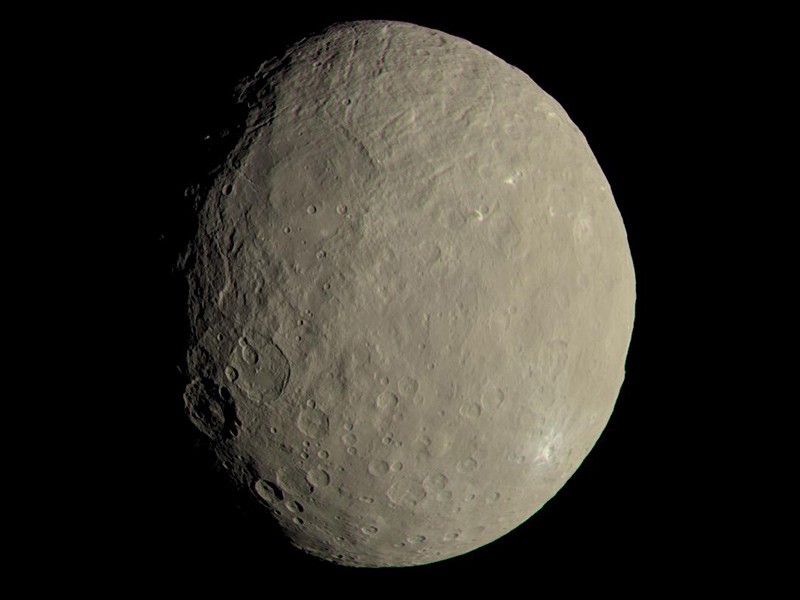
Bright does not mean self-luminous
Occator’s deposits reflect much more sunlight than the surrounding dark terrain. They do not need to generate their own visible light. Exposure and colour processing can make the contrast especially dramatic in photographs, so the physical question is which materials are unusually reflective. [1] [2]
Dawn’s spectrometer measured how the surface reflected different wavelengths. Those spectral signatures identified salts, especially sodium carbonate, in the bright areas. The main concentrations became known as Cerealia Facula and Vinalia Faculae. [1] [2]
A spectral identification does more than assign a colour. It constrains the chemistry of the material and the processes capable of delivering it to the surface. The salts pointed towards water carrying dissolved substances and leaving a reflective residue behind. [1] [2]
Follow the liquid before it disappeared
A brine is water containing dissolved salts. Its freezing behaviour differs from pure water, helping liquid persist under conditions where an unsalted reservoir would be less stable. If that liquid reaches Ceres’s low-pressure surface, water can escape while less volatile salts remain. [2]
The bright crust is therefore a record of transported material. It does not require an exposed lake to survive in the photograph. The liquid can disappear while its dissolved cargo preserves evidence of the route it took. [2]
To explain the deposits, researchers needed both a source of brine and pathways through the crust. Occator’s large impact supplied a possible local source of melting and an extensive system of fractures. [2]
One crater connects two reservoirs
Analysis reported in 2020 combined Dawn’s close images, composition measurements and gravity data. The researchers inferred a deep brine reservoir about 40 kilometres below Occator, extending across a broad region. [2]
The impact that made the roughly 92-kilometre-wide crater also heated shallow ice-rich material. As that local melt cooled, fractures created by the impact could still connect the surface with deeper, longer-lived liquid. The resulting picture included more than a short-lived puddle produced by one collision. [2]
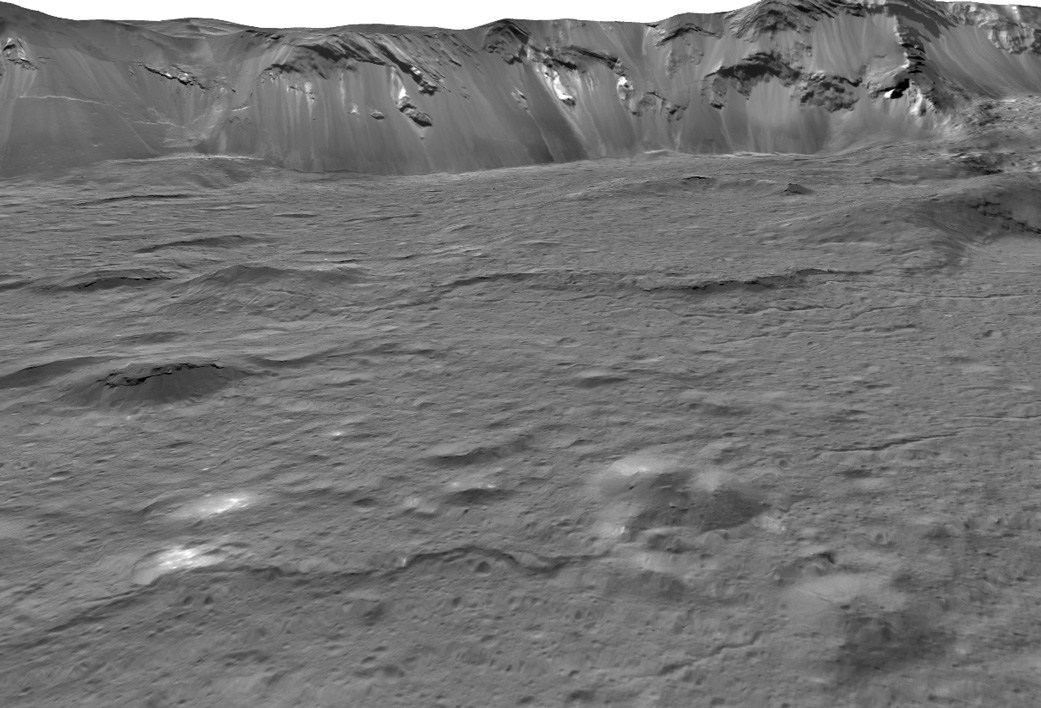
The depth is an inference from the combined geological and geophysical model. Gravity constrains the distribution and properties of material below the spacecraft; it is not a photograph of an underground chamber. The interpretation is strongest when it also accounts for the observed salts and landforms. [2]
A mineral can preserve evidence of timing
Dawn detected hydrated salt compounds in the central bright deposit, including sodium chloride associated with water. Such material is not expected to retain its water indefinitely under surface conditions on Ceres. [2] [3]
Its survival therefore provided evidence for geologically recent emplacement. The 2020 studies concluded that some bright deposits were less than about two million years old and that transfer of brine towards the surface could have continued much more recently. [2] [3]
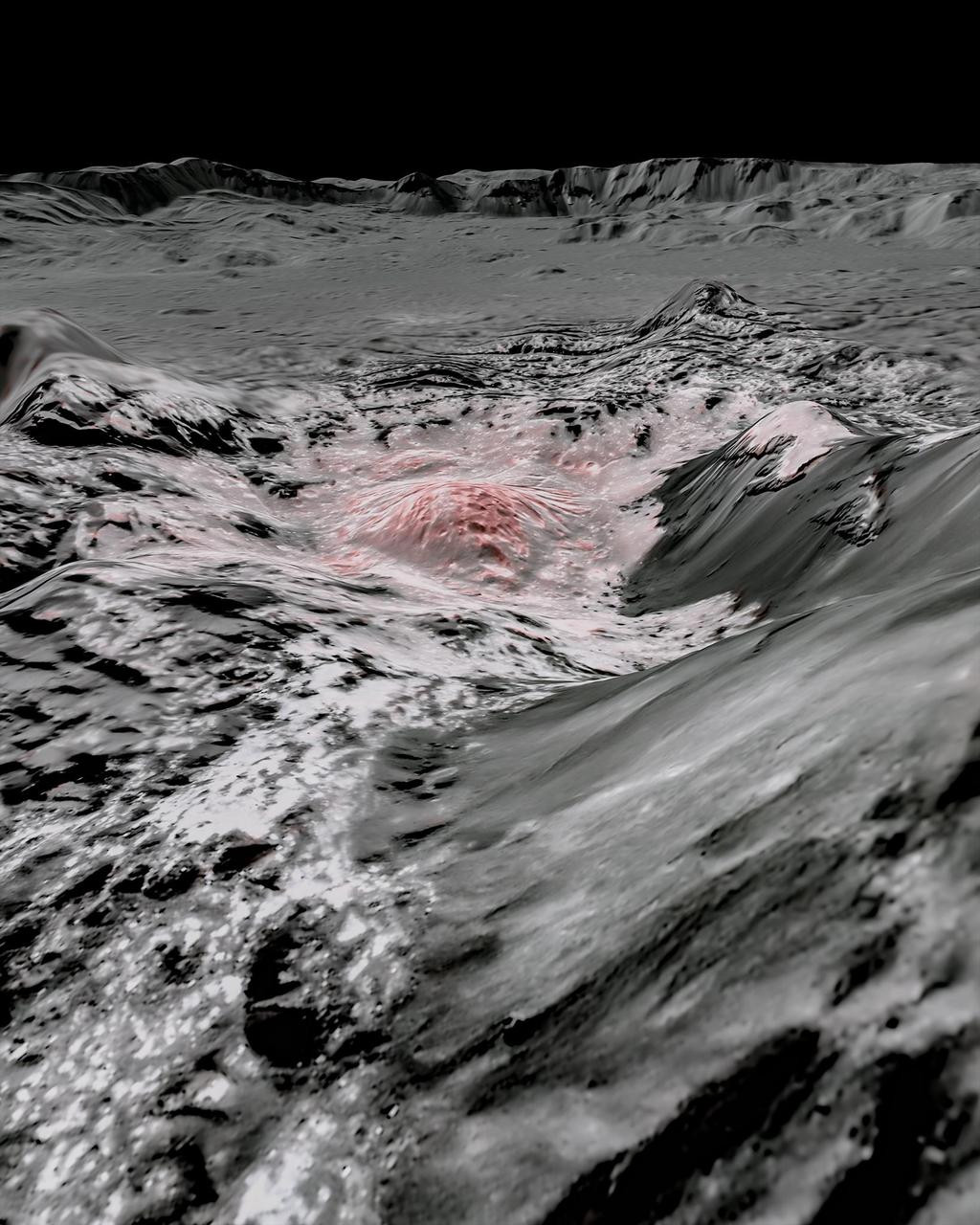
That argument uses a material’s expected lifetime as a clock. It does not mean Dawn filmed a fountain erupting in Occator. The evidence is the combination of fresh-looking deposits and compounds that should change after prolonged exposure. [2] [3]
Why Ceres differs from an icy moon
Ceres orbits the Sun in the main asteroid belt, between Mars and Jupiter. It does not receive the same strong planet-driven tidal heating that helps sustain activity on moons such as Enceladus. Its thermal history must instead account for stored heat, radioactive heating, salts and the insulating or mechanical properties of its crust. [1] [2]
That makes the bright spots particularly useful. A small world can preserve water-rich interior processes even without a giant planet repeatedly squeezing it. Occator’s white patches are the visible residue of that hidden history: dissolved material brought upwards, followed by water loss that left the salts behind. [1] [2]
Sources & image credits
Related reading and objects
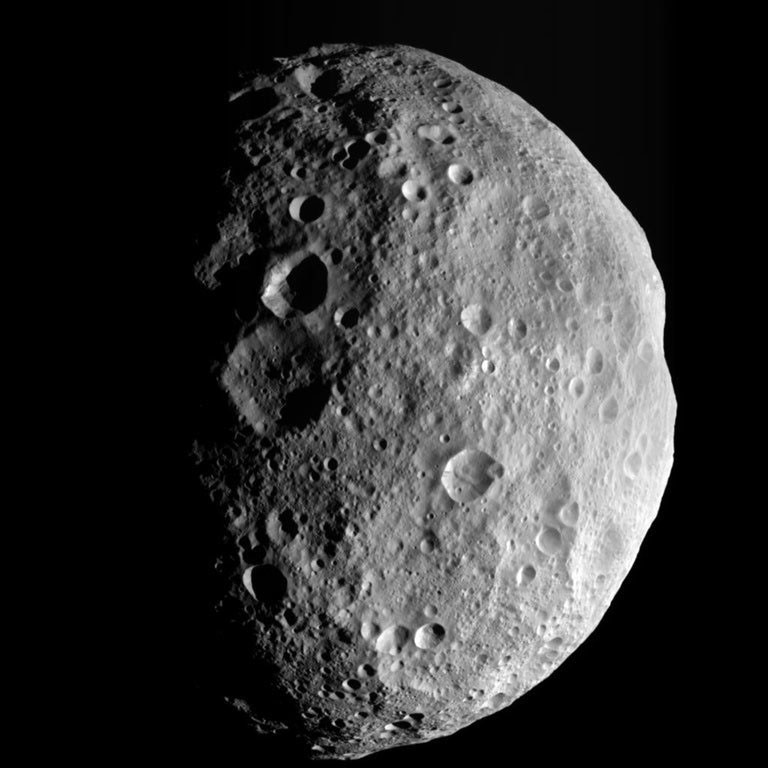
How can a meteorite be traced back to Vesta?
Long before Dawn orbited Vesta in 2011, laboratories held meteorites suspected to come from it. The spacecraft could test that connection by measuring the asteroid’s minerals, chemical composition and the impact scars capable of launching fragments into space.
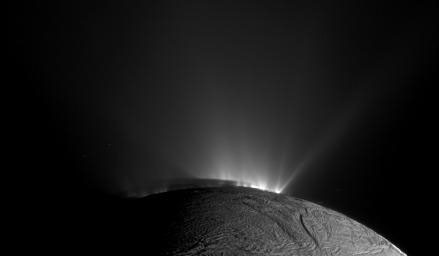
What Enceladus’s plumes reveal about its ocean
Cassini discovered that Enceladus sends water vapour and icy grains into space. Flying through that material gave scientists access to a buried ocean without landing on the moon or drilling through its frozen shell.