

How can a meteorite be traced back to Vesta?
Long before Dawn orbited Vesta in 2011, laboratories held meteorites suspected to come from it. The spacecraft could test that connection by measuring the asteroid’s minerals, chemical composition and the impact scars capable of launching fragments into space.
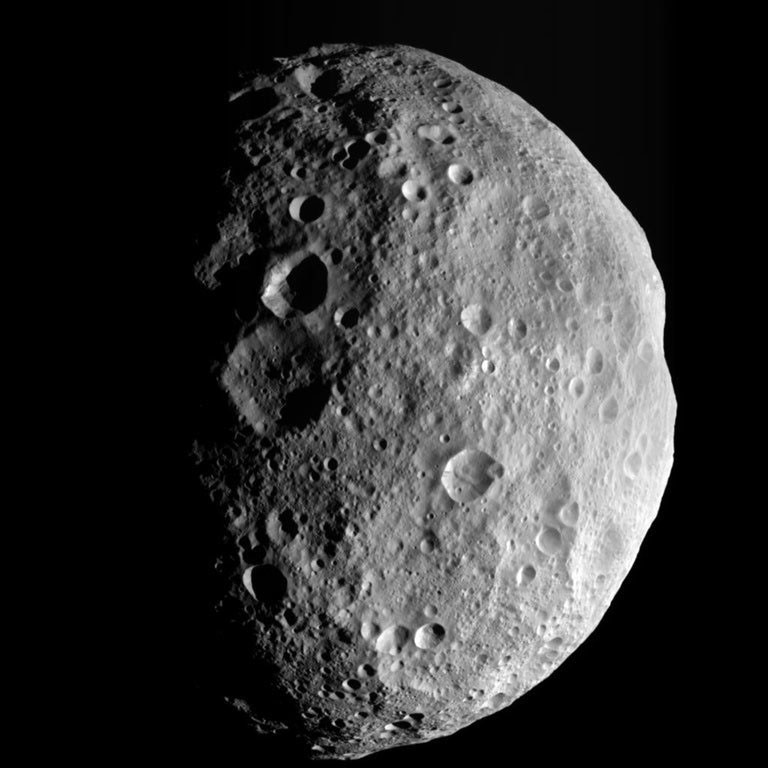
Begin with three related kinds of rock
Howardites, eucrites and diogenites form the HED meteorite group. Eucrites and diogenites record different products of igneous processes, while howardites contain mixtures of material broken and recombined by impacts. Their mineralogy points to a parent body that melted and separated into layers. [1] [2]
That history distinguishes them from primitive rocks that largely preserve an unmelted mixture of early ingredients. A differentiated parent can form a crust, deeper rocky layers and a metal-rich core. The meteorites therefore predicted a kind of world before a spacecraft supplied its close geological map. [1] [2]
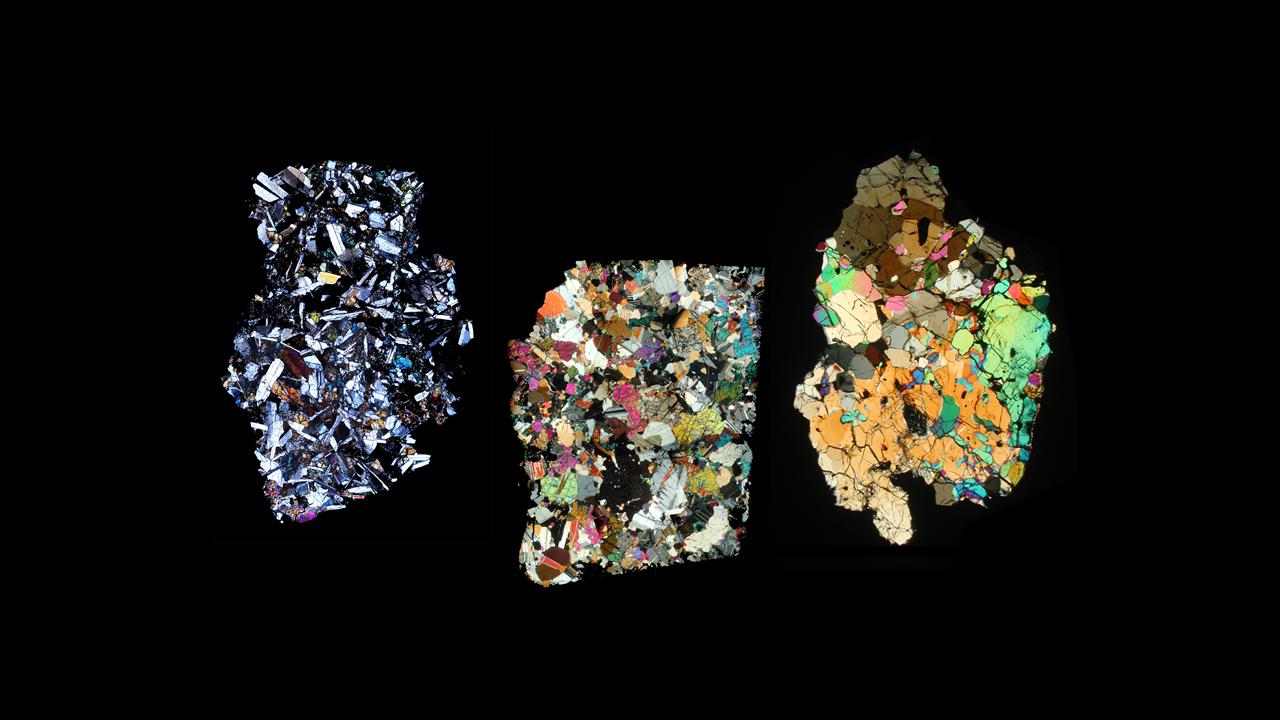
To connect them with Vesta, researchers needed evidence that was more specific than “both are rocky.” A match had to account for the measured minerals and elemental abundances as well as a plausible route from the asteroid to Earth. [1] [2]
Compare the same material in two settings
Minerals absorb and reflect light in characteristic ways. Laboratory measurements of meteorites can be compared with telescopic spectra and with a spacecraft’s observations of an asteroid’s surface. [1] [2]
Dawn’s mineral and elemental measurements confirmed the strong connection between Vesta and the HED group. Agreement across different measurements made the case more persuasive than matching one broad colour. The spacecraft could also place compositional variations within their actual geological setting. [1] [2]
The comparison links a remote surface to pieces that can be cut, dated and examined with laboratory instruments. Each side supplies information the other cannot: the meteorite offers microscopic detail, while the spacecraft shows where related material occurs across a world. [1] [2]
The southern basins provide an escape route
Dawn mapped two enormous impact basins near Vesta’s south pole. The younger Rheasilvia structure is about 500 kilometres wide, comparable to the asteroid’s mean diameter. The older Veneneia basin records a previous major collision. [1]
Such impacts can eject fragments above the asteroid’s escape speed. Some debris becomes smaller asteroids associated with Vesta; other fragments can eventually enter orbits that reach Earth after further dynamical evolution. [1]
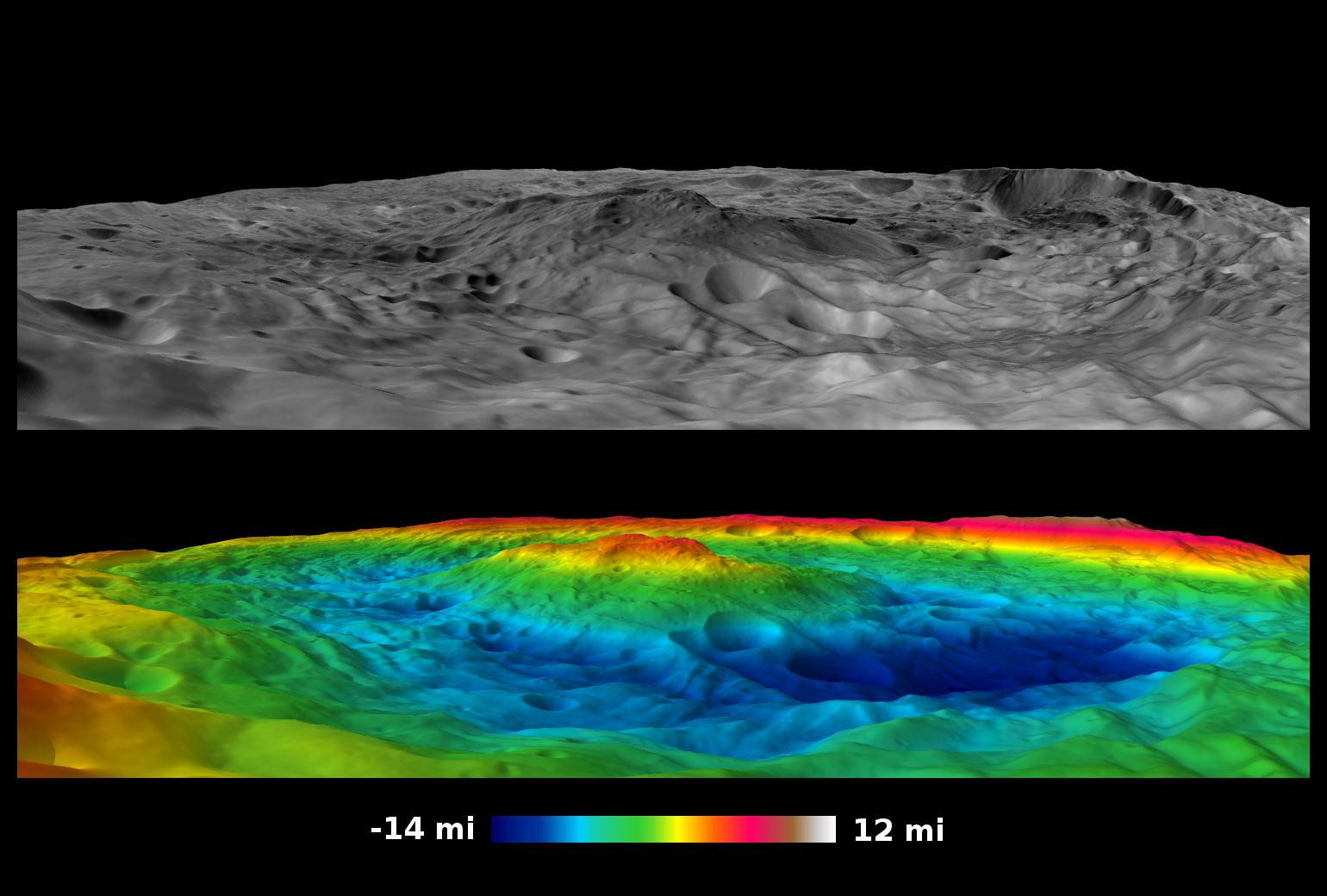
That does not mean every meteorite followed one known trajectory from one identified crater. It establishes a physically plausible supply of material from a parent whose composition matches the recovered rocks. The giant basins explain how deep geological material can leave a small world rather than remaining buried there. [1]
Gravity checks the layered-world prediction
Dawn also measured Vesta’s gravity field through the spacecraft’s motion. The inferred mass distribution was consistent with a dense central core, supporting the differentiation history indicated by the HED meteorites. [1]
Gravity and mineralogy are independent kinds of evidence. One constrains how mass is arranged; the other records which rocks formed and how they cooled. Their agreement strengthens the interpretation of Vesta as a surviving early differentiated body. [1]
Later impacts altered that body without erasing the original chemical record everywhere. The surface is a mixture of exposed layers, impact deposits and material added from outside, so a geological map remains essential to interpreting any one spectrum. [1]
A meteorite gains a world, and a world gains a laboratory
Dawn left Vesta in September 2012 and continued to Ceres, allowing the mission to compare two very different large bodies in the asteroid belt. Vesta’s dry, igneous history contrasted with Ceres’s water-rich materials and salt deposits. [1] [3]
The HED connection makes Vesta unusually accessible. Researchers can investigate an asteroid-scale history using both orbital measurements and physical samples already on Earth. The origin is established by converging evidence—chemistry, minerals, interior structure and impact escape routes—rather than by a meteorite’s appearance alone. [1] [3]
Sources & image credits
Related reading and objects
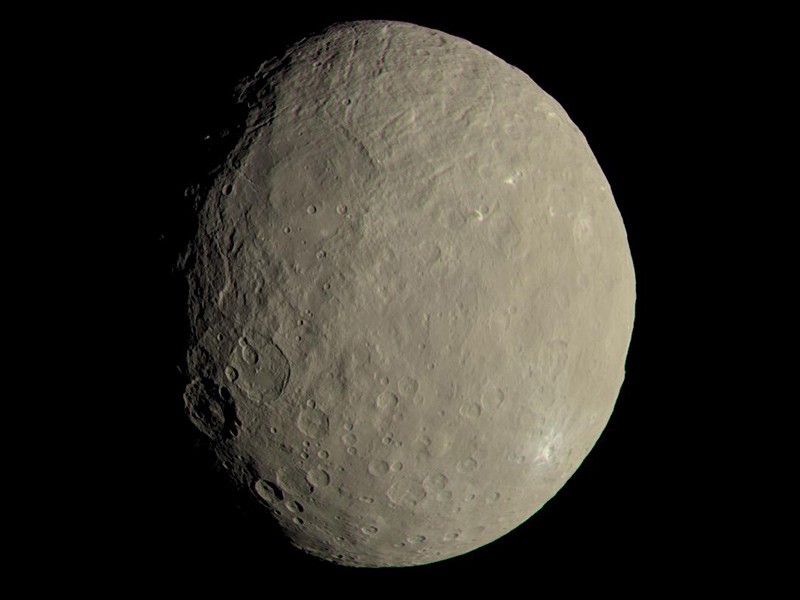
What makes the bright spots on Ceres?
As Dawn approached Ceres in 2015, bright spots stood out inside Occator crater. Close observations transformed them from an optical puzzle into evidence for salty liquid moving through the dwarf planet’s crust.
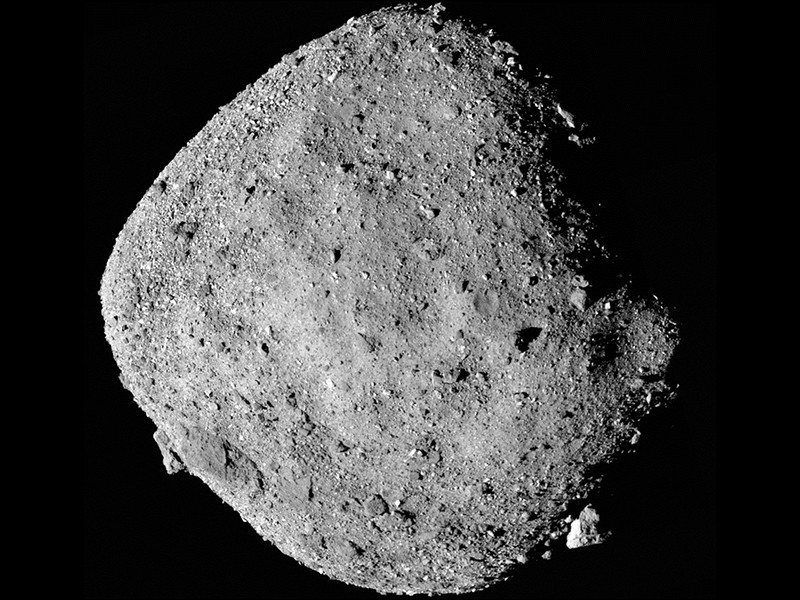
What did the Bennu sample bring back to Earth?
OSIRIS-REx delivered material from Bennu on 24 September 2023. In laboratories, the dark grains revealed a history that photographs could not: water-altered minerals, salts and a varied inventory of carbon chemistry inherited from the asteroid’s parent body.