

What split Charon’s crust apart?
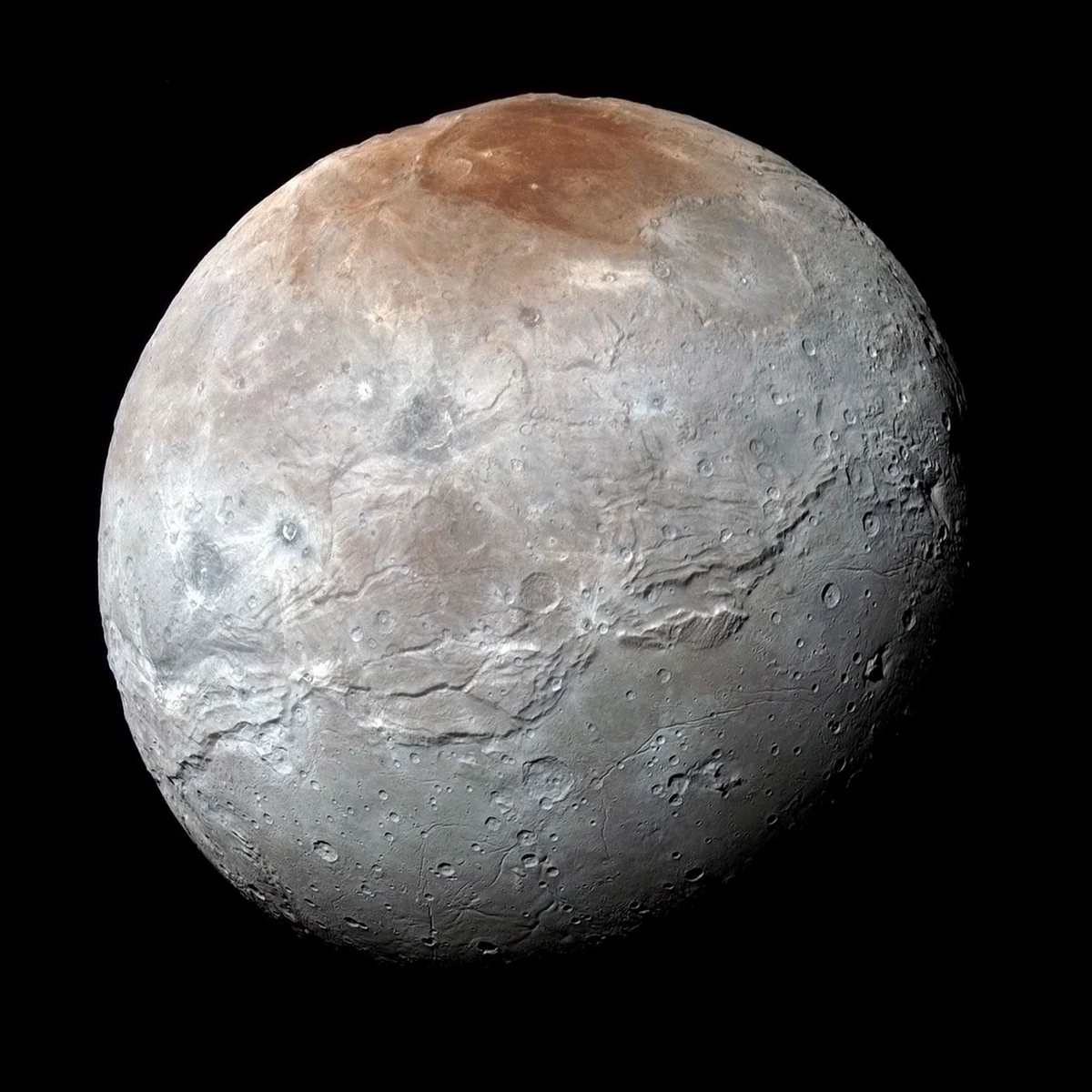
New Horizons photographed Pluto’s large moon Charon on 14 July 2015. A belt of enormous fractures cut across the encounter hemisphere, suggesting that the icy crust had stretched. One explanation begins with water freezing deep below the surface.
Read the fractures before choosing a cause
A crust pulled apart develops faults that allow blocks to move relative to one another. On Charon, New Horizons recorded scarps, ridges and deep valleys arranged in an extensive tectonic system. Some valleys in the observations exceed six kilometres in depth. [1]
The important evidence is the geometry: the surface appears to have extended. The images establish the deformation that an interior model has to explain. They do not directly show what lay beneath the crust when it happened. [1]
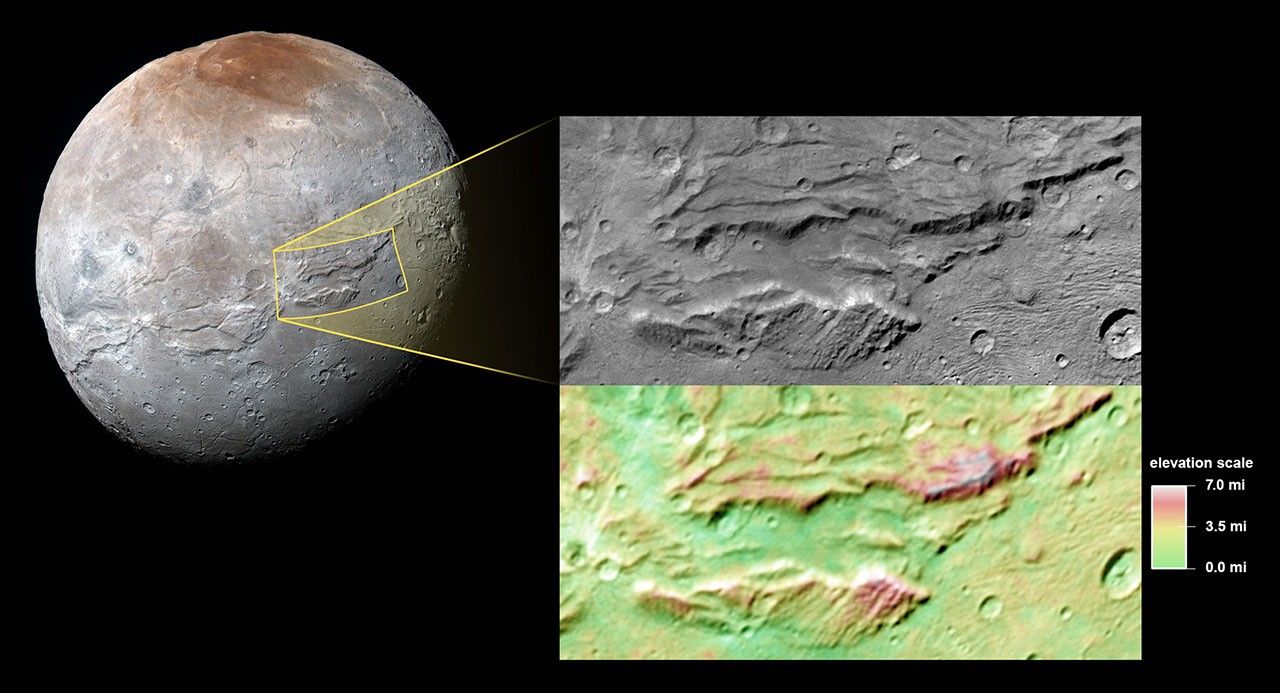
This is why the cracks matter more than a comparison with a familiar canyon on Earth. Their scale and distribution constrain a change in the moon itself, rather than merely recording water cutting a channel through one small region. [1]
Expansion supplies a possible mechanism
Ordinary water ice takes up more volume than the same mass of liquid water. If Charon once had an internal ocean and that water later froze, the expansion could have pushed the outer shell outwards. A shell unable to stretch smoothly would fracture. [1]
The proposed sequence requires an earlier source of enough heat to maintain liquid water, followed by cooling and freezing. It connects thermal evolution inside the moon with the pull-apart features visible at the surface. [1]
NASA presented this as a possible ancient-ocean explanation after the flyby. It is an interpretation of landforms, not an observation of a present ocean. The distinction matters because evidence of expansion can preserve an event long after the liquid responsible has disappeared. [1]
Follow the boundary across the encounter hemisphere
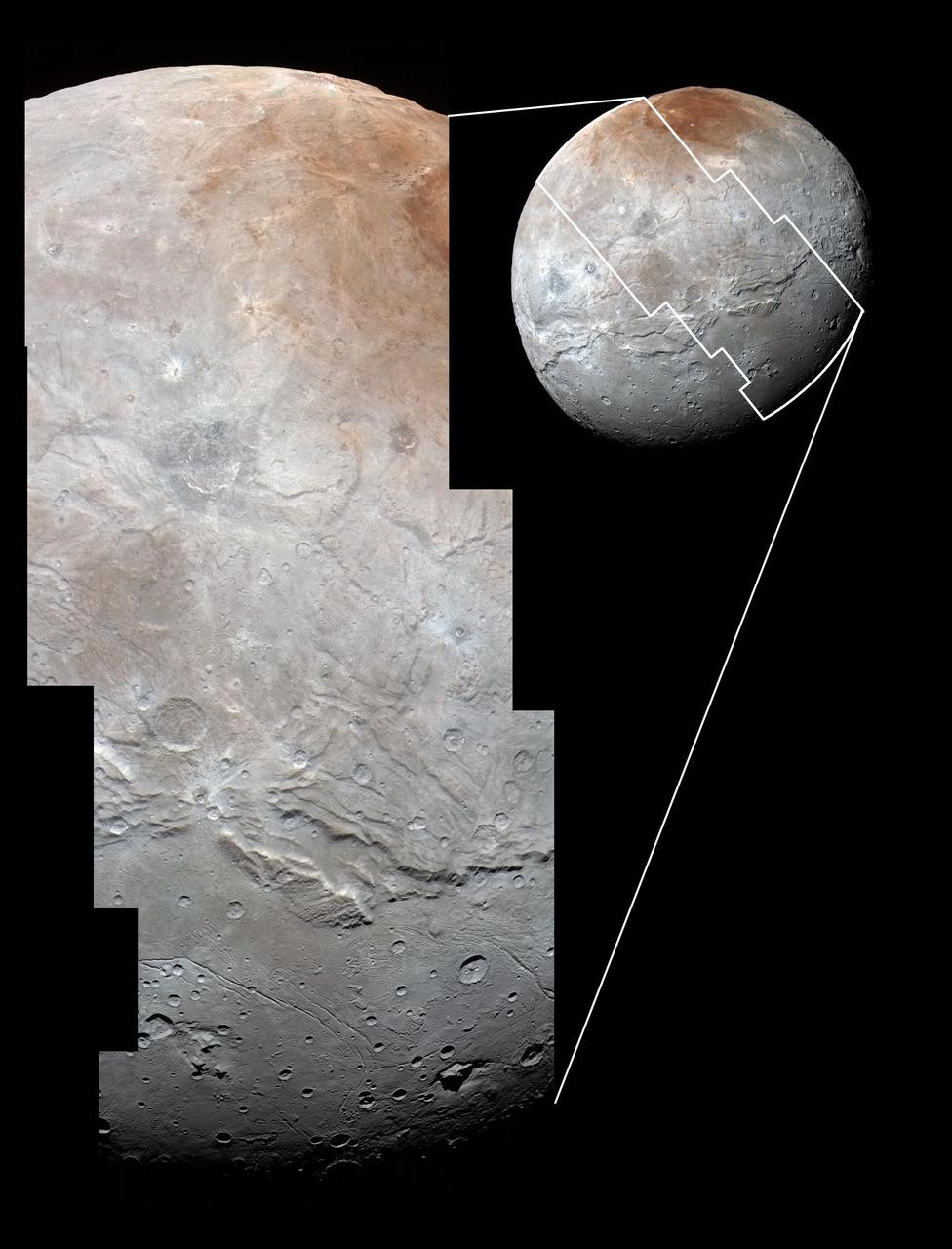
The great fracture system separates terrain with different textures and histories. Relatively smoother ground to the south contrasts with more rugged areas to the north. Mapping which features cross or cover others helps researchers reconstruct their order of formation. [1] [2]
New Horizons saw only part of Charon at its best resolution. A prominent boundary on the encounter hemisphere cannot automatically be traced at equal detail around the entire globe. The geological reconstruction has to retain that uneven coverage. [1] [2]
The images nevertheless changed the basic question. Charon was no longer just a faint companion whose orbit could be measured from Earth; it was an icy world with evidence for substantial internal evolution. [1] [2]
The colour has a different explanation
The reddish north polar region does not provide the same evidence as the canyons. Research reported in 2016 connected its colour to methane escaping from Pluto and becoming trapped in Charon’s extremely cold winter polar regions. [3]
Radiation processes that material into less volatile, darker compounds. When temperatures rise and more volatile frost leaves, the processed material can remain. Repeated seasonal cycles allow a coloured deposit to accumulate. [3]
That model links two separate bodies through the movement and chemistry of escaping gas. It also explains why a red region in an enhanced-colour photograph should not be read as a lava field or as proof of a particular exposed interior layer. [3]
A close companion, with its own history
Charon is about half Pluto’s diameter. The pair are mutually tidally locked, with the same sides facing each other over a roughly 6.4-day cycle. Their shared geometry is striking, but their surfaces respond differently to their materials and histories. [2] [1] [3]
On Charon, the canyons point towards stretching of the ice shell; the red cap points towards volatile transfer and radiation chemistry. Keeping those explanations separate gives the photographs their full value. One image can preserve both an ancient mechanical change within a moon and a continuing connection to its neighbour. [2] [1] [3]
Sources & image credits
Related reading and objects

Why is Pluto a dwarf planet?
When New Horizons flew past Pluto in July 2015, the former ninth planet became a world of mountains and glaciers. Its new classification had changed its place in a list, but the flyby showed how much remained to explain about the place itself.
Why can ancient-looking Mimas hide a young ocean?
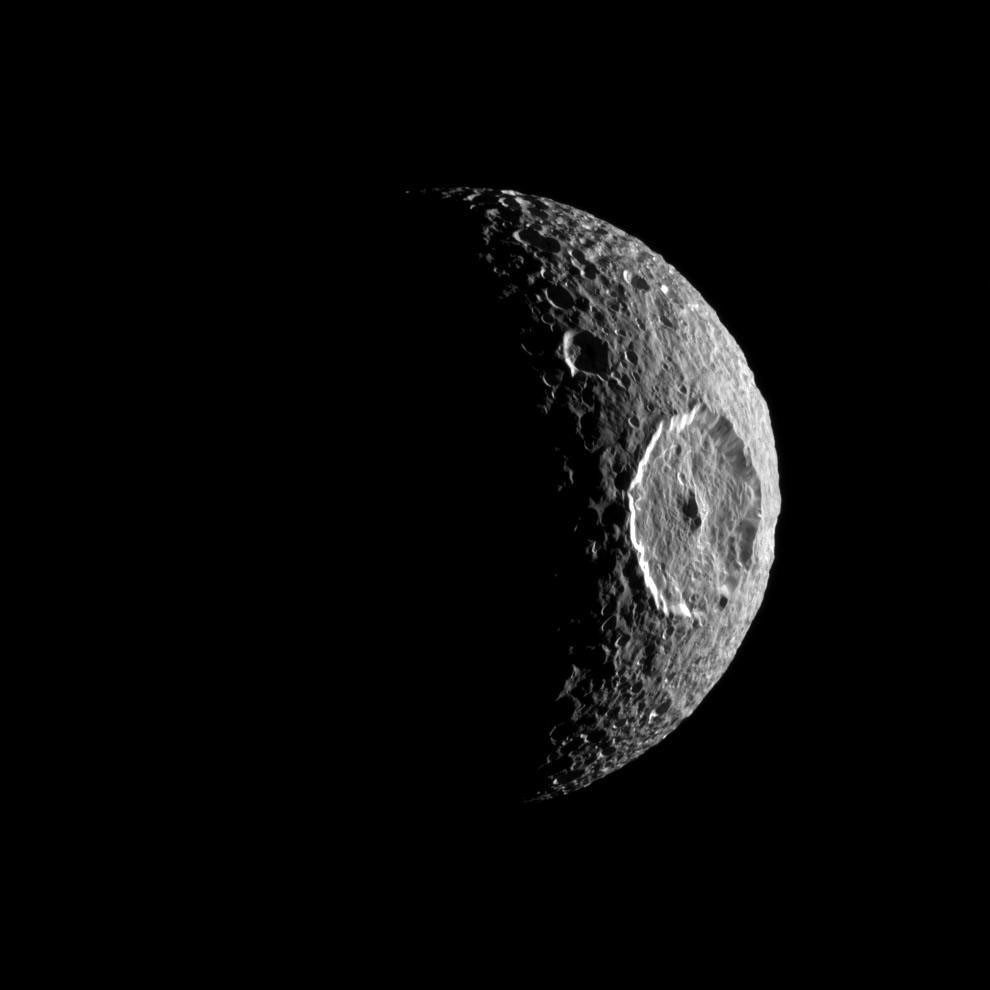
Mimas looks like a frozen, heavily battered moon in Cassini’s photographs. Yet an analysis published in 2024 found that subtle details of its motion were best explained by a global ocean. The apparent contradiction is a question of timing.