

Why can ancient-looking Mimas hide a young ocean?
Mimas looks like a frozen, heavily battered moon in Cassini’s photographs. Yet an analysis published in 2024 found that subtle details of its motion were best explained by a global ocean. The apparent contradiction is a question of timing.
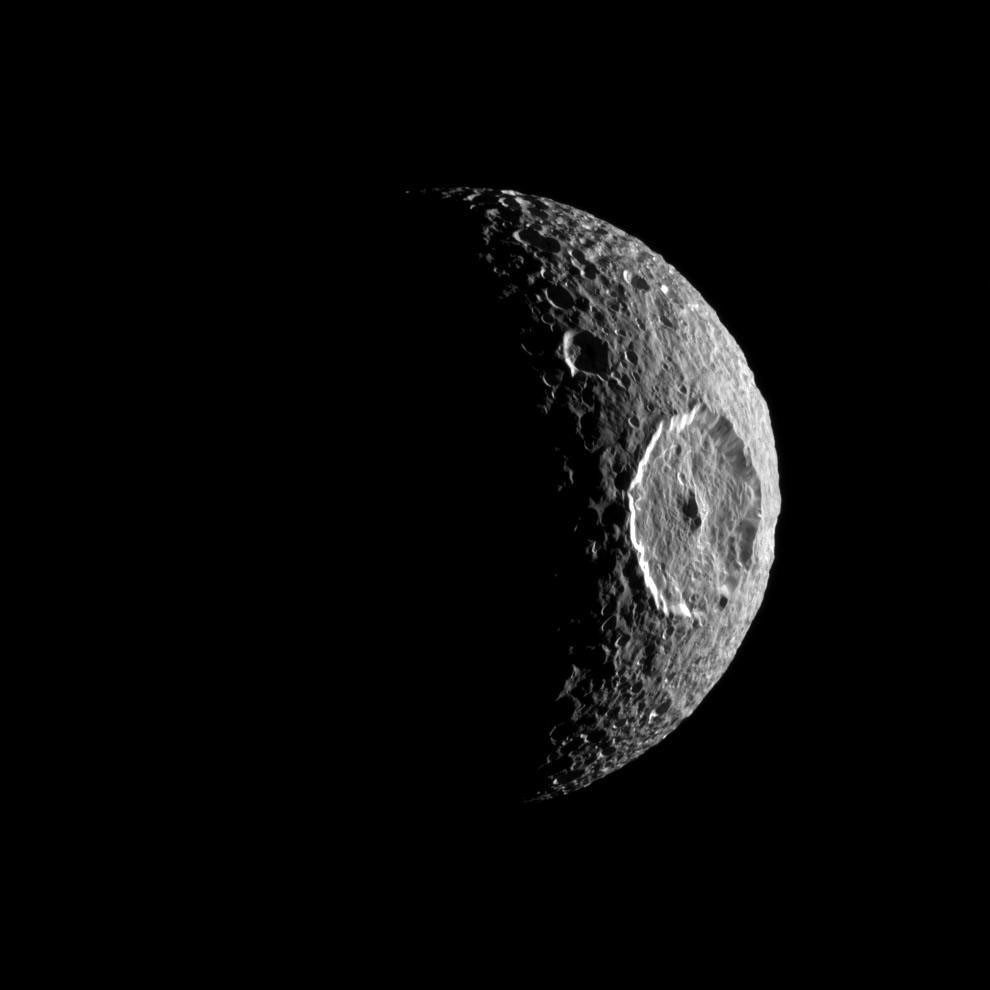
The exterior gave little warning
Mimas is about 400 kilometres across and covered in impact craters. Herschel, its most conspicuous scar, spans roughly 130 kilometres. Its walls and central peak dominate many spacecraft views of the small moon. [1]
Unlike Enceladus, Mimas has no observed system of active south-polar jets. Its preserved impact terrain long encouraged the interpretation of a largely frozen body with little recent surface renewal. For a moon this small, retaining enough heat to sustain liquid water also posed a difficulty. [1]
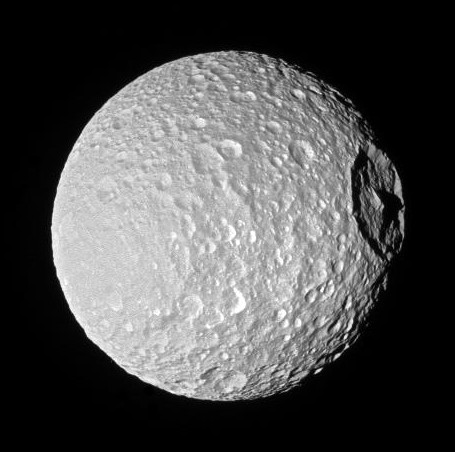
Photographs, however, primarily record the outer shell. An old surface can outlast a change deeper inside if that change has not yet produced widespread fractures, eruptions or resurfacing. Testing the interior required measurements other than the visible terrain. [1]
Measure an orbit closely enough to test the inside
Mimas is synchronously rotating, keeping roughly the same face towards Saturn. Small oscillations, called librations, are superimposed on that average motion. Their behaviour depends on how the moon’s mass is arranged and how its outer layers couple to the interior. [2] [3]
The 2024 study used Cassini observations to analyse the orbital motion, including the changing orientation of the orbit. The researchers compared the measured behaviour with numerical models of different interiors. A buried global ocean provided the explanation that fit the detailed motion. [2] [3]
This is an inference from dynamics. No instrument photographed water through the ice. The strength of the result lies in a model having to reproduce precise motions that a simple solid-body interpretation could not adequately explain. [2] [3]
Liquid changes the mechanical response
An ocean can let an ice shell move differently from the deeper solid interior. That mechanical decoupling alters the rotational and orbital response to Saturn’s gravity. Combining the orbital analysis with libration measurements led the researchers to an ice-shell thickness of roughly 20–30 kilometres. [2] [3]
That range belongs to the inferred interior model. It should not be confused with the depth of a directly imaged cavern or a uniform measurement at every location. The observations constrain the moon’s large-scale structure through its response to gravitational forces. [2] [3]
The proposed ocean is much younger than the ground
To investigate when liquid water could have appeared, the team modelled tidal heating. A more eccentric orbit produces a stronger changing deformation, allowing more mechanical energy to dissipate as heat within the moon. [2]
Their reconstruction placed the onset of the ocean within roughly the last 5–15 million years. That is young compared with the Solar System’s age and the long history preserved by Mimas’s craters. The proposed timing helps explain why the surface has not acquired the obvious active features seen on Enceladus. [2]
The age is a model result, dependent on the assumed orbital and thermal history. It explains the contrast rather than making the exterior irrelevant: the continued survival of old terrain is itself a constraint on how and when the interior changed. [2]
What Mimas changes about the search for oceans
Enceladus supplies escaping material that a spacecraft can sample. Mimas instead supplies a dynamical signature beneath a quiet-looking shell. The two moons show why one visual checklist cannot identify every ocean-bearing world. [1] [2]
A young ocean also poses a different scientific problem from one maintained for billions of years. Researchers need to understand the available heat, the rate of freezing and the opportunity for chemical exchange with rock. The immediate lesson is narrower and firmer: a moon’s old face does not by itself establish that its entire interior has stayed frozen. [1] [2]
Sources & image credits
Related reading and objects
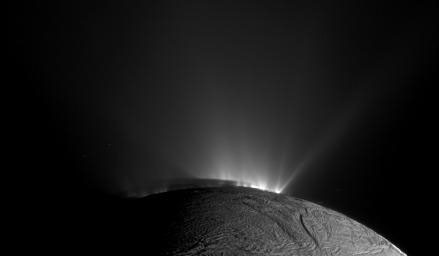
What Enceladus’s plumes reveal about its ocean
Cassini discovered that Enceladus sends water vapour and icy grains into space. Flying through that material gave scientists access to a buried ocean without landing on the moon or drilling through its frozen shell.
How to read Saturn’s rings
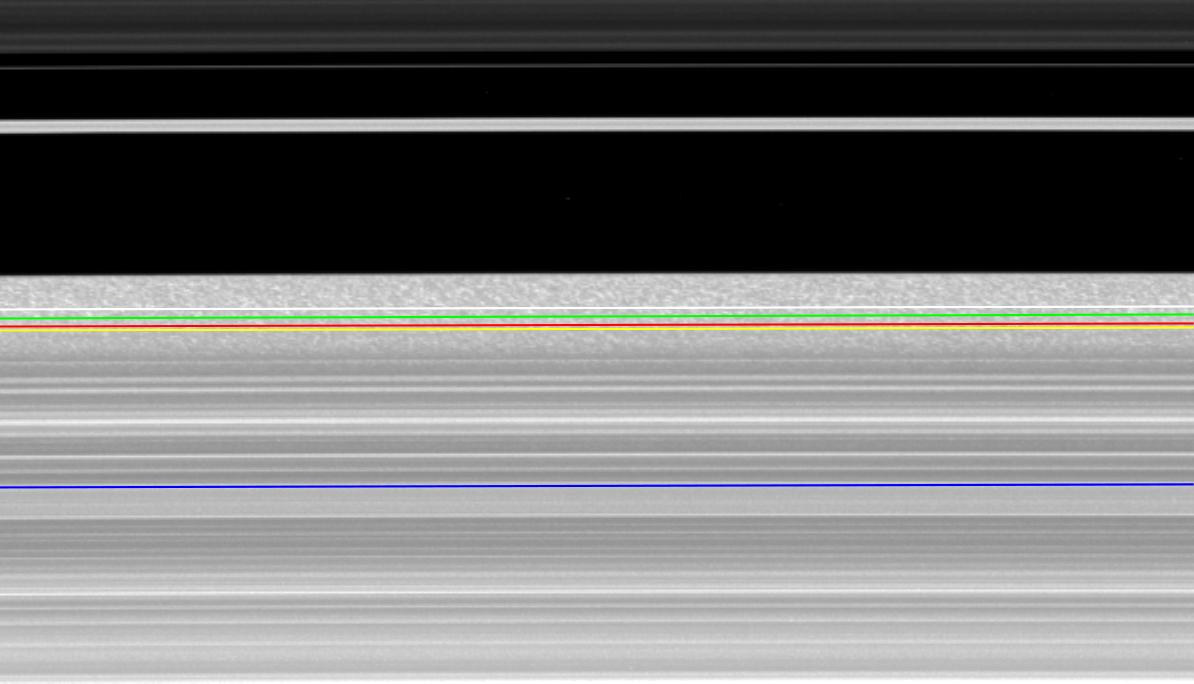
From Earth, Saturn’s rings look like smooth bands. Cassini revealed particles moving at different speeds, waves driven by moons and small objects throwing long shadows. Their patterns explain how a disk of ice can become a measuring instrument.