

Why is one side of Iapetus so dark?
Cassini’s September 2007 flyby showed an abrupt contrast on Iapetus: dark terrain beside bright ice, with surprisingly little middle ground. Dust can start the difference, but sunlight and the movement of water molecules help explain why it becomes so strong.
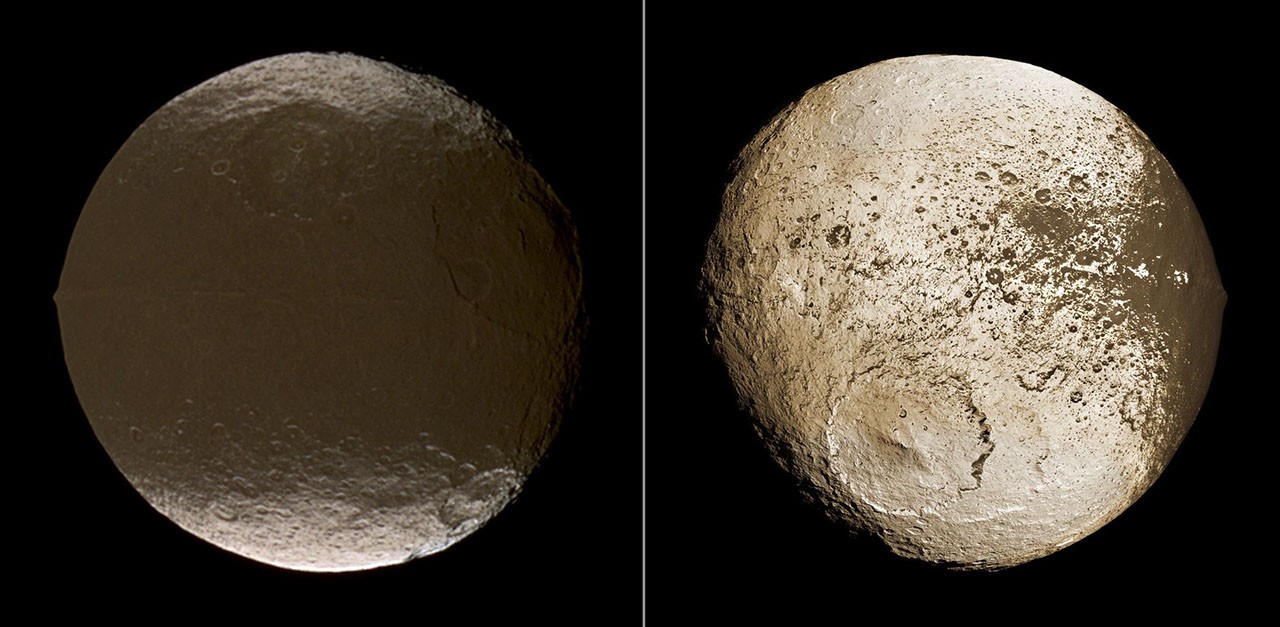
Specify which side is dark
Iapetus keeps the same face towards Saturn as it travels around the planet. That tidal locking also makes one hemisphere lead through the orbit while the other trails behind. The leading hemisphere contains the enormous dark region; much of the trailing side and the polar terrain are brighter. [1]
Leading and trailing describe motion, whereas near and far describe orientation towards Saturn. Confusing those pairs makes the colour pattern harder to understand. The key external-material hypothesis concerns what strikes the forward-facing surface as the moon moves. [1]
The contrast was apparent even before spacecraft. Giovanni Cassini found in the seventeenth century that Iapetus was much easier to see on one side of Saturn than on the other. Close images eventually turned that changing brightness into a map of different surface materials. [1]
A small initial difference can matter
Dust from more distant irregular moons can migrate inwards through the Saturn system. Material travelling on different orbital paths can preferentially strike Iapetus’s leading side, gradually adding a dark coating. [1] [2]
The external dust provides a way to begin the asymmetry. It does not by itself explain every sharp boundary or the full strength of the colour contrast. Cassini’s close views and temperature measurements showed why the moon’s own surface response has to be part of the explanation. [1] [2]
Dark ground absorbs more energy
A dark patch absorbs more sunlight than clean, reflective ice. Iapetus rotates slowly, with a day comparable to its roughly 79-day orbital period, allowing a long interval of illumination before night returns. [2]
Cassini’s infrared observations found dark material warm enough for water ice to lose molecules slowly to space above the surface. At the moon’s extremely low pressure, ice can pass directly into vapour by sublimation. It does not need to melt into a flowing liquid first. [2]
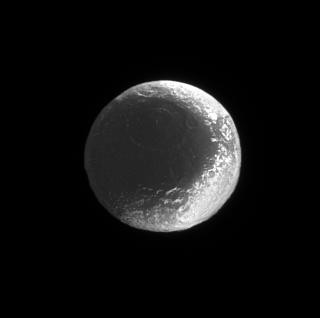
The rate may be slow in everyday terms, yet it can change a surface over long periods. The important comparison is between warmer, dark terrain and colder places where the escaping molecules can remain after landing. [2]
Ice migration increases the original contrast
Water molecules leaving a warm dark region can condense on colder ground. The dark region loses reflective ice and becomes darker; colder bright terrain gains ice and remains reflective. Each step makes the temperature contrast more effective at continuing the redistribution. [2]
This thermal segregation is a positive feedback. It amplifies a difference rather than requiring the initial deposit to create the entire observed pattern at once. Cassini’s observations of small bright craters within dark terrain also indicate that at least some of the dark covering is shallow enough for impacts to excavate brighter ice beneath it. [2]
The result is not a uniform division into two perfectly painted hemispheres. Local slopes, illumination and temperature affect where ice survives, giving the boundaries their detailed structure. [2]
The equatorial mountains pose another problem
Iapetus also carries a prominent mountain ridge near its equator. Some peaks reach about ten kilometres above the surrounding terrain. Proposed explanations involve its early rotational history or material arriving from a former ring, but the ridge’s origin remains debated. [1]
That uncertainty should not be transferred to the colour mechanism. The observations supporting surface heating and ice redistribution address a different process from the one that built an enormous chain of mountains. [1]
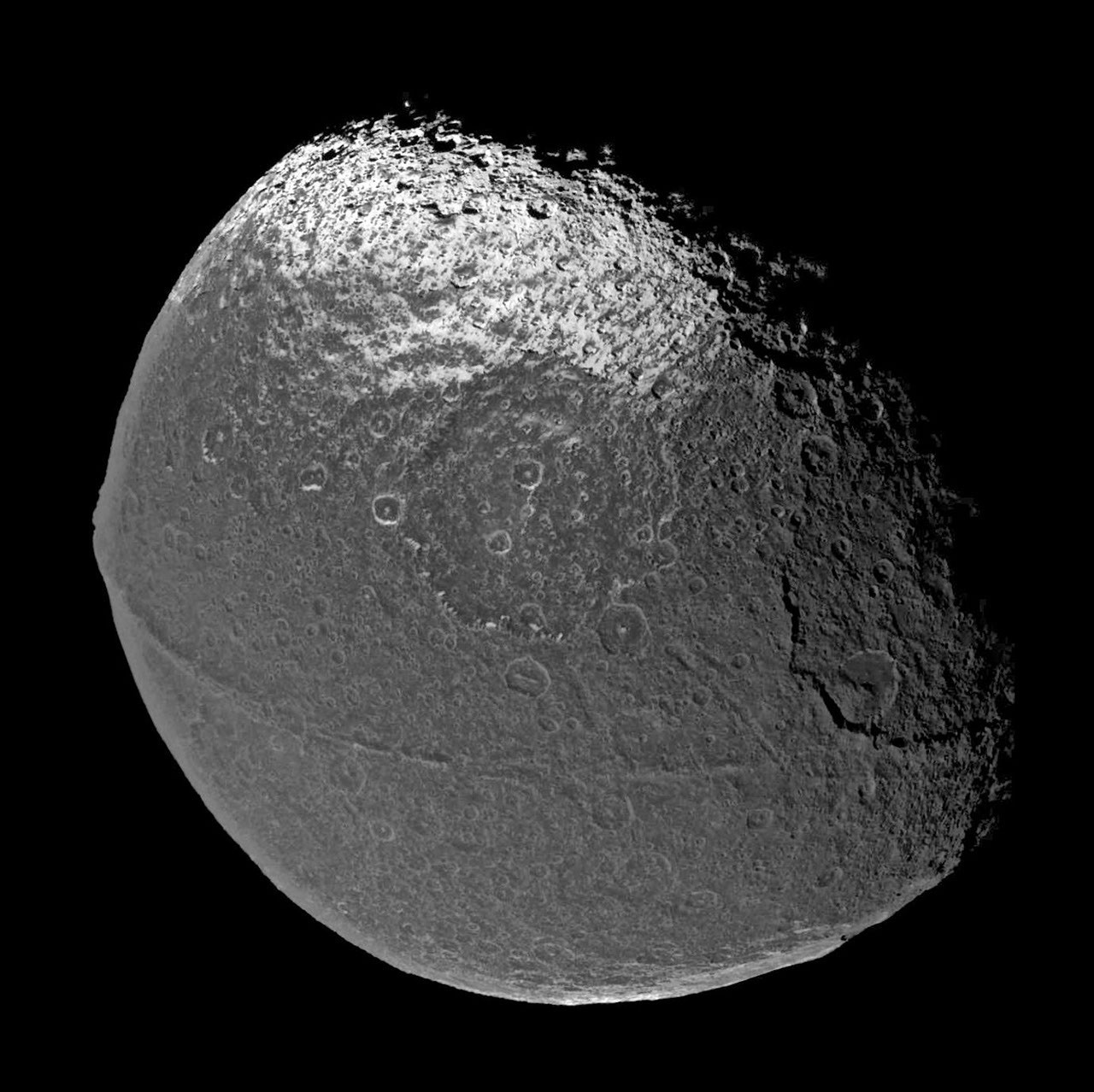
Read colour as the outcome of a process
A photograph freezes the dark and bright areas into a pattern, but the explanation follows material over time: an initial darkening changes heat absorption, warmth removes ice, and cold ground collects it. The pattern becomes stronger because the surface responds to the material added from outside. [1] [2]
Iapetus is therefore a useful case of how a modest environmental difference can grow into a striking global feature. Its two faces record both what the moon encountered in Saturn’s system and what sunlight subsequently did to the ice. [1] [2]
Sources & image credits
Related reading and objects
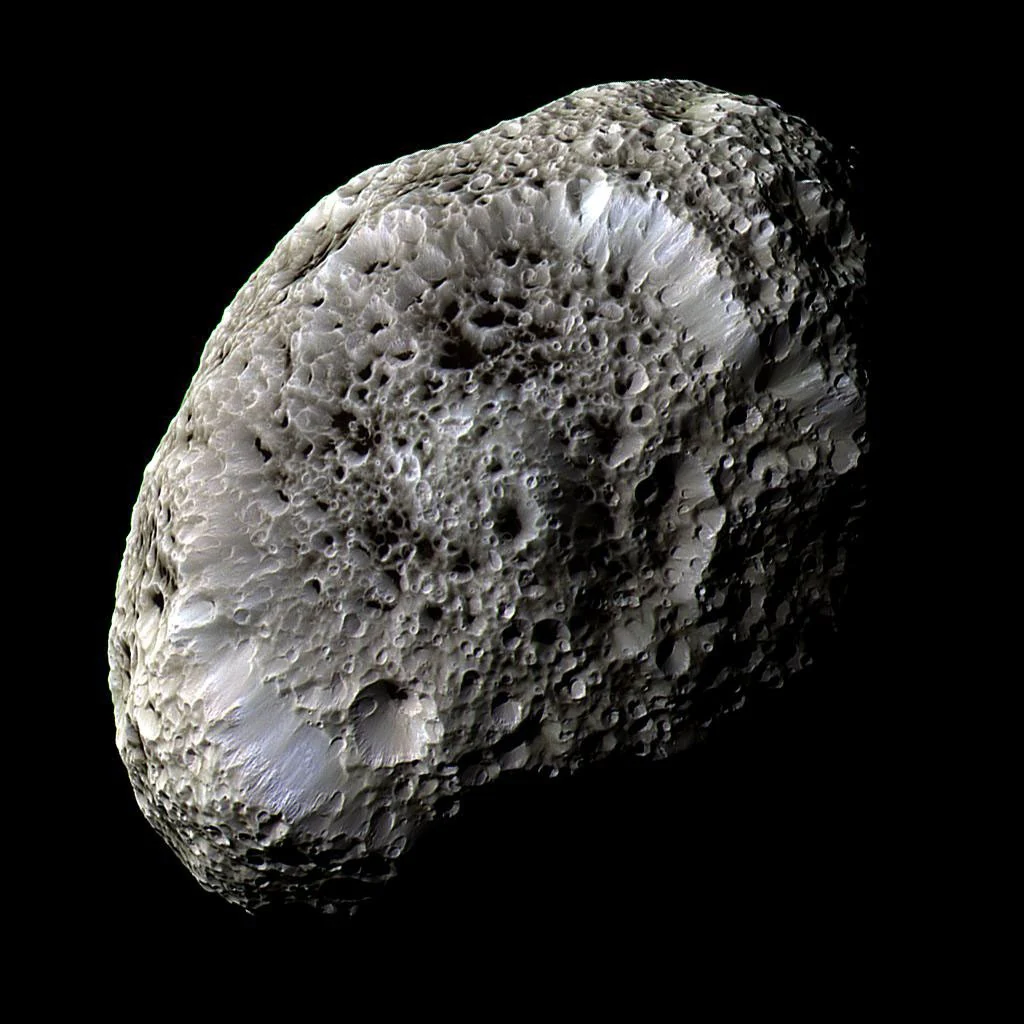
Why does Hyperion tumble instead of turning steadily?
Cassini’s September 2005 encounter revealed deep, closely packed cavities across Hyperion. The moon was unusual in another way: it did not keep one orderly face towards Saturn. Its uneven shape and changing gravitational torques produce chaotic rotation.
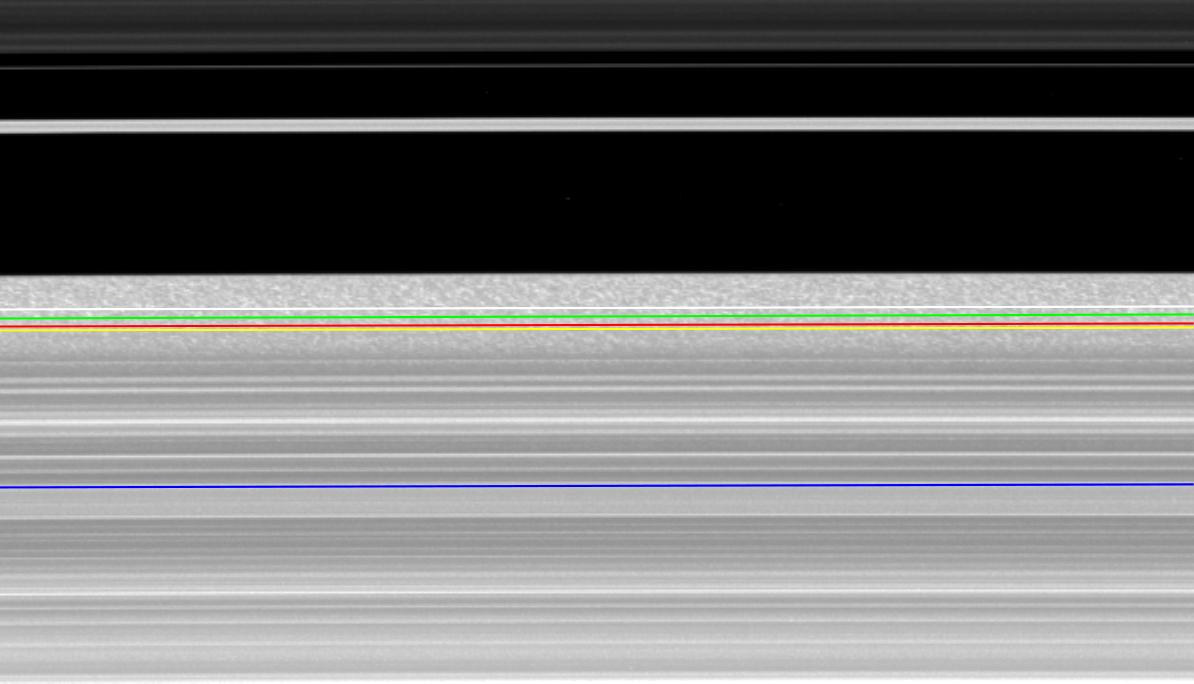
How to read Saturn’s rings
From Earth, Saturn’s rings look like smooth bands. Cassini revealed particles moving at different speeds, waves driven by moons and small objects throwing long shadows. Their patterns explain how a disk of ice can become a measuring instrument.